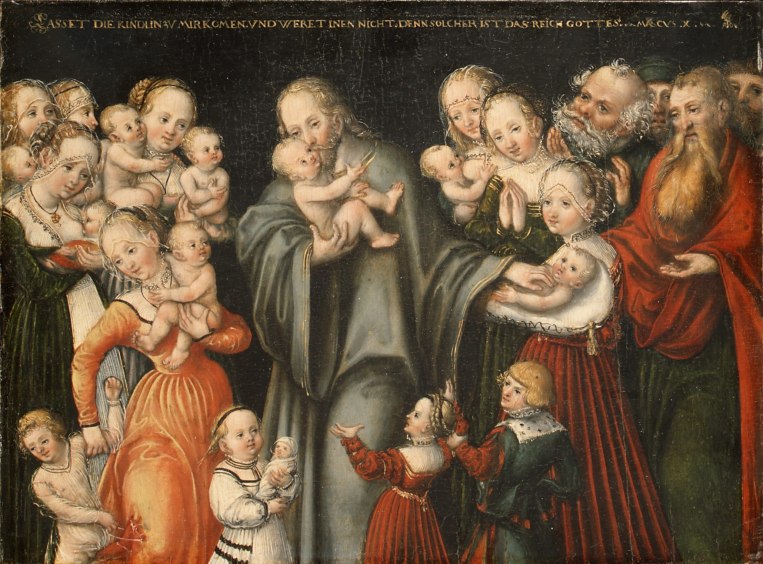
“Whoever receives this child in My Name receives Me ….”
During Christmastide we are used to thinking of Jesus—the divine Word made Flesh—dwelling among us as an infant. But today, near the start of Autumn, Jesus counsels us to receive Him as a child. Clearly, then, spiritual childhood isn’t just for Christmas!
To receive Jesus as a child means that the one who receives Jesus becomes a child him- or herself.
Spiritual childhood is a common theme in the literature of the Catholic masters of spirituality. Of course, pondering this theme first requires a distinction between the childhood of fallen human nature and the childhood of what we might call either the “original human nature” or the “redeemed human nature”. What does this distinction mean concretely? We can picture this distinction by comparing two different images: on the one hand is a two-year-old who refuses to go to sleep; on the other, the child resting peacefully upon his mother’s chest.
In addition to what Jesus says in today’s Gospel passage, we can use a Scriptural image to help us picture the spiritual childhood to which the Christian is called. Consider Calvary, where Jesus entrusts Mary and the Beloved Disciple to each other’s care. This Beloved Disciple, child of Mary, is our icon for spiritual childhood.
Today’s Gospel passage, from fairly early in Luke’s Gospel account (in chapter 9 of 24 chapters), helps us to focus squarely on Jesus, even if His words here confuse the disciples. You and I have the advantage of hindsight, of course, in knowing “the rest of the story” of the Gospel. We know perfectly well what Jesus is referring to when He predicts that the “Son of Man is to be handed over to men.”
Still, we shouldn’t pat ourselves on the back for being unlike the disciples portrayed today. Consider the setting of today’s Gospel passage. We need to recognize Jesus’ deliberateness in choosing the moment that He did to speak the words that He did: it was “[w]hile they were all amazed at His every deed” that Jesus foretold His Passion.
What is the relationship between these two: Jesus’ amazing deeds and His Passion? Did Jesus foretell His Passion when He did to bring the disciples back down to earth, similar to the occasion of His Transfiguration? Was Jesus wanting to minimize the significance of His amazing deeds, or at least to help the disciples realize that they were not the ultimate reason for His presence in their midst? Reflect on these questions in the light of your own desire for God to work amazing deeds in your life, and your reluctance to share in the “handing over” of Jesus that He foretells today.
Today’s First Reading is one of the Old Testament options for a Requiem Mass. The first two-thirds of the passage are striking, as the phrase “a time to…” is proclaimed repeatedly. Taken together, all these descriptions of times in a man’s life stand in contrast to the immortal life than one enters after his death. This passage can stir something profound in the hearts of those attending a Requiem Mass. They may leave the church pondering how the “times” of their own earthly lives fit into a larger picture.
The first sentence of today’s Gospel passage shouldn’t be overlooked in this regard. “Jesus was praying in solitude, and the disciples were with Him.” This might seem like an odd statement, perhaps even contradictory. But from the larger canvas on which all four Gospel accounts are drawn, we see several portraits of Jesus as one who prays intensely, at length, in solitude, and often. That His disciples were with Him doesn’t mean that they were all engaged in prayer together, but that they had the occasion to witness Jesus in this intense, solitary prayer with His Father.
The point of this first sentence within the context of today’s Gospel passage, however, is heard in what Jesus says next. “Who do the crowds say that I am?” After they offer the view of the crowds, Jesus asks, “But who do you say that I am?” After they give their own view, Jesus offers His view of His own identity. This portrait of Himself as the “Suffering Servant” who will be raised on the third day was most likely the content of His prayer moments earlier. There is no doubt about Jesus accepting this call from the Father. But the disciples’ reactions show that most of them could not accept Jesus as someone called to suffer, much less accept such a call themselves. We might make an examination of conscience, asking if we ourselves are like these disciples.
CCC 1807: just person distinguished by habitual rectitude toward others CCC 2842: only Holy Spirit can give us the mind of Christ CCC 1928-1930, 2425-2426: the obligation of social justice CCC 446-461: the Lordship of Christ CCC 2822-2827: “Thy will be done”
+ + +
When you’re stopped at a stop light, you don’t have much time to accomplish much of anything. Maybe that’s why someone starting designing frames for license plates: to give those behind a vehicle something to ponder and maybe chuckle over before the light turns green again.
It’s amazing how many of them have to do with families and the rearing of children. There’s the license plate frame that says: “One child makes you a parent. The second makes you a referee.” Then there’s the one that says: “Silence is golden… unless you have kids, then it’s just downright suspicious.” You can see a trend here, which is confirmed by the license plate frame that says: “Insanity is hereditary: you get it from your children.”
Unfortunately, the capacity to drive others insane is something we’re all born with. We inherit it from our first fallen parents, Adam and Eve. Its origin is found in sin, which by definition drives people apart, and drives people away from God. Grace, on the other hand, is what makes us strong enough to love our neighbor and our God.
The capacity for self-sacrifice is the measure of authenticity in the Christian life. By contrast, the world around us encourages us to do what is contrary to the path that Christ asks us to walk. Instead of choosing self-sacrifice, we choose self-glorification and self-gratification. Or in contrast to Christ’s path of self-sacrifice, we fudge a little bit: we make sacrifices, but not of our selves. We sacrifice things to which we have no attachment. We’re like the child on Ash Wednesday who proudly announces that he’s giving up spinach and homework for Lent.
Our children receive our attention regarding the discernment of their vocations, and rightly so. But our efforts will be of no avail if we don’t help each young person free himself to accept whatever call God makes of him. In other words, putting knowledge about vocations into our young people’s minds is not enough.
A vocation is also a matter of the will. After all, education in any subject requires a shaping not only of the intellect, but also of the will. Any school that only gives knowledge about math, English, music, etc. is largely wasting its time. If a school doesn’t first give its students a love for those subjects, then the knowledge will likely evaporate after the final final exam.
Love in the will must be the start of seeking knowledge. Yet the will also has a role at the end of education. The will takes the acquired knowledge and puts it into action, whether practical or speculative, secular or sacred.
A similar process has to guide a young person’s search for his or her God-given vocation. It’s not enough for the young person to learn what that vocation is. The young person also has to want what is learned. The young person has to want whatever God wants for him or her. But for a young person to be able to want whatever God wants, a change has to happen inside the young person.
A young person’s own fallen human will has to be purified like the biblical gold that’s tried in fire, so that what emerges is the capacity for self-sacrifice. This is the capacity described poetically by Saint Paul in Sunday’s Second Reading, where he paints a portrait of self-sacrifice in the Flesh, in the person of Jesus, who, “though He was in the form of God, did not regard equality with God something to be grasped. Rather, He emptied Himself, taking the form of a slave … He humbled Himself, becoming obedient to the point of death, even death on a cross.”
For sinners to grow in this capacity requires purification. For while it’s true that each human being is conceived and born with free will, that free will is tempted from the start by selfishness. Any parent of a two-year-old can tell you that his favorite word is “No!”, while his next favorite word is “Mine!” Unfortunately, self-will doesn’t disappear on a child’s third birthday. We human beings don’t spontaneously become more selfless as we grow older. Instead, we learn social skills that help us mask our selfishness. Giving up our selfishness is something that comes only with difficulty.
To accept a vocation in Christ is to recognize that my life is not “mine”, but “His”. To live a vocation in Christ is to say “Yes!” to God’s Will for me. God our Father calls us to spend our earthly lives not like the first son in Jesus’ parable: saying “No” to the father’s will, and only later doing it. Nor does God will for us to be like the second, who’s all talk and no follow-through. To call God our Father means to be a child who not only says “Yes” to Him, but also always puts the words that we mouth inside church into action during the week when we’re outside church and in the world.
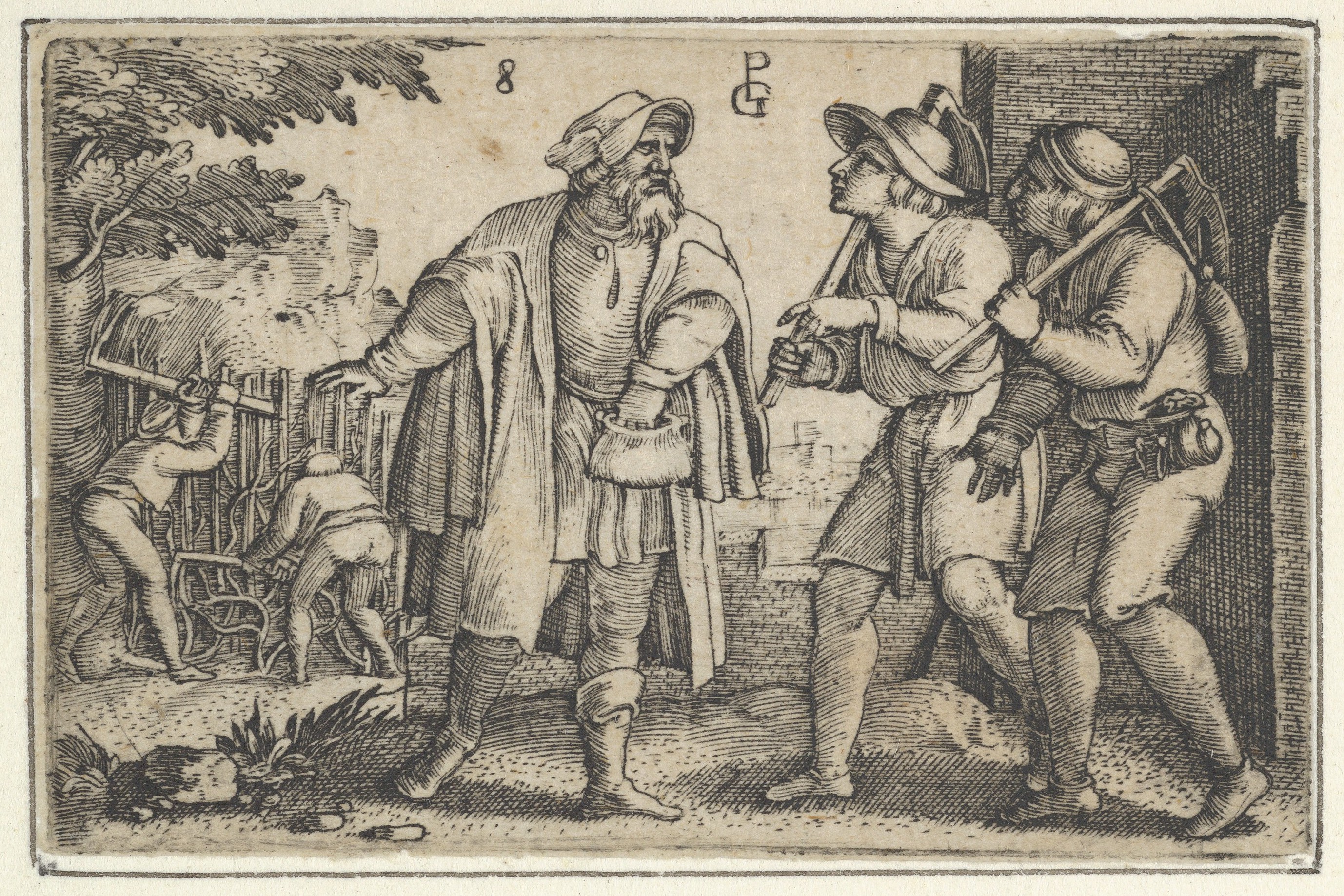
The Parable of the Father and His Two Sons in the Vineyard by Georg Pencz (c. 1500–1550)
In our First Reading today, we continue to hear from the Wisdom Literature of the Old Testament. But we are not still hearing from the Book of Proverbs. We hear today through Saturday from the Book of Ecclesiastes.
Ecclesiastes is probably best known for its opening verses, from the very first chapter, from which we have heard today. The writer of this book, who is named Qoheleth, is talking about the uselessness, or vanity, of things in this world. We hear: “Vanity of vanities, says Qoheleth, vanity of vanities! All things are vanity!” We might wonder why God would want a book like this in the Bible.
This book is not Manichaean in nature. That is, it’s not arguing that life itself, or creation in general, is evil. We can profitably focus upon this book by focusing upon the meaning of the word “vanity”. Not all vanity comes from looking in a mirror.
Here is the question that all seven books of the Wisdom Literature of the Old Testament concerns themselves with: which things can help us get to Heaven, and which things cannot? The things in this world that cannot help us get to Heaven are vain: they are vanities. They may have some meaning and value, but in the end, that meaning or value is going to pass away. The more we hold on to them, the more of our own self that will pass away.
… He sent them to proclaim the Kingdom of God and to heal the sick.
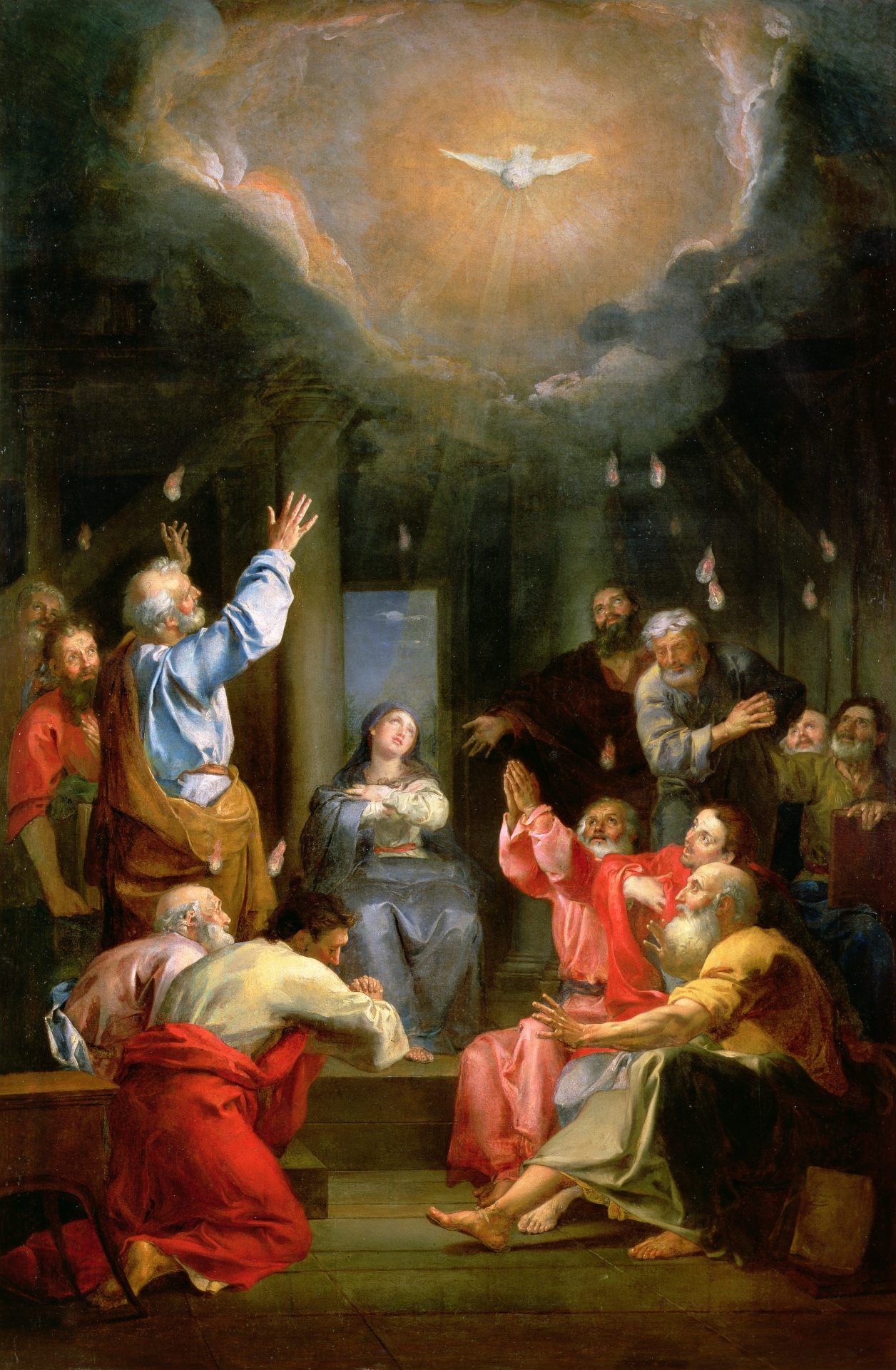
The word “apostle” literally means “one who is sent”. But the reason for being sent can vary, and this reason therefore qualifies the type of apostolic ministry. For example, today’s Gospel passage comes from the ninth chapter of Luke, which is 24 chapters long. Here, the apostles are not being sent to proclaim the Resurrection, because Jesus has not died yet! At the end of the Gospel, the Apostles will be sent to proclaim the Gospel and thereby build Jesus’ Church.
In today’s Gospel passage, however, the Twelve are being sent for a simpler mission. Jesus “sent them to proclaim the Kingdom of God and to heal the sick.” This two-fold mission is interesting. How does it relate to the mission that the Apostles will begin to carry out on Pentecost? Is proclaiming “the Kingdom of God” the same thing as proclaiming the Gospel? Why does Jesus here give the Apostles power to heal the sick, but not to raise the dead?
Although a book could be written trying to answer these questions, reflect today on the way in which you yourself have been sent by God in the past, and may be sent for a new mission today or very soon. At any point on one’s earthly journey, the Lord can surprise you with a new request. Like the Hebrews at the first Passover, we must be ready to move as the Lord asks.
“My mother and my brothers are those who hear the word of God and act on it.”
Today’s First Reading is from the Book of Proverbs. A “proverb” is a very short saying—often only one sentence long—that reveals some little bit of wisdom. Almost every culture in the world, and throughout time, has its own proverbs. In our own country, one of the Founding Fathers—Benjamin Franklin—spent a lot of his time creating proverbs for the first Americans to reflect on: such as, “A stitch in time saves nine”, or “A penny saved is a penny earned.” These proverbs, if we reflect on them, can help us be smarter in the way that we lead our lives in this world.
The proverbs that we hear in the Bible, though, come from God. These proverbs are not just about helping us lead a better life in this world: the Book of Proverbs also helps us get to the world to come, which is Heaven.
The proverbs of the Bible are bite-sized. When we hear from the Book of Proverbs at Mass, we’re hearing a whole bunch of proverbs at once. The simplest way to gain spiritual profit from the Book of Proverbs is to take just one proverb—usually just one sentence—and repeat it, over and over, in our heart, mind and soul.
Today, we might take the very last sentence of today’s First Reading: “He who shuts his ear to the cry of the poor / will himself also call and not be heard.” What does this mean? Is this proverb talking about you? Who are the poor in my midst, and what can I do to help them?
We should turn this proverb over in our soul, keeping in mind the words of the Lord Jesus in today’s Gospel passage: “My mother and my brothers are those who hear the word of God and act on it.”
“I did not come to call the righteous but sinners.”
Among the four evangelists, only Matthew and John were apostles. Mark and Luke did not, as far as we know, ever meet Jesus during His earthly life. Nonetheless, Mark and Luke were disciples of Peter and Paul, respectively, and from those two Mark and Luke received the apostolic witness to the Good News.
On this feast of St. Matthew, we also ought to keep in mind that while all four accounts of the Gospel are apostolic in origin, each presents a unique portrait of the Messiah. If a man has four very close friends during his life, then after his death each of those four would likely write a different biography of their common friend. Each account of his life would reflect the biographer’s interactions with him.
Today’s Gospel passage presents Matthew’s own account of how Jesus called him to serve. Matthew is strikingly honest about his sinfulness. In light of his own need for mercy, Matthew presents Jesus’s own vocation through the words that the Lord speaks at the end of today’s Gospel passage: “I did not come to call the righteous, but sinners.” God the Father called His divine Son to carry out this mission, and that Son extends here to Matthew a share in that mission.
The First Reading might seem fitting today because of St. Paul describing various roles within the Body of Christ, such as apostle and evangelist, both of which Matthew was. However, consider the beginning of this passage, where Paul describes the Christian’s need for humility and patience, so as to bear “with one another through love”. These words echo Matthew’s description of how Jesus called himself.
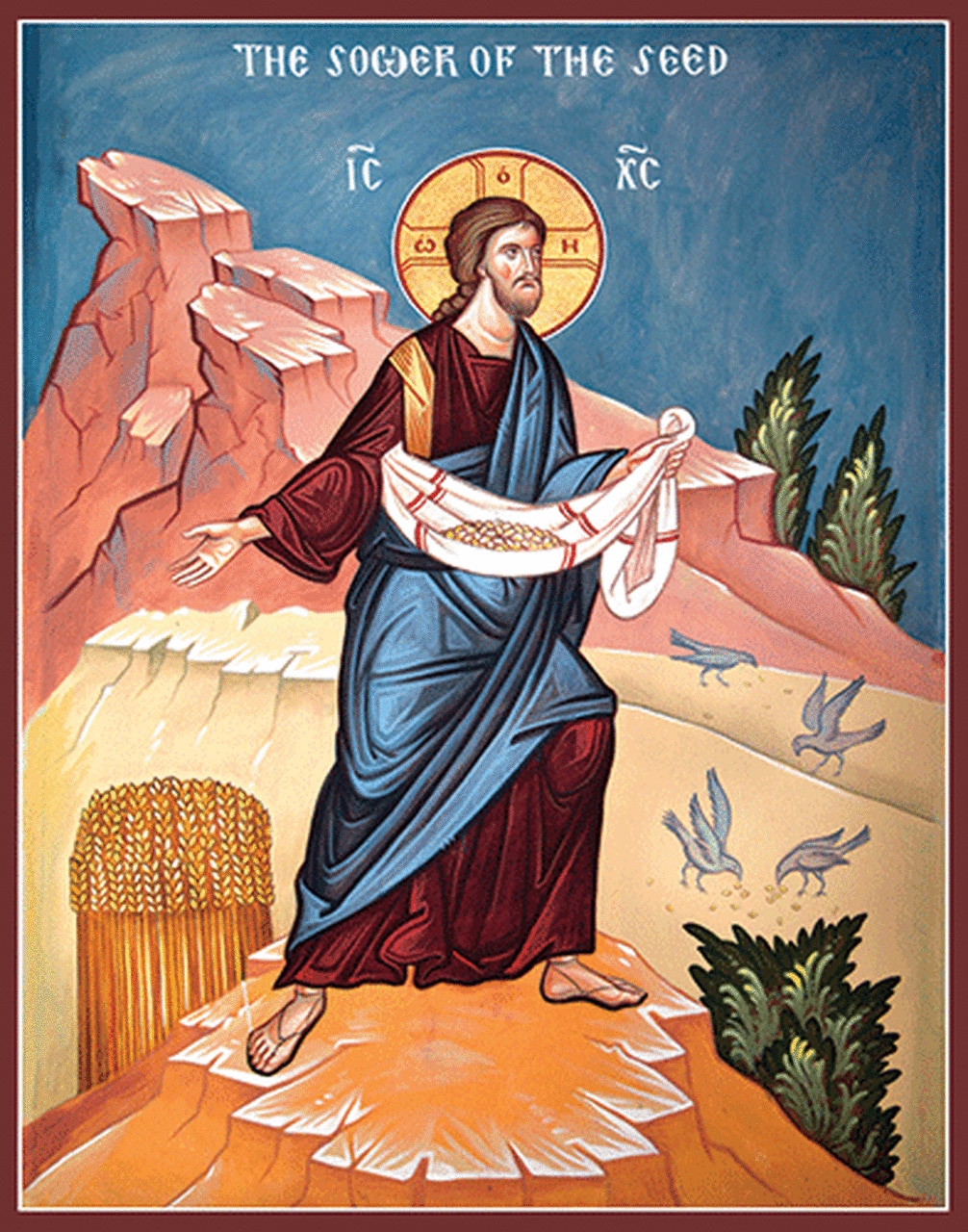
The parable Jesus preaches to us today is well-known. Its meaning is clear because Jesus Himself explains the parable: something He rarely does. Given this explanation, we might apply the parable to ourselves as an examination of conscience. While Jesus describes the different elements of the parable as relating to different groups of persons, one can reflect on these elements as relating to oneself at different times in one’s life.
“The seed is the Word of God”, that is, God the Son, as St. John tells us in the prologue to his Gospel account. Our lives as disciples are all about allowing this seed to sink into our souls: allowing God the Son entrance into our hearts and minds, so that He might bear good fruit within us.
When are we “on the path”? When are we so shallow in giving our attention to Jesus that the devil snatches Him from our lives? When are we “on rocky ground”? When do we allow temptation to have the upper hand over Christ? When are we “among thorns”, allowing our worldly concerns to choke off both God the Son and the graces He wills to bring into our lives? During the offering of the Holy Eucharist, ask the Word made Flesh to help you till the field of your life so that it might be “rich soil”.