The Most Holy Trinity [B]

The Most Holy Trinity [B]
Deuteronomy 4:32-34,39-40  +  Romans 8:14-17  +  Matthew 28:16-20

The Spirit Himself bears witness with our spirit that we are children of God ….

A well-written biography fascinates.  The narrative of a subject’s life—the events surrounding the person, as well as the choices which the person makes amidst those events—captures the imagination.  The individual person’s choices are windows into the person’s inner life:  the person’s mind, heart and soul.

Something similar is true regarding the Most Blessed Trinity.  Theologians describe the Trinity by means of two different terms.  One is called the “economic Trinity”.  The word “economic” refers in this case not to money, but to works performed, as in the phrase “home economics”.  So the “economic Trinity” is the Blessed Trinity described in terms of works performed “outside” the Trinity.

In other words, the “economy” of the Trinity is those works that the Trinity never had to carry out, but nevertheless freely chose to carry out.  The Trinity carried out these works simply out of love.  These works chiefly fall into two groups:  creation and salvation.  The work of creation concerns every created thing in the universe, visible and invisible.  The work of salvation solely concerns mankind, and includes man’s redemption and sanctification.

The Trinity’s works of creation and salvation serve as windows into the inner life of the Trinity.  This inner life is called the “immanent Trinity”.  This inner life of God is the very essence of the Trinity.  While the works of the “economic Trinity” are “exterior” to God, and therefore never had to be carried out, the “immanent Trinity” is God’s essential Being throughout eternity:  as He was in the beginning, is now, and ever shall be.

On this Sunday’s Solemnity of the Most Holy Trinity, we can reflect on God’s works of creation and salvation as a way of peering into His inner life.  It’s fitting that the Church celebrates the Solemnity of the Most Holy Trinity on the Sunday after Pentecost.  The two solemnities stand in a certain contrast to each other.  Pentecost celebrates the culmination of the Trinity’s “economy of salvation”, while the Solemnity of the Most Holy Trinity peers into the inner life of the “immanent Trinity”.  Consider further the connection between the “economic Trinity” and the “immanent Trinity”, and how the former illuminates the latter.

The beauty of creation inspires poets and mountain climbers, biologists and physicists to see the works of creation in a transcendent way.  In other words, the beauty of the works of creation points our attention to “where” they came from.  For believers, this reflective act of transcendence leads beyond those particular works, and also beyond the “how” of creation, all the way back to God Himself.

Chief among the visible works of God’s creation is the human being.  It’s little wonder that first-time parents draw closer to God as they stand in awe of the innocence, beauty, and dignity of a single, tiny human life.  Throughout the Church’s history, the greatest teachers of the Catholic Faith have reflected on how man—male and female—is created in the image of God.  This image is seen especially in how man’s intellect and will operate.  Although every animal has an intellect and a will, allowing it to reason and make choices, the human intellect and will are different because they are capable of self-transcendence.  The human intellect can map the cosmos and the human will can construct an edifice to last a millennium.

Yet while the works of creation reveal God’s inner life in a myriad of ways, the Trinity’s work of salvation does so even more powerfully.  In the order of salvation history, this work includes both redemption and sanctification.

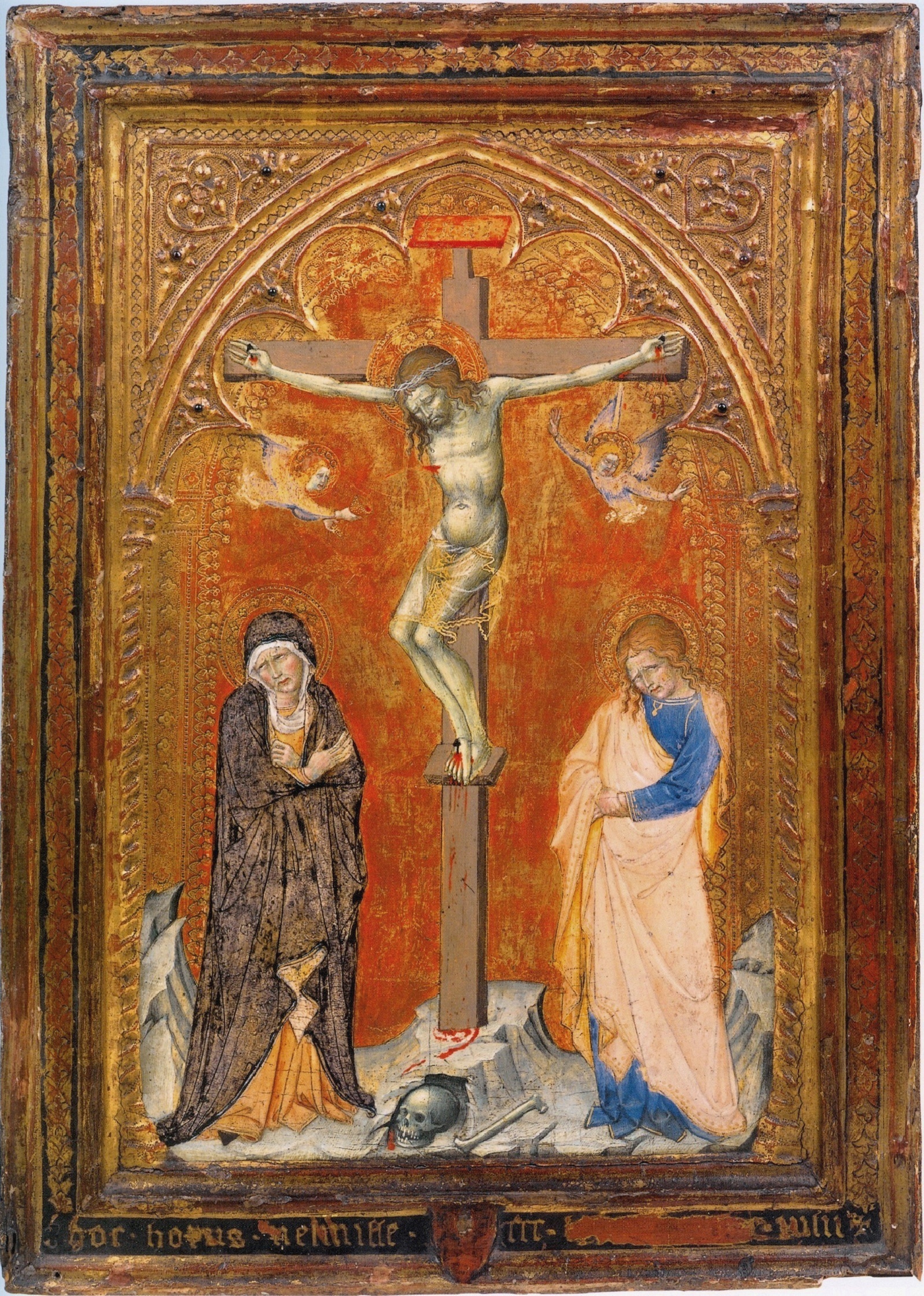
In the fullness of time God revealed Himself as a Trinity of Persons when He established His new and everlasting Covenant through the Sacrifice of Jesus on the Cross.  In this singular act of self-sacrifice—which Jesus offered fully through His human intellect and will, which is to say, knowingly and freely—Jesus gave up His divine and human life for the sake of His Bride, the Church.  Nonetheless, the Sacrifice of the Cross is not only the work of God the Son.  It is is a Trinitarian sacrifice, made at the initiative of God the Father and through the Power of God the Holy Spirit, who is the love of the Father and the Son for each other.

Thursday of the Eighth Week in Ordinary Time

Thursday of the Eighth Week in Ordinary Time
Mark 10:46-52

“What do you want me to do for you?”

In the midst of your prayers to Him, or before Him in the Most Blessed Sacrament or during Holy Mass, have you ever heard Jesus ask this question to you?  “What do you want me to do for you?”  If He were to ask this question, most of us wouldn’t know how to respond.

Is this question that Jesus asks to the blind man simply a rhetorical question?  After all, in His divine nature, Jesus knows both what the blind man wants, as well as what the blind man needs.  The deeper question, however, is whether the blind man knows what he needs.

The same is true of each of us.  Most of us spend a majority of our prayer time petitioning God for what we want, or what we believe we need.  However, sometimes what we believe we need is different than what we truly need.

Was the recovery of his sight the blind man’s most important need?  Of course it was not.  But the blind man knows this, as does the evangelist, who ends this passage not by describing the man’s recovery of his sight, but by pointing out that he “followed [Jesus] on the way.”  The blind man subjected the recovery of his sight to a greater need:  the need to follow Jesus on the way.

Wednesday of the Eighth Week in Ordinary Time

Mark 10:32-45

“The chalice that I drink, you will drink ….”

Throughout the course of the four accounts of the Gospel, most of the apostles take turns appearing quite clueless.  Today the cluelessness of James and John (the Beloved Disciple!) is on display.

Today’s Gospel passage begins with Jesus foretelling His passion, death, and resurrection.  This momentous proclamation is met with complete self-interest on the part of the sons of Zebedee.  When they express to Jesus their request, He replies with words that you and I need to commit to memory:  “‘You do not know what you are asking.’”

Although there are commonly four types of prayer through which a Christian speaks to God—petition, adoration, contrition, and thanksgiving—the early stages of our spiritual life tend to be dominated by our speaking to God, rather than listening to God.  In our speaking to Him, we tend to focus more on petition than the other three.  To most of our petitions, the words of Jesus to James and John are the only fitting reply:  “‘You do not know what you are asking.’”

Here’s a very good petition to offer to God in your prayers today:  “Help me, Lord, to focus on Your providential Will rather than my own self-focused will, and help me to listen for your Word rather than to voice my own.”

Tuesday of the Eighth Week in Ordinary Time

Tuesday of the Eighth Week in Ordinary Time
Mark 10:28-31

Peter began to say to Jesus, “We have given up everything and followed you.”

The Evangelist doesn’t give us details surrounding Peter’s statement that Jesus’ disciples have given up everything to follow Him.  But Jesus surely reads Peter’s heart before replying.  Jesus is speaking to us disciples in the 21st century, as well.  He explains the logic of discipleship.  Then He sums up His teaching with a brief point for our meditation.

Is there some regret in Peter’s heart as he lays bare the sacrifice he’s made to follow Jesus?  Jesus explains that both in this world and the next, a disciple’s sacrifice bears fruit.  In “this present age”, material sacrifices are compensated by the superabundance of the Church’s graces and charisms.  All the more, “in the age to come”, the consequence of following Jesus is eternal life.  Jesus’ logic lays bare what St. Francis of Assisi expressed in his canticle:  “It is in giving that we receive, and in dying that we are born to eternal life.”

Jesus then sums things up.  “Many that are first will be last, and the last will be first.”  Jesus seems to respond to Peter by saying:  in loving your God and your neighbor first, you are putting God and neighbor first, and yourself last.  But in opening ourselves by the act of loving, we are opening our hearts and minds to receiving divine love from God and His Church.

The Blessed Virgin Mary, Mother of the Church

The Blessed Virgin Mary, Mother of the Church
Genesis 3:9-15,20 [or Acts 1:12-14]  +  John 19:25-34
May 24, 2021

And from that hour the disciple took her into his home.

On the feast of Our Lady of Lourdes in 2018, Robert Cardinal Sarah—the prefect of the Congregation for Divine Worship and the Discipline of the Sacraments—announced the institution of a new obligatory memorial for the Ordinary Form of the Roman Rite of the Catholic Church.  This memorial is to be celebrated every year on Pentecost Monday, which is to say, the day following Pentecost Sunday.  In the Extraordinary Form of Holy Mass, this is the second day of the Octave of Pentecost.

In his decree inscribing this new memorial into the General Roman Calendar, Cardinal Sarah noted the following:

“The joyous veneration given to the Mother of God by the contemporary Church, in light of reflection on the mystery of Christ and on His nature, cannot ignore the figure of a woman (cf. Gal 4:4), the Virgin Mary, who is both the Mother of Christ and Mother of the Church.”

“Indeed, the Mother standing beneath the cross (cf. Jn 19:25), accepted her Son’s testament of love and welcomed all people in the person of the beloved disciple as sons and daughters to be reborn unto life eternal. She thus became the tender Mother of the Church which Christ begot on the cross handing on the Spirit. Christ, in turn, in the beloved disciple, chose all disciples as ministers of his love towards his Mother, entrusting her to them so that they might welcome her with filial affection.”

“This celebration will help us to remember that growth in the Christian life must be anchored to the Mystery of the Cross, to the oblation of Christ in the Eucharistic Banquet and to the Mother of the Redeemer and Mother of the Redeemed, the Virgin who makes her offering to God.”

Mary the Mother of the Church

Saturday of the Seventh Week of Easter

Saturday of the Seventh Week of Easter
Acts 28:16-20,30-31  +  John 21:20-25
May 22, 2021

I do not think the whole world would contain the books that would be written.

This morning’s Gospel passage consists of the final six verses of the Gospel according to John.  The Easter Season draws to a close, then, with an almost parenthetical reminder that the Gospel accounts of Jesus’ earthly life are by no means exhaustive.  Nor are they meant to be.

Matthew, Mark, Luke and John, in composing their accounts of the Gospel, did not aim to give an exhaustive record of Jesus’ saving words and deeds.  For that matter, even if all of the words spoken—and deeds carried out—by Jesus during His earthily life were recorded, that account of the Gospel would not be the “final word”.

Does this assertion sound blasphemous?  Does it reduce the power and beauty of the Incarnate Word?

In truth, it reveals the full intent—the full vocation and mission—of the Incarnate Word.  God’s providential, covenantal, saving Work blossoms through the life of the Mystical Body of Christ:  the Church.  The life of the Church—from her conception in the Sacred Triduum, to her birth at Pentecost, until her consummation on the Last Day—is the Way, the Truth, and the Life of Jesus on this earth.

Easter 7-6 Ascension

Friday of the Seventh Week of Easter

Friday of the Seventh Week of Easter
Acts 25:13-21  +  John 21:15-19
May 21, 2021

Peter was distressed that He had said to him a third time, “Do you love me?”

On these last two weekdays of Easter, our Gospel passage comes from the epilogue of John’s Gospel account.  In these final days, we hear John’s account of Jesus’ “final word”, which echoes what John records time and time again throughout his Scriptural writings (the Book of Revelation, his three epistles, and his Gospel account).

Jesus’ “final word” is Love—caritas—which in fact is the very nature of the Triune God, and so then also of the “Word made Flesh”.  As we prepare to celebrate the Sundays and other solemnities that flow forth from the Easter Season, we meditate on the meaning of the Caritas Who Is God.  In the weeks following the Easter Season, the Church will celebrate the Solemnities of the Most Holy Trinity, Corpus Christi, and the Most Sacred Heart of Jesus.  Through each of these, the Church reflects and liturgically celebrates the goodness of God’s very nature:  the Love that the Risen Jesus extends to us.

Today, Jesus calls Peter, the Rock of the Church, to accept this divine caritas as the heart of his own life and ministry.  We pray for our Holy Father, the Pope.  We also pray for ourselves, that no matter what our vocation may be, our lives will also reflect this divine outpouring of love.

Easter 7-5 Ascension

Pentecost

Pentecost
Acts 2:1-11  +  1 Corinthians 12:3-7,12-13  +  John 20:19-23
May 23, 2021

When the time for Pentecost was fulfilled, they were all in one place together.

Almost 2000 years ago on this day, the Church was born.  The Church would be nothing without the Holy Spirit.  The Church couldn’t have been born without the Holy Spirit, and she could not live today without the Holy Spirit.  Where the Church is strong, it’s because of the Holy Spirit.  Where the Church is weak, it’s because the Holy Spirit is not given His due.

In saying “where”, we don’t just refer to different parts of the world.  It’s true that the Church is stronger in some parts of the world than others.  Certainly the Church in the Western world is not as strong—that is, doesn’t live the Gospel with as much fidelity—as the Church in many third-world countries.  In those countries where the Church has fewer material resources, the Church tends to be stronger:  this is a paradox that simply points to the fact that the Christian Faith is based upon the Cross.  It is in giving that we receive, and it is in dying that we are born to eternal life.

When the event of Pentecost occurred almost 2000 years ago, the apostles were greatly changed by their “encounter” with the Holy Spirit.  How were they changed?  The Holy Spirit didn’t make them taller, richer, or stronger.  The Holy Spirit doesn’t try to change us in these ways because He isn’t interested in our bank accounts, or the vehicles we drive, or our looks, but only the state of our souls.

So how were the apostles changed?  What did the apostles “get out of” their encounter with the Holy Spirit?  It was a spiritual change, certainly, but we need to be more specific.  The apostles didn’t receive the Holy Spirit in order to help them “feel good” about their relationship with God.  The apostles didn’t receive the Holy Spirit in order to tickle the ears of others by preaching about sunshine and daffodils, but instead to call others to an adult faith:  that is, to a catholic faith that preaches and lives out even the “hard teachings” of the Church.

This is just as true today.  The gifts of the Holy Spirit are given to apostles and prophets, clergy and lay people, in the first and twenty-first centuries, in order to build the Church on earth by means of self-sacrifice.  The Holy Spirit is given to make possible greater self-sacrifice.

We receive the Holy Spirit in simple ways.  We receive the Holy Spirit by reading Scripture, by devoutly receiving the sacraments, and by carrying out the corporal and spiritual works of mercy.  But as we receive Him—as we grow spiritually—the gifts and graces of the spiritual life that we receive are to be laid at the feet of others.

We see this when we look at the sacraments of Baptism and Confirmation.  Through Baptism, a person becomes a member of the Church:  an individual member of the Mystical Body of Christ.  Through Confirmation, a person is prepared to offer his or her life in service for the sake of the Church, for the sake of that Body of which he or she is one member.

The Holy Spirit leads us in our spiritual life.  He leads us in making decisions about how to serve the needs of others.  There are countless opportunities to do good all around us each day of our lives.  But we cannot take up all of those opportunities.  The Holy Spirit helps us discern in this regard.

Likewise, we sometimes ask God to help us accomplish something:  to help us see how to get something done that we want to do.  We often need to realize, though, that the Holy Spirit is not going to show us how to do something that He has no interest in us doing in the first place.  If we do not feel that God is guiding us, it may be because that path would lead us in a direction that God does not want us to travel.

At this conclusion of the Easter season, ask God to help you to be open to the Presence of the Holy Spirit in your life.  Ask this not simply for your own sake, but to help you seek and serve the needs of others.  For we cannot find salvation on our own.

Thursday of the Seventh Week of Easter

Thursday of the Seventh Week of Easter
Acts 22:30; 23:6-11  +  John 17:20-26
May 20, 2021

“… so that they may all be one, as you, Father, are in Me and I in You.”

There are many types of unity.  For example, if two persons agree about a political issue, and join a common party, these two persons have political unity.  If two persons agree about a moral teaching, or agree to act in common on behalf of a moral goal, these two persons have moral unity.  If two students study for doctorates in physics, specializing in the same topic, and become the two foremost experts in the world about that topic, these two persons bear a certain intellectual unity.

Two persons can also be united by far less significant matters:  their nationality, the clothes they wear, or the physical space they share (whether in an elevator, a house, or a courtroom).  Two siblings are united by their parentage, and identical twins enjoy an even more specific genetic unity.  Beyond physical traits, siblings—or a parent and child—can be united by psychological traits, temperament, or even predispositions towards certain virtues and vices.

None of these is what Jesus is preaching about in John 17:21.  Jesus is preaching about something far more profound.

The tiny word “as” in Jesus’ petition to the Father unlocks the petition’s meaning:  “that they may all be one, as you, Father, are in Me and I in You.”  Reflect, meditate, and contemplate the meaning of the Unity that the Three Persons of the Blessed Trinity not merely have or share, but essentially are.

Ascension medieval 6