The Fifth Sunday of Lent [B]

RSL banner

The Fifth Sunday of Lent [B]
Jeremiah 31:31-34  +  Hebrews 5:7-9  +  John 12:20-33

“If it dies, it produces much fruit.”

The Resurrection of Jesus is a sign, a foreshadowing, of what will happen to each one of us if we believe in Christ Crucified.  When your life on this earth is over, there will be a particular judgment of your life made by God, and your soul will end up in either Hell or Heaven (the latter, perhaps, via a temporary stay in Purgatory).

However, at the end of time, when Christ comes to the earth a second time, there will be another judgment.  This is a general judgment of all mankind.  This is the judgment that Jesus describes as the separation of the sheep from the goats.

Many people, though, including many Catholics, find a little confusion in this idea of a general judgment at the end of time.  “Why would people be judged again if they’re already in Heaven or Hell?”  An important part of the dogma of the general judgment is the truth that when the general judgment occurs at Christ’s Second Coming, the bodies of those who have died will be raised and re-united with their souls.

On this fifth Sunday of Lent, as we hear again a passage from Saint John’s Gospel account, Jesus presents us with His last teaching before we enter into Holy Week next Sunday.  The heart of Jesus’ teaching is simple:  “Unless the grain of wheat falls to the earth and dies, it remains just a grain of wheat.  But if it dies, it produces much fruit.”  Obviously, this passage refers both to Jesus and to us.

The end of today’s Gospel passage says plainly that these words of Jesus indicated the sort of death He was going to die.  His death was going to be followed by His Resurrection.  We could even say that His Death was the cause of His Resurrection.  But Jesus’ resurrection was not the only fruit of His Death.  If the grain of wheat falls to the earth and dies, it produces much fruit.  The resurrection of every one who has faith in the power of Jesus’ Death is also a fruit of Jesus’ Death.  We hope that the resurrection of our own bodies at the Second Coming will also take place.

But if we imagine ourselves at the end of time, at the Final Judgment, hopefully we would be rejoicing in the judgment of all of God’s saints.  Hopefully each of us would, in a sense, be cheering for every other human person as they were judged.

From a human point of view, we might find the Final Judgment more difficult to undergo than our particular judgment at the moment of death.  That particular judgment, before God, is swift and sure:  after all, God already knows everything there is to know about us, even things we might try to forget.

But at the Final Judgment, when all mankind is judged, hopefully we will realize just how many people’s lives our actions—and failures to act—affect.  If we refuse to die to our selves—if we fail to develop the virtue of humility as the basis of our spiritual lives—then God’s grace will bear little fruit within us.  Just as serious, however, is the honest fact that our actions or inactions may not only bear little fruit in our lives, but may also keep others from bearing fruit in theirs.

Perhaps we would downplay the idea that our human lives are really bound together, that we really have an important effect on the spiritual well-being of others.  In John’s account of Jesus’ teaching that we have heard, it is no coincidence that it is Greeks—that is, foreigners—who approach Jesus, and that it is only through others, in this case through the apostles Philip and Andrew, that these foreigners are able to see Jesus, and hear Him teach the very heart of the Gospel that we are drawing near in Holy Week:  “Unless the grain of wheat falls to the earth and dies, it remains just a grain of wheat.  But if it dies, it produces much fruit.”

St. Joseph, Husband of the Blessed Virgin Mary

RSL banner

St. Joseph, Husband of the Blessed Virgin Mary
II Sam 7:4-5,12-14,16  +  Rom 4:13,16-18,22  +  Mt 1:16,18-21,24 [or Lk 2:41-51]
March 19, 2021

“Forever will I confirm your posterity ….”

In the midst of our ascent to Calvary, we pause to take a deep breath and sing of “the favors of the Lord”.  Like King David, we dare to chant that “through all generations my mouth shall proclaim your faithfulness”.  On this feast of Saint Joseph, the husband of Mary, all of our readings draw our minds to the enduring nature of the covenant between the Lord and His People.

On a day-to-day basis, most of us have difficulty even remembering the small things that we promise to do for others.  Of course, all of the small promises that we make are concrete examples of the promises by which we have consecrated our lives to the Lord:  first in baptism, and then—many of us—by means of more specific vows or promises.

This promise of oneself—this faithful handing over of one’s own earthly life to another—is the greatest covenant we can establish as individuals.  It is by this that we become more than individuals.  As such, we bow in homage before the Lord who wishes to make this covenant with every human person.

It is specifically as the spouse of the Blessed Virgin Mary that we honor Saint Joseph today.  Today, in a manner of speaking, is a Marian feast.  It is the spousal nature of Joseph’s life that mirrors in his earthly life the enduring fidelity of the Lord.  From his place in Heaven, St. Joseph is the patron of the universal Church, that instrument through which the Lord wishes to make a covenant with each member of the human race, making each person a member of His divine Son’s Body.  It is the Church that proclaims to the world yet converted the faithfulness of the Lord, and it is to the Church that the Lord promises that He will strengthen us in all our trials.

The life of Saint Joseph is one of silent fidelity to the Lord.  We have in Scripture no words of St. Joseph recorded.  Even the words that are spoken by others to St. Joseph are words that measure by measure call for ever-growing trust in the Lord’s plan.  Step-by-step:  that’s the only way to reach Heaven.  As we continue to step up the path to Calvary, let us pray that Saint Joseph’s spousal trust and fidelity will be our own.

Holy Family - flight to egypt 05

Thursday of the Fourth Week of Lent

RSL banner

Thursday of the Fourth Week of Lent
Exodus 32:7-14  +  John 5:31-47
March 18, 2021

“… these works that I perform testify on my behalf that the Father has sent me.”

Jesus’ words today seem somewhat harsh, as they often seem in St. John’s Gospel account.  Jesus’ words to the Jews confirm that they are lacking in faith, unwilling to believe in the Good News that Jesus is preaching.  As we, the members of the Church, draw closer to Good Friday, we ought to ask whether we fully believe in the power of the Cross in our lives.  Do we believe that in suffering we can find redemption?  Do we believe that there is a meaning to all the suffering that we are constantly experience (often, of our own making)?

Jesus asserts that there is meaning in suffering, and that His Cross most perfectly reveals that meaning.  But to those with weak faith, Jesus’ words don’t suffice, so He offers four witnesses who testify to the Truth of who Jesus is.  John the Baptist, the miracles of Jesus, the Scripture, and God the Father each testify to what Jesus is saying, just as they will each testify to the sacrifice that Jesus will offer on Good Friday.  Saint John the Baptist, Jesus’ miracles, and the Scriptures all foretold the mystery that Jesus would in time reveal on the Cross, but it is God the Father Himself who will give ultimate meaning to the Cross.  The Father grants this meaning in raising Jesus from His suffering and death.

In saying all this in today’s Gospel passage, Jesus is preparing us to receive the Eucharist:  that is, to share in the Sacrifice of the Cross sacramentally.  He knew that many people would reject His teaching on the Eucharist, and that in doing so they would be rejecting Jesus Himself.  In the Cross we find our redemption, and in the Holy Eucharist we have the opportunity to willingly and lovingly participate in Christ’s self-offering to the Father.  We must have the confidence that the Father loves us—his adopted sons and daughters—as He does His only-begotten Son.  In our own lives, we must have confidence that our sacrifice will be acceptable to God the Father.

Lent 4-4

Wednesday of the Fourth Week of Lent

RSL banner

Wednesday of the Fourth Week of Lent
Isaiah 49:8-15  +  John 5:17-30
March 17, 2021

“Amen, amen, I say to you, the Son cannot do anything on his own, but only what he sees the Father doing”.

In these latter weeks of Lent, each weekday’s Gospel passage comes from St. John’s account of the Gospel.  These are proclaimed in sequential order, but they’re not always consecutive:  each does not necessarily follow the previous day’s passage.  For example, this Thursday’s Gospel passage ends with John 5:47, the last verse of that chapter.  The following day’s Gospel passage begins at John 7:1.

However, there are days within these latter weeks of Lent when the Gospel passages are consecutive.  In fact, from Monday through Thursday of this fourth week of Lent, the Gospel passages immediately follow one after the other.  This is especially important to keep in mind regarding today’s Gospel Reading.  In fact, for the sake of appreciating the context of today’s passage, we ought to back up to the latter two verses of yesterday’s Gospel Reading.

After Jesus healed the man at the pool of Bethesda, the “man went and told the Jews that Jesus was the one who had made him well.  Therefore, the Jews began to persecute Jesus because he did this on a sabbath.”  That sheds light upon the first two verses of today’s passage:  “Jesus answered the Jews:  ‘My Father is at work until now, so I am at work.’  For this reason they tried all the more to kill him, because he not only broke the sabbath but he also called God his own father, making himself equal to God.”

So in yesterday’s and today’s passages, we hear two rationales for the attempts made to kill Jesus, attempts that reach success in His crucifixion on Good Friday.  It’s easy for us to explain these rationales as false:  after all, Jesus as God is Lord of the Sabbath, and Jesus didn’t make Himself equal to God but was begotten by God the Father from eternity as His co-equal Son.

However, better than our explanations are Jesus’ own words.  St. John’s account of the Gospel is especially rich in Trinitarian doctrine.  Reflect, then, upon Jesus’ teaching in today’s Gospel Reading as a way for you, as one of the Father’s adopted children, to learn more about the Father who in all things wants to draw you closer to Himself.

Easter 5-5 Trinity Botticelli

Holy Trinity with Mary Magdalene, John the Baptist and Tobias and the Angel (c. 1491–1493)
Sandro Botticelli (c. 1445–1510)

Tuesday of the Fourth Week of Lent

RSL banner

Tuesday of the Fourth Week of Lent
Ezekiel 47:1-9,12  +  John 5:1-16
March 16, 2021

Therefore, the Jews began to persecute Jesus because he did this on a sabbath.

It was divine love that moved Jesus to heal the sick man in today’s Gospel passage.  It was this love that motivated Jesus to risk incurring the wrath of the Jewish people by healing this man on the Sabbath.  Sadly, even the man who is healed by Jesus does not quite understand Him.  When the healed man is confronted by the Jews about the “inappropriateness” of this miracle being performed on the Sabbath, he does not give faithful witness to Jesus’ love for Him.  Instead, he lamely tries to pass the buck to Jesus so that he himself is not blamed.

The irony of these events is that there is no “blame” here, except for that manufactured by those who wish to condemn Jesus.  Nonetheless, this guilt, like the true guilt of all mankind, is passed on to Jesus, and He accepts it, for He can make all things new in Himself.  He can even use an occasion such as this to bring glory to God.

Saint John is not, in narrating this “third sign” of the Book of Signs, focusing upon a miracle of physical healing, though that is what this passage seems to be about at first glance.  Certainly the man in today’s Gospel passage is healed of his ailment.  But on the other hand he incurs a much more serious moral ailment in accepting false guilt for Jesus’ miracle and passing that guilt along to Jesus.

It is in the Temple that Jesus confronts this man for a second time—as He spoke twice to the royal official in yesterday’s gospel.  In the first encounter between these two men, Jesus speaks the truth but is not understood.  In the second encounter, something even more powerful takes place.  It is in the Temple—the scene of today’s First Reading—that Jesus speaks a much more important truth, reminding the healed man that he has sins that must be given up.

It was not for physical healings that Jesus came into this world.  The Word of God became flesh so that He could offer His Flesh and Blood on the Cross for the forgiveness of our sins.

Christ healing the Paralytic at the Pool of Bethesda

Monday of the Fourth Week of Lent

RSL banner

Monday of the Fourth Week of Lent
Isaiah 65:17-21  +  John 4:43-54
March 15, 2021

“Unless you people see signs and wonders, you will not believe.”

The Fourth Sunday of Lent—sometimes known by the Latin name “Laetare Sunday”—is roughly the mid-point of Lent.  Before this mid-point, at the weekday Masses of Lent the Gospel Readings are taken from non-sequential chapters among the first three Gospel accounts.  For example, on the first four days of Lent, the Gospel Readings are taken from Matthew 6, Luke 9, Matthew 9, and Luke 5, respectively.

During the Fourth Week of Lent, the respective Gospel Readings are taken from John 4, John 5, John 5, John 5, John 7, and John 7.  If you notice a pattern, you see what the Church is up to.  In fact, this pattern continues through Monday of Holy Week, when the Gospel Reading is taken from John 12.

How do these chapters—from John 4 to 12—prepare us for the sacred events of Holy Week?  Jesus’ words in today’s Gospel Reading offer a clue:  “Unless you people see signs and wonders, you will not believe.”  Following the prologue of St. John’s Gospel account, the first half of the account is often called “The Book of Signs”.  In a better world, where people held stronger faith, signs and wonders would not be needed.  But with compassion for our human weakness, Jesus works signs throughout the chapters of John 4 to 12.  The signs point to an even greater work that Jesus will accomplish through the Sacred Triduum, which the Lord foretells in today’s First Reading:  “Lo, I am about to create new heavens / and a new earth”.

Lent 4-1

Saturday of the Third Week of Lent

RSL banner

Saturday of the Third Week of Lent
Hosea 6:1-6  +  Luke 18:9-14
March 13, 2021

“… for everyone who exalts himself will be humbled ….”

Jesus cautions us in this morning’s Gospel passage.  Even as we pray to God, our words of thanks can easily turn in on ourselves.  The Pharisee did not give thanks to God for the gifts God have given him.  The Pharisee did not give thanks to God for the good that the Pharisee had been able to do for others.  The Pharisee gave thanks for himself, because in his own eyes he was “not like the rest of men.”

In the person of the tax collector, Jesus is teaching us of the primacy that humility plays in the spiritual life.  Before the tax collector can give thanks, he knows he must first beat his breast and ask pardon from God.  Unlike the Pharisee, the tax collector realizes that he is just like “the rest of men”.  In humility he pleads God for mercy.

Through this parable, Jesus is teaching us a basic lesson about the spiritual life.  In his own person, however, he teaches us something even more important.  Jesus himself was not at first “like the rest of men”.  Rather, “for us men and for our salvation / he came down from heaven: / by the power of the Holy Spirit / he was born of the Virgin Mary, and became man.”  Before he came down from heaven he was true God; after the Annunciation, He was both true God and true man.

Before we give God thanks for our salvation, we plead to Him for mercy.  But before we plead to God for mercy, we give Him thanks for having sent His sent to become human, to show us how to be humble.

Lent 3-6

Friday of the Third Week of Lent

RSL banner

Friday of the Third Week of Lent
Hosea 14:2-10  +  Mark 12:28-34

And no one dared to ask him any more questions.

When the scribe challenges Jesus to identify the prime commandment of God, Jesus quotes from Deuteronomy the prayer known as the Shema.  This prayer, which is as important to Jews as the “Our Father” is to Christians, commands you when you pray it to “love the Lord your God with all your heart … soul … mind, and … strength.”  Consider this strength that Jesus is directing our attention towards.

Have you ever had the experience of praying to God for the strength—or the wisdom or perseverance—to accomplish some specific goal, only to hear silence from God in response?  “Where is God?” we ask.  “Why isn’t God here for me?”  If you ever feel like God’s not here for you, and that He’s standing remote and silent over there, at a distance, you might reflect on that distance between here and there.  Ask yourself, and then ask God, if maybe He’s wanting you to move from here to there.  Maybe where you are, isn’t where God wants you to be.

Relating that to the biblical virtue of strength, we have to get it through our heads that God is not going to give us the strength to accomplish a goal that He has no interest in us reaching.  It’s not as if we set the goals, and God gives us whatever we need to reach our goals.  If our goals are not God’s goals, we shouldn’t be surprised when we call on God, and hear silence on the other end of the line.

The Ten Commandments

The Fourth Sunday of Lent [B]

RSL banner

The Fourth Sunday of Lent [B]
II Chronicles 36:14-16,19-23  +  Ephesians 2:4-10  +  John 3:14-21

“But whoever lives the truth comes to the light ….”

Saint John the Evangelist lived these words:  “whoever lives the truth comes to the light”.  He not only wrote them in the third chapter of his Gospel account, from which today’s Gospel Reading comes.  His life reflected these words.  His life was an icon of these words:  “whoever lives the truth comes to the light”.

St. John the Evangelist is called “the Beloved Disciple”.  He’s called this because he was the only apostle to stand fast at the foot of the Cross.  Judas Iscariot betrayed Jesus by selling Him for thirty pieces of silver.  The other ten apostles turned tail and ran.  Peter even lied about knowing Jesus.  But St. John the Beloved Disciple stood fast at the foot of the Cross.

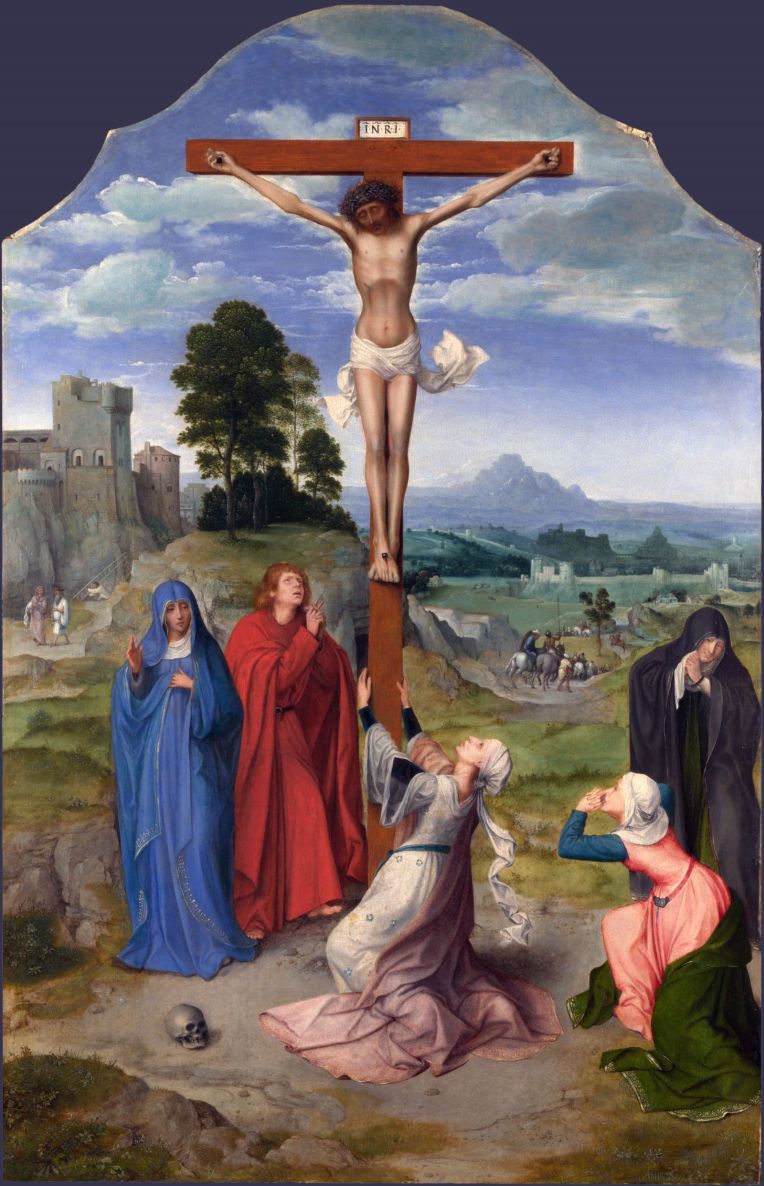
While the other apostles saw the Cross as utter darkness, St. John saw the light.  John saw the Cross for what it really is.  We need to do the same during Lent.  We need to see the light that shines from the Cross.

There’s another fact that also distinguishes the Beloved Disciple from the other apostles.  He was the only apostle to die of old age.  That is to say, St. John was the only saintly apostle not to suffer martyrdom.  That’s why, on the feast day of every other saintly apostle, the priest, the tabernacle and the chalice bear red vestments:  to reflect the apostles’ blood, which they shed in witness to Jesus.  But on December 27th—the feast of St. John—the vestments are white, reflecting the purity of his faith.  St. John died an old man, in exile on the island of Patmos in the eastern Mediterranean.

So you might wonder whether these two features of St. John’s life are related.  In other words, was it God’s Providence that St. John was the only apostle to live to old age?  Was this so that he might have time, first, to pray and reflect on what he saw on Good Friday, and then to write down the truth of what he saw in five books of the New Testament:  his account of the Gospel, three epistles, and the Book of Revelation?

All the apostles saw Jesus risen from the dead, but only one apostle saw Jesus sacrifice His Body and Blood on the Cross.  Surely St. John’s perspective on Calvary influenced his account of the Gospel.  In his five New Testament books, St. John gave witness to the light of Christ:  that is, a witness to the power of Jesus’ crucifixion; to the light that shines from the Cross.

One of the unique features of John’s Gospel account is the extent to which he comments on the words and actions of Jesus.  These commentaries obviously were the fruit of his years and years of prayer, through to the end of a long life.

Take today’s Gospel Reading as an example.  This passage is eight verses long, but only two of them present Jesus speaking.  The other three-fourths of the passage are Saint John, inspired by the Holy Spirit, commenting on what it means to follow Jesus.  This commentary begins with one of the more famous verses of the Bible:  “For God so loved the world that he gave his only Son, so that everyone who believes in him might not perish but might have eternal life.”  Yet the passage doesn’t stop there, and neither should our reflection upon today’s Gospel passage.

This passage is not only about God’s love for us.  It’s also in turn about the love we must have for God.  The Beloved Disciple’s commentary speaks to the demands that the Faith places upon the shoulders of a Christian disciple:  “whoever lives the truth comes to the light, so that his works may be clearly seen as done in God.” 

These “works” of which St. John speaks are not just religious works:  works of stewardship that we do for our parish.  The Beloved Disciple is speaking about the whole of a disciple’s life and all of that life’s thoughts, words, and actions.  For God the Father claims the whole life of one who is baptized.  Being a devout Catholic means that one’s whole life is held up to the light of the Gospel as taught by God’s Church on earth.  Living the truth doesn’t mean spinning the truth, but submitting oneself to the truth with all its consequences, both earthly and eternal.