Friday of the Twenty-first Week in Ordinary Time

Friday of the Twenty-first Week in Ordinary Time
Matthew 25:1-13

“Therefore, stay awake, for you know neither the day nor the hour.”

The parable that Jesus teaches in today’s Gospel passage presents at the outset a question which can prevent us from reaching down into Jesus’ point.  We might well ask, “Why are there ten virgins but only one bridegroom?”  What is the setting or background to this story that Jesus is telling?  Scholars may debate such points, but for ordinary Christians like ourselves, it would be more fruitful to set aside such speculation, and dwell instead on applying the parable to our own spiritual lives today.

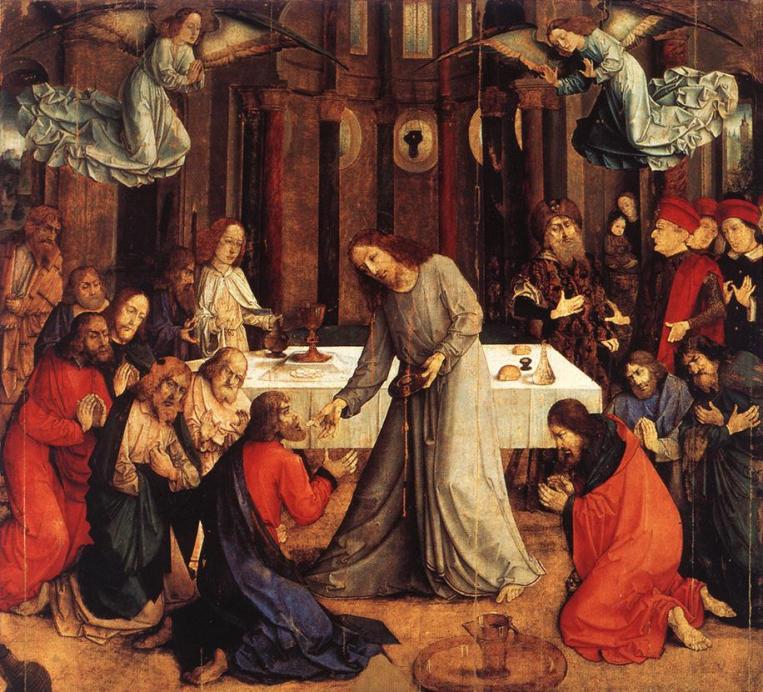
Christ is the divine Bridegroom, and each Christian is—in our fallen humanity—called to wed one’s self to Christ.  Our sacramental, spiritual life consists of our espousal to Christ, and in this each of us is one member of the Mystical Body of Christ.  Throughout her history the Church has (so far) had well over a billion members, each a spiritual bride to Christ.  Men may have difficulty applying this imagery to themselves, and of course this imagery has to be considered carefully.  Nonetheless, the writings (not to say the very lives) of both male and female saints show us how to grow authentically within these truths.

If we were to apply Jesus’ parable in a succinct way, we might consider the final sentence, where the divine Bridegroom exhorts us to “stay awake”.  We ought not rest comfortably in God’s grace, but rather realize our need each day to be alert to His coming more deeply into our lives.

OT 21-5

St. Monica

St. Monica
1 Thessalonians 4:1-8  +  Matthew 25:1-13
August 27, 2021

“Therefore, stay awake, for you know neither the day nor the hour.”

The parable that Jesus teaches in today’s Gospel passage presents at the outset a question which can prevent us from reaching down into Jesus’ point.  We might well ask, “Why are there ten virgins but only one bridegroom?”  What is the setting or background to this story that Jesus is telling?  Scholars may debate such points, but for ordinary Christians like ourselves, it would be more fruitful to set aside such speculation, and dwell instead on applying the parable to our own spiritual lives today.

Christ is the divine Bridegroom, and each Christian is—in our fallen humanity—called to wed one’s self to Christ.  Our sacramental, spiritual life consists of our espousal to Christ, and in this each of us is one member of the Mystical Body of Christ.  Throughout her history the Church has (so far) had well over a billion members, each a spiritual bride to Christ.  Men may have difficulty applying this imagery to themselves, and of course this imagery has to be considered carefully.  Nonetheless, the writings (not to say the very lives) of both male and female saints show us how to grow authentically within these truths.

If we were to apply Jesus’ parable in a succinct way, we might consider the final sentence, where the divine Bridegroom exhorts us to “stay awake”.  We ought not rest comfortably in God’s grace, but rather realize our need each day to be alert to His coming more deeply into our lives.

OT 21-5

The Twenty-second Sunday in Ordinary Time [B]

The Twenty-second Sunday in Ordinary Time [B]
Deuteronomy 4:1-2,6-8  +  James 1:17-18,21-22,27  +  Mark 7:1-8,14-15,21-23

So the Pharisees and scribes questioned Him ….

On Calvary, Jesus sacrificed His Body and Blood, soul and divinity for all mankind:  not just for those who liked Him.  This means that Jesus gave up His very self in sacrifice on the Cross so that each scribe and Pharisee might enter Heaven.

So why did Jesus speak so boldly against the scribes and Pharisees in today’s Gospel passage?  Why are the scribes and Pharisees wrong, when they seem to have the Book of Deuteronomy on their side?  The Book of Deuteronomy, which is the fifth book of the Bible and the final book of the Jewish Torah, is set on the threshold of the death of Moses.  It is the end of the Exodus, that forty-year trek from slavery in Egypt, through the wilderness of the Sinai desert, to the Promised Land of milk and honey.

The entire Book of Deuteronomy takes place on this side of the Jordan River, before the Israelites conclude their Exodus by entering the Promised Land.  However, the Lord had decided that Moses, as punishment for his infidelities while leading the Exodus, would not be permitted to enter the Promised Land.  Before he dies, Moses must proclaim the Law that God had entrusted to his care on Mount Sinai towards the beginning of the forty-year Exodus.

It’s in this setting that Moses in today’s First Reading makes clear that the Promised Land is Israel’s only on the condition that its people neither subtract from nor add to God’s commands.  The result for being unfaithful to God is clear in the person who is speaking.  That is, Moses is a living example—or more accurately, a dying example—of what happens to those who are unfaithful to God.  God in effect is saying, “If you are unfaithful to my commands, which includes adding to or taking away from them, you will end up like this Moses:  outside the Promised Land, which is to be dead.”

Given this, how ought we understand Jesus saying that the scribes and Pharisees need to change in order to follow Him?  More to the point, do Jesus’ words against the scribes and Pharisees present a challenge to your own spiritual and moral life?

The simplest way to get at the “course correction” Jesus is demanding is to notice the contrast that Jesus speaks about.  He quotes the Old Testament prophet Isaiah:  “This people honors me with their lips, but their hearts are far from me” [Isaiah 29:13].  Jesus contrasts “lips” and “hearts”:  one’s outer self with its actions, and one’s inner life of motives.

But notice that for Jesus, it’s not lips versus hearts.  It’s the scribes and Pharisees who have in fact set up opposition between lips and hearts.  Jesus is pointing out that there’s not meant to be opposition.  Lips and hearts are meant to be integrated.  The scribes and the Pharisees, however, are content with just giving lip service to God.  It’s within this context that Jesus clarifies which human traditions and customs are in conformity with God’s Law.

How, then, can we make certain that, unlike the Scribes and Pharisees, our lips and hearts—our good works and faith—are thoroughly integrated?  The answer starts in what might seem an unlikely place:  silence.  St. James in the Second Reading sets the stage for this answer.

St. James invites us to “[h]umbly welcome the word”.  This “word”, of course, is Christ [see John 1:1].  The best start for humbly welcoming this word is silence.  Yet the silence needed here is not just a lack of audible noise.

Internal silence is needed.  Some people can very easily pray for an hour surrounded by external silence, yet the whole time they’re stuffing human words into their hearts, minds, and souls by reading or carrying on an internal monologue.  These human words exclude the divine word.

The divine “word”, who became flesh and dwelt among us [see John 1:14], is the measure—the standard—against which every person will be judged.  The divine Word made Flesh judges each human person, not only scribes and Pharisees.  In prayer we have to dispose ourselves by silence and patience to hearing this divine Word.  We must not only allow Him to speak to us, but also to judge the works of our lips and hearts.

Thursday of the Twenty-first Week in Ordinary Time [I]

Thursday of the Twenty-first Week in Ordinary Time [I]
1 Thessalonians 3:7-13  +  Matthew 24:42-51
August 26, 2021

“Stay awake!”

I’m sure all of us have had experiences throughout our lives where we struggled to stay awake.  Maybe those experiences were experiences of waiting for someone to return home late at night.  In such a case, you might have experienced any sort of emotion:  perhaps joy, or perhaps fear, or perhaps anger.  Maybe the experience was one of driving late at night, anxious and exhausted, to reach a far-off destination.  Maybe the experience was one of finishing a project, paper, or report for school or the office:  such an experience may have been fraught with fear.

There is a wide variety of emotion which can accompany the experience of trying to stay awake, but if we consider the two events that Jesus’ words today concern—the coming of Christ in salvation history, and Christ coming to us at the moment of our death—we see that these two things share something in common:  namely, that they are both unexpected in terms of when they will occur.  To stay awake for these two things is to stay awake for the unexpected.  Do not expect Christ to be part of your life in the way that you expect, or even perhaps in the way that you would prefer.

OT 21-4

Wednesday of the Twenty-first Week in Ordinary Time

Wednesday of the Twenty-first Week in Ordinary Time
Matthew 23:27-32

“Woe to you, scribes and Pharisees, you hypocrites.”

The next time sometime suggests to you that Jesus was nothing more than a teddy bear, point out today’s Gospel passage.  One of several things will happen.  That someone may recognize that he’s mistaken.  Or that someone may suggest—as some scholars actually do—that this passage was made up, and that Jesus never said what this passage records Him as saying.  Or that person might suggest that it’s only against people like the scribes and Pharisees that Jesus ever spoke in such a way.

The third of these possibilities is most likely to be the response of those challenged to explain this passage.  But this is where the sharp point of the Gospel needs to be recognized.

Today’s passage was not included in Matthew’s Gospel account so that we could wag our fingers at those in our own lives who resemble the scribes and Pharisees.  Rather, we need to hold their lives up to ours, and see to what extent we mirror them.  We might like Jesus always to be a teddy bear, but more often than not we need Him for our own sakes not to be.

St. Bartholomew, Apostle

St. Bartholomew, Apostle
Revelation 21:9-14  +  John 1:45-51
August 24, 2021

“Come and see.”

When Philip points out Jesus as the promised Messiah, what does Nathaniel—also known as Bartholomew—say?  We can almost see Nathaniel shrugging his shoulders as he says, “Can anything good come from Nazareth?”  In this one sentence, he insults both Jesus and Jesus’ hometown.  Clearly, he does not have faith at this point.

But we see that Nathaniel is like Peter:  a slow learner, but someone who, once he realizes what’s going on, is completely “in”.  When Nathaniel hears Jesus call him, he realizes who Jesus is, and confesses this truth, declaring:  “Teacher, you are the Son of God; you are the king of Israel.”  So if any of us are slow to learn, we should remember that Jesus does not give up on us.  Jesus will still call each of us to live out his vocation each day, and give him whatever is needed to carry it out.

Yet we should also note something else in this “vocation story”:  that is, the role of Philip.  When God calls a young man to be a priest, or a young woman to the consecrated life, He usually calls him or her through other people.  We need not only to encourage vocations:  we need also to encourage those “other people” like Philip to encourage vocations.

After all, Philip said just three words:  “Come and see.”  But if Philip had not said these three simple words, Nathaniel might never have met Jesus, and the Church would not have been built up by this holy apostle Bartholomew.  Little words can do a lot for God’s great glory.

St. Bartholomew LORES

The Martyrdom of St. Bartholomew by Jusepe de Ribera [1591-1652]

Monday of the Twenty-first Week in Ordinary Time

Monday of the Twenty-first Week in Ordinary Time
Matthew 23:13-22

“You do not enter yourselves, nor do you allow entrance to those trying to enter.”

Christians often confess the sin of anger, perhaps without considering that anger cannot only be justified at times, but indeed can at times even be righteous.  Perhaps the most famous example from the earthly life of our Savior is His overturning the tables of the money-changers in the Temple.  However, the words of Jesus also at times demonstrate anger on His part.  His words in today’s Gospel passage could hardly have been spoken without anger.  But when justified, anger must be directed to an object deserving anger.  What is the object of Jesus’ condemnation today?

We might at first consider the object of Jesus’ anger to be the scribes and Pharisees, and in one sense that’s true.  But we ought to remember that on Calvary, Jesus died for them as for us, with deep love in His Sacred Heart for them.  Jesus never at any moment did not want these “blind fools” to “exult in glory” in Heaven.

Today’s redaction of the Gospel says that Jesus’ words were said “to the crowds and to His disciples”.  Indirectly, He may have said these words for their sake, but clearly they were directed to the scribes and Pharisees.  More importantly, His words were spoken not only for the crowds and His disciples, but also for the scribes and Pharisees:  for their conversion, that they might “rejoice in [Jesus as] their king”.

OT 21-1

St. Pius X, Pope

St. Pius X, Pope
Ruth 2:1-3,8-11;4:13-17  +  Matthew 23:1-12
August 21, 2021

“‘… you have but one Father in Heaven.’”

Today’s Gospel passage contains a verse that some Christians quote to “prove” that one of Catholics’ most common practices is “unbiblical”.  Jesus declares, “Call no one on earth your father; you have but one Father in heaven.”  These words of Jesus would seem to condemn the Catholic practice of addressing a priest as “Father”, as well as referring to the Pope as the “Holy Father”.

Those who make this argument might be taken aback, then, if it were pointed out to them the many passages from Saint Paul’s letters where he refers to himself as a spiritual father.  For example, Paul explains how the Corinthians have one father.  He squarely preaches to them, “You might have thousands of guardians in Christ, but not more than one father […] it was I who begot you in Christ Jesus…” [1 Cor 4:15].  It’s hard to imagine—if you were to interpret Holy Scripture in a literalistic sense—any words that more directly contradict Jesus’ command to “call no man on earth your father” than what St. Paul says of himself:  “You might have thousands of guardians in Christ, but not more than one father […] it was I who begot you in Christ Jesus….”

What are we to make of this seeming contradiction?  St. Paul’s following words only seem to heighten the contradiction with Jesus’ command.  St. Paul commands those listening to him:  “Be imitators of me, as I am of Christ” [1 Cor 4:16].  Why doesn’t St. Paul just say instead, “Be imitators of Christ”?  Some Christians will argue over and over again that the Catholic priesthood is a corruption of the Word of God because it puts a middle-man—a mediator—between Christ and the individual believer.  They will say instead that the individual Christian can go straight to Christ, without needing men in between.

It’s here that the teachings of Saint Paul—found, of course, in the Holy Bible—lead us deeper into the mystery of the Christian Faith.  St. Paul’s words don’t contradict Jesus’ command to call no man on earth your father:  St. Paul’s words deepen the revelation of Jesus.  Christian fathers, whether in the home or in the sanctuary, whether through the Sacrament of Holy Matrimony or through the Sacrament of Holy Orders, are called to say—by their example if not by their words—what St. Paul proclaims here:  “Be imitators of me, as I am of Christ.”  Christian fathers are called to lead their children each day and each week into the life of Christ.

St. Bernard, Abbot and Doctor of the Church

St. Bernard, Abbot and Doctor of the Church
Ruth 1:1,3-6,14-16,22  +  Matthew 22:34-40
August 20, 2021

“The whole law and the prophets depends on these two commandments.”

When we were little we were expected to memorize the basic truths of our Faith.  At the top of the list were the Ten Commandments, which are difficult for a child to memorize.  Today’s Gospel passage offers a clue to help us to remember—or to teach—the Ten Commandments more easily.

If not pointed out, we may never have noticed that in many pictures of Moses bringing down the two tablets from Mt. Sinai, the Ten Commandments are not divided five and five.  Rather, the first tablet has the first three commandments, and the other tablet the remaining seven.  This illustrates Jesus’ teaching today:  that there are, in fact, simply “two commandments”.

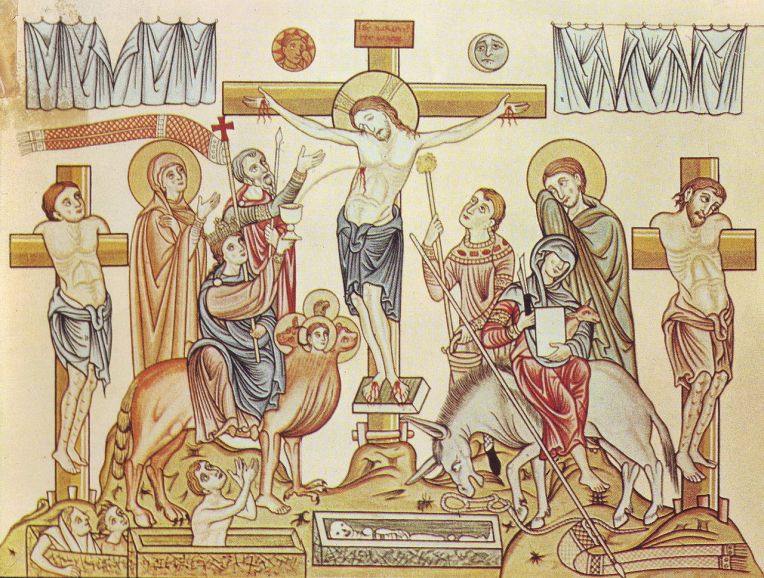
On the Cross most especially, in His very Person, Jesus embodies the unity of these “two commandments”.  True God and true man, Jesus’ teaching today merely foreshadows what He teaches us on Calvary.  Some people teach a piety that promotes complete devotion to God, but ignores or even disdains the corrupted human race.  Others teach an ethic that promotes an apotheosis of human nature, but disdains or even altogether denies God.  But neither of God’s “two commandments” can stand or be understood thoroughly without the other.  Jesus reveals the meaning of each of these commandments in His divine Person, and in His Self-sacrifice on Calvary.

The Ten Commandments