St. Martin of Tours, Bishop

St. Martin of Tours, Bishop
Wisdom 7:22—8:1  +  Luke 17:20-25
November 11, 2021

“For behold, the Kingdom of God is among you.”

In today’s Gospel passage, Jesus describes the phrases “the Kingdom of God” and “the Son of Man”.  The meanings of both are elusive, and that’s Jesus’ point.

In the Pharisees, who ask “when the Kingdom of God would come”, we can see many in our own day who exert great effort in predicting and spreading news of the time of this coming.  Jesus splashes cold water on them all:  this coming “‘cannot be observed, and no one will announce, “Look, here it is”’”.  Along the same line, Jesus soberly explains to the Pharisees that while they “‘will long to see one of the days of the Son of Man,’” they “‘will not see it.’”

However, in the midst of this sobering up, Jesus declares something provocative, if not confusing.  “‘For behold, the Kingdom of God is among you.’”  So while the coming of the Kingdom “‘cannot be observed,’” it already “‘is among you.’”  How are we to understand what seems on the surface like a contradiction?  Perhaps such understanding ought only be sought by the Pharisees of old.  Perhaps our part is simply to live within the Kingdom of God, under the shepherding of the Son of Man.

OT 32-4

Wednesday of the Thirty-second Week in Ordinary Time

Wednesday of the Thirty-second Week in Ordinary Time
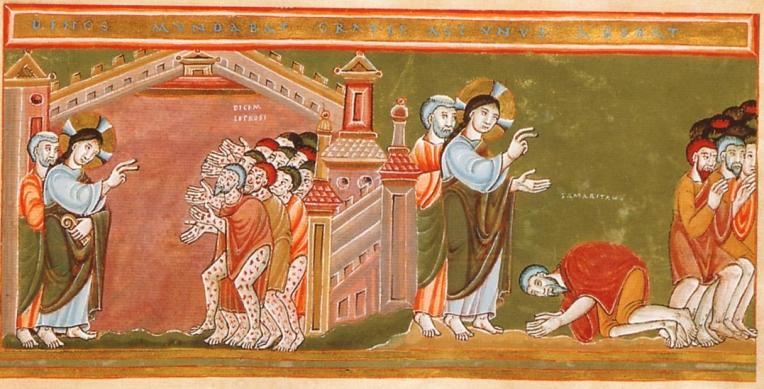
Luke 17:11-19

“Jesus, Master, have pity on us!”

We may not feel inclined to think of ourselves as lepers.  It’s not an appealing image.  But that’s the plain meaning of these ten persons in today’s Gospel passage.  The ten lepers represent us.

In fact, we’re much worse off than lepers.  Leprosy ends with earthly death.  But the effects of sin—alienation and estrangement from God and neighbor—are unending, ever-lasting, without end if we die in mortal sin.  Without a Redeemer to save us from sin, our suffering will not end with earthly death, but only begin in earnest.

Jesus saves the ten from leprosy with little more than a few words, such is His divine power.  But Jesus saves all of mankind from the far greater penalty of eternal death.  Jesus offers salvation to you not by speaking a few words, but by sacrificing up His complete self—Body, Blood, soul and divinity—to a Passion and Death on the Cross that He suffered out of love:  not out of compulsion, or to get something back in return, or to impress anyone, but simply and completely out of love for us.  If this doesn’t inspire gratitude in each of us, it’s hard to imagine what might.

OT 32-3

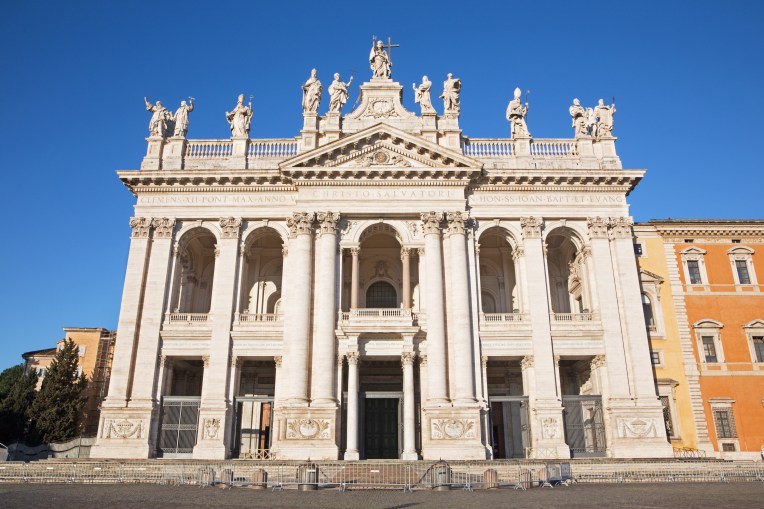
The Dedication of the Lateran Basilica in Rome

The Dedication of the Lateran Basilica in Rome
Ezekiel 47:1-2,8-9,12  +  1 Corinthians 3:9-11,16-17  +  John 2:13-22
November 9, 2021

… you are the temple of God ….

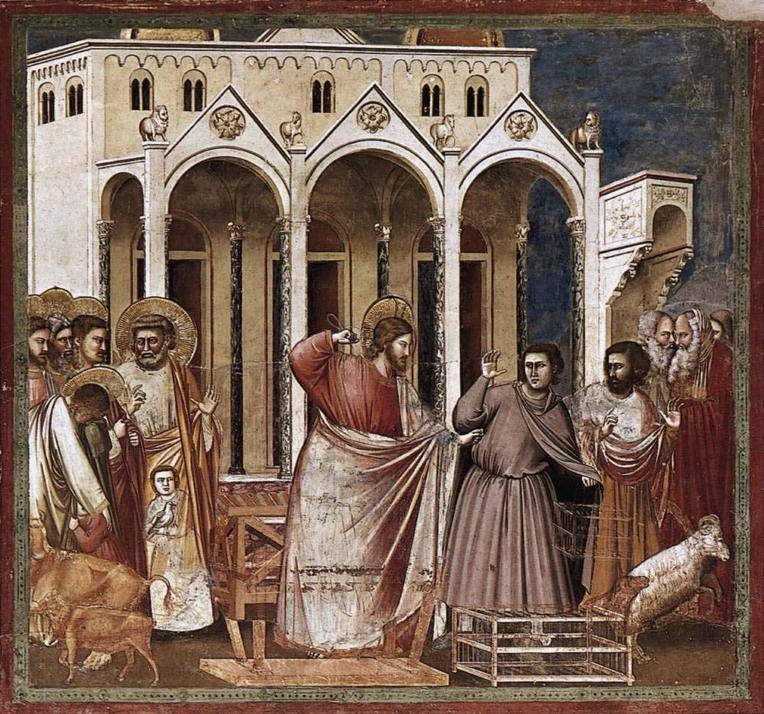
Today’s Gospel passage shows us God’s passion for His temple, and His passion for the sacrifice offered there.  In the confessional, priests often hear people confess anger.  A priest might find it necessary to ask questions when someone confesses “getting angry”.  In light of Jesus’ action in this passage, it’s important to remember not only that merely “getting angry” is not necessarily a sin.  Also, even acting in anger is not necessarily a sin.

Acting in anger, or fostering anger in oneself or others, certainly can be a sin.  But Jesus acts in anger in today’s Gospel passage, and with good reason.  When reflecting on a state of anger, and actions that flow from it, it’s important to ask what the object of one’s anger is.  This object can make all the difference in the morality of such an act.

While experiencing the passion of anger, Jesus purifies the Temple.  In the passion of love, He purifies the temple of the human body of sin on Calvary, by offering up His own body in sacrifice.  St. John the Evangelist makes this point clearly.  When Jesus challenges His opponents, saying, “Destroy this temple and in three days I will raise it up”, the evangelist explains that Jesus “was speaking about the temple of His Body.”  The Church’s belief in the great goodness of the human body is based in large measure on this Gospel truth.  The Church’s challenging ethic of purity of body stems not from a belief that the human body is bad, but that the human body’s purity ought to concern us as much as the purity of the Temple concerned Jesus.  Both temples ultimately belong to God, for His purposes and for His glory.  The temple of the human body is meant for the offering of sacrifices, small and large.

St. John Lateran.jpg

Click HERE to take a virtual tour of the Papal Basilica of St. John Lateran in Rome

Monday of the Thirty-second Week in Ordinary Time [Year I]

Monday of the Thirty-second Week in Ordinary Time [Year I]
Wisdom 1:1-7  +  Luke 17:1-6

Love justice, you who judge the earth; think of the Lord in goodness, and seek him in integrity of heart ….

At weekday Mass during this second-to-last week in Ordinary Time, the Church’s First Reading is taken from the Old Testament Book of Wisdom.  Not surprisingly, the Book of Wisdom is part of the Old Testament group of books called the “Wisdom Literature” (the other three groups of Old Testament books being the Pentateuch, the Historical Literature, and the Prophetical Literature).  There are seven books that make up the “Wisdom Literature”.

This book is fitting for us to listen to as we draw near to the end of the Church year.  Towards the end of the Church year, the Sacred Liturgy draws our attention to the Last Things:  Heaven, hell, death and judgment.  You and I need wisdom to think rightly about these four last things.

Today’s First Reading consists of the first seven verses of Wisdom.  It might surprise some just how “earth-bound” this passage is.  It is not “pie in the sky”, meditating abstractly on ideas and theories about God’s wisdom.  The passage is very concrete.

The first two words of the book are “Love justice”.  A good retreat master could develop an entire week-long retreat exploring just these two words, so profound are they.  Love and justice are both virtues:  the former the greatest of the theological virtues, and the latter one of the moral (or “cardinal”) virtues.  To love justice is to devote one’s self to a right ordering of one’s thoughts, words and actions:  giving to God what is His due, and recognizing God in our neighbors, whom He created for us to love.  In attending to the simple matters of daily life with divine love, we cannot fail to grow in wisdom.

OT 32-1.jpg

Saturday of the Thirty-first Week in Ordinary Time [I]

Saturday of the Thirty-first Week in Ordinary Time [I]
Romans 16:3-9,16,22-27  +  Luke 16:9-15
November 6, 2021

“You cannot serve God and mammon.”

This sentence of Jesus is sometimes falsely and simplistically interpreted to mean that you cannot have both God and money in your life.  In other words, this false interpretation says that there’s a sort of competition in your life between God and money which is a zero-sum game.  Or to use a picture metaphor:  this false interpretation says that there’s a see-saw in your life:  God and money are sitting at opposite ends of the see-saw.  If one goes up, the other goes down.  The holier you are, the less money you will have, and the more money you have, the less holy you must be.  This interpretation of Jesus’ words is false.

Our spiritual well-being and our financial well-being are not in competition with each other.  Rather, when Jesus plainly tells you that “You cannot serve both God and mammon”, the key is the word “serve”“You cannot serve both God and mammon.”  You can serve God, or you can serve mammon.  But you cannot serve both.

The beautiful thing about serving God is that through this form of love, we become more like Him.  After all, “God is love”, as St. John taught the first Christians.  So in the very act of loving God, we become like Him:  that is to say, we enter into His very way of life, His very way of being.  This is as God wants, and in fact this is as each of you wants, in the deepest center of your heart, because God planted that desire there when He created your heart:  the desire to serve Him, and so become more like Him.

Friday of the Thirty-first Week in Ordinary Time [Year I]

Friday of the Thirty-first Week in Ordinary Time [I]
Romans 15:14-21  +  Luke 16:1-8

… because of the grace … in performing the priestly service of the Gospel of God ….

There are differences among Christians, and then there are disagreements.  Differences can be of various types, including those willed by God Himself for the sake of the Church.  Saint Paul has preached about “diversity for the sake of unity” in the First Readings of recent days.  Differences can come about through human sin, contrary to the will of God.  But disagreements often point to something more difficult to reconcile:  beliefs that are contrary to the mind of God.

There are disagreements among Christians about Christians serving others as priests.  A priest, of course, is a mediator:  in more common parlance, a “middle man”.  He stands between God and another human person in order to serve that person:  in order to bridge the gap between God and the other.  Is there such a thing as an authentic Christian priesthood?  If so, what form or forms does it take?

Saint Paul in today’s First Reading shows us that the answer to the first of these questions is “Yes”.  Speaking to the Romans about himself, St. Paul speaks of his “priestly service of the Gospel… so that the offering up of the Gentiles may be acceptable”.

Among Christians who speak regularly against Catholic teaching and practice about the priesthood, you will often hear that there is only one mediator, Jesus Christ.  Therefore, there ought to be no human mediators between “me and Jesus”, as they might put it.  But St. Paul’s words today—inspired as they are by the Holy Spirit—clearly show such an idea to be contrary to the mind of God.  This is only the first principle by which to understand Christian priesthood, but it’s good for us to reflect on it today.

OT 31-5

The Thirty-second Sunday in Ordinary Time [B]

The Thirty-second Sunday in Ordinary Time [B]
I Kings 17:10-16  +  Hebrews 9:24-28  +  Mark 12:38-44

“… she, from her poverty, has contributed all she had, her whole livelihood.”

Tithing is a biblical tradition by which one can carry out the Precept to support the Church materially (CCC 2043).  Yet tithing demands more from some than others.  To illustrate, say that the currency that the characters in today’s Gospel passage put into the treasury was dollars.  And let’s say that one of those “rich people” earned $100,000 a year, and that in today’s Gospel passage, this rich person put $10,000 into the treasury:  in other words, 10% of his annual income.  Certainly that’s a large sum.

So then imagine that the “poor widow” had an annual income of 20 small coins.  The “two small coins” that she put into the treasury was ten percent of her annual income.  But at the time of today’s Gospel passage, those “two small coins” were all she had in her possession.  She had no savings or checking account, no mutual funds or IRA, no annuity, stocks, or bonds.  She had no husband, no children or extended family, no Social Security or Lord’s Diner.  This widow, “from her poverty, … contributed all she had, her whole livelihood.”

By contrast, the rich person who put ten thousand dollars into the treasury had more where that came from.  As Jesus said, the rich person “contributed from [his] surplus wealth”.  So while the rich person and the poor widow both may have given equal percentages of their income, the rich person still gave from his surplus, while the poor widow gave “from her poverty”.

Jesus points our attention towards—and wants us to imitate—this “poor widow” giving “from her poverty”.  That’s easier said than done.  But there are at least two ways to make this easier.  The first is a virtue to be cultivated, and the second is a practice to be followed.

First is the virtue of trust:  specifically, putting one’s trust in God.  The virtue of putting trust in God first means acknowledging that God is your providential Father.  God has made you for Himself, and you can only reach Him in Heaven by surrendering each day to the One who is your providential Father.

What practice, then, might help us concretely to give like the “poor widow”?  It’s the practice of giving “first fruits”.

Giving God one’s first fruits is rooted in Sacred Scripture.  Of course, the examples in the Bible of giving from one’s first fruits are literal, based on harvesting different grains grown by many of God’s People.

Consider a farmer with 1000 acres.  In ancient times, having only primitive tools meant that it would take him a long time to harvest 1000 acres.  At any point during that stretch of harvest time, bad weather could destroy the remaining crops.  So for a farmer to give the fruits of the first hundred of his acres to be harvested—not knowing how much of the remaining 90% would ever be harvested—was a concrete act of trust on the part of that farmer.

So how would a modern person relate such a biblical example to giving one’s treasure to God?  How could one today imitate the “poor widow” in giving one’s “first fruits”?

Maybe the simplest way would be—to use a modern expression—by giving to God off the top.  If you haven’t gone green when it comes to paying bills, and if you don’t pay all your bills by means of automatic withdrawal, then each month you have a stack of paper bills to pay.  Many Christians are tempted to give God from their “leftover treasure”:  if, that is, there is any treasure left over after the bills are paid.  Instead, you can metaphorically offer God the first fruits of your monthly treasure by giving to God a sacrificial amount before even touching the first bill that needs to be paid.

There are many other practical ways to include one’s personal finances within the sphere of one’s spiritual life, rather than falsely thinking that the two have nothing to do with each other.  This inclusion—your finances within your spiritual life—demands the virtue of trust.  The foundation of this trust is the wisdom that the “poor widow” demonstrated:  knowing oneself to be nothing without God.  Knowing oneself to be nothing without God is the foundation that allows us to give from our poverty, and allows God to bear abundant fruit through our lives.
St. Charles Borromeo, Bishop

St. Charles Borromeo, Bishop
Romans 14:7-12  +  Luke 15:1-10
November 4, 2021

“This man welcomes sinners and eats with them.”

Jesus’ first parable in today’s Gospel is heartfelt, offering us hope of God’s compassion for the wayward.  Jesus offers a “moral” to the parable in explaining that “there will be more joy in Heaven over one sinner who repents than over ninety-nine righteous people who have no need of repentance.”

Although Jesus’ “moral” seems straightforward enough, there is something about it that seems paradoxical.  Wouldn’t it make sense for the “righteous” to rank higher in Heaven than the repentant?  Why isn’t there such rejoicing in Heaven over the righteous?  There are at least two responses that might be offered.

First, the “righteous” of whom Jesus is here speaking are defined by the righteous themselves.  Yet such self-righteousness is a false righteousness.  Only God can make a human person righteous.

Second, those who are righteous in the true sense of the word are so only through their repentance.  A saint is a sinner who knows he’s a sinner.  In this sense, all human beings in Heaven (excepting, of course, Our Lord and Our Blessed Mother) are righteous through their self-repentance.  You and I as sinners rejoice that the Lord has not left us in our sins, but has offered us His grace, which is the means to righteousness in God’s sight.

OT 31-4

Wednesday of the Thirty-first Week in Ordinary Time

Wednesday of the Thirty-first Week in Ordinary Time
Luke 14:25-33

“Whoever does not carry his own cross and come after Me cannot be My disciple.”

The Catholic approach to following Jesus is not “either/or”, but “both/and”.  Throughout the course of the Church’s two thousand year history, various heretical groups have tried to split apart aspects of the Catholic Faith that God means to be wedded to each other.  For example, regarding the person of Jesus Christ, some heretics have falsely taught that Jesus is only a human being, and not divine.  In turn, other heretics have falsely taught that Jesus is only divine, and not human.  There are serious consequences to believing in either of these falsehoods.  By contrast, salvation is only possible if Jesus Christ is both fully divine and fully human.

In today’s Gospel passage, Jesus speaks to an area of the Christian life that calls for another “both/and”:  faith and good works.  There are some who claim that faith in what Jesus accomplished two thousand years ago on Calvary is enough to reach Heaven.  Jesus insists, however, that both faith and good works are needed.  Not only must a Christian have faith in Christ’s saving work on Calvary.  One must also conform the whole of one’s life – heart, mind, soul, and strength – to what Christ accomplished on Good Friday.  This is what He refers to when He insists:  “Whoever does not carry his own cross and come after Me cannot be My disciple.”

The phrase “his own cross” distinguishes that the disciple is an individual with free will:  he may choose to carry his own cross, or not to carry his own cross.  Nonetheless, when the disciple – with faith in the power of Jesus’ saving death and resurrection – carries “his own cross”, he is not merely following Jesus at a distance.  Carrying one’s own cross is not only a moral act.  For the Christian, carrying one’s own cross after Jesus is one of the chief means of entering into Jesus’ saving sacrifice on Calvary.

OT 31-3