The Third Sunday in Ordinary Time [C]

The Third Sunday in Ordinary Time [C]
Nehemiah 8:2-4,5-6,8-10  +  1 Corinthians 12:12-30  +  Luke 1:1-4; 4:14-21

When you’re little, your imagination helps you fill in the gaps about all the things in the world that you don’t understand completely.  When I was a boy, I did not think very much about becoming a priest.  I never seriously thought about being a priest until my freshman year of college when I was at K-State.  Maybe one reason that I didn’t think much about entering the seminary when I was little was because of what my imagination told me that the seminary must be like.  For whatever reason, when I was a little boy I thought that life in the seminary consisted chiefly of two things:  kneeling on wooden kneelers for hours on end, and memorizing all the names of the popes.  When as a boy I learned that there were over two hundred sixty popes, I gave up thinking about the seminary.

Why does our imagination want to fill in the gaps about things that we don’t understand?  It’s pretty simple, really.  No one likes to be ignorant.  No one likes to be in the dark.  Everyone by nature desires to know.

Imagine that you were given a bag of 500 jigsaw puzzle pieces, but were not given the box displaying the picture that the pieces make.  You would probably be able to put many of those puzzle pieces together, two pieces at a time.  But eventually you would also form an idea about what the overall picture looks like, and if your imagination were correct, that would make it easier to find two pieces to fit together.  The point is that our imagination by nature fills out pictures that we only have pieces of.

This is true of our Catholic Faith, as well.  That makes sense.  After all, one of the key words of our Catholic Faith is the word “mystery”.  Understanding our Catholic Faith, and living the spiritual life that flows from it, are filled with mysteries that go beyond what our imagination can help us picture.

+     +     +

When I was a boy, I loved mysteries, but not the sort of mysteries that make up our Catholic Faith.  I read lots of mystery stories when I was a boy.  First I read all the stories of the Bobbsey Twins, and then the stories of the Hardy Boys, and then I graduated to Sherlock Holmes.  I devoured all fifty-six short stories and four novels about the world’s greatest detective.  Every mystery story presents a mystery that challenges the reader to piece together the clues leading to the solution of the mystery.

The great thing about such stories is that there always is a solution that we can thoroughly figure out.  I as the reader may not be smart enough to figure out what that solution is until the last page, but the solution is there all along.  The mystery is just a veil that hides the solution from my sight.

The mysteries of faith are different in an important way, because the mysteries of our Catholic Faith resist any ultimate solution.  If we go about reading God’s Word in one of the books of the Bible—like Ezra in today’s First Reading, or Our Lord Jesus in the Gospel passage—and if expect God’s mysteries to be solved by the end of the book, we’re going to be disappointed.

That’s not to say that the Bible makes no sense, or that we cannot make headway in exploring the mysteries of our Faith.  In the First Reading, “Ezra read plainly from the book of the law of God, interpreting it so that all could understand”.  Likewise, in his second letter to Timothy, St. Paul instructs us that the “sacred scriptures… are capable of giving you wisdom for salvation through faith in Christ Jesus.  All scripture is inspired by God and is useful for teaching, for refutation, for correction, and for training in righteousness” [2 Timothy 3:15-16].

So when it comes to God’s sacred mysteries, there’s a tension between what can be grasped and what remains elusive.  This tension was captured by the layman St. Thomas More.  About 1500 years after the New Testament was composed, St. Thomas More wrote that Holy Scripture is “so marvelously tempered, that a mouse may wade there…, and an elephant be drowned…” [Thomas More, A Dialogue Concerning Heresies, I, 25].

+     +     +

In the light of these sacred mysteries, with all its tension between reason and faith, how are we meant to live out our Catholic Faith?  There are two opposite extremes that we need to avoid.  The approach that the Church shows us to take falls between these two extremes.  But the more common extreme in our own day is the one we need to be more cautious of.

One extreme is the crutch of rejecting everything that is mysterious.  Those who resort to this extreme only deal with mysteries, if they do at all, in order to solve them and move beyond them.  Mystery as mystery has no value.

One of the chief examples in our modern culture of such extremists are secular scientists:  those who believe that the universe is made only of matter; only of what can be measured; only of what can be manipulated.  Of course, this sort of scientist also has a counterpart in ordinary society today.  This common man counterpart is skeptical of anything he cannot see and touch with his own senses; that he cannot judge and evaluate; that he cannot put in its place.

But you have to wonder:  what do these secular scientists and common man skeptics make of love?  After all, love is not made of matter.  You cannot examine love under a microscope.  You cannot put love in its place.  Does it not exist, then, or is it simply a mystery not worth bothering about?  Or is love just an illusion caused by neurons firing in the brain, with no real substance of its own?

Love is a mystery, and as St. John writes in his first New Testament letter, “God is love” [1 John 4:8 and 4:16].  So if God is infinite love, He is infinite Mystery.

God is infinite Mystery.  God in not made of matter.  You cannot examine God under a microscope.  You cannot put God in His place.

Unfortunately, there are many Christians who try to do just that.  Three are many Christians who believe that they can put God in a box, as if God is something that they can control, and measure, and figure out.  This way of dealing with God has many things wrong with it, but the most disastrous is the truth that God is absolute Mystery, and if my approach in life is to avoid whatever cannot be controlled, then I must forfeit a relationship with God Himself.

So how, then, can we approach and possibly even explore and enter into this Mystery?  It’s not possible through objective, rational knowledge, but through a heart-to-heart relationship that God initiates by speaking to us His Word.

Unfortunately, many Christians—and as a man, I will admit, many men—are not comfortable with talking about a relationship with God.  Many men, for whatever reason, have difficulty with relationships.  They prefer to live their lives according to the work that they accomplish, and the money that they earn.  Those are not bad things:  in fact, they’re necessary in this world here below.  But they don’t go to the heart of a relationship.

A relationship, by definition, is a mystery.  A relationship is a mystery because it involves an “other”:  that is to say, an other person.  Not a fact that I can memorize; not a problem to be solved; not a job to be accomplished; not a paycheck to be earned.  In a relationship, I stand before an “other”, who is a mystery and whom I cannot control.  Because of this, a relationship is always open-ended, as opposed to the way in which I relate to fact and figures, jobs and money.

This is part of what we see in today’s Gospel passage.  The passage about Jesus in the synagogue follows immediately after Satan tempting Jesus in the desert, which in turn follows the narrative of Jesus’ baptism.  In other words, this is the beginning of Jesus’ three years of public ministry.  In the town “where He had grown up”, Jesus goes “according to His custom into the synagogue on the sabbath day”.  In other words, He was in a place very familiar to Him, and He in turn was familiar to those in the synagogue that day.  No mystery here!  It’s all very comfortable.

But then something happens to break the sense of custom and familiarity.  Jesus proclaims a passage from the Old Testament prophet Isaiah, and after doing so He tells the others in the synagogue, “‘Today this Scripture passage is fulfilled in your hearing.’”  That’s a striking thing to say, that a passage of the Old Testament has been fulfilled right here and now.  This isn’t what the average Jewish person would have expected to hear when he went to the synagogue on the sabbath.  After Jesus proclaims the passage from Isaiah and sits down, “the eyes of all in the synagogue looked intently at Him.”  This was a mystery that they could not explain.

Still early on in this new Church year—today being just the Third Sunday in Ordinary Time—it’s good for us to focus on the fundamentals of our Catholic Faith.  The whole of our Faith focuses on this divine Person, Jesus of Nazareth, who is God’s Word made Flesh.  This Person is true God and true man, and founded a church that—He insisted—the gates of Hell would never prevail against.  This Person offered up on a cross His own Body and Blood, soul and divinity.  This is the same Person who becomes truly and substantially present on the altar in the Holy Sacrifice of the Mass, and from there within the soul of the person who enters into relationship with Him, and worthily receives Him.  God offers us this Word made Flesh.  How will you reply to Him?

The Eighth Sunday in Ordinary Time [B]

The Eighth Sunday in Ordinary Time [B]
Hosea 2:16,17,21-22  +  2 Corinthians 3:1-6  +  Mark 2:18-22

Twenty-one of out of the seventy-three books that make up the Bible are letters, written by the apostles (most of them were written by Saint Paul).  These letters—written during the first seven decades of the Church—are like the letters of settlers.  In these letters, if we listen to them openly and honestly, we hear very human anxieties, excitement, daily problems, and surprises being expressed by the apostles.

The second reading of today’s Mass is taken from the beginning of Second Corinthians.  Saint Paul writes this letter as a spiritual father to the Corinthians.  Saint Paul had been the one to bring them the Gospel for the first time.  Before Paul, the Corinthians had not heard of Christ.  Though Paul, the Corinthians began to follow Christ.  But then Paul had moved on.  He had missionary work to do elsewhere.  He founded the Church in Corinth, and then moved on.  But now, five years later, he was making contact with them again, because the Corinthians were facing a lot of pressures.  There were many influences that were tempting them to give false witness, or to give up altogether any effort to give witness to Christ by their lives.

+     +     +

This relationship between the Corinthians and Saint Paul, is similar to the relationship between Confirmation candidates and their parents.  Confirmation candidates are at a point in their lives when they are like settlers, making preparations to set out from their homes—where they are comfortable—in order to explore, and take a risk on new and unknown experiences in their lives.  And so Saint Paul, as their spiritual father, as the one who gave them this new life, is speaking to them with both joy and frustration.  He wants to encourage—and caution—his children at the very same time.

What a balancing act it is, for a parent to try and carry out.  When Saint Paul addresses the Corinthians again, he rhetorically asks them whether he needs a letter of introduction in order to begin a conversation with them again.  His point is:  “Don’t you remember?  I’m the one who gave you new life in Christ!”  He says to the Corinthians, “if you want a reminder of what I am to you, look at your lives as followers of Christ.”  Wanting to encourage his children by pointing to their faith, he expresses his pride in being their father:

You are our letter, written on our hearts, known and read by all, shown to be a letter of Christ ministered by us, written not in ink but by the Spirit of the living God, not on tablets of stone, but on tablets that are hearts of flesh.

These children are living witnesses of the faith that has been handed on to them.  Others in the world can see in them, the invisible Spirit of God.

These words echo a verse from the Old Testament reading, chosen by our Confirmation candidates to be the First Reading of the Confirmation Mass.  This reading is from Ezekiel, where the prophet speaks in the Name of the Lord.  The Lord speaks to His own children, and gives to them the same promise that He is giving to our Confirmation candidates, when He speaks to them in their prayer:

…from all your idols I will cleanse you. I will give you a new heart and place a new Spirit within you, taking from your bodies your stony hearts and giving you natural hearts. I will put my Spirit within you and make you live by my statutes, careful to observe my decrees. 

With this promise, a Christian can have confidence that whatever lies in the future, it’s through the Holy Spirit that anxiety can be overcome.  It’s through the Holy Spirit that problems can be resolved.  It’s through the Holy Spirit that the words “surprise” and “excitement” have new meaning.

+     +     +

Even though Saint Paul is a spiritual father, he is also a Christian, a follower of Jesus.  This might seem obvious, but Saint Paul takes the time to point out to the Corinthians that everything he’s done for the Corinthians, has also been done for God.  It was God, who gave Paul, the responsibility of being their spiritual father.  It was God, who gave Paul, the Corinthians to be his spiritual children.  In the same way, it was God, who gave our parents in this parish, the gifts of their children.  And as Saint Paul speaks to his spiritual children, our parents can speak to their children.  As Saint Paul expresses his gratitude for being their father, and his confidence in what his children will accomplish in the future, so our parents can speak the words of Saint Paul:

Such confidence, we have through Christ toward God. Not that of ourselves we are qualified to take credit for anything as coming from us; rather, our qualification comes from God.

The Seventh Sunday in Ordinary Time [B]

The Seventh Sunday in Ordinary Time [B]
Isaiah 43:18-19,21-22,24-25  +  2 Corinthians 1:18-22  +  Mark 2:1-12

Most of have difficulty dealing with sickness and disease.  No one likes being sick, and it’s difficult to be with others who are sick, or who are suffering.  We want to be compassionate, but we sometimes feel lacking, because — we can’t take away another person’s sickness or suffering.  And on the contrary, when someone recovers from sickness, or especially from a crippling disease, we share in their joy, though we know that the healing was not of our doing.

Even physicians are forced to admit that they do not heal people themselves.  They use things in the natural world to bring about healing within the human body.  All the more are physicians called to humility when all their textbooks leave them without an answer for someone in the hospital.  In the end, no one on this earth has power over death.  At the door of death, a physician’s job is over.

Today in the Gospel, we hear Jesus continue to use physical healings as signs, pointing people’s attention towards a greater healing.  Jesus worked many miracles of physical healing during the three years of his public ministry.

But Jesus made it clear that those miracles were not the real reason he was on this earth.  This is true not only of his healings, but even of those occasions when he raised people from the dead, such as Lazarus and the daughter of the royal official.  Yes, they were raised from the dead, but those occasions were not the same as what happened Easter Sunday.  The people whom Jesus raised from the dead died again at a later date, and Jesus was not there to raise them again.  Was he a failure, then?  If we thought that Jesus had come to this earth simply to restore physical health and life, then we’d have to say “Yes.”  But that’s not the case.  Let’s listen to what’s happening in today’s gospel.

+     +     +

The scribes insisted that only God could forgive sins, but Jesus, on this occasion, did not only forgive sins.  He showed that he had another power, one that also belongs to God alone:  the power to disclose the secrets of the heart.  The scribes, of course, did not reveal out loud what they were thinking.  Rather, some of the scribes were sitting there [saying to] themselves: “He is blaspheming.”  Jesus immediately knew in his mind what they were thinking to themselves, so he said: “Why are you thinking such things in your hearts?”

Now only God knows the secrets of a person’s heart.  And so, to prove his divinity and his equality with the Father, Jesus brought the scribes’ secret thoughts out into the open, which they had not dared to do for fear of the crowds, knowing that the crowds normally took Jesus’ side.

Yet in doing this, Jesus shows great compassion.  He says to the scribes, “Why are you thinking such things in your hearts?”  After all, if anyone had reason for complaint, it was the paralytic.  As though he were cheated, the paralytic might well have asked the scribes:  “Have you come to heal something else, then?  How can I be sure that my sins are forgiven?”  In fact, however, the paralytic said nothing, but entrusted himself to the care of Jesus.

The scribes, on the other hand, felt left out and envious.  So they plotted against the good of others.  So Jesus rebuked them, but with patience.  Jesus said to them, in effect:  “If you do not believe the first miracle—the forgiveness of sins—and think it is just an empty boast, then look, I will offer you another miracle by reading your minds and revealing your thoughts.  And to this I will also add a third miracle as a proof for you.”  The third miracle, of course, is the physical healing of the paralytic.

Jesus didn’t show his hand, so to speak, when he had first spoken to the paralytic.  He had not said, “I forgive you your sins,” but, “Child, your sins are forgiven.”  But when the scribes forced his hand, Jesus showed his power more clearly, “that you may know [he said,] that the Son of man has authority to forgive sins on earth.”

Before doing this Jesus asks the scribes:  “Which is easier, to say to the paralytic, ‘Your sins are forgiven,’ or to say, ‘Rise, pick up your mat and walk?”  This was the same as asking: “Which seems easier to you, to heal the body, or to forgive the soul its sins?  Obviously, it is easier to heal the body.  However, since the one is invisible, but the other visible, I will grant you also this lesser, visible miracle as proof of the miracle which is greater but invisible.”  And so Jesus showed by his deeds the truth that John the Baptizer had proclaimed:  “Behold, the Lamb of God, who takes away the sins of the world.”

So here we have three miracles on the part of Jesus, all showing us part of his divine powers.  Each of the three reveals to us, in its own way, who this Jesus is.  He is a healer, he is all-knowing, and he is a forgiver of sins.

But every time that Jesus works a miracle in someone’s life—whether in the first, or the twenty-first century—his intention is not to make our daily life perfect.  Jesus raised Lazarus from the dead, but Lazarus died a second time.  The paralytic, as well, lived an earthly life after picking up his mat and walking home, but he died all the same.  Was Jesus a failure because they died?

When a catechumen is washed clean of all his sins through the waters of Baptism, does he walk away from the baptismal font a perfect person, with all his vices and imperfections washed away?  When you pick yourself up off your knees, leave the confessional, and return home after receiving absolution, is it likely that you’re never going to sin again?

Our lives on this earth are a journey.  Along the way Jesus picks us up, sustains us, and encourages us to continue to follow him.  The three years of Jesus’ public ministry were a journey.  Jesus’ journey ended on the Cross.  You are invited to walk with Him towards Calvary.  Jesus is the Divine Physician:  by his death, you are healed.  Through sharing in his life, and by dying with him, you will hear Jesus say to you when we leave this earth, “Rise, and walk with me to Our Father.”

Healing of the Paralyzed Man at Capernaum by Jan Rombouts the Elder [c. 1480 – 1535]

The Thirtieth Sunday in Ordinary Time [B]

The Thirtieth Sunday in Ordinary Time [B]
Jeremiah 31:7-9  +  Hebrews 5:1-6  +  Mark 10:46-52

Today’s Second Reading—from the New Testament Letter to the Hebrews—points our attention to the priesthood of Jesus Christ.

This past week, the priests of our diocese gathered with the bishop for an annual conference.  It’s a time for continuing education, for prayer together, and for simple fraternity.  During the conference, as I thought about this weekend’s homily, the Second Reading came to mind. 

It’s important to preach occasionally about the priesthood:  Jesus’ priesthood, the ordained priesthood, and the priesthood of Baptism.  But when a priest stands in the pulpit, there’s generally a reluctance to preach about the ordained priesthood, because it might seem as attention-grabbing.  Yet during the conference, our main speaker—a Scripture scholar from Detroit—spoke about the New Testament’s Letter to the Hebrews, and an idea occurred about how to preach about the ordained priesthood.

I’d like to share with you part of my own vocation story.  The most important part of the story is the foundation that my parents set in our home:  the Christian home being what’s called “the domestic Church”.  But if I were to tell you everything that my parents did to foster my vocation, it would take much longer than the usual length of a Sunday homily.

So instead, let me share with you another part of my vocation story.  Let me tell you about three individuals who fostered my vocation to the ordained priesthood.

The first was my Second Grade CCD teacher, who prepared me for First Confession and First Holy Communion.  She was a Dominican nun, who still wore a traditional habit.  Sister Eloise taught us from a version of the Baltimore Catechism.  She taught us the Catholic Faith, pure and simple.  There were no felt banners, and we didn’t sing Kumbaya.  Sister taught us that Jesus died for our sins, that Jesus loved us enough to give His life for ours, and that the night before He died for us, He gave to the Church the gift of the Mass, so that we could be nourished and strengthened by His Body and Blood.

Above all, there’s one thing that Sister Eloise taught us Second Graders that has stayed with me ever since.  She taught us that when we were at Holy Mass, after the priest consecrates the bread and it becomes the Body of Christ, that as the priest elevates the Host, we ought to say silently to ourselves, “My Lord and my God!”:  the words that St. Thomas the Apostle spoke when he first saw the Risen Jesus.  Moments later, Sister taught us, when the priest elevates the chalice after the wine has been changed into the Blood of Christ, we ought to say silently to ourselves, “My Jesus, mercy!”  The earnestness and devotion with which Sister Eloise witnessed to us Second Graders about the importance of the Mass made an impact on my life that remains with me today.

A second person whose witness made an impact upon me was, like Sister Eloise, only part of my life for one year.  I met this second person ten years after my First Communion, when I was a freshman at Kansas State.  Father Norbert Dlabal was the chaplain at St. Isidore’s, the Newman Center for Catholic college students.

In the Spring semester of that school year, I attended a weekend retreat in Missouri.  When I returned to campus, I started attending weekday Mass in addition to Sunday Mass.  There in the chapel, as Father Dlabal preached and offered the Holy Sacrifice of the Mass, I asked myself and God whether I was supposed to enter the seminary.

One day at St. Isidore’s I ran into Father Dlabal.  As we visited, I mentioned what I was wrestling with in prayer, and his counsel helped me decide to enter the seminary the following semester.

About twenty years later, the priest who officiated at my parents’ wedding and who was my grandparents’ pastor for many years passed away.  I drove to the cathedral in Salina for the funeral, and in the room where all the concelebrants were vesting, I saw Father Dlabal.  I told him that I was a priest of the Wichita Diocese, and I told him how important his counsel had been to me, and as I went on and on, I could tell by the look on his face that he did not know me from the Man on the Moon.

At first, I was pretty disappointed.  But then I thought of how many hundreds of college students he must have had conversations with over the decades, and how many of them he had also inspired.  Likewise, I thought of the people who had come up to me over the years of my priesthood to thank me for something that I had said to them in conversation, in Confession, or in a homily.  When that happens, I rarely recall what I said.  But it’s not important whether a priest remembers what he said to others, as long as they do.

A third person who fostered my vocation to the ordained priesthood was one of my family’s pastors, Father Bob Kocour.  He was the man who sent me a letter inviting me to the retreat in Missouri that I attended during my freshman year of college.  He was the man who I had breakfast with every time that I returned home from the seminary, and who answered my questions about the priesthood.  From his wisdom I learned the difference between the answers you learn in the seminary and the answers you learn from a man who has been in the trenches as a parish priest for more than five decades.

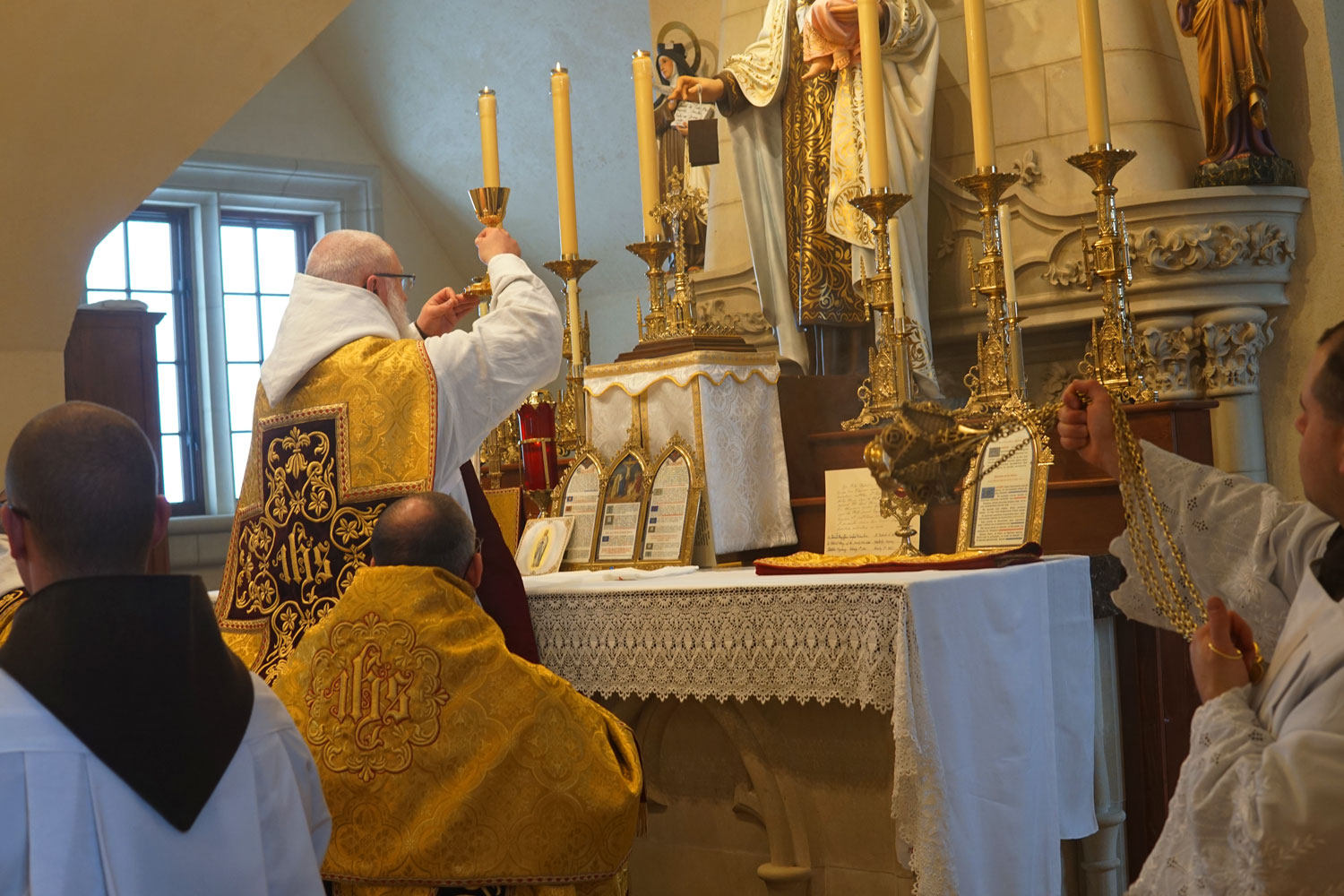
Father Bob Kocour was the man who, shortly before my ordination, gave me his own chalice, which he had had commissioned from a craftsman in Europe before his own ordination.  Usually when I offer Mass here, I use the parish’s chalice.  Today I will offer Mass with Father Kocour’s chalice.  It’s a reminder that all good things in our lives—and especially the most important ones—come both through God’s grace and the sacrifices of others.

Father Hoisington’s First Mass on May 28, 1995. He is elevating the chalice – containing the Precious Blood of Jesus – that Father Robert Kocour (third from the right) gave him.

The Twenty-FIFTH Sunday in Ordinary Time [B]

The Twenty-fifth Sunday in Ordinary Time [B]
Wisdom 2:12,17-20  +  James 3:16—4:3  +  Mark 9:30-37

The Cross is the heart of Jesus’ life.  We heard this in last Sunday’s Gospel passage, when Jesus declared:  “Whoever wishes to come after me must deny himself, take up his cross, and follow me.  For whoever wishes to save his life will lose it, but whoever loses his life for my sake and that of the gospel will save it.”  In today’s passage, Jesus in a similar way declares:  “The Son of Man is to be handed over to men, and they will kill him, and three days after his death the Son of Man will rise.”

Of course, last Sunday’s and today’s Gospel passages are not the only two times that Jesus taught how central the Cross is to His life.  So that raises a question.  Why does Jesus teach this lesson repeatedly?  One answer is that it’s such an important lesson.  Another answer is that His disciples are—to be honest—rather slow.  Jesus is a very patient teacher, willing to try over and over again to get His point across to us sinners.

But Jesus is not only a patient teacher.  He’s also a shrewd teacher.  Like any good teacher, He knows that if you repeat the same lesson over and over in exactly the same way, your odds of getting through to your students is lower.  However, if you teach the same lesson in different ways—from a slightly different perspective each time—more of your students will grasp your lesson.  Today’s Gospel Reading gives us an example of Jesus doing just that.

The first half of today’s Gospel passage is connected to the second half in a unique way.  In the first half, Jesus explains again to His followers about His having to suffer, die, and rise.  But in the second half of the passage, while Jesus seems to change the topic, in fact what He teaches in that second half sheds light on His teaching about the Cross.  Jesus helps us see His point from a new perspective.

“Taking a child, he placed it in the their midst, and putting his arms around it, he said to them, ‘Whoever receives one child such as this in my name, receives me; and whoever receives me, receives not me, but the One who sent me.’”  So how do these words of Jesus put His teaching about the Cross in a new light?

One of the saints of the Church can help us see this connection.  The Church will celebrate her feast day a week from this coming Tuesday, on October 1st.  This saint is one of the most popular saints of the Church, even though her teaching is very demanding.  Her name is St. Thérèse of Lisieux, or more simply, The Little Flower.

St. Thérèse speaks in her writings about bearing one’s cross in life with the faith of a little child.  She shows the connection between the two halves of today’s Gospel passage.

St. Thérèse does this in a very practical manner.  In this way, the Little Flower’s counsel is a lot like the counsel that Saint James offers in his New Testament letter.  The Second Reading at Sunday Mass has been coming from James for four weeks now, and will continue through next Sunday.

At first hearing, you might not imagine that St. Thérèse and St. James have much in common.  But they do.  They’re both, in the language of the Church, “doctors of the soul”.  As “doctors of the soul”, they’re both profoundly practical, just as your physician needs to be.

The difference between these two saintly doctors is that St. James focuses more on diagnosis:  he exposes the spiritual wound and underlying spiritual disease, making them clearly visible.  St. Thérèse, on the other hand, offers a treatment plan.  This plan she calls the Little Way of Spiritual Childhood.  She approaches the Cross, and embraces the Cross, through this Little Way of Spiritual Childhood.

In her autobiography, the Little Flower writes this:  “Our Lord told his apostles that they must be converted and become as little children….  In the natural order… little children show their love… [t]hrough little things.  A little child, just because it is little, is… unable to show its love in any other way.  … [V]ery little children will continually offer little things to their mother—a toy, a picture, a flower—as evidence of their love.  …  [T]he mother, although she has no need of the toy, the picture, or the flower, loves the child to make these offerings, because she wants the love that lies behind them.”[1]

She continues:  “Unless [you, as a Christian,] love Our Lord through ‘the toys, the pictures, [and] the flowers’ of everyday life, [you’ll] never really love him at all.”[2]  In a letter to one of her blood sisters—who was also her sister in the Carmelite Order—the Little Flower wrote, “You know well Céline, that Our Lord does not look so much at the greatness of our actions, or even at their difficulty, as at the love with which we do them.”[3]  Likewise, in her autobiography she plainly wrote:  “To strew flowers is the only means I have of showing my love.  That is to say I will let no little sacrifice escape me, not a look, not a work.  I will make use of the smallest actions and I will do them all for love.”[4] 

So then:  what sorts of occasions made up the Little Flower’s holiness?  They were the same occasions that your life is filled with.  In ordinary human life, these “occasions are provided by the interruptions of others, sometimes unavoidable but sometimes quite unnecessary; [by] the call to sacrifice our own point of view where no principle is involved, for the sake of peace; [by] the failure of the hopes we had placed in others; [by others’] lack of gratitude and lack of response [to our best efforts]; ….  From [occasions like] these there is no escape; we have to accept them in one way or another, and more often than not[,] we do so in the wrong way.”[5]  

The life of the Little Flower illustrates the right way.  St. Thérèse “shows us that these occasions of sacrifice [are not] something to be avoided, [but instead] are providentially arranged by Our Lord and… proportioned by Him to our” abilities.[6]  God calls us through these difficulties, not in spite of them.

———————————————————–——-

[1] St. Thérèse of Lisieux, Autobiography, quoted in Spiritual Childhood: The Spirituality of St. Thérèse of Lisieux, by Vernon Johnson (San Francisco, Ignatius Press, 2001), pages 127-128.

[2] Johnson, 128.

[3] Autobiography, quoted in Johnson, 128.

[4] Autobiography, quoted in Johnson, 130.

[5] Ibid.

[6] Ibid.

The Twenty-fourth Sunday in Ordinary Time [B]

The Twenty-fourth Sunday in Ordinary Time [B]
Isaiah 50:5-9  +  James 2:14-18  +  Mark 8:27-35

There are two types of death.  One is much worse than the other.  Lots of folks work hard to avoid the one type of death, but not the other, which is strange.  It’s strange because the death they work to avoid is actually unavoidable.  Yet the death they don’t worry about is completely avoidable.

The first death is the death of our body.  This is the death that God Himself suffered in the person of Jesus Christ on Good Friday.  This death is unavoidable.  You cannot run from it.  Inevitably, your body will die.  Just look at a crucifix:  there is your proof.  Even God died in the flesh.

This is the death of which Isaiah prophesies in today’s First Reading.  It’s not a coincidence that today’s First Reading is also proclaimed at Mass on Palm Sunday, in connection with the Passion narrative.  Isaiah’s prophecy in the First Reading clearly foreshadows the Passion and Death of Jesus Christ.

To reflect more deeply upon this, we ought to remember that Jesus had a faithful Jewish upbringing.  It’s likely that as the Blessed Virgin Mary and St. Joseph brought Jesus up, the child Jesus memorized large parts of the Scriptures.  Many years later, during the years of His public ministry, it’s likely that Jesus, while walking the dusty roads of Judea, Samaria and Galilee, meditated on the words of Isaiah that we heard a few minutes ago.  Jesus could see that these words referred to His own experiences of rejection:  for example, when He was expelled from the synagogue in His hometown, and when He was rebuked by the Scribes and the Pharisees.

Finally, as Jesus spent those three hours on the Cross at the top of Calvary, the words of Isaiah undoubtedly ran through His mind:  “The Lord God opens my ear that I may hear;  /  and I have not rebelled,  /  have not turned back.”  Jesus on Good Friday is completely faithful to the will of God the Father.

By contrast, Peter in today’s Gospel Reading is clearly not faithful to the will of God.  Peter’s lack of fidelity stems from his confusion about the two different types of death.

In turn, you need to ask if you will be faithful to the will of God.  In today’s Gospel Reading Jesus makes a demand of you:  “Whoever wishes to come after me must deny himself, take up his cross, and follow me.”  Do you, who call yourself a Christian, hear what Christ is saying to you?  Or are you like Peter?  Are you tempted to turn your back on the words spoken by Jesus?

Along the way to Caesarea Philippi, Jesus asks those following Him exactly who it is that they think they’re following.  Peter responds, “You are the Christ.”  Here’s where Peter’s trouble begins.

Peter has spoken the right words, but for the wrong reason.  It’s true that this Christ—this Anointed One—has come down from Heaven to save God’s People from certain death.  But Peter does not understand which death Christ has come to save us from.

Jesus begins teaching His disciples that the Son of Man must suffer greatly, be rejected, be killed, and rise after three days.  “He spoke this openly.”  But the ears of Peter are not open.  Peter turns his back on these words of Christ, and actually begins to rebuke the Son of God.  Peter cannot believe that the Christ must suffer greatly and die.  Peter cannot believe that any good can come out of human death.  Peter cannot believe that out of human death can come a share in the life of God.

Are you like Peter?  What do you make of death?  Do you believe that Christ suffered for us, but not with us?  If you’re older, you might remember the commercial for a product called Dow Scrubbing Bubbles.  The tag line was, “We work hard so you don’t have to.”  Is this how we think the Christian Faith works?  If Jesus came to earth today and made a commercial to advertise His Gospel, would he say, “I suffered greatly and died so you don’t have to”?

On the Cross, Christ destroyed the power of death by dying Himself.  When He died, death split in two.  Christ separated the death of the body from the death of the soul, so that the soul’s death would not inevitably follow the body’s death.  Christ didn’t die so that you wouldn’t have to.  Christ died so that the death that you will inevitably face—the death of the body—would not be the last word.

When you were baptized, and God the Father adopted you as His own child, you took on Christ’s life as your own, which also means taking on His death.  This is true because the meaning of Christ’s life—the mission of Christ’s life on this earth—was to destroy death.  So if you wish to share in Christ’s life, you must accept His mission—His death—as your own.  In other words, you must not rebel against the words that Christ speaks today:  “Whoever wishes to come after me must deny himself, take up his cross, and follow me.  For whoever wishes to save his life will lose it, but whoever loses his life for my sake and that of the gospel will save it.”

+     +     +

There are two types of death:  the death of the body, and the death of the soul.  The death of the body is unavoidable, while the death of the soul is completely avoidable.  The death of the body, which many people try so hard to avoid, is in fact the door that Christ has opened to eternal life.  Yet the death that people don’t worry much about is a death that lasts forever.

There is an old saying:  “If you are not struggling in your spiritual life, then one of two things is true:  either you are dead, or your soul is.”  We need to make sure that we’re working to avoid the death that is eternal, and to follow the Person whose death is the path to eternal life.

The Twentieth Sunday in Ordinary Time [B]

The Twentieth Sunday in Ordinary Time [B]
Proverbs 9:1-6  +  Ephesians 5:15-20  +  John 6:51-58

Praying each set of mysteries of the Rosary is like climbing a mountain.

The five mysteries of each set—whether you’re talking about the Joyful, Luminous, Sorrowful, or Glorious Mysteries—are not five random, unconnected mysteries.  The five mysteries of each set tell a single story, and they climb to a peak, which is reached in the fifth mystery.  In each set, the fifth mystery is set on a mountaintop.

For example, the fifth Sorrowful Mystery is literally and geographically set on a mountaintop.  The Fifth Sorrowful Mystery of the Crucifixion is set upon Mount Calvary.  Of course, it’s true that this mount is not on the scale of the Rockies or the Alps, but only 2,500 feet above sea level, less than half the altitude of Denver.

However, it wasn’t the physical climb of Mount Calvary, but the spiritual climb that was so steep for Jesus.  That ascent was not only the act of walking up the mount, but was also in the raising of His life to God the Father during the three hours that He was nailed to the Cross.  The ascent of Mount Calvary is steep because Jesus was steeped in the sins of every human person throughout history—past, present, and future—from Adam and Eve in the beginning to the last sinner to trespass against God before the Second Coming at the end of human history.  Atop Mount Calvary on Good Friday, the God-man Jesus Christ reconciled God and man by offering up His life in sacrifice, to God the Father, for the sake of fallen man.

In a similar way, the Fifth Joyful Mystery is also set on a mountain.  The fifth Joyful Mystery is the Finding of the Child Jesus in the Temple.  The Temple Mount, built upon what in the Book of Genesis is called Mount Moriah, was and is the holiest site in Judaism, because the Jewish Temple was built upon this mount.  It was within the Jewish Temple—more specifically, within the Temple’s Holy of Holies—that God descended to earth and manifested His divine Presence.  It was there that the Word made made Flesh—a mere boy of twelve—said to Mary and Joseph, “Did you not know that I had to be in my Father’s House?”

In a similar way, the Fifth Luminous Mystery is set on a mountain:  not geographically, but spiritually.  The Fifth Luminous Mystery is Jesus instituting the Eucharist at His Last Supper.  The Catechism of the Catholic Church, quoting one of the documents of the Second Vatican Council, declares that the Eucharist is “the source and summit of the Christian life” [CCC 1324, quoting Lumen Gentium 11].  This summit—this mountaintop—is the peak of the Christian life here on earth.  Nowhere on earth is Christ more powerfully present than in Jesus’ complete gift of Self, which He gave us as a sacrament on the night before He offered Himself on the Cross.  At the Last Supper, Jesus instituted the Sacrament of the Eucharist.

+     +     +

This is the gift of Self that Jesus preaches about in today’s Gospel passage.  Jesus, in this sixth chapter of John’s Gospel, has been speaking about bread for some time.  But His intentions are constantly misunderstood.

The first confusion that Jesus has to clear up is the belief that Jesus is present in the crowd’s midst in order to fill their stomachs.  Of course, it’s true that Jesus did perform a miracle of feeding five thousand men with just five loaves.  But that miracle was a sign, pointing to something even greater.

The first words that He speaks in today’s Gospel passage are:  “I am the living bread”.  Now if Jesus had just stopped there, John 6 would have ended just fine (spoiler alert:  the end of John 6, as we’ll hear next Sunday, does not end just fine).  In any case, these first words that Jesus speaks in today’s Gospel passage are innocent enough:  “I am the living bread”.  That could mean just about anything you might want it to mean.  Many Christians can accept those words as referring to Jesus’ teaching, or more generally, to the Word of God.  But is that what Jesus is chiefly directing our attention towards in His Sermon on the Bread of Life?  Jesus’ declaration that He is “the living bread” are a sign, pointing to something even greater.

Jesus declares to the crowd:  “the bread that I will give is my flesh for the life of the world.”  This astounds the crowd.  But it hardly astounds Christians in our day and age, because to us it’s a clear foreshadowing of Good Friday.  It seems obvious that Jesus is foretelling His sacrificial death on the Cross when He declares, “the bread that I will give is my flesh for the life of the world.”  All Christians can accept these words in that way.  But Jesus does not stop there.  These words point us further, into an even deeper belief in Christ Jesus.  The chief meaning of His Sermon on the Bread of Life is still to come.  He has something more to give us.  Jesus through His preaching of this sermon is ascending a mountain, and He has to continue climbing, and continue to invite us to follow Him to the sermon’s peak.

When Jesus declares, “the bread that I will give is my flesh for the life of the world”, His words are a sign that point to a sacrament:  the Sacrament of the Eucharist; the Sacrament of the Real Presence of Christ Jesus, which comes into our midst through the Holy Sacrifice of the Mass.  Jesus speaks of this Most Blessed Sacrament when He preaches these words to you:

“unless you eat the flesh of the Son of Man and drink his blood, you do not have life within you.  Whoever eats my flesh and drinks my blood has eternal life, and I will raise him on the last day.  For my flesh is true food, and my blood is true drink.  Whoever eats my flesh and drinks my blood remains in me and I in him.”

Here at the mountaintop of His Sermon on the Bread of Life, Jesus is not speaking about bread that fills the stomach.  He’s not speaking about the bread that’s preached through the Word of God.  He’s not even speaking chiefly about the historical event of His impending Crucifixion, because the Crucifixion in an historical event, far back in the historical past.  He’s speaking about the Sacrament of the Eucharist, which makes His believers present at His Crucifixion, even if they live 2,000 years after the historical event that took place on Good Friday. This Sacrament makes us not just witnesses to the event of His Crucifixion, but invites us to partake of the Crucifixion by worthily eating the Flesh and drinking the Blood of the Word made Flesh.

The mountaintop of the Sermon on the Bread of Life is in invitation from Jesus to His disciples to believe in His Real Presence in the Eucharist, and to worthily partake in this Sacrifice.  Next Sunday we will hear about the disappointing fallout that occurred 2,000 years ago when Jesus first preached this sermon.  Today, you and I have to decide whether to accept Jesus at His Word, and accept the Gift of His very Self in the Eucharist as His means of our abiding in Him, and living our lives with His very strength inside us.

The Eighteenth Sunday in Ordinary Time [B]

The Eighteenth Sunday in Ordinary Time [B]
Exodus 16:2-4,12-15  +  Ephesians 4:17,20-24  +  John 6:24-35

“I am the Bread of Life; whoever comes to me will never hunger, and whoever believes in me will never thirst.”

Today is the second of five Sundays when we hear from the sixth chapter of Saint John’s account of the Gospel.  In this chapter, St. John the Evangelist records both the miracles and the teaching of Jesus that point towards the Eucharist.  Last Sunday we heard Jesus miraculously multiple five loaves of bread, and as a consequence of this sign, the crowd wanted to carry Jesus off to make Him their King.  In spite of their desire, last week’s Gospel passage ended when Jesus, surely frustrated by the crowd misunderstanding His miracle, fled to a mountain alone.

Before we reflect on this Sunday’s passage, stop and consider Jesus’ flight to the mountain.  Please consider that Jesus might at times act towards you as He acted towards that crowd.  Consider that Jesus might flee from you for the same reason that He fled that crowd.  If we don’t take this personally, we won’t appreciate fully the rest of John 6.

First of all, we ought to recognize that everything that Jesus did and does is loving.  Even when Jesus spoke strictly to others, it was with love in His heart for the one to whom He spoke, and with a desire for that person to turn over his or her life fully to God.  Likewise, when Jesus at the end of last Sunday’s passage fled the crowd for the mountain, it was a loving action.  But, we might wonder, how could leaving someone be a loving act?  Consider just two reasons from the spiritual and moral life.

In the spiritual life, one of the causes of what sometimes is called “spiritual dryness” or “spiritual desolation” is that God wants your desire for Him to grow.  The old saying “Absence makes the heart grow fonder” applies to the spiritual life.  At times, God will absent Himself from the Christian’s soul to make her longing for Him grow stronger.  This type of God leaving us in no way implies that there’s anything wrong with the state of our soul.

However, the other type of God leaving us does implies that we’ve done something wrong.  I’m not talking here about someone committing mortal sin, in which case all grace in the soul is gone.  Instead, I’m talking about God choosing to leave the Christian’s soul because of what that Christian wants from God:  that is, because of the Christian’s desires.

This is why Jesus fled for the mountain alone at the end of last Sunday’s passage.  In this Sunday’s passage, Jesus speaks to this point also.  God wants us to want Him for the best possible reason, not just to fill our stomachs, or heal our illnesses.  As each of us grows in the Christian life, we have to allow God to purify our motives and desires.  We have to ask God to help us to love Him only for His sake, and not for our own sake.  Only the disciple with a pure heart shall see God, and only the disciple with a more pure heart shall have God abide within his soul.

So with that as a backdrop, consider what we heard today from John 6.

When the crowd saw that neither Jesus nor His disciples were at the place where Jesus had eaten the bread, they went looking for Him.  We see this crowd hungering for something.  In last Sunday’s Gospel passage, the crowd hungered for bread.  This Sunday, we see the crowd hungering for Jesus.  They want to learn from Jesus how never to hunger again.

In this passage, we hear the crowd speak to Jesus four times.  The first three times they ask questions; the fourth time they make a request.  The first question they ask is, Rabbi (meaning, “Teacher”), when did you come here?  The crowd is confused about the origin of Jesus, but Jesus confronts them with the fact that they are only concerning themselves about their physical hunger.  He tells them, as He tells each of us, You should not be working for perishable food, but for food that remains unto life eternal, food which the Son of Man will give you.  Jesus shifts attention from the physical hunger He satisfied through the miracle He offered to them shortly before, to the spiritual hunger He will meet through the Sacrifice of His Body and Blood which He will offer to them some time later.

Well, this seems all right to the crowd.  They want in on the deal, so they ask Jesus their second question:  What must we do to perform the works of God?  Jesus’ response is brief and to the point.  This is the work of God:  have faith in the One He sent.  In other words, they do not themselves have the means to satisfy this spiritual hunger:  there is no spiritual refrigerator, supermarket, or field for them to go to.  Their spiritual hunger is not only for something to fill the emptiness inside their souls, but also for something to fill the emptiness around them.  For there is nothing around them capable of sustaining them eternally.

But the response of the crowd at this point is to demand a sign from Jesus, so that they’ll know He is worthy of their faith.  They’re looking for a sign like the one their ancestors received in the desert during the Exodus, when bread rained down from Heaven.  Jesus explains, however, that while this sort of physical bread can sustain one during one’s days in this world, it only has meaning in this world.  The daily bread Jesus offers from God the Father, a spiritual bread, is the food that is capable of making the Exodus from earth to Heaven.

In any case, we have during these five weeks the words and deeds of Jesus recorded in the sixth chapter of Saint John’s Gospel account, and I encourage you to spend time in meditation on what Jesus wants us to want most during our earthly days.  The Most Blessed Sacrament of the Eucharist fulfills the deepest need we have.  If, like the crowd in the Gospel, we continue to have a hard time believing that truth, Jesus will nonetheless continue to invite us here.  He will continue to teach us throughout our earthly days that our lives find real meaning only through His life.  He’s continue to teach us that all the earthly things that we think are important, and for which we hunger, are important only inasmuch as they lead us to love God and others more deeply.

The Seventeenth Sunday in Ordinary Time [Year B]

The Seventeenth Sunday in Ordinary Time [B]
II Kings 4:42-44  +  Ephesians 4:1-6  +  John 6:1-15

Some years back, three brother priests and I set out east along the highways and interstates of America to attend a conference in Louisville, Kentucky.  The round trip was more than 1500 miles, so the four of us prayed the Rosary often during the trip, and for several different reasons.

One reason for praying the Rosary was disagreements about directions.  I’m sure you’ve heard the old joke:  “Why did it take Moses and Joshua forty years to lead the Israelites through the desert?  Because men hate to ask for directions.”  That was true on our trip to Louisville.  Each of us read the signs of the road differently.

However, there was an additional problem.  Each of the other three priests had an electronic device which could look up directions.  Now, you would think that this abundance of technology would mean fewer disagreements about reading the signs of the road.  You would be wrong.

With each brand of technology—three different high-tech devices, and one Rand McNally Road Atlas—came a slightly different set of directions.  Each piece of technology read the signs of the road in its own way.  We had one driver and four navigators, which was three navigators too many.  When all these directions became too much for the driver, he would usually suggest that we pray the Rosary… again.

+     +     +

Signs are important in today’s Gospel passage.  Signs appear at the beginning and at the end of this Gospel passage.  But before looking closely at today’s Gospel passage, consider signs in general.

Of course, there are many different types of signs.  There are television ads, traffic signs, interstate markers along the side of the road, and billboards farther back from the road; there are signs of weather in the sky, and written signs on a page.

However, regardless of what type of sign you’re talking about, if a sign is going to be effective, it has to accomplish two goals.  A sign has to first catch your attention by diverting it away from whatever currently holds your attention.  The advertising industry spends billions of dollars each year in order to succeed at this.  Advertisements use color, bright light, cute children and animals, and also appeal to man’s baser instincts:  all in order to turn your attention away from what you’re focusing on.  A sign needs to captivate you.

For example, a stop sign uses the bold color of red in order to catch your attention, in order to focus your attention on your legal requirement to stop.  This requirement is very serious—it can easily be a matter of life or death—so the stop sign is as bold as a road sign can be.  Other road signs—for example, along the side of a highway that have less important messages—might be green, blue, or brown.  The signs are not as bright as a stop sign, because if you miss the green, blue or brown sign, you may be inconvenienced—you may, for example, have to take a 45-minute detour—but it’s not likely to be a life or death matter (unless someone strangles you in frustration) .

The second goal of a sign is to fix your attention on the object of the sign:  the goal.  The sign is not a sign for its own sake.  A sign points your attention beyond itself to something more important.  That’s where today’s Gospel passage poses a challenge.

+     +     +

Consider the signs of Jesus mentioned in the Gospel passage.  Signs are mentioned twice:  once at the beginning of this passage, and the second time at the end.  At the beginning of the passage, Saint John the Evangelist explains to us that “a large crowd followed [Jesus] because they saw the signs he was performing on the sick.”  Then at the end of the passage, St. John explains how after “the people saw the sign He had done” just then—that is, multiplying the loaves and fish—“Jesus knew that they were going to come and carry him off to make him king, [and so] he withdrew again to the mountain alone.”

That’s a very sad statement:  Jesus “withdrew again to the mountain alone.”  Again.  Apparently this had happened before, and likely would also happen again later.  The problem, of course, was not Jesus, the one performing the signs.  The problem was in the crowds who saw His signs, but mistook their message.  Yet it’s not the crowds, but Jesus who chooses to withdraw, again and again, to the mountains alone.

Now, your average person, if he knew that a crowd were wanting to make him a king, would definitely not retreat into solitude.  We see this in the culture of the Internet, where on blogs or YouTube an individual can very quickly become a celebrity with thousands, or even millions, of followers, regardless of whether what he does is very noble or praiseworthy.  Sometimes, the baser the content, the more followers a content provider gains.

For His part, Jesus did not want to be a celebrity.  Jesus wanted crowds to follow Him, but only for the right reason.  At the end of today’s Gospel passage, after the Multiplication of the Loaves, the people proclaim Jesus to be “‘the Prophet, the one who is to come into the world.’”  “They were going to… carry Him off to make Him king.”  In these two sentences, we can see the problem with the way the people were looking at Jesus.  They were looking at Jesus for the sake of His signs, instead of looking at His signs for the sake of seeing Jesus.  Or in other words, Jesus to them is significant because of the way that He changes this world.  That’s why they call Him “the Prophet, the one who is to come into the world.”  That’s why they were going to carry Him off to make Him king:  because of the way that they thought that Jesus would change their world for the better.

They think Jesus is in this world to rid it of hunger by His miracles.  They don’t understand what the miracle of feeding 5000 is pointing to.  Like the sign of Jesus’ healing the sick, the miracle of feeding 5000 is meant to be a road sign, not the end of the road.  All of Jesus’ signs beg an important question.  What was the object of Jesus’ life on earth?  What were all of Jesus’ miracles advertising?

Every one of Jesus’ signs points to Jesus Himself.  Maybe that sounds too simple to be true, but it is.  Each of Jesus’ signs points to Himself.  He does this in order to reveal to others who He is, not simply so that people might be healed or miraculously fed, but instead so that they might follow Jesus, and abide with Jesus, and that Jesus might abide with them, and within them.

This is significant because this Sunday is the first of five Sundays during which most of the sixth chapter of St. John’s Gospel will be proclaimed.  This chapter of John 6, as you know, is where Jesus proclaims His teaching about the Most Blessed of the seven Sacraments:  that is, the Eucharist, where the Real Presence of Jesus Christ comes into our midst through the Holy Sacrifice of the Mass.  The Eucharist is not a mere sign, but a sacrament, which makes the end of the road present in our midst during our travels down the road of life. 

Practically speaking, I encourage you over the next several weeks to take your bible and read John 6.  Read the whole chapter at one sitting, so that you see what the Sunday Gospel passages are presenting to us in five separate passages.  See the signs that Jesus presents, and see what the signs are pointing to.  If you’re especially ambitious, also read John 13-17, because these chapters are set at the Last Supper.  In these chapters, Jesus speaks to the Apostles, to whom He is giving at the Last Supper the power to celebrate this Sacrament, and to ordain other men that they might do the same, so that Jesus Christ—really, truly, and sacramentally—will abide within the members of His Mystical Body, the Church.