Tuesday of the Eighteenth Week in Ordinary Time [Year A]

Tuesday of the Eighteenth Week in Ordinary Time [Year A]
Matthew 15:1-2,10-14

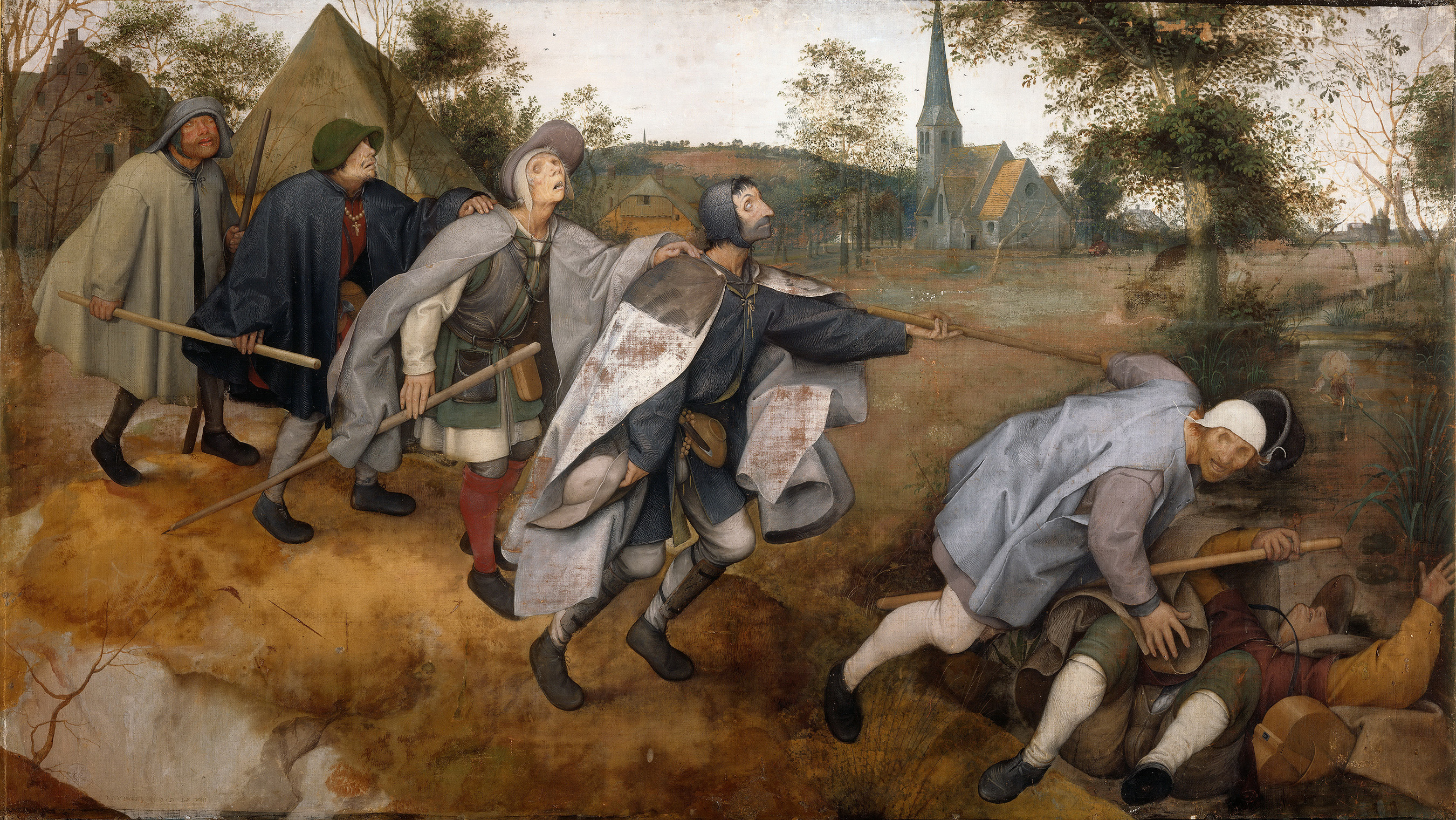
“If a blind man leads a blind man, both will fall into a pit.”

Jesus’ words in today’s Gospel passage might seem harsh. We might say that He’s calling a spade a spade. He describes the Pharisees as “blind guides of the blind”. Regarding precepts that the Pharisees had commanded, Jesus states: “Every plant that my heavenly Father has not planted will be uprooted.”

Jesus is making a distinction here between commands that are divine in origin and those that are human in origin. A slightly different distinction that might be made is between commands that are of permanent duration and those that are temporary because they are circumstantial.

We’re familiar with such distinctions in the world around us. For example, the command against murder is objective in nature and may not be transgressed by any person or “repealed” by any court of legislature. However, a traffic sign stating that the speed limit on a ten-block stretch of road is 35 mph may be changed by a local authority if a good reason arises.

Although Jesus speaks harshly about the Pharisees, we cannot assume that originally there may not have been good reasons for the commands that the Pharisees taught. However, Jesus’ words make it apparent that the commands no longer had purpose and ought not to be followed.

Within the life of Jesus’ Church, there is a similar principle at work. Jesus speaks to this principle when He says to St. Peter, “I will give you the keys of the kingdom of heaven, and whatever you bind on earth shall be bound in heaven, and whatever you loose on earth shall be loosed in heaven” (this passage will be proclaimed at Mass this Thursday).  Jesus is not speaking here about rules concerning such things as murder or the nature of marriage. But He is giving Peter – and his successors – wide latitude in making changes for the sake of a Church whose mission already has spanned twenty centuries and every continent of the earth. Yet regarding rules that may be changed, the Holy Spirit’s guidance is needed to ask whether rules ought to be changed, or in other words whether they continue to guide Jesus’ disciples along His Way.
The Nineteenth Sunday in Ordinary Time [C]

The Nineteenth Sunday in Ordinary Time [C]
Wisdom 18:6-9  +  Hebrews 11:1-2,8-19  +  Luke 12:32-48
Catechism Link: CCC 359

“Much will be required of the person entrusted with much ….”

When Jesus says these words about us, two questions immediately arise.  First, what has Jesus entrusted us with?  Second, what therefore will be required of us?

Each of us, naturally, has been given the gift of life.  You’ve probably seen the bumper sticker that says, “Smile:  your mom chose life!”  In our day and age, this is not a gift that we ought to take for granted.  Still, when we thank God each day for the gift of life, what exactly are we giving thanks for?

Human nature has two parts to it:  body and soul.  Like the simpler types of animals, we have bodies that are subject on the one hand to hunger and physical pain, and on the other hand to the pleasures of good meals and the process of physical healing.

However, unlike the lower animals, we humans can find meaning even in bodily suffering and pain.  Yet we can discover this meaning only through our souls.  The human soul is the means through which we can, if we choose, rise above being merely an animal.  “Much will be required of the person entrusted with much ….”  God has entrusted each of us with a human soul, and that’s not a gift to be underestimated.

“In the beginning”, “God said, ‘Let us make man in our image, after our likeness ….’”  In those words, we hear how much God has entrusted us with in giving each of us a human soul.  The human soul is given to a person at the moment of his or her conception:  that moment when the human body starts to exist from the gifts given by the father and the mother.  But while the human body comes from a child’s parents, the human soul comes directly from God at that moment of conception.  So what about that soul:  what kind of gift is it that God gave each of us at the moment of conception?

If there’s a single word that sums up the power, the meaning, and the aim of the human soul, it’s the word “transcendence”.  The human soul allows man to transcend himself.  There’s nothing more boring, numbing, and deadly than to live for oneself.  Unfortunately, the message of the world around us is to do just that:  to live for oneself.  But Christ calls us to live for others.  The powers of the human soul, when animated by God’s grace, allow us to live for others and to rejoice in doing so.  In doing so, we imitate the self-sacrificial love of the three Persons of the Trinity for each other.

Here, then, is what God requires of us:  to transcend ourselves by living for others, both the others who are our neighbors, and the Other who is God.  Living for others means loving those others.  This is a high bar, of course, that God has set for us.  Everything that’s sinful in us inclines us to live for ourselves, because living for ourselves is so much more comfortable.  But God did not make us for comfort.  If you doubt that, look at the crucifix.  As a saint once said, “The crucifix is the true answer to every heresy.”

The fathers of the Church at the Second Vatican Council declared that “it is only in the mystery of the Word made flesh that the mystery of man truly becomes clear” [Gaudium et Spes 22].  This divine Word became flesh and blood so that He might offer His self—His divinity and humanity—upon the Cross.

You see this when you gaze upon the crucifix.  If you want to know what it means to be human; if you want to know what man is meant for; if you want to know the antidote to human misery, selfishness, and frustration with the meaningless of living the good life of comfort:  look at the crucifix.

The soul is a vessel of grace.  Grace is the power of God’s life that makes us strong enough to clear that very high bar that God has set for us:  the bar of living for others instead of for ourselves.  “Much will be required of the person entrusted with much ….”  God has entrusted each of us with soul and body in order to offer them up each day for others.  The crucifix shows us how.  The Eucharist gives us the strength to do so.

Catechism Link

A new feature now appears in the header of Father Hoisington’s Sunday reflections.  In the line under the Scripture citation is a reference to a passage from the Catechism of the Catholic Church.  This passage relates to one of the themes discussed in the reflection.  Many of these Catechism Links will come from the Vatican’s 2014 Homiletic Directory, which builds upon Pope Benedict XVI’s Apostolic Exhortation Verbum Domini.  Clicking on the hyperlink will take you to that section of the Catechism.

Tuesday of the Eighteenth Week in Ordinary Time [Years B & C] *

Tuesday of the Eighteenth Week in Ordinary Time [Years B & C]
Monday of the Eighteenth Week in Ordinary Time [Year A]
Matthew 14:22-36

Please note:  In year A, when the Gospel Reading for the 18th Sunday in Ordinary Time is Matthew 14:13-21, the Gospel Readings for Monday and Tuesday of the week are different than in the Years B & C.

+     +     +

Those who were in the boat did Him homage, saying, “Truly, you are the Son of God.”

The Church’s treasury of Scripture interpretation is based upon a four-fold view of the Holy Bible.  The first view of the Bible looks at the literal meaning of a Scripture passage. In the case of today’s Gospel passage, for example, the literal meaning of the passage is an historical event involving Jesus interacting with His disciples, and miraculously walking on water.  One could make a long and spiritually fruitful meditation focusing only upon the literal meaning of this passage.

However, the other three views of Scripture consider different “spiritual senses” of a given passage.  That doesn’t mean, of course, that the literal meaning doesn’t deal with spiritual matters.  But the three spiritual senses of Scripture relate the literal meaning to a broader meaning that the passage doesn’t directly touch upon.

For example, at the end of today’s Gospel passage, those who were in the boat did Jesus homage, saying, “Truly, you are the Son of God.”  Above and beyond the literal meaning of this action, one can “see” the boatful of disciples confessing the divinity of Jesus as symbolizing the Church Militant (that is, the Church on earth).  Around this basic symbol are several complementary symbols:  for example, the water on which the boat rests, as well as the weather surrounding the boat, as the turbulent world in which the Church Militant lives.  Then again, the action of confessing faith in Christ is a symbol of the Church’s Sacred Liturgy, which receives Jesus into the Church’s “boat” in the sense of the faithful receiving during the Sacred Liturgy God’s Word and His Word made Flesh.

It is easier to ponder the literal sense of Scripture than the three spiritual senses.  But with the guidance of the Church’s saints and magisterium, the spiritual senses invite us into great theological riches, and a more profound encounter with the Word of God made Flesh.

St. Alphonsus Liguori, Bishop & Doctor of the Church

St. Alphonsus Liguori, Bishop & Doctor of the Church
Jeremiah 28:1-17  +  Matthew 14:13-21
August 1, 2022

“… his heart was moved with pity for them ….”

Being compassionate, Jesus was certainly concerned with the physical well-being of the people who had come to hear him preach.  Just how deep Christ’s compassion was is made obvious when we consider again something the first verse of this passage tells us:  Jesus is told about the hunger of the crowds right after he had heard of the death of John the Baptist, and had withdrawn by boat to a deserted place by himself.  If we were to take time to imagine this, we could very clearly see just how human Christ was, responding in grief and perhaps anger at the death of his own cousin.  He withdrew from others to be by himself.  And yet, even at this point in his life, the needs of others pressed upon him.  His response was that of God himself:  he turned to help those in need.

Jesus was certainly concerned with the physical well-being of the people who had come to hear him preach.  But he knew the people in the crowds better than they knew themselves.  Christ had a much deeper concern for their spiritual well-being.  He had reminded them that their ancestors, whom God had fed in the desert by sending bread in the form of manna, had died.  His divine Father, Jesus told them, had sent him to be their spiritual bread which would allow them to live for ever.  If they would eat this bread by accepting him and following his commandments they could enter into God’s eternal kingdom of love.

Saturday of the Seventeenth Week in Ordinary Time

Saturday of the Seventeenth Week in Ordinary Time
Matthew 14:1-12

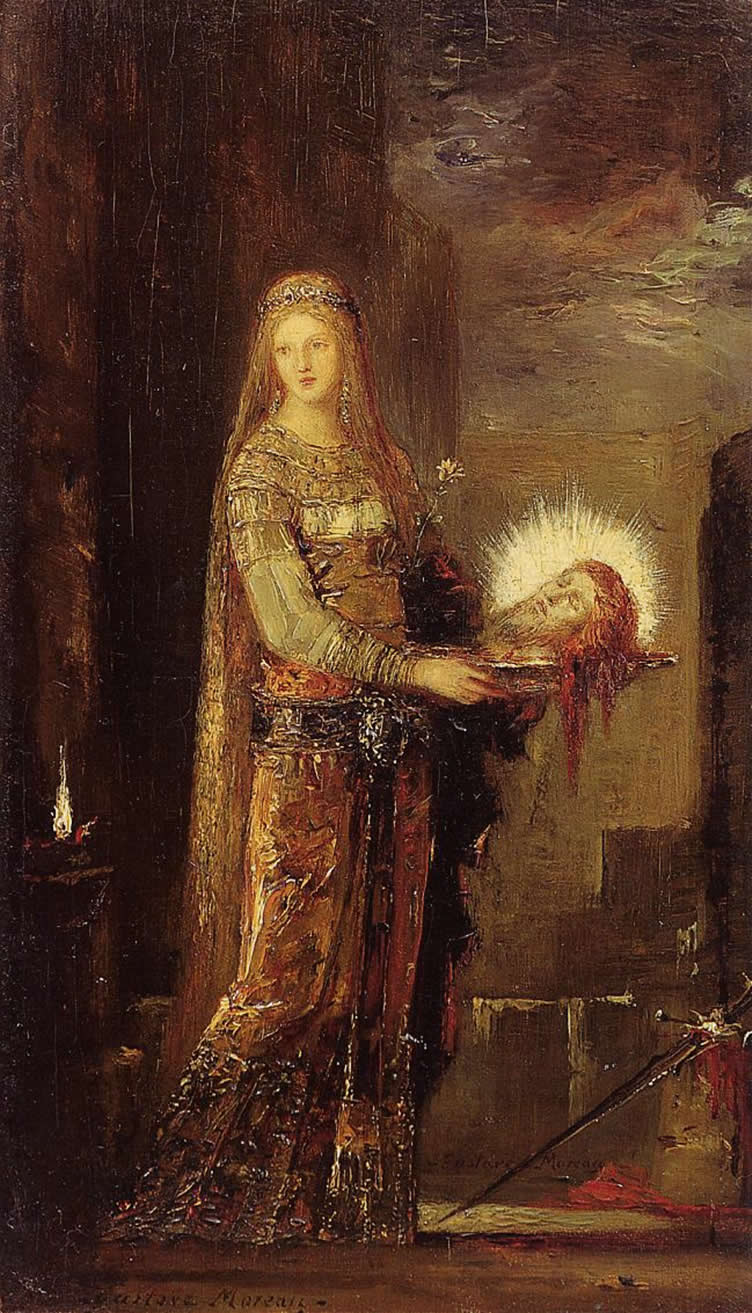
His head was brought in on a platter and given to the girl, who took it to her mother.

On August 29 the Church celebrates the Passion of St. John the Baptist, and on that memorial we hear his passion narrative according to Saint Mark.  Today’s Gospel Reading offers us this narrative according to St. Matthew the Evangelist.

Jesus does not appear in today’s Gospel passage.  His name is mentioned twice.  Focus on the latter instance, where His name is in fact the last word of the passage.  This is fitting.  In terms of the life and Passion of St. John the Baptist, Jesus is the last word.

John is often considered the last of the Old Testament prophets.  Like many prophets, he was killed because of his witness to God’s Word.  The uniqueness of John’s life and martyrdom lay in how they intertwined with those of the Word made Flesh.

You and I, as Christian disciples, have been baptized into the role of prophet.  It is part of our baptismal commitment to profess the truth of the Gospel no matter what the cost to us.  At times we profess this Truth through our actions; at other times, through our words.  How often do we count the cost first before deciding whether to profess the Truth?  It’s certainly necessary to exercise the virtue of prudence is proclaiming the Truth.  But we ought to ask St. John’s the Baptist’s intercession if we’re ever tempted by fear to refrain from professing the Truth.

Sts. Martha, Mary & Lazarus

Sts. Martha, Mary & Lazarus
John 11:19-27 [or Luke 10:38-42]

Click HERE for the propers for today’s feast.

“Martha, Martha, you are anxious and worried about many things.”

On this revised feast of Saints Martha, Mary, and Lazarus, the Gospel Reading must come from the feast day.  The other readings may come from the day in Ordinary Time.  However, there are two options for the Gospel Reading on this feast.

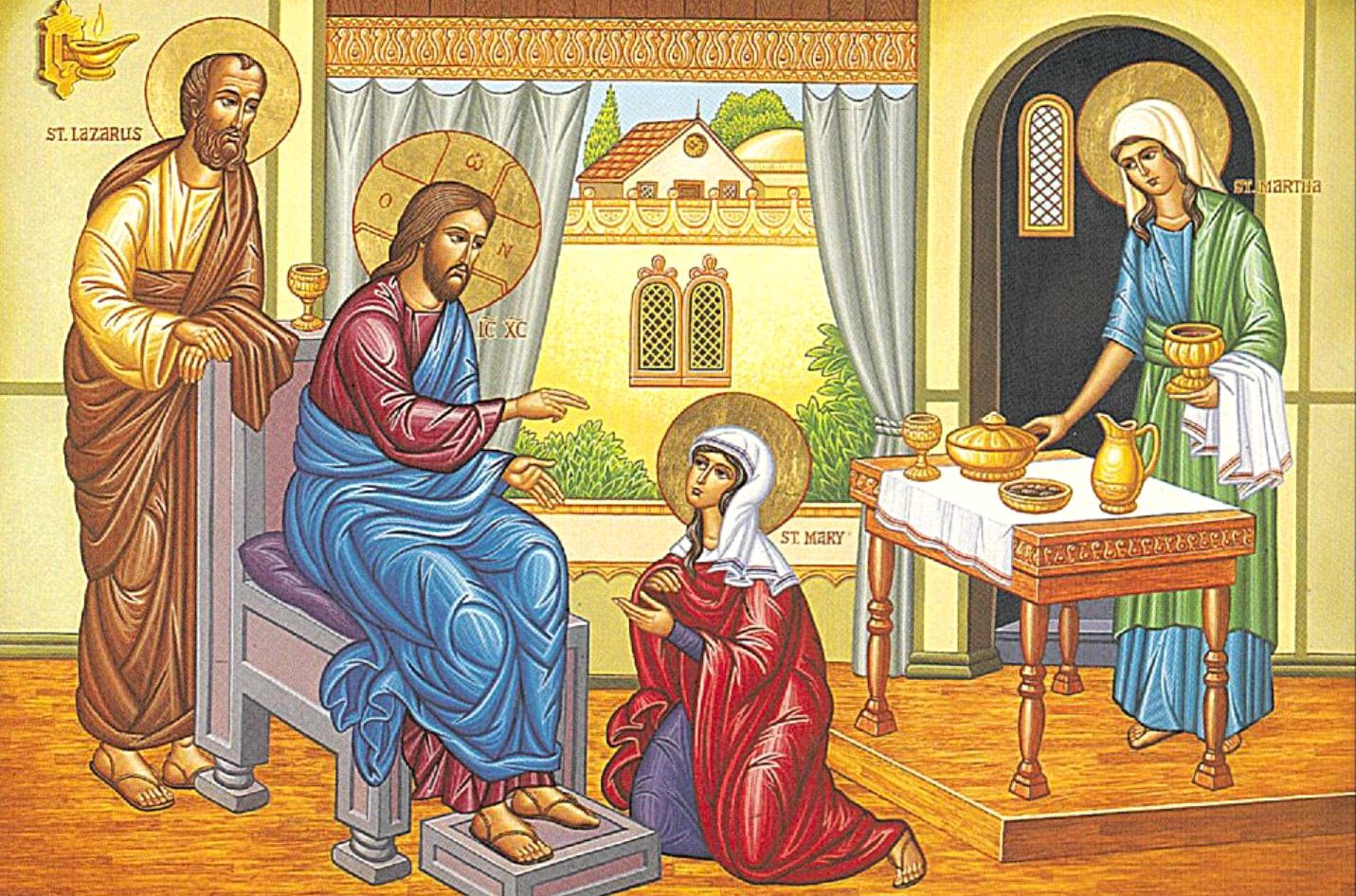
The first option offers a bit more flattering portrait of Martha.  The occasion is the death of Lazarus, the brother of Martha and Mary.  Martha goes out to meet Jesus, while Mary sits at home, which is an interesting contrast to the sisters’ respective roles in the other Gospel Reading for the feast.  Martha’s words to Jesus express not only her love for her deceased brother, but also for Jesus, as well as faith in Jesus.  Yet Martha is missing something.  When Jesus declares to Martha, “Your brother will rise”, she does not understand fully what Jesus means.  Jesus is promising that her brother will return to her, not on “the last day”, but on that very day when Jesus and Martha are speaking.  It’s to Martha’s credit that when Jesus makes more clear His intention, Martha makes clear her faith in Jesus.  This faith in Jesus, who is “the resurrection and the life”, is a model for our own faith.

The second option for the feast’s Gospel Reading is perhaps the better-known Gospel story about Martha.  Martha is overshadowed by her sister Mary, the latter being an example of putting “first things first”.  Nonetheless, perhaps the example of Martha in this passage is more like most of us Christians.  To identify with Martha in this passage is to humble ourselves and to recall that our good works are empty if they don’t proceed from a faith that’s nourished by the Word of God.

Martha and Mary

Thursday of the Seventeenth Week in Ordinary Time [II]

Thursday of the Seventeenth Week in Ordinary Time [II]
Jeremiah 18:1-6  +  Matthew 13:47-53
July 28, 2022

Can I not do to you, house of Israel, as this potter has done?

In the Catholic press, much has been said recently about an idea called the “Benedict Option”.  The idea is that Christians would opt to imitate the example of Saint Benedict of Norcia in the face of the disorder within civil society.  Is the example of St. Benedict apropos to our day?  To what extent is Western culture vulnerable to collapse?

Regardless, only an ostrich would be unable to notice the red flags that the high priests of secular culture wave in the faces of everyone.  So ought Christians flee as much as possible from civil society, and form small communities of dedicated Christians?  Or ought Christians engage the secular culture as much as possible in the public square, even until the dying day of that culture?

Regardless of whether Christians choose the “Benedict Option”, or the “Dominican Option”, or the “Gregorian Option”, or any other option, today’s First Reading places before us a salient reminder.  If secular culture is subject to decay and collapse, so also is the spiritual life of a child of God, and of His entire People.  The image of the potter, and the Lord’s message regarding the potter’s work, is an Old Testament complement to Jesus’ exhortation to remove the plank from one’s own eye before attempting to remove the speck from another’s.  “Indeed, like clay in the hand of the potter, so are you in my hand”.

OT 17-4 YEAR 2

Wednesday of the Seventeenth Week in Ordinary Time

Wednesday of the Seventeenth Week in Ordinary Time
Matthew 13:44-46

“Again, the Kingdom of Heaven is like a merchant searching for fine pearls.”

Jesus offers us two brief parables today, both metaphors describing “the Kingdom of Heaven”.  Either parable and its imagery would suffice for a day’s meditation.  We could also meditate, though, upon common threads between the two.

In the first parable, the treasure is buried.  In the second, the pearl of great price is sought by a merchant.  In both cases, the object of great value and meaning has to be discovered.  But there’s a difference between the two.  While the treasure is out of sight, presumably the pearl is in plain sight, yet like a needle in a haystack as it rests amidst many other items in the market.

In the first parable, we don’t know whether the person who finds the treasure was looking for it, or chanced upon it.  In the second parable, Jesus tells us that the merchant was actively “searching for fine pearls”.  The differences and possible differences between these two parables allows us to apply them to various situations in real life.  After all, sometimes an individual seeks the Faith for many years before receiving it as a gift from God.  Others, like St. Paul on the road to Damascus, are struck by what seems a bolt from the blue.  Nonetheless, for every Christian, faith in Christ and life in Christ make for a treasure worth all that we have to give.