Thursday of the Fourteenth Week in Ordinary Time

Thursday of the Fourteenth Week in Ordinary Time
Matthew 10:7-15

“Whoever will not receive you or listen to your words—go outside that house or town and shake the dust from your feet.”

The Scriptures and Tradition of the Church use many images to describe God.  The reason for this wealth of images, of course, is the fact that God is infinite:  no one image does justice to the depth and richness of God who is love.  Likewise, there are many images used to describe the peoples whom, throughout salvation history, God has desired to draw to Himself.  The tribes of Israel and the Mystical Body of Christ are described by varied metaphors.

However, we also have to confess that it takes many images to describe God’s People for a another, very different reason.  There are so many ways in which God’s People sin, and fail to live up to the relationship to which He constantly calls us.  It takes many different images and metaphors to describe the infidelity of the People of God.  So it is in Hosea, as the prophet describes Israel with the image of a spouse, as well as the image of a child, capturing the ingratitude of one who fails to give thanks for the sacrifices that the father has made.

One of the metaphors that Hosea uses speaks to us especially as followers of Jesus.  Offering the Lord’s prophecy to Israel, Hosea says, “Yet, though I stooped to feed my child, they did not know that I was their healer.”  The “child”—in the singular—is the nation gathered together and nourished through the Law and the Prophets, yet the Lord recognizes that “they”—all of them—were unfaithful to Him.

Even more so did our Heavenly Father offer His own divine Son for the sake of His people, only to be met with rejection.  The sacrifice of Christ Jesus is both healing and nourishment for the People of God.  This is an important reason to prepare for Holy Mass with great devotion:  spending time in private prayer and devotion, considering how many joys and sorrows we have to offer to God, that we might be both strengthened and healed.

OT 14-4

Wednesday of the Fourteenth Week in Ordinary Time

Wednesday of the Fourteenth Week in Ordinary Time
Matthew 10:1-7

“Go rather to the lost sheep of the house of Israel.”

Today’s Gospel passage speaks about reaching out to those who are hurt and sick.  We hear Jesus sending his twelve apostles to go out and heal “every disease and every illness.”  More than just a prophet, Jesus has authority not only to call back the repentant to Himself, but also to heal them.

When Jesus sends the apostles, His instructions are for them to go to “the lost sheep of the House of Israel”.  In our own day, there are many fallen-away Catholics, and of course we pray for them.  But we can do more for them than just pray.  With the sort of love that Jesus held in His Sacred Heart when He looked at the crowds and said, “the harvest is abundant, but the laborers are few”, we can reach out to those who have fallen away from the Church.

We can offer gentle instructions to those who don’t know how to start again to live the Faith:  to begin again to receive the sacraments, the gifts of grace which come to us through the apostles and their successors.  It’s the bishops’ responsibility—and the responsibility of those priests who work under their bishops—to bring lost sheep back into the fold through the sacraments.  But often, it will be ordinary Christians who point those lost sheep in the right direction.

OT 14-3

Tuesday of the Fourteenth Week in Ordinary Time

Tuesday of the Fourteenth Week in Ordinary Time
Matthew 9:32-38

“The harvest is abundant but the laborers are few ….”

The cry that we hear Jesus utter in today’s Gospel passage—“the harvest is abundant, but the laborers are few”—is one that we usually associate with the need for vocations in the Church.  But Jesus also speaks through these words about the harvest of one’s heart and the fruits of one’s soul.  In each person is a soul created by God, and each soul is capable of being completely filled, as much as it is able:  that is, to be “perfected” by God’s grace.

Unfortunately, this “harvest of the soul” is neglected by so many of us by our actions and our inaction.  We are not willing to believe what the Church teaches about God calling every human person to be a saint.  The Church at the Second Vatican Council spoke strongly about the “universal call to holiness”.

God gives each one of us many gifts, but only when we talk with God and are strengthened by Him do we learn how to use those gifts correctly, in accord with His plan.  Through our prayer, and God’s grace, our minds and wills can be formed, so that we can be more perfectly the saints God wants us to be.

Monday of the Fourteenth Week in Ordinary Time

Monday of the Fourteenth Week in Ordinary Time
Matthew 9:18-26

“Courage, daughter!  Your faith has saved you.”

In today’s Gospel passage are two people who see how God wants to be in their lives in time of need.  In our day and age, most prayers that are offered to God are prayers of petition.  Perhaps that’s always been the case.  In fact, our knowledge of that fact doesn’t mean that we ourselves don’t have lengthy lists of petitions that we’d like to offer to God.

It’s true that petitionary prayer—in which we ask for something from God—is not as selfless a form of prayer as adoration, or even as selfless as thanksgiving or contrition.  But God does desire that we present our petitions to Him.

Consider the woman in today’s Gospel passage.  She had suffered for many years.  She interrupts Christ right in the middle of His trying to help someone else.  We should make that woman’s faith our own:  not simply her faith in Christ’s power, but also her faith in His patience and compassion.  There is no true need in our lives that we should not offer to God.

Of course, not every petition is answered as we wish, as are the petitions of this woman and the official.  Sadly, some Christians stop offering their petitions to God—or even stop believing in God—when He doesn’t provide the responses they want.  But growth in prayer requires the acceptance of God’s “No”’s, and learning through them to trust more deeply His providential Will.

Saturday of the Thirteenth Week in Ordinary Time

Saturday of the Thirteenth Week in Ordinary Time
Matthew 9:14-17

“Can the wedding guests mourn as long as the bridegroom is with them?”

It’s the disciples of St. John the Baptist—and not the saint himself—who appear and speak in today’s Gospel passage.  Nonetheless, today’s passage offers us similarities and contrasts between these two cousins:  one of them the voice of the Word, and the other the Word made Flesh.

One of the more obvious contrasts concerns fasting, and the fact that John’s disciples fast while Jesus’ do not.  But John’s disciples misunderstand the reason for this difference.  They misunderstand the relationship between John and Jesus.  Perhaps they thought of them as two equally inspiring religious figures.  Perhaps they thought of them as two equally valid paths leading to God’s righteousness.

In fact, John leads to Jesus.  John himself preached this clearly, but his disciples did not hear John clearly.

The last four sentences of today’s Gospel passage offer two mini-parables as a way to see these differences between John and Jesus.  Jesus is the new wine that must be poured into new wineskins.  This parable echoes His first public miracle at Cana [John 2:1-12].  To follow Jesus, a new approach to God must be accepted.  To be a disciple means to follow John in the constant need for penance and repentance.

OT 13-6 Wedding at Cana Mary

Friday of the Thirteenth Week in Ordinary Time

Friday of the Thirteenth Week in Ordinary Time
Matthew 9:9-13

“I did not come to call the righteous but sinners.”

Today’s Gospel passage presents to us the vocation of Saint Matthew.  The word “vocation” literally means a “calling”.  A vocation is something “vocal”, which comes from the Voice of God (or perhaps better, the Word of God).  That might not seem earth-shattering news.  But what we sometimes forget is that a Christian vocation is not announced by Christ to a Christian at a single initial moment, as the old TV series began each week with the explanation of the spy’s mission, should he choose to accept it.

Rather, a Christian vocation is “declared” to the Christian in an on-going, unfolding manner.  Of course, it’s true that in the beginning a specific form of vocation is made known:  marriage or life as a vowed religious, for example.  But that is only the beginning of Christ’s announcement of one’s vocation.  That is only the beginning of Christ’s guidance.

Throughout the course of living out one’s Christian vocation, the Christian must expect, listen for, and heed God’s Word.  Each of these is a different skill in the skill-set required to flourish in one’s vocation.

The Fourteenth Sunday in Ordinary Time [C]

The Fourteenth Sunday in Ordinary Time [C]
Isaiah 66:10-14  +  Galatians 6:14-18  +  Luke 10:1-12,17-20

I bear the marks of Jesus on my body.

Saint Paul tells us today about a spiritual gift that he received from God.  This gift is called the “stigmata”, which refers to Jesus’ wounds from the Crucifixion.  Very few saints have received this gift:  among those who have are St. Francis of Assisi and St. Padre Pio.

But in case we’re tempted to think of the stigmata as mere scars, we ought to realize that St. Paul bore, in addition to the open wounds of Jesus’ crucifixion, the physical pain of those wounds.

To understand what it means for a person to bear the stigmata, it’s helpful to hear St. Paul declare, “May I never boast except in the cross of our Lord Jesus Christ, through which the world has been crucified to me, and I to the world.”  The stigmata, including its pain and disfigurement, sharply distinguish the world from the person who bears these marks.

A few weeks ago the Church celebrated Pentecost.  From the Upper Room in Jerusalem, the Church has grown to the ends of the earth and through the course of twenty centuries.  The life of the Church stands in contrast to “the world” of which St. Paul speaks.

The Christian believer is caught between the Church and the world.  The “catch” stems from the fact that fallen human nature is powerful in its “fallen-ness”.  Try to imagine, if you can, someone who has the five marks of the stigmata on his own body, but doesn’t even notice them.  That’s pretty hard to imagine.  We might be able to imagine someone who is absent-minded not noticing someone next to him bearing the stigmata, but it’s nearly impossible to imagine that someone who bears those wounds does not notice them.

Since you and I are not likely to be given the marks of the stigmata, we might think it a waste of time to speculate about such matters.  But bring the subject closer to home:  if you do not have to deal with the stigmata, what about the wounds caused by your sins?

Personal sins may not often cause physical wounds, but they do often cause wounds of other types.  These wounds often go either unnoticed by us, or are ignored.  Perhaps this is because the pain of these wounds seems greater if we acknowledge it.  Perhaps it’s because acknowledging the pain would imply the need for some sort of action on our part.  We easily look past our sins and their effects on our selves and others.

All this is to say that in dealing with the wounds that mark our souls, we have a radical choice to make.  Each of us has to decide by what means to deal with these wounds, if at all.  St. Paul suggests that we deal with these wounds through the power of Christ’s Cross.

What does St. Paul mean when he claims that through “the cross of our Lord Jesus Christ… the world has been crucified to me, and I to the world”?  Consider the explanation of “The Way of the Cross” offered by the 20th century Carmelite friar, Father Gabriel of St. Mary Magdalen, OCD in his work titled Divine Intimacy:

“We must be thoroughly convinced that if the Holy Spirit works in our souls to [conform] us to Christ, He can do so only by opening to us the way of the Cross.  Jesus is Jesus crucified; therefore, there can be no conformity to Him except by the Cross, and we shall never enter into the depths of the spiritual life except by entering into the mystery of the Cross.  St. Teresa of [Avila] teaches that even the highest… graces are given to souls only in order to enable them to carry the Cross.  ‘His Majesty,’ says [Teresa], ‘can do nothing greater for us than to grant us a life which is an imitation of that lived by His beloved Son.  I feel certain, therefore, that… favors are given to us to strengthen our weakness, so that we may be able to imitate Him in His great sufferings’ [Interior Castle VII, 4].”

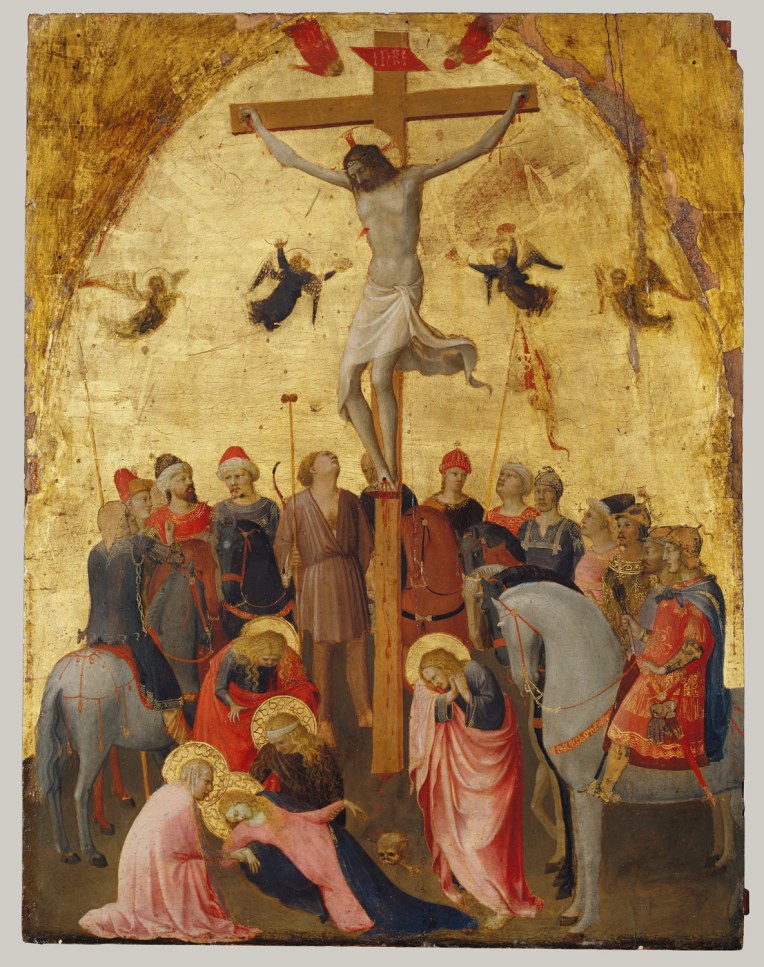
This coming week, say your daily prayers kneeling in front of a crucifix.  If because of health you’re unable to kneel, place a picture of the Crucifixion before you, and look at this image of Jesus dying for you on the Cross as you offer all your prayers through the power of the Cross.

Thursday of the Thirteenth Week in Ordinary Time

Thursday of the Thirteenth Week in Ordinary Time
Matthew 9:1-8

“Which is easier, to say, ‘Your sins are forgiven,’ or to say, ‘Rise and walk’?”

Jesus asks many rhetorical questions during the course of His three years of public ministry.  His questions often seem on the surface to be simple questions.  Frequently, as in today’s Gospel passage, Jesus follows up a rhetorical question with a dramatic deed that captures one’s attention, distracting one’s attention away from the rhetorical question.

Yet without disregarding the importance of the miracle that Jesus works in today’s Gospel passage, it would be profitable to focus upon Jesus’ rhetorical question:  “Which is easier, to say, ‘Your sins are forgiven,’ or to say, ‘Rise and walk’?”

So which of those two statements is, in fact, easier to say?  The most literal response would be that both are equally easy for anyone who has the faculty of speech.  There’s nothing difficult about saying those words.

Of course, the deeper meaning of Jesus’ question concerns the difference between forgiving someone’s sins and giving a lame person the ability to walk.  Why, then, doesn’t Jesus instead ask:  “Which is easier, to forgive a man’s sins, or to give a man the ability to walk?”?  It’s in the context of this difference – between these two types of miracles – that the following words of the passage draw our attention:  “‘But that you may know that the Son of Man has authority on earth to forgive sins’ – he then said to the paralytic” the words by which Jesus healed his physical infirmity.

In other words, Jesus’ rhetorical question draws our attention to the fact that by means of His divine authority, Jesus chooses to work miracles through the speaking of words.  Instead of saying to the lame man, “Rise, pick up your stretcher, and go home”, Jesus could have waved His arms over the lame man.  Or Jesus could have snapped His fingers.  In fact, as is so often the case during the course of His public ministry, Jesus chooses human words to serve as the effective means of working His miracles.  In turn, Jesus gave to His Church a share in this divine power.  The Church confers the seven Sacraments through the use of words (and often actions as well):  for example, bread and wine become Jesus’ Body and Blood when the priest speaks the same words that Jesus spoke at His Last Supper.  So the simple rhetorical question that Jesus asks in today’s Gospel passage offers us a lot to reflect upon:  Jesus’ choice to use human speech to work miracles, and His choice to extend this means of accomplishing divine words to His Bride, the Church.

OT 13-4 Gospel

Sts. Peter and Paul, Apostles

Sts. Peter and Paul, Apostles
Readings for the Vigil:
Acts 3:1-10  +  Galatians 1:11-20  +  John 21:15-19
Readings for the Day:
Acts 12:1-11  +  2 Timothy 4:6-8,17-18  +  Matthew 16:13-19

“I will give you the keys to the Kingdom of heaven.”

Peter, whom Jesus in today’s Gospel passage entrusts with the care of His Church, was very different than Paul.  Peter’s personality was rough and impatient.  He was poor and uneducated.  Now if Jesus had thought as worldly people do, He never would have chosen Peter as the first pope.  Instead, he would have chosen someone like Paul, refined and educated.

Regardless of their differences, Peter and Paul came to the same end:  martyrdom for the Holy Name of Jesus.  In the year 67, Saint Peter was crucified upside-down in the circus of Nero, and buried nearby in an out-of-the-way cemetery on a hill called the Vatican.  Saint Paul, after being held a prisoner in Rome for many years, was beheaded just outside the walls of the city.

As with their Lord, these two men came to what seemed to be shameful deaths.  Unfortunately, unlike their Lord, there was no report of Peter or Paul rising from the dead.  They were simply failures.  That’s surely how they were sized up by many around them, both in the Roman Empire and perhaps even among some members of the Church.  What kind of foundation had they laid for the Church?

Rome wasn’t built in a day, and neither was the Roman Church, the church that spread from that city throughout the world.  Twenty centuries later, the Church certainly is universal, with more than one billion members across the globe.  But are we really any holier than those first members of the Church?  Are we willing to put our lives or even our names on the line for Christ?

Our spiritual lives are never a “done deal.”  They are always under construction.  The Mass we share in is a continual source of strength for us, as each week we struggle to be faithful disciples of Jesus.  Each day is a building block of faith, in which, by our daily sacrifices, we build up others as well as our own spiritual lives.