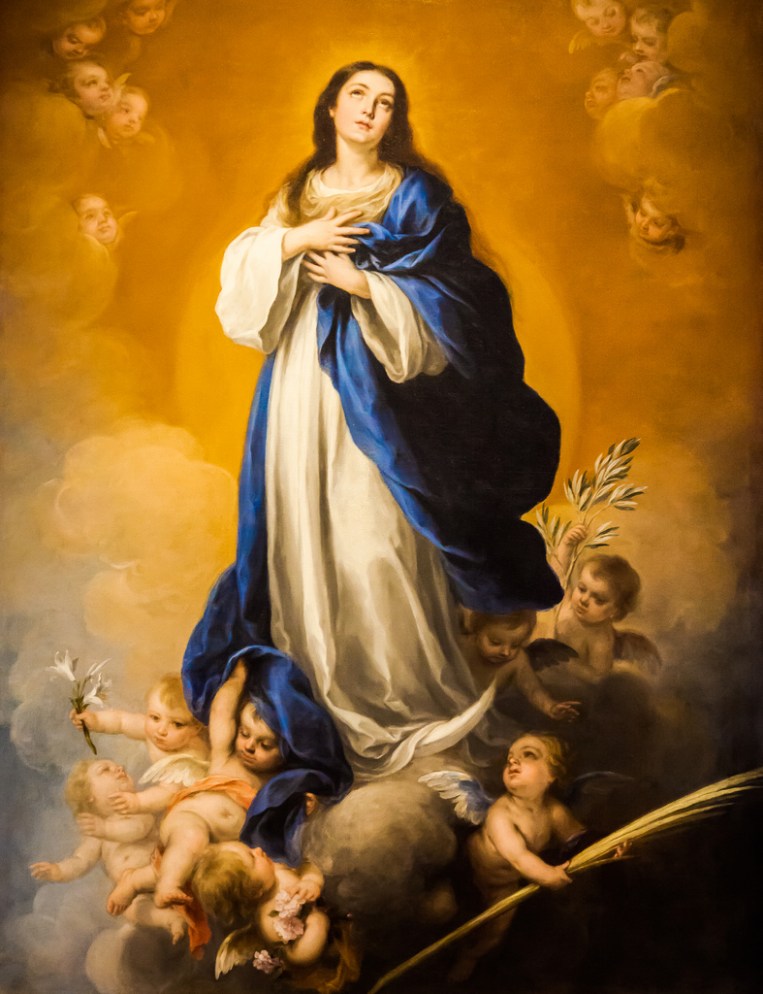
The Immaculate Conception of the Blessed Virgin Mary

The Immaculate Conception of the Blessed Virgin Mary
Genesis 3:9-15,20  +  Ephesians 1:3-6,11-12  +  Luke 1:26-38
December 8, 2021

“Hail, full of grace! The Lord is with you.”

In the beginning, God had a plan.  God’s plan was for mankind to live a blissful life in this world, and at the end of that earthly life, to rise body and soul into Heaven.

But mankind did not cooperate.  You know how Adam and Eve brought sin into the world.  They did not cooperate with God’s plan, and so God came up with a “Plan B”.  In this “Plan B”, God would show His love for mankind by sending His only Son to earth, knowing that man would crucify this Son, yet also knowing that the Crucifixion of His Son would destroy the power of sin and death.

In God’s “Plan A”, one man and one woman were to begin God’s plan.  They failed.  Adam and Eve instead brought sin and death into human experience.  Adam and Eve changed a human paradise into a valley of tears, full of suffering, doubt, and at time, even despair.

In God’s “Plan B”, one man and one woman were to begin God’s plan.  These two obeyed.  They fulfilled God the Father’s Will.  And so through there two—Jesus and Mary—you now have the opportunity to live a life here below filled with hope and joy.  Those virtues and all the rest of the virtues will be fulfilled in the perfection of Heaven if we cooperate with God’s grace to the hour of our death.

+     +     +

Today the Church throughout the world celebrates the Immaculate Conception of the Blessed Virgin Mary.  Our Blessed Mother is the one creature in all of God’s Creation who obeyed God unfailingly.  Our Blessed Lady is the one human person who has been completely open to accepting Jesus into her life.  God knew that Mary would be such a woman before her life began.  That’s why He gave her a gift at the moment that her mother, St. Anne, conceived her.  God kept Mary from inheriting Original Sin, so that Mary would be the best possible mother for His Son.

We hear of Mary’s faithfulness in today’s Gospel passage.  “Gabriel was sent from God… to a virgin betrothed to a man named Joseph… and the virgin’s name was Mary.”  She asks how she, a virgin, can conceive.  But God’s messenger assures Mary that God’s Son will be conceived in her womb by the Power of the Holy Spirit.

Mary’s virginal conception of Jesus reflects God’s omnipotence.  God can create something out of nothing.  In the beginning, God created the universe out of nothing.  Similarly, in the nothingness of Mary’s virginity, God creates, and His Son is conceived as a human being in Mary’s womb.  But these two acts of God creating out of nothing—God’s creation of the universe, in the beginning; and God’s creation of Jesus’ human body and soul, in the fullness of time—both foreshadow an even greater miracle on God’s part.

Likely you have heard the saying, “The wood of the crib is the wood of the Cross.”  This saying isn’t literally—historically—true, but its truth lies in pointing out that Jesus’ conception and birth were a means to a greater end:  that end being Jesus’ Death and Resurrection.  As another saying puts it, “Jesus was born into this world, so that he might die from this world.”

Through Mary, God’s Son comes into the world to destroy sin and death.  Jesus’ vocation is fulfilled more than three decades later, according to the same pattern by which God created in the beginning, and in Mary’s womb.  God creates… out of nothing.  So it is with the Death and Resurrection of Jesus.  Human sin is a failure to love.  Human sin is an absence of grace, an absence of love.

You and I, as human beings:  how do we respond when someone doesn’t love us?  In our sinfulness, we usually respond in kind.  If someone gives us the cold shoulder, we do the same.  We respond to an absence of love with a further absence of love.  That’s how sin works:  it spreads like a spiritual and moral cancer, destroying the love that God meant, in the beginning, for our human life to be all about.

Thanks be to God, God does not respond to sin as you and I do.  If God did, then when we wandered far from Him, God would have (metaphorically) turned His back on mankind, and left us to wallow in sin, finally to die and exist forever separated from Him.  Thanks be to God, God responds to the nothingness of sin by choosing to love.  Down into the midst of a human race of sinners, God chose to send His only-begotten Son.  On Calvary, in the midst of the nothingness of rejection, rebuke, scourging and mockery, Jesus offered His life for the forgiveness of sin.  In the midst of the nothingness of sin, God “re-deemed” the world.

+     +     +

Thanks be to God for His act of “re-creation”.  Thanks be to Our Blessed Mother Mary for saying “Yes” to her part in God’s plan.  And thanks be to God for preparing Mary to say “Yes” to His will for her life.  Those are the three truths that the Church celebrates today on this Holy Day of Mary’s Immaculate Conception.

First, God from all eternity, knowing that man would reject Him, planned to re-create the human world through the offering of His Son.  Second, God chose Mary to be the Mother of His only-begotten Son, and Mary chose perfectly to accept this vocation.  Third, knowing from all eternity of Mary’s fidelity, God prepared Mary for her vocation be means of a unique grace:  the grace that we call the “Immaculate Conception”, preserving her at the moment of her conception from Original Sin.

This gift was given to Mary not only for her own sake, but for the sake of her Son, and for the sake of all those who would become members of her Son’s Mystical Body, the Church.  You and I celebrate Mary’s fidelity today because she is our Mother.  We honor her as the first and best disciple of Jesus Christ.  We also honor her because of the unique gift of holiness that God gave her through her Immaculate Conception.  During this Season of Advent, Mary’s life shows us best how to receive Jesus into our lives.
Saturday of the First Week of Advent

Saturday of the First Week of Advent
Isaiah 30:19-21,23-26  +  Matthew 9:35—10:1,5,6-8
December 4, 2021

… they were troubled and abandoned, like sheep without a shepherd.

This morning’s Gospel Reading bears imagery that foreshadows Lent, the Sacred Triduum, and Eastertide.  Catholics instinctually understand that Advent prepares Christians for Christmastide, and that Lent prepares them for Eastertide.  Less understood is that Advent and Christmastide, considered as a single block of time, prepares Christians for Lent and Eastertide.

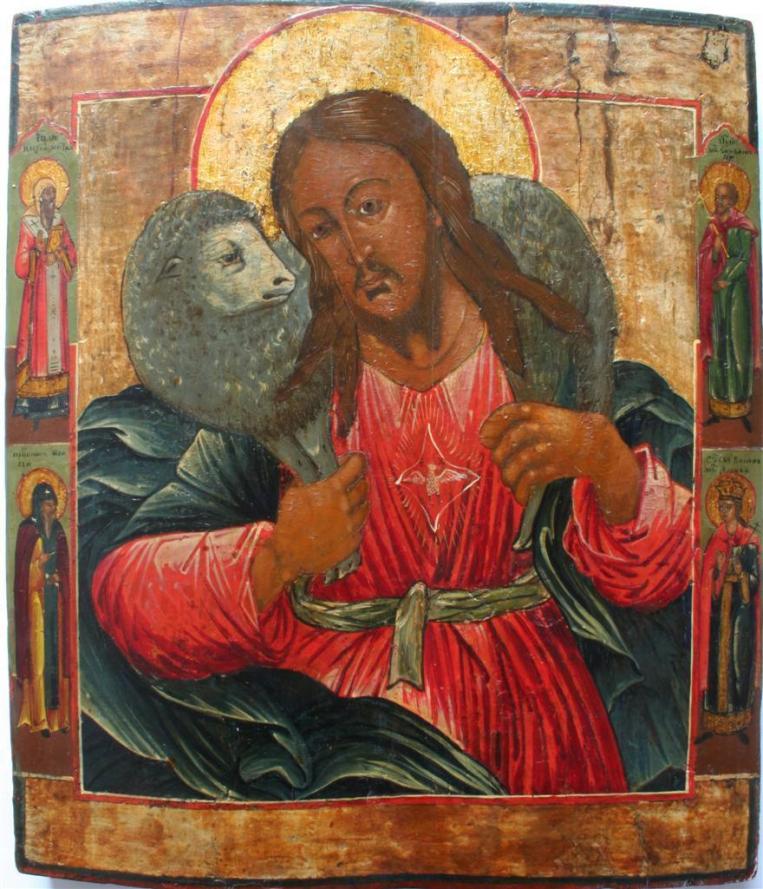
The evangelist tells us that the crowds were “like sheep without a shepherd”.  Jesus, of course, is the Good Shepherd [see John 10:11,14].  His noblest act of shepherding took place on Calvary, when He sacrificed His life for His flock.

Jesus’ vocation of Self-sacrifice on Calvary is the chief reason why God the Father sent His Only-Begotten to earth.  It’s important not to lose sight of this during Advent and Christmastide.  God the Father sent His Son to be both shepherd and sheep.  Indeed, He shepherds us by becoming one of the sheep:  by being born as one of us, so that on the Cross He could offer to the Father the sacred humanity He received from the Blessed Virgin Mary.

St. Francis Xavier, Priest

St. Francis Xavier, Priest
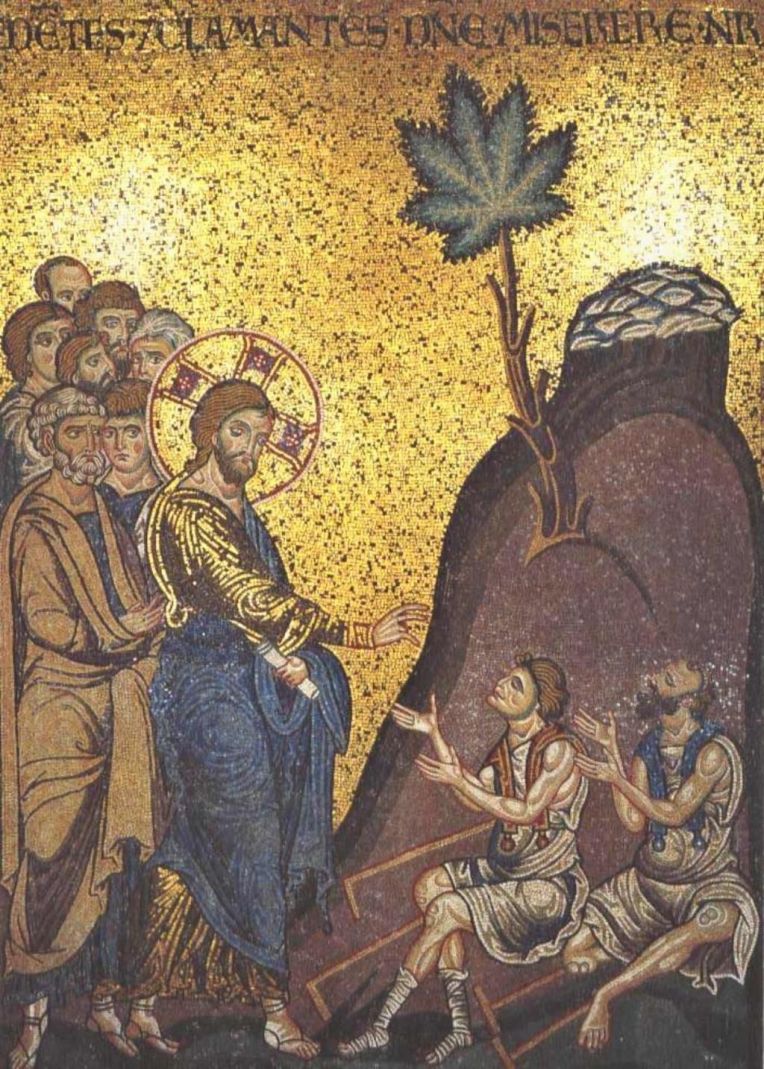
Isaiah 29:17-24  +  Matthew 9:27-31
December 3, 2021

The Lord is my light and my salvation.

Advent corresponds roughly with the final weeks when the day grows shorter (at least, in the Northern Hemisphere).  There’s a great deal of imagery in the scriptures and liturgies of Advent that relates to the human struggle with darkness.  For example, the feast day of Saint Lucy—whose name comes from the Latin word for light, and whose feast is celebrated in many countries with a brilliant display of candles—falls close to the midpoint of Advent.  On the following day the Church celebrates the feast of St. John of the Cross, a Doctor of the Church whose writings explore the “dark night of the soul”.

The refrain to today’s Responsorial is:  “The Lord is my light and my salvation.”  To reflect upon the Lord God Himself as “light” is infinitely more significant than reflecting upon the earth’s annual descent into darkness, or even upon the human darkness that one experiences while undergoing spiritual purification and growth in the divine virtue of faith.

The notion of the Lord God as light transcends any other notion of light that human persons experience.  One way to appreciate this difference is to notice how Psalm 27 continues its description of the Lord.  This Lord whom the Psalmist has just described as “light” is the object of the Psalmist’s sight.  Consider how unusual that is.

In ordinary human life, light serves to illuminate physical objects.  A man would be thought odd if he stared at a light bulb, and reckless if he stared at the sun.  But in Psalm 27 the Psalmist describes the Lord as the focus of his sight:  “One thing I ask of the Lord; / this I seek: / To dwell in the house of the Lord / all the days of my life, / That I may gaze on the loveliness of the Lord / and contemplate his temple.”  One might consider these verses as the Old Testament’s clearest description of what the Church calls the “Beatific Vision”.  To be a saint in Heaven is to gaze forever at the Lord, who is pure light.

The Second Sunday of Advent [C]


The Second Sunday of Advent [C]
Baruch 5:1-9  +  Philippians 1:4-6,8-11  +  Luke 3:1-6

“A voice of one crying out in the desert ….”

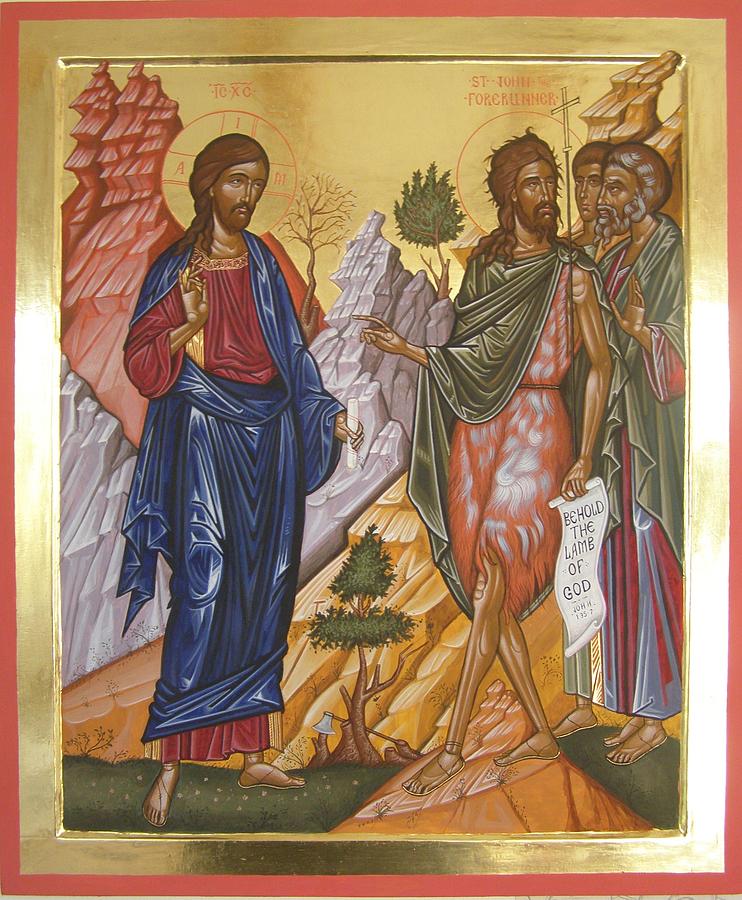
In today’s Gospel Reading we hear St. John the Baptist preparing the way for Jesus.  In other words, John is preparing others to receive Jesus for who Jesus is, which is no small task.  The beginning of the Gospel passage situates John’s ministry in a specific worldly context, explaining what sort of men were leaders of the world into which the Messiah had come.  These pagan and Jewish leaders were corrupt.  This is why Saint Luke the Evangelist mentions them:  to tell us that John—and the Lord after him—had an up-hill battle before them.

John the Baptist himself is the “hinge” or “pivot” between the Old and New Testaments.  In the texts that describe him, he appears as one who foreshadows the coming of the Messiah.  We might ask, though, why it is that John also happens to be the cousin of Jesus.  Is this familial relationship a mere historical co-incidence?

Regardless, the Gospel accounts make clear that for two persons who were related, John the Baptist and Jesus were very different persons.  They were both criticized, but for opposite reasons:  Jesus for being a drunkard, and John for being ascetical.  At times it seems that the only thing these cousins have in common is that they were unjustly persecuted.  What were John and Jesus really about, then?

Both an openness to and care for others mark the kingdom of the Messiah, its King, and its herald.  These qualities also mark the lives of those invited to His Table.  The kingdom that Jesus was sent to establish is not one which seeks to conquer other nations.  Instead, it’s one which invites children gathered from the east and west to share in God’s splendor.  Each of us as a member of Christ’s Mystical Body—the Church—shares in the missionary command given to the Church.  So then, we should consider during Advent who it is that we ought to be inviting to share in the riches of the Christian life.

It might not be who we think.  If John the Baptist were to appear on our doorstep, it’s likely that we would want nothing to do with him.  Our reluctance might be because of his appearance.  But more than likely it would be because as we hear John described in the Gospel, we notice that he tells everyone like it is.  When he speaks of sinners, he points out their sins.  When he speaks of Christ, he points and shouts, “Behold, the Lamb of God who takes away the sins of the world.”

In preparing for the birth of the Messiah, we give thanks that Jesus was born 2000 years ago in order to die for us.  His death is what we celebrate when we come before the altar to share in the Sacrifice of His life for us.  If a Christian devoutly receives that life in Holy Communion, she will have the strength to seek out others in order to serve them, whether or not she believes that they deserve her love and service.

It is not safe to think or act this way, of course.  In fact, the Christian life is not only a narrow path, but a dangerous one as well.  If our love is to increase more and more, as Saint Paul urges us in the Second Reading, we must be willing to embrace those whom we do not care for, or even—in our own minds—consider part of God’s plan.  We must do so by remembering that we ourselves were once far from the Lord, and that He has done great things for us.  There may be many persons in our lives whom we dislike, but our dislike is no reason to think that God loves them any less, or that Christ became human to save us, but not them.

God did all that He could for each of us in sending His Son to become human and die for us on the Cross.  Yet choosing to respect our free will, the Lord will not save us from evil in spite of ourselves.  He allows us to bring evil into our lives if we so wish.  Each one of us, like God, is called to share in His work of saving others.  As with God, there is only so much each of us can do for others, but there certainly is something we can do.

Thursday of the First Week of Advent

Thursday of the First Week of Advent
Isaiah 26:1-6  +  Matthew 7:21,24-27
December 2, 2021

“… only the one who does the will of my Father ….”

The Apostle Paul is sometimes quoted in order to create a false division between faith and good works.  St. Paul makes clear—so it’s said—that salvation in Christ is based upon faith alone.  Good works play no role—so it’s said—in reaching salvation.

Against such misappropriation of St. Paul’s words we have the explanation of Jesus in today’s Gospel Reading.  “Not everyone who says to me, ‘Lord, Lord,’ will enter the Kingdom of heaven, but only the one who does the will of my Father in heaven.”  Should we take Jesus’ reference to someone saying, “Lord, Lord” and equate it with faith, which some say alone bears salvation?  One might argue that point, and it’s a point worth debating.

However, one cannot doubt that Jesus in today’s Gospel Reading is making a sharp contrast.  Nor can one doubt that when Jesus declares that only the one who does the will of His Father will enter the Kingdom of Heaven, Jesus is speaking about the performance of good works.  At the same time, we ought to be precise about Jesus’ words about this point:  in order to be good works, works must be done according to the will of God the Father.  Not just any old good works will do.

Finally, we ought to note something about those who say to Jesus, “Lord, Lord”.  Jesus doesn’t say here, and the Church does not teach, that salvation is reached by good works alone.  Note whom Jesus is speaking about when He declares:  “Not everyone who says to me, ‘Lord, Lord,’ will enter the Kingdom of heaven.”  He is speaking about a general set of people:  all those who say to Jesus, “Lord, Lord.”  Within that set, there is a smaller sub-set.  Among those who say to Jesus, “Lord, Lord”, only those who also do the will of God the Father will enter the Kingdom of Heaven.

During this holy season of Advent, then, our good works can help us not only prepare one day to enter Heaven, but also to celebrate Christmastide fittingly.  This celebration begins with allowing the newborn Christ to bring us from Heaven a bit of His divine life.