The Most Holy Body and Blood of Christ [B]
Ex 24:3-8 + Heb 9:11-15 + Mk 14:12-16,22-26
June 3, 2018
“This is my blood of the covenant, which will be shed for many.”
Some fifty years after the close of the Second Vatican Council, disagreements still simmer over the best way to interpret its teachings. Disagreement is found is different areas of the Church’s life, such as marital morality and ecumenism. Yet nothing engenders more disagreement than the celebration of the Eucharist. Today’s feast of Corpus Christi can help us reflect upon the Church’s teachings about this most blessed of the seven sacraments.
One of the more confused ideas used to interpret the Council is that Holy Mass ought to be entertaining (for example, through its music or preaching). During summer vacation, if you travel far enough outside our diocese, you might stumble upon Masses animated by the principle of giving the faithful what they want.
By contrast, the Church’s history shows a different approach: give the faithful what they need, and do so by giving them what God has handed down. There are two questions that have to be answered, then. First, what do the Christian faithful most need? Second, what has God handed down?
We’re not talking here about the sacraments’ inner essence, which is grace, but about their outer form, which the Church has the power to change to some extent. Concerning the form of Holy Mass, what principle should shape it? What would be wrong with elements drawn from popular entertainment, which clearly draw crowds marked by outer enthusiasm?
Some seem eager for great crowds and great outer enthusiasm in churches. Yet the history of the Church, both ancient and modern, shows that when the Church sets the course of her mission according to numbers and outer enthusiasm, the Church bears little lasting fruit for lack of roots. Consider that during the hours that Jesus was nailed to the Cross, the number of His followers was few, and they had little enthusiasm for the way He had trod. Nonetheless, the Church knows that she is called to preach nothing but Jesus Christ crucified [see 1 Cor 2:2].
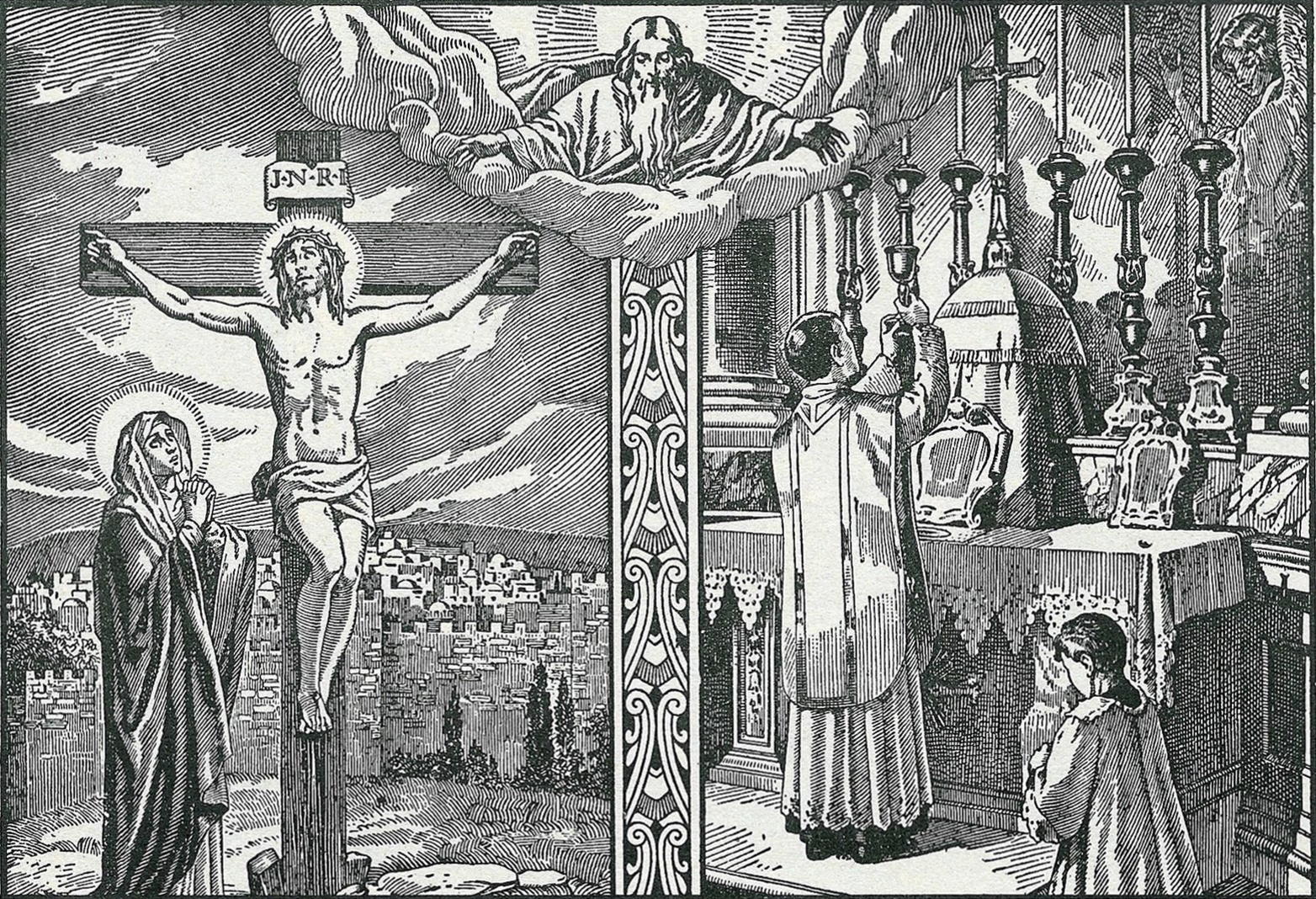
At the heart of this preaching is self-sacrifice. If we want to know what the Christian faithful most need, then, we need to know self-sacrifice. Jesus’ words at the Last Supper, when He instituted the Eucharist, reflect this central principle. “This is my body, which will be given for you; do this in memory of me.” “This is my blood of the covenant, which will be shed for many.” These words of Jesus don’t reflect a spirit of entertainment, which indulges whatever the crowd currently cries for.
But how can a principle like self-sacrifice take form within Holy Mass? Consider the example of hymn lyrics. Tally the proper nouns and pronouns in any given hymn. Are most of them first-person (I, me, mine, we, us, ours), or do most of them refer to God? Who is the focus of the hymn: man or God? A hymn that illustrates the principle of self-sacrifice sings more about God than man, and sings about man as fallen and redeemed by Jesus’ self-sacrifice on Calvary.
So if the faithful need chiefly from the form of Holy Mass a spirit of self-sacrifice, what, secondly, has God handed down to the Church to foster this goal? The simplest answer is that He has given Himself, in Word and Sacrament. God’s Word and the Sacrament of Corpus Christi shape the form of Holy Mass. The content of the Mass shapes the form of the Mass. Form follows function, and one of the functions of Mass is to form us into the likeness of Jesus Christ, and Him crucified.
If that seems a bit abstract, consider practical examples regarding the role of Scripture within Holy Mass. With a few exceptions, most consider the fact that more of the Bible is read at Mass during the year to be a positive change made after the Second Vatican Council. Yet two other modern changes distort—towards one extreme or the other—the place of Scripture within Holy Mass.
In some churches built or renovated after the Second Vatican Council, the altar and pulpit are positioned at equal distances from the sanctuary’s midpoint. This arrangement suggests that the two chief parts of Holy Mass—the Liturgy of the Word and the Liturgy of the Eucharist—are of equal importance. Yet the Church throughout her history has taught that the structure of Mass—like salvation history itself—contains a dynamism. The first half of Mass prepares the faithful for the second half, as the Old Testament prepares God’s People for the New, where the Word becomes Flesh and dwells among us.
On the other hand, the modern change that gives prominence to hymns at Mass has come at the cost of the proclamation of Scripture. In the form of Mass used before the Second Vatican Council, hymns didn’t supplant the singing of the scriptural antiphons (during the Entrance procession, the Offertory, and the Communion procession). Each of them—antiphons and hymns—had its own place. But the modern form of Mass allows these scriptural antiphons—which may be sung either in a brief form or in an extended form like the Responsorial Psalm—to be omitted altogether, impoverishing the faithful by substituting the human words of hymns for the divine Word of Scripture.
What the Christian faithful most need is what they most deeply want. God has handed down to man through the Church what mankind most deeply wants: self-transcendence through self-sacrifice. The Church’s Sacred Liturgy inspires us, nourishes us, and fits us for self-sacrifice, and so for fitting praise to God for His own self-sacrificial love.
 Reflections on the Sacred Liturgy