The 15th Sunday in Ordinary Time [A]

The Fifteenth Sunday in Ordinary Time [A]
Isaiah 55:10-11  +  Romans 8:18-23  +  Matthew 13:1-23
July 16, 2017

“‘And as he sowed, some seed fell on the path, and birds came and ate it up.’”

Humility is the foundation of the spiritual life.  Because of this foundation, the Lord God can dwell more fully within us.  In today’s Gospel parable, “A sower went out to sow.”  Now either this sower is foolish, or he knows something that we don’t know.  If you were driving down a paved road, and came up behind a farmer driving his tractor and drill, dropping seed for miles onto the asphalt, you’d be concerned for him.  Doesn’t he know he’s wasting his time, energy, and money, in addition to probably ruining his drill?

But the sower in Jesus’ parable acts in a similar way:  “…as he sowed, some seed fell on the path, and birds came and ate it up.”  Later on in the same chapter of Matthew, Jesus explains “the parable of the sower.  The seed sown on the path[,] is the one who hears the word of the kingdom without understanding it, and the evil one comes and steals away what was sown in his heart.”

This is the first of four illustrations that Jesus paints in today’s parable.  The first three illustrations are pictures of the sower laboring in vain, because of the path, rocky ground, and thorns.  Only the fourth illustration describes seed falling on rich soil, producing fruit, a hundred or sixty or thirtyfold. Continue reading

St. Bonaventure

St. Bonaventure, Bishop & Doctor of the Church
Genesis 49:29-32; 50:15-26  +  Matthew 10:24-33
July 15, 2017

“‘…not one [sparrow] falls to the ground without your Father’s knowledge.’”

Jesus preaches today about Our Father’s providential knowledge and will.  God knows all things.  We know this abstractly, but perhaps we fail to consider all that this truth of our Faith means. Continue reading

St. Kateri Tekakwitha

St. Kateri Tekakwitha, Virgin
Genesis 46:1-7,28-30  +  Matthew 10:16-23
July 14, 2017

“‘Behold, I am sending you like sheep in the midst of wolves….’”

Jesus was always realistic during His earthly life.  So it’s no surprise that He says to His Apostles, “I am sending you like sheep in the midst of wolves”.   His words were true in the first century, and are so also today. Continue reading

July 13, 2017

Thursday of the Fourteenth Week in Ordinary Time [I]
Genesis 44:18-21,23b-29;45:1-5  +  Matthew 10:7-15
July 13, 2017

“‘Whoever will not receive you or listen to your words—go outside that house or town and shake the dust from your feet.’”

One of the items on my “bucket list” is to spend a considerable amount of time writing about The City of God by St. Augustine of Hippo.  He lived in a cultural setting similar to ours.  The book is a contrast between the City of God and the city of man.  His comparison of the two leads to many reflections on the nature of divine Providence.  Many of these reflections consider how God chooses to bring moral good out of moral evil. Continue reading

July 12, 2017

Wednesday of the Fourteenth Week in Ordinary Time [I]
Genesis 41:55-57;42:5-7,17-24 +  Matthew 10:1-7
July 12, 2017

“Jesus summoned his Twelve disciples and gave them authority….”

Today’s Gospel passage speaks about reaching out to those who are hurt and sick.  We hear Jesus sending his twelve apostles to go out and heal “every disease and every illness.”  More than just a prophet, Jesus has authority not only to call back the repentant to Himself, but also to heal them. Continue reading

This week at the Spiritual Life Center:

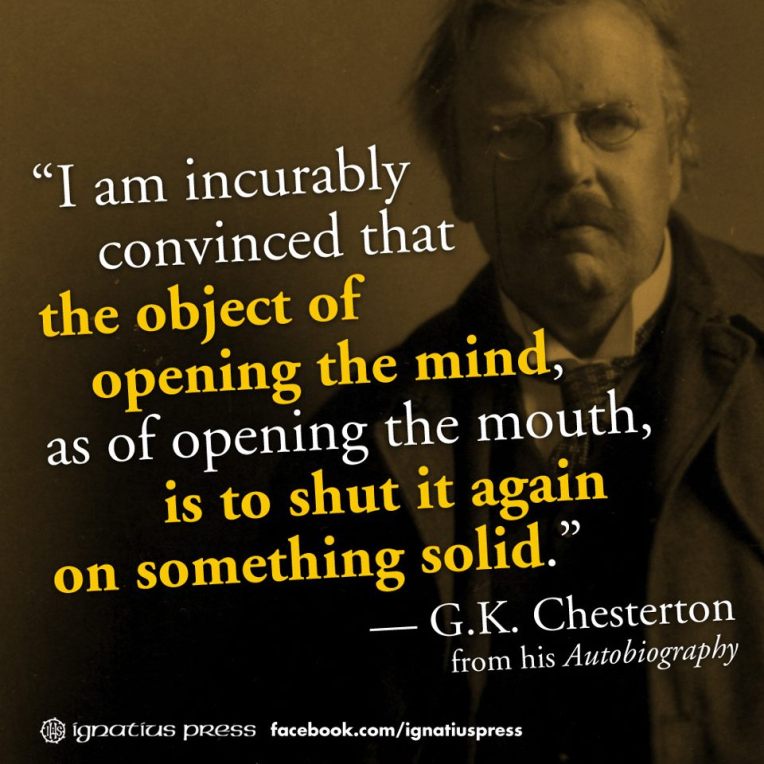
If you’re in or near south-central Kansas, I encourage you to attend the Summer Symposium this Thursday and Friday at the Spiritual Life Center in Wichita. The theme this year is “Conversion & Conscience”. Each year, the theme is tackled from four perspectives: Doctrine, Spirituality, Literature, and Catholic Living. I’m offering the Literature talks, focusing upon G. K. Chesterton, the great 20th c. British journalist and apologist. No less a figure than C. S. Lewis credited Chesterton’s book The Everlasting Man with moving him from agnosticism to Christian orthodoxy. Chesterton himself was a convert, so his approach to the Roman Catholic Faith is especially interesting for those who want to know how to encourage others along the roads that lead across the Tiber to Rome.

Click on the image of Chesterton below to link to the SLC’s Symposium page:

Quote GKC 001

Saint Benedict of Norcia

St. Benedict, Abbot
Genesis 32:23-33  +  Matthew 9:32-38
July 11, 2017

“‘…the harvest is abundant, but the laborers are few….’”

We usually associate the cry that Jesus utters in today’s Gospel passage with the need for vocations in the Church.  But Jesus also speaks through these words about the harvest of one’s own heart, and the fruits of one’s individual soul.  In each person is a soul created by God, and each soul is capable of being completely filled, as much as its capacity allows:  to be “perfected” by God’s grace. Continue reading

July 10, 2017

Monday of the Fourteenth Week in Ordinary Time [I]
Genesis 28:10-22  +  Matthew 9:18-26
July 10, 2017

“‘Courage, daughter!  Your faith has saved you.’”

In today’s Gospel passage are two people who see how God wants to be in their lives in time of need.  So many people turn to Christ in need.  When we are honest with ourselves, we know that we would like to ask Christ’s help for so many things in our lives.  It’s true that petitionary prayer—in which we ask for something from God—is not as selfless a form of prayer as adoration.  But God wants us to present our petitions to Him. Continue reading

10th Anniversary of Summorum Pontificum

10th Anniversary of Summorum Pontificum
July 7, 2017

“Nemo dat quod non habet.”  Nowhere is this more true than in regard to the Sacred Liturgy.  The Church’s liturgy, of course, includes both the Divine Office and the Holy Sacrifice of the Mass.  However, as the Church reiterated at the Second Vatican Council and in the Catechism of St. John Paul the Great, it is specifically the Eucharistic Sacrifice that is the source and summit of the Church’s life.

“No one gives what he does not have.”  This saying is one way of summing up one of the most famous narratives in the four Gospel accounts:  that of Jesus in the home of Martha and Mary.  There is, of course, a tension in this story.  Jesus is not teaching that only the contemplative dimension of the Christian life is good, and that the apostolic dimension is bad.  Instead, Jesus is teaching us that there must be a right ordering of the Christian’s life.  The apostolic must flow from the contemplative, and the apostolic life of the Christian can be no more fruitful than her contemplative life.  To the degree that we want our apostolic works to be fruitful, to that extent we will devote time and energy to the Sacred Liturgy.

Of course, every baptized Christian, no matter her or his particular vocation, must be mindful of how to live out the tension illustrated in the story of Martha and Mary.  Martha and Mary, we might say, were as different from each other as were Peter and Paul.  Despite their differences, however, the Lord had to explain to Martha what Mary already understood and was already living out:  only one thing is necessary, and that one thing is the better part.

That this one thing is the better part is illustrated even by the structure of the Catechism of St. John Paul the Great.  Familiar as you undoubtedly are with the works of Dr. Peter Kreeft, you’ll recognize his summary of the pillars of the Christian Faith as being three-fold:  Creed, Code and Cult; Words, Works and Worship.  Yet the Catechism has four pillars.  The last of Kreeft’s pillars—which he calls Cult or Worship—is given two pillars in the Catechism:  the second and the fourth, the Sacred Liturgy, and personal prayer.

One reason that the Church’s official Catechism places such great emphasis on the Cult and Worship of Christians is that this “better part” has both a communal and a personal dimension.  We might be tempted to think of the sacraments and other forms of the Sacred Liturgy as communal, while private prayer is personal.  But that distinction is too simple, because participation in the Sacred Liturgy is intensely personal, and all individual prayer—if it is authentic—takes place within the Communion of Saints.

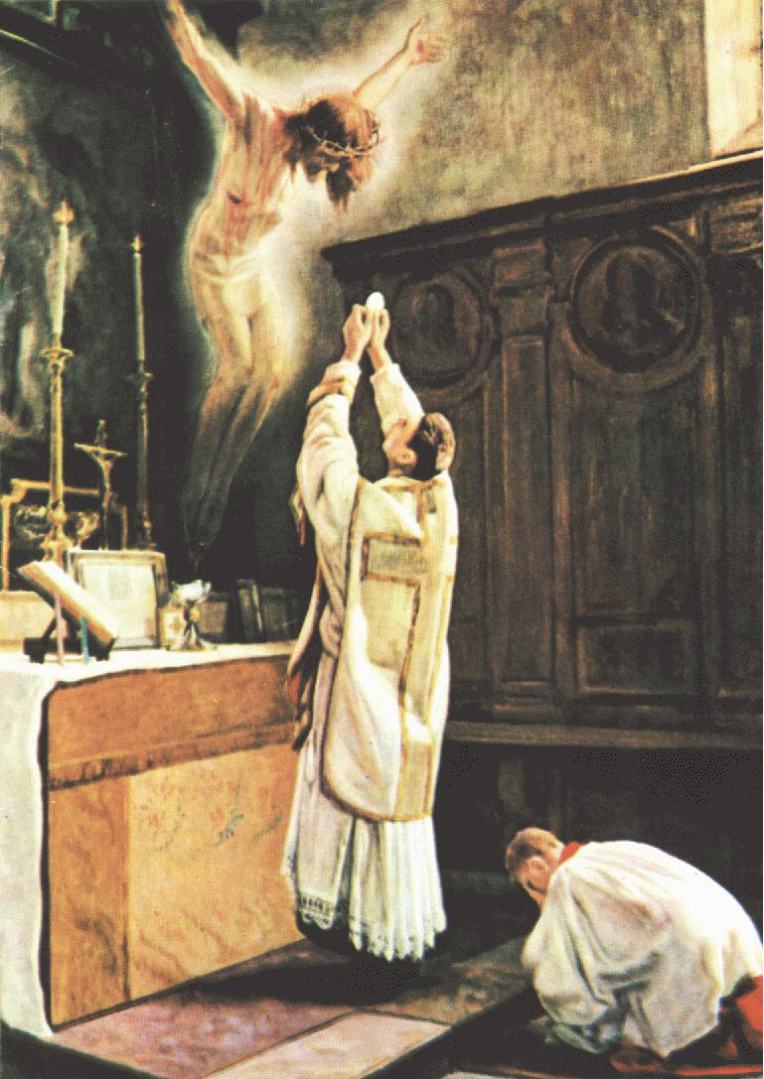
A more convincing reason why the Catechism has two pillars dedicated to Cult/Worship is very simple.  The Church has always taught that the Eucharistic Sacrifice of Holy Mass, the culmination of the Sacred Liturgy, is the source and summit of the Christian life.  Everything else, including Creed and Code, Words and Works, must serve this source and summit.

In that case, all Christians need—if they want to grow in the Christian life as the Church teaches—to give priority to Cult and Worship, above all in the Eucharistic Sacrifice of Holy Mass, as the Catechism does, proportionate to their vocations.  It does no good to evade this truth by stating:  “I’m not a Benedictine.”  The Church does not say that only for Benedictines is the Eucharistic Sacrifice the source and summit of the Christian life.  The Eucharistic Sacrifice is the source and summit of the Christian life for each and every Christian.  May we recognize Christ calling us to union with Him through His Eucharistic Sacrifice not only as the better part, but as the measure of the efficacy of all our labors, and the measure of our fidelity as His People.
Holy Sacrifice of the Mass 2