“The child grew and became strong in spirit, and he was in the desert until the day of his manifestation to Israel.”
When the Church celebrates the feast day of a saint, we are usually celebrating the day of the saint’s death. You might call this the saint’s “supernatural birthday”: the day on which he or she set out for Heaven. But the Church also celebrates the natural birthdays of three persons: Christ Jesus, of course, on the feast we call Christmas; the Blessed Virgin Mary, on September 8th, nine months after the feast of her Immaculate Conception; and Saint John the Baptist, on this day which falls sixth months before Christmas eve.
Considering this celebration of St. John’s birth, we see more clearly the relationship between John and his cousin Jesus. Their relationship is an intimate one, and yet also one of strong contrasts. In the same way, by celebrating the birth of Saint John we see more clearly what our own relationships with Our Lord are to be like.
John and Jesus were cousins by nature. Each one of us is a brother or sister of Jesus by our supernatural baptism into the Paschal Mystery. John and Jesus each had a message to proclaim to others. We are obligated to listen to each of these messages, and to follow each. St. Augustine of Hippo comments on today’s Gospel passage in saying that: Continue reading →
“In this is love: not that we have loved God, but that he loved us and sent his Son as expiation for our sins.”
Most years we would celebrate tomorrow the Immaculate Heart of Mary, the heart of her who was never touched by any sin, but instead is “full of grace”. (We won’t celebrate her feast this year because of the Nativity of St. John the Baptist.) Of course, Jesus is sinless also, sharing in the divinity of His Father, so we could speak of the Immaculate Heart of Jesus. But today we are celebrating instead the “Sacred Heart” of Jesus.
To be “sacred” means “to be set aside for a special purpose.” What, then, is the purpose of Jesus’ heart? The heart is obviously a human aspect of who Jesus is. It certainly expresses the love of God the Son, for as Saint John the Beloved Disciple tells us, “God is love”. As God, in his divinity, the Son of course has no physical heart—we can say only that the Godhead possesses a heart in a metaphorical sense—but in His humanity Jesus possesses a physical heart, beating within His Body, pumping His life-blood to all its parts.
What does it mean then to say that Jesus, as human, has a heart? It means that He is capable of suffering. To have a heart means to be able to be broken, to be weak, to be vulnerable. This is “the breadth and length and height and depth of Christ’s love”: that He would carry a Cross and die upon it for us, in order to open the gates of Heaven for the redemption of our darkened, sinful hearts. Continue reading →
“Our Father who art in Heaven, hallowed be Thy name.”
Putting the Gospel passages from recent weekday Masses in context, we see the theme of God the Father emerge. These passages come from the Sermon on the Mount. Two days ago the Church proclaimed the last section of Matthew 5, the last phrase of which is Jesus’ command to “be perfect, just as your heavenly Father is perfect.” Yesterday’s Gospel passage concerned the performance of “righteous deeds”, for which God the “Father who sees in secret will repay you.”Continue reading →
“‘And your Father who sees what is hidden will repay you.’”
Today’s Gospel passage is—to the verse—the same passage that we hear every year on Ash Wednesday. The Church proclaims it today, in the middle of a week in Ordinary Time, because the cycle of Gospel passages for weekday Mass tends to go sequentially through a Gospel account. This is different than the cycle for Sunday Mass, in which the Gospel jumps occasionally, though not always, throughout the course of the Gospel account. Continue reading →
“‘…pray for those who persecute you, that you may be children of your heavenly Father….’”
Today’s Gospel passage is from the first third of the “Sermon on the Mount”. This “inaugural address” is recorded in full only in Matthew, in Chapters 5-7. Today’s Gospel passage forms part of a series in Chapter 5 of five contrasts between the commands of the Law and Jesus’ commands to love. Each contrast uses a variation of the form, “You have heard it said… but I say to you.”Continue reading →
The Most Holy Body and Blood of Christ [A] Deuteronomy 8:2-3,14-16 + 1 Corinthians 10:16-17 + John 6:51-58 June 18, 2017
“…the bread that I will give is my flesh for the life of the world.”
Among our Catholic customs, the crucifix is central. Some of our separated brothers and sisters in Christ object to the symbol of the crucifix. It seems gruesome to them. It seems to overshadow the joy and glory that Christians ought to take in the Risen Christ, who came so that we might have life, and have it to the full.[1] But what the crucifix symbolizes so clearly is the price of that joy and glory. Forget the price, and gratitude dwindles. Throughout the summer months—from Memorial Day to Independence Day—we hear the old saying, “Freedom isn’t free”: either civil freedom, or spiritual freedom.
The first question we need to ask on today’s celebration of Corpus Christi is, “Why did Jesus institute the Sacrament of the Holy Eucharist on the night before He died?” Wasn’t His death on the Cross good enough? Does the celebration of the Holy Eucharist add anything to what Jesus accomplished on Calvary? If not, why does the Church teach that it’s a mortal sin to miss Mass on a Sunday or Holy Day of Obligation?
If you were to survey a hundred Catholics and ask them why the Church says they have to go to Mass on Sundays, the most common answer might be either, “Because I’ll go to hell if I miss Mass” or “Because going to Mass is how we get to Heaven”. While there’s truth in both those statements, they need to be placed in a broader context. Saint Paul puts us on the right track when he explained to the Corinthians what they were doing when the Eucharist is celebrated: St. Paul told them, “you proclaimthe death of the Lord until He comes.”[2]
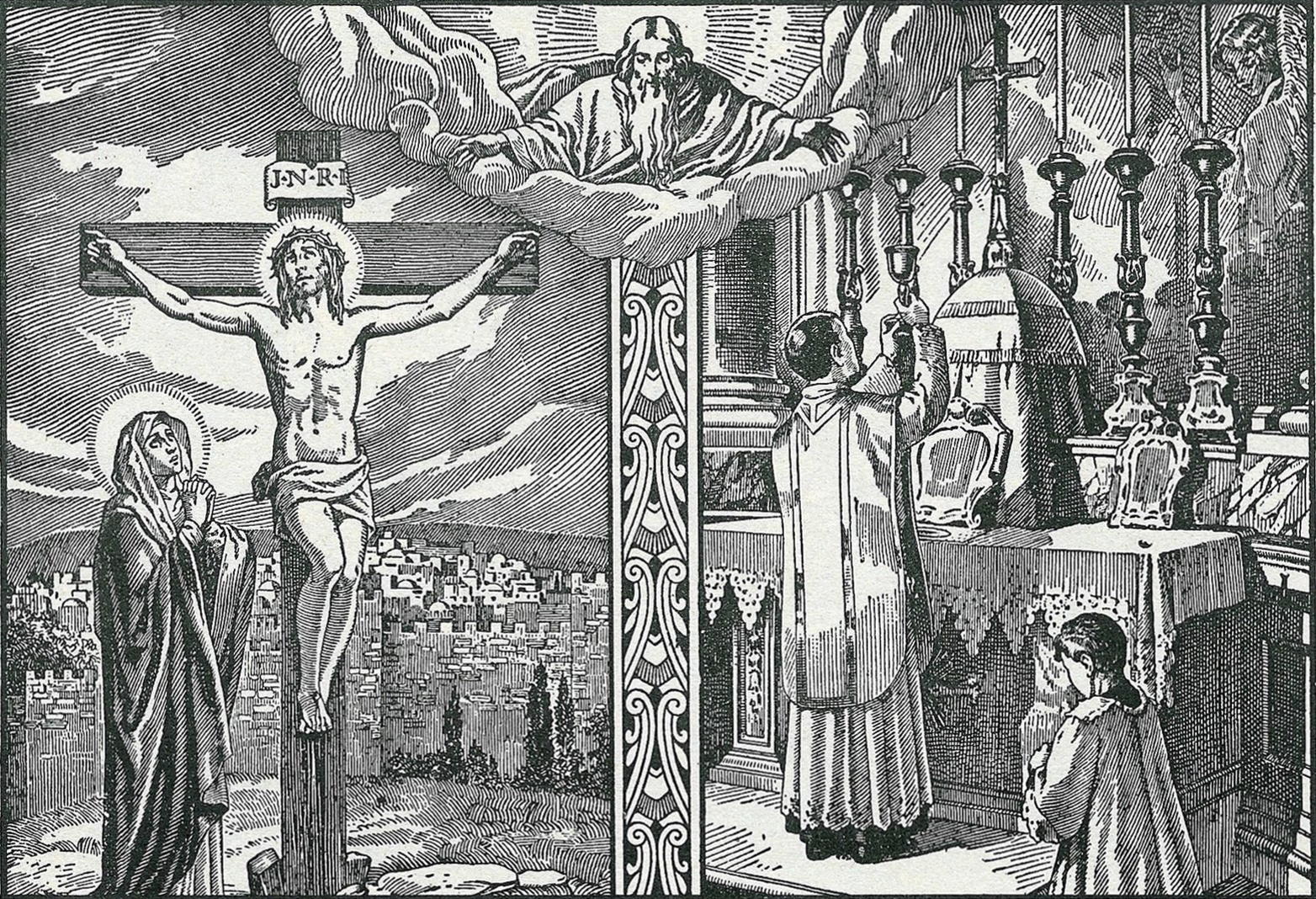
St. Paul states that the Eucharist is a proclamation of death: of the death of God in the Flesh. This is true for us today, also. When you participate in the Holy Sacrifice of the Mass, “you proclaim the death of the Lord until He comes.” At Holy Mass, when the Eucharistic Prayer is offered, you are transported mystically and sacramentally to the spot of Calvary, on the day of Good Friday some 2000 years ago.
Why this focus? Why is the Eucharist a proclamation of Jesus’ death? For one thing, it’s because the death of Jesus is the price of our salvation. Proclaiming the death of Jesus can help us to grow morally: in our gratitude to God, and so in our expressions of charity. But on the other hand, we might ask, why did God choose the death of Jesus as the means of our salvation?
After all, God is All-Powerful. God can accomplish whatever He wills, in whatever manner He wills. He could have redeemed mankind from sin and death by snapping His fingers (metaphorically speaking), or by simply saying, “I hereby declare mankind innocent of all sin.” After all, God created with nothing more than His own Word when He said, for example, “ ‘Let there be light’, and there was light.”[3] So he could re-create mankind in the same way: God could simply have said, “Let there be forgiveness for mankind,” and mankind would have been forgiven.
On the other hand, there is a certain fittingness or aptness to God redeeming mankind through the Incarnation and death of God the Son.[4] St. Paul points out to the Romans that “just as through the disobedience of one man the many were made sinners, so through the obedience of one man the many will be made righteous.”[5] God is, if you will, into fittingness, aptness, and order, so it’s no surprise that God would choose to redeem mankind by the death of God made Flesh, rather than by snapping His fingers. But He wasn’t limited to that choice. He could have used any means He wished to redeem mankind.
But the Most Holy Sacrament of the Eucharist reveals to us another reason why God chose the death of Jesus as the means of man’s redemption. This reason is the most loving reason possible, though at first glance it might not appear so. You may flinch, because you’re human, from God loving you this much. God chose the death of Jesus as the means of man’s redemption so that man in his turn could enter fully into the saving mysteries of Christ.
By way of contrast, imagine that God had chosen to purchase man’s salvation at a different price. Imagine (and granted, this will take some imagination) that God set the price of man’s salvation at ten billion galaxies, or imagine that God snapped His fingers to release man from the bonds of sin and death. Or imagine that God purchased man’s salvation at the price of every drop of water in all the oceans and seas of the earth. Where would that leave you (besides awfully thirsty)? It would leave you free. It would leave you redeemed. But it would not leave you with the ability to imitate our merciful God.
Can you offer ten billion galaxies to God? Can you destroy death with the snap of your fingers? Can you collect every drop of water in every ocean and sea on earth? You cannot, because all of those actions are beyond the capacity of being human. But every human being can die.
Death is our means of entrance into the saving mysteries of Christ. What could be simpler? This is why, when the Eucharist is celebrated, “you proclaim the death of the Lord until He comes.” This is why Jesus, at His Last Supper, willed to institute the Holy Sacrifice of the Mass as the way to Calvary: so that there, accepting the Body and Blood of the Lord, we might die to our selves: our fallen selves, so as to discover our true selves. This is not easy to do. It may be simple, but it’s not easy. Those of you who work in health care or in hospice care have perhaps seen a person on his death bed who dies not from his disease, but from exhaustion: who expends all his energy not in continuing his life, but in avoiding his death. Sin occupies in our moral and spiritual life much of the same struggle. We don’t want to die.
This is why the Church compels every one of her members to participate in the Holy Sacrifice of the Mass every Sunday and Holy Day of Obligation. By faithfully receiving the Body and Blood of Our Lord Jesus Christ, we receive Jesus’ life, which gives us the strength to die: to accept death as a means of life, or in the words of the Prayer of St. Francis, to believe truly that it is in “dying that we are born to eternal life.”
This death is a daily walk for the Christian disciple. Julius Ceasar said (in the words that Shakespeare put on his lips), “Cowards die many times before their deaths. / The valiant never taste of death but once.”[6] But Ceasar, of course, was a pagan who met a gruesome death. The Christian who follows Jesus faithfully dies not only many times, but every day. It’s this daily death, expressed as it is within our vocation and our sacrifice of time and talent to our neighbor, that gives us hope for the hour of our death, and allows us to embrace that hour in peace. The strength to walk the Way of Christian discipleship—the Way of love that leads to eternal Love—comes to each of us through this Most Blessed Sacrament.
[1] See John 10:10.
[2] 1 Corinthians 11:26.
[3] Genesis 1:3.
[4] See St. Thomas Aquinas, Summa Theologiae, III, 1, 1.
[5] Romans 5:19.
[6] William Shakespeare, Julius Caesar, Act II, scene 2.
“‘Give to the one who asks of you, and do not turn your back….’”
As we continue to hear Our Lord preach the Sermon on the Mount, it is striking how down to earth His words are. He does not speak fluff: the sort of words that we hear from so many spiritual gurus. He gives very practical advice about how to treat others. In doing so, Our Lord is drawing us into a deeper relationship with the Father. Continue reading →
“‘… unless you eat the Flesh of the Son of Man and drink His Blood, you do not have life within you.’”
There is a certain fittingness or aptness to God redeeming mankind through the Incarnation and death of God the Son. St. Paul points out to the Romans that “just as through the disobedience of one man the many were made sinners, so through the obedience of one man the many will be made righteous” [Romans 5:19]. God is, if you will, into fittingness, aptness, and order, so it’s no surprise that the Father redeemed mankind by the death of His Son made Flesh, rather than by, say, metaphorically snapping His fingers. But He wasn’t limited to redeeming mankind by the death of the Son of God. The Father could have used any means He wished to redeem mankind. Continue reading →
“‘Let your “Yes” mean “Yes,” and your “No” mean “No.”’”
Saturday is the day of the week dedicated to Our Blessed Mother Mary. We ought, each Saturday morning and/or afternoon, spend time in devotion to her. One way to foster such devotion is to reflect on the Scriptures from that morning’s Mass in light of Mary’s life and vocation. Continue reading →