“‘If you keep my commandments, you will remain in my love….’”
The long discourse of Jesus at the Last Supper, recorded in chapters 13-17 of John, has several themes which Jesus touches upon over and over again. Jesus weaves these themes together, as if his words on this solemn night formed a tapestry of the Good News. Continue reading →
“‘I am the true vine, and my Father is the vine grower.’”
The powerful metaphor that Jesus proclaims today—the Vinegrower, the Vine, and the branches with their fruit—is, like so many of the passages from John proclaimed by the Church during the Easter Season, a powerful exposition of the relationship between God the Father and God the Son. Within this relationship we see our own place, as members of the Mystical Body of Christ. Continue reading →
CCC 551, 761-766: the Church prefigured in Old Testament community CCC 783-786: the Church a priestly, prophetic, royal people CCC 849-865: the apostolic mission of the Church
+ + +
In our Scripture readings today, we hear two things: first, how much our heavenly Father cares for us; and second, the way in which He shows us that care.
In the First Reading from the Book of Exodus, we hear God promise the Israelites that if they listened to His word and kept their covenant with Him, He would look upon them as His “special possession, dearer to [Him] than all other people ….”His people would “be to [Him] a kingdom of priests.”
This is as true of the Church today, as it was of the Israelites four thousand years ago. The Church—of which you are a member—is “a kingdom of priests.” This is the way in which God wants to show the world His care: through your life, as one member of the Church. God wants to show the world His care through the lives of His priestly people. That’s why it’s important to remember that in the Church, there are two types of priests: there are those who are ordained priests, and then there is the type of priesthood that every baptized Christian belongs to. Ordained priests offer sacrifice at the altar. Those who are priests through their baptism, having been strengthened by the Eucharistic sacrifice, offer their sacrifices in the world.
Saint Paul in the Second Reading reminds us of the source of both types of Christian priesthood. Christ Jesus, our High Priest, made the ultimate sacrifice for us on the Cross. St. Paul reminds us how much the Lord cares for us: that while it’s only with difficulty that someone dies for a just person, God proves His love for us in that “while we were still sinners, Christ died for us.”
Christ is our High Priest. He is not like the priests of the Old Testament who offered goats and bulls as sacrifices. Christ offered Himself as a sacrifice, as “the Lamb of God who takes away the sins of the world.”In imitation of our Lord, every baptized Christian offers spiritual sacrifices, which are sacrifices of the self.
To find inspiration for her works of sacrifice, the Church looks first to the example that Jesus Christ gave us on the Cross. This is Jesus’ definitive sacrifice. Yet in fact, the entire life of our Lord reveals to us—in example after example—the care He has for us. In the Gospel Reading, we hear that Jesus was not willing to let any need go untended. Jesus couldn’t stand to see the unclean spirits, the sicknesses and diseases of every kind. So He gave the twelve apostles a share in His own power.
In our turn, each one of us is sent forth from Mass in order to care for the needs of others. We have been commanded to undertake the corporal works of mercy: to go and feed the hungry and give drink to the thirsty, to visit the sick and imprisoned, to clothe the naked, to shelter the homeless, and to bury the dead.
Parents have the opportunity to carry out all of these in the home. Likewise, all of us have many opportunities to exercise the corporal and spiritual works of mercy in our neighborhoods. Whether it’s something we organize ourselves, or whether we “plug into” apostolates like The Lord’s Diner, or the Guadalupe Clinic, all of them are sacrifices of our time and talent by which we can grow in faith.
When we care for others with the grace that comes from God, we recognize that we are small. We exist and live in this world only to serve others, by seeing the Image of God in them. The gift that we have received, we are to give as a gift. That gift is our Lord, Jesus Christ.
“‘Peace I leave with you; my peace I give to you.’”
Is peace a daily goal that I focus on? What form do I expect peace to take? All of us would like to have peace in our lives, but maybe we think of peace merely as a “bonus” that God might give us if we live right. However, Jesus proclaims today that peace is at the very heart of what it means to be His disciple. We should fix our attention on this peace, then, and cultivate our lives so as to accept this gift from Jesus. Continue reading →
“‘…He will teach you everything and remind you of all that I told you.’”
At the Last Supper, Jesus speaks about the role that the Holy Spirit will play in the lives of the disciples after Jesus’ Ascension. Although Jesus calls the Holy Spirit the “Advocate”—a legal term sometimes translated “Counselor”—it’s in terms of teaching that Jesus here describes the Holy Spirit’s mission. “The Advocate… will teach you everything….”Continue reading →
The Fifth Sunday of Easter [A] Acts 6:1-7 + 1 Peter 2:4-9 + John 14:1-12 May 14, 2017
“… be a holy priesthood to offer spiritual sacrifices acceptable to God through Jesus Christ.”
The older you grow, you know fewer and fewer people in this world. The older you grow, the fewer contemporaries you have. The older you grow, the fewer people there are around who have shared most of your life with you. Because of this, the older you get, the more you look ahead to the future.
But here there’s a sharp difference between the elderly and young people. After all, young people—who at times do get caught up with the present moment—certainly do look ahead to the future. We might think, for example, about those graduating this month, or being promoted from grade school to high school, or those engaged couples who anticipate in just a few weeks becoming husband and wife. All of these young people look ahead to the future: to the opportunities of high school, to the independence of college, to the paycheck that comes from a job, to the beauty of a shared life with one’s spouse.
But all these future realities that young people dream about are realities within this world here below. All of them are “earthly opportunities”, you might say. Continue reading →
“…whoever believes in me will do the works I do….”
“I am the way, and the truth, and the life.” When Jesus speaks these words at the Last Supper, two disciples speak out. Maybe you can relate to each of them in turn.
The first is the Apostle Thomas, often called “Doubting Thomas”. This not-too-positive name is usually connected to Thomas doubting his fellow apostles when they tell him that they’ve seen the Risen Lord (John 20:24-25).
But today, we hear Thomas express doubt, not about his fellow apostles, but about his Lord. He does this in two ways. First, he doubts Jesus when he complains that “we do not know where you are going”. He’s expressing doubt about Jesus as a leader. Continue reading →
On this one-hundredth anniversary of the first appearance of Our Lady of Fatima, the Church is in the midst of her Easter Season. This week we’ve been hearing Jesus’ words from the Last Supper. John’s is the loftiest of the four Gospel accounts, but the Last Supper discourses offer the loftiest of the loftiest words spoken by Christ in John. Much of what He says at the Last Supper concerns the unity of the Holy Trinity, and specifically of the Father and the Son. Continue reading →
“Rather, blessed are those who hear the word of God and observe it.”
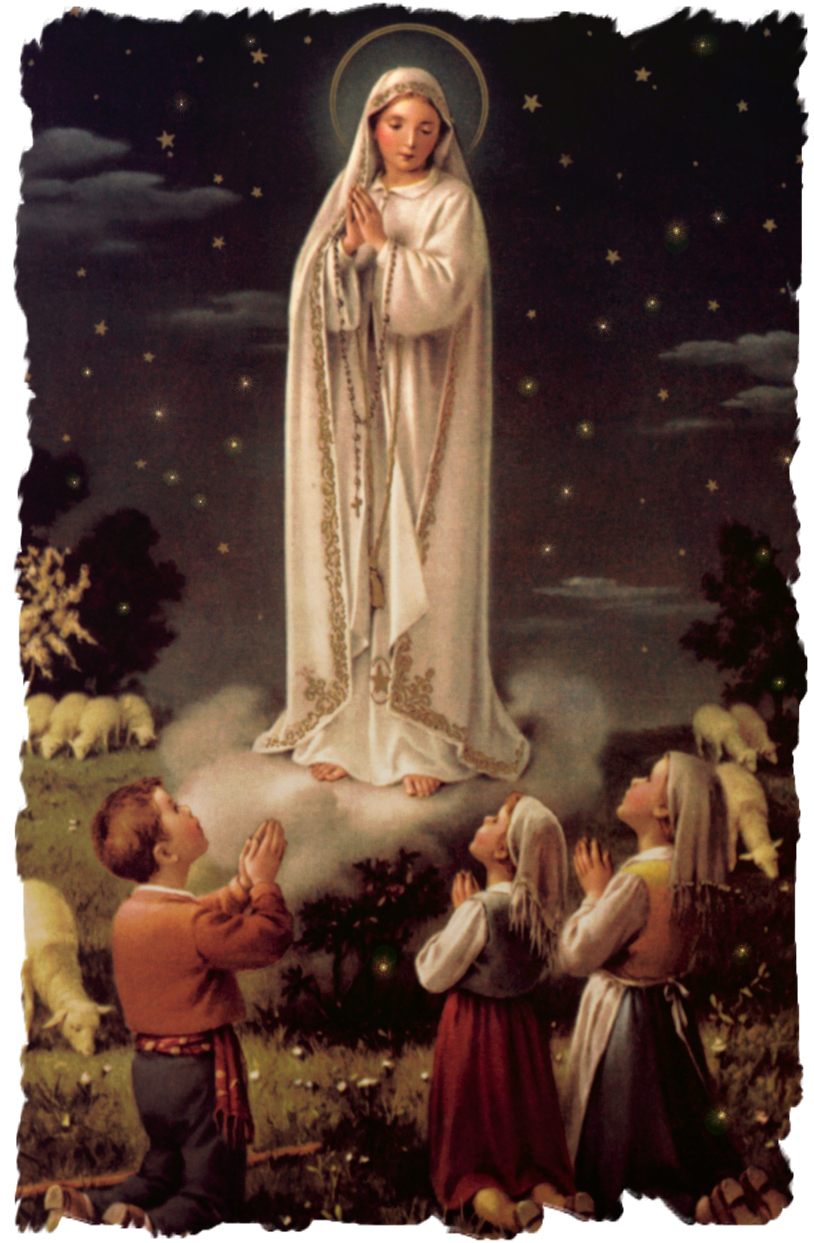
The message of Our Lady of Fatima can be summarized in three words: prayer, penance, and reparation. These three works are not novel, of course. They are part and parcel of the Gospel message proclaimed by Jesus during His earthly life, and taken up anew by His Church during each age of the Church’s journey through history. Mary is the Mother of the Church, so it’s hardly surprising that she, like all the other members of the Church, would proclaim this message when she appeared to the three shepherd children at Fatima, Portugal starting on May 13, 1917.
During that fateful year, in which the travesty of the Russian Revolt began to spread atheistic communism throughout the world, Our Lady appeared six times to the shepherd children. She counselled the faithful to works of prayer, penance, and reparation. Specifically, Our Lady told her children to take up the prayer of the Rosary. In fact, during the final apparition, on October 13, Our Lady identified herself as Our Lady of the Rosary. Among all the devotions of the Church (that is, outside the realm of the Sacred Liturgy), the Rosary holds pride of place.
“Rather, blessed are those who hear the word of God and observe it.” It is the mission of each and every Christian to proclaim the Word of God to the world. This Mary did at Fatima. She counsels us to observe the Word of God through prayer, penance, and reparation. From Heaven, Our Lady of Fatima intercedes for each of her children within the Church, that God’s grace might strengthen them to take up faithfully the works of the Gospel.
 Reflections on the Sacred Liturgy