The Thirtieth Sunday in Ordinary Time [B]
Jeremiah 31:7-9 + Hebrews 5:1-6 + Mark 10:46-52
Today’s Second Reading—from the New Testament Letter to the Hebrews—points our attention to the priesthood of Jesus Christ.
This past week, the priests of our diocese gathered with the bishop for an annual conference. It’s a time for continuing education, for prayer together, and for simple fraternity. During the conference, as I thought about this weekend’s homily, the Second Reading came to mind.
It’s important to preach occasionally about the priesthood: Jesus’ priesthood, the ordained priesthood, and the priesthood of Baptism. But when a priest stands in the pulpit, there’s generally a reluctance to preach about the ordained priesthood, because it might seem as attention-grabbing. Yet during the conference, our main speaker—a Scripture scholar from Detroit—spoke about the New Testament’s Letter to the Hebrews, and an idea occurred about how to preach about the ordained priesthood.
I’d like to share with you part of my own vocation story. The most important part of the story is the foundation that my parents set in our home: the Christian home being what’s called “the domestic Church”. But if I were to tell you everything that my parents did to foster my vocation, it would take much longer than the usual length of a Sunday homily.
So instead, let me share with you another part of my vocation story. Let me tell you about three individuals who fostered my vocation to the ordained priesthood.
The first was my Second Grade CCD teacher, who prepared me for First Confession and First Holy Communion. She was a Dominican nun, who still wore a traditional habit. Sister Eloise taught us from a version of the Baltimore Catechism. She taught us the Catholic Faith, pure and simple. There were no felt banners, and we didn’t sing Kumbaya. Sister taught us that Jesus died for our sins, that Jesus loved us enough to give His life for ours, and that the night before He died for us, He gave to the Church the gift of the Mass, so that we could be nourished and strengthened by His Body and Blood.
Above all, there’s one thing that Sister Eloise taught us Second Graders that has stayed with me ever since. She taught us that when we were at Holy Mass, after the priest consecrates the bread and it becomes the Body of Christ, that as the priest elevates the Host, we ought to say silently to ourselves, “My Lord and my God!”: the words that St. Thomas the Apostle spoke when he first saw the Risen Jesus. Moments later, Sister taught us, when the priest elevates the chalice after the wine has been changed into the Blood of Christ, we ought to say silently to ourselves, “My Jesus, mercy!” The earnestness and devotion with which Sister Eloise witnessed to us Second Graders about the importance of the Mass made an impact on my life that remains with me today.
A second person whose witness made an impact upon me was, like Sister Eloise, only part of my life for one year. I met this second person ten years after my First Communion, when I was a freshman at Kansas State. Father Norbert Dlabal was the chaplain at St. Isidore’s, the Newman Center for Catholic college students.
In the Spring semester of that school year, I attended a weekend retreat in Missouri. When I returned to campus, I started attending weekday Mass in addition to Sunday Mass. There in the chapel, as Father Dlabal preached and offered the Holy Sacrifice of the Mass, I asked myself and God whether I was supposed to enter the seminary.
One day at St. Isidore’s I ran into Father Dlabal. As we visited, I mentioned what I was wrestling with in prayer, and his counsel helped me decide to enter the seminary the following semester.
About twenty years later, the priest who officiated at my parents’ wedding and who was my grandparents’ pastor for many years passed away. I drove to the cathedral in Salina for the funeral, and in the room where all the concelebrants were vesting, I saw Father Dlabal. I told him that I was a priest of the Wichita Diocese, and I told him how important his counsel had been to me, and as I went on and on, I could tell by the look on his face that he did not know me from the Man on the Moon.
At first, I was pretty disappointed. But then I thought of how many hundreds of college students he must have had conversations with over the decades, and how many of them he had also inspired. Likewise, I thought of the people who had come up to me over the years of my priesthood to thank me for something that I had said to them in conversation, in Confession, or in a homily. When that happens, I rarely recall what I said. But it’s not important whether a priest remembers what he said to others, as long as they do.
A third person who fostered my vocation to the ordained priesthood was one of my family’s pastors, Father Bob Kocour. He was the man who sent me a letter inviting me to the retreat in Missouri that I attended during my freshman year of college. He was the man who I had breakfast with every time that I returned home from the seminary, and who answered my questions about the priesthood. From his wisdom I learned the difference between the answers you learn in the seminary and the answers you learn from a man who has been in the trenches as a parish priest for more than five decades.
Father Bob Kocour was the man who, shortly before my ordination, gave me his own chalice, which he had had commissioned from a craftsman in Europe before his own ordination. Usually when I offer Mass here, I use the parish’s chalice. Today I will offer Mass with Father Kocour’s chalice. It’s a reminder that all good things in our lives—and especially the most important ones—come both through God’s grace and the sacrifices of others.
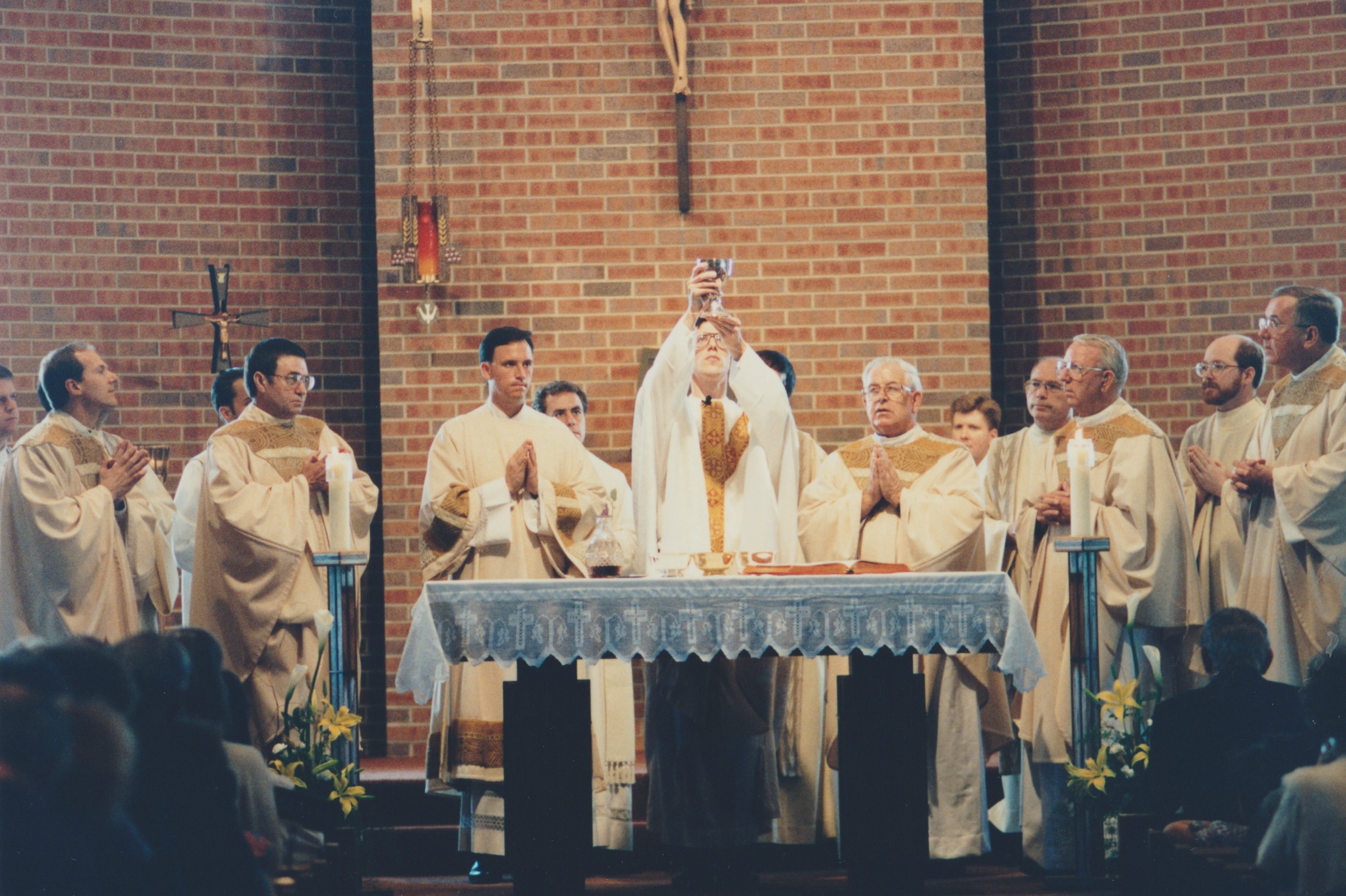
Father Hoisington’s First Mass on May 28, 1995. He is elevating the chalice – containing the Precious Blood of Jesus – that Father Robert Kocour (third from the right) gave him.
 Reflections on the Sacred Liturgy