PLEASE NOTE: In some dioceses, on Thursday of the Sixth Week of Easter the Ascension of the Lord is celebrated.
Thursday of the Sixth Week of Easter Acts 18:1-8 + John 16:16-20
“… you will grieve, but your grief will become joy.”
Just as the earth has two poles, so the Season of Easter has two poles: the Resurrection and Pentecost. Both are solemnities of great joy for Christians. Yet each is preceded by an event of loss, of “grieving” even. The Resurrection is preceded by the Death of the Lord, and Pentecost is preceded by the Ascension of the same Lord. But to use the word “preceded” here is a bit lacking. The Death and Ascension of the Lord are the “events”—the sacred “mysteries”—that make the Resurrection and Pentecost possible.
Jesus refers to both sets of mysteries—the Death and Resurrection, and the Ascension and Pentecost—by His words in today’s Gospel passage: “you will grieve, but your grief will become joy.” Today’s Gospel passage is from the sixteenth chapter of John: part of Jesus’ Last Supper discourse. In the short-term, then, He is speaking about His Death and Resurrection. Yet in His divinity, Jesus also knew of His impending Ascension as well as the Descent of the Holy Spirit, so He is also speaking here about His Ascension and Pentecost.
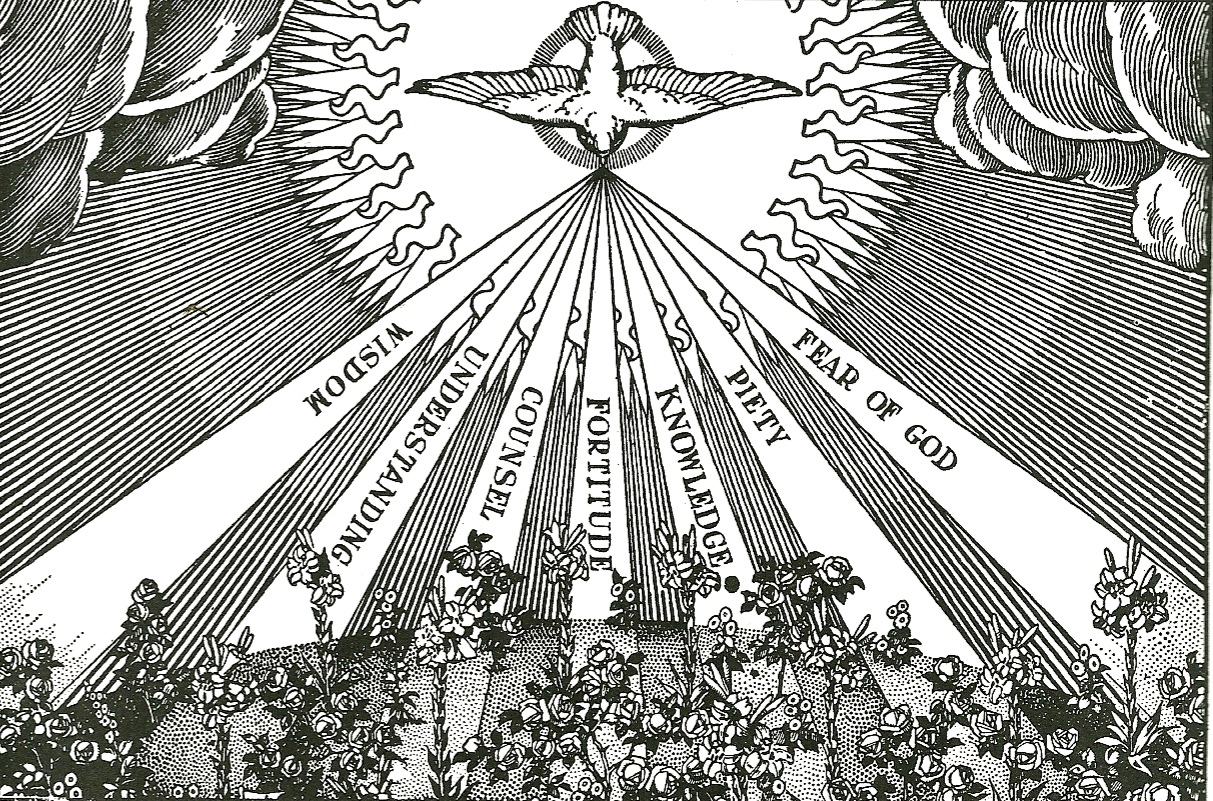
Much of the world today celebrates the Ascension of the Lord. Some dioceses will transfer the Ascension to this coming Sunday, and celebrate today as a weekday of Easter. In either case, begin a novena today: nine days of prayer, longing for the Holy Spirit to come into your life more powerfully, and to help you live more fully your vocation within the Mystical Body of Christ.
Wednesday of the Sixth Week of Easter Acts 17:15,22—18:1 + John 16:12-15
“… when He comes, the Spirit of truth, He will guide you to all truth.”
St. John Henry Newman, the nineteenth century convert to the Church from Anglicanism, is renowned for many theological works. One of the more famous is about the process of the “development of doctrine”. Newman had from boyhood been a keen student of history, and later in life he said that “to be deep in history is to cease to be Protestant”.
To make an analogy: as fundamentalist Christians say that God created the universe, Earth, and mankind immediately (that is, within six days), so the same fundamentalists often say that God created the doctrines of the Church immediately. If a phrase is not found in the Bible—they insist—it cannot be admitted into the mind of a Christian. Therefore, dogmas such as the “Immaculate Conception” and “papal infallibility” are clearly not Christian—they insist—because the apostles who composed the Bible never used these phrases, or spoke about these topics.
However, if beliefs cannot be accepted by Christians if they are not mentioned in the Bible, then these same people cannot profess a belief in the “Trinity”, since this word never appears in the Bible. “But,” these fundamentalists might argue, “the belief in the Trinity is in the Bible. It’s the word “Trinity” that came later, in order to dispel false interpretations of the Bible….” Yet such a defense supports Cardinal Newman’s teaching, which itself is simply an unpacking of Jesus’ words today: “when He comes, the Spirit of truth, He will guide you to all truth.”
Tuesday of the Sixth Week of Easter Acts 16:22-34 + John 16:5-11
“But if I go, I will send Him to you.”
In addition to their divinity, the divine Persons of God the Son and God the Holy Spirit were both sent by God the Father into this world, filled as it is by sin and death. Their missions differ, yet their missions converge as God’s Providential Will unfolds within salvation history.
Of course, before considering the Son’s and the Holy Spirit’s missions within salvation history, we ought to reflect on their work “in the beginning”. God the Father created everything in the universe, visible and invisible, through His divine Word, and through the Power of the Holy Spirit. The creation narratives in Genesis are more suggestive than telling. Nonetheless, they point us towards contrasts that we ought to reflect upon as we approach Pentecost: contrasts, that is, between God’s work of creation “in the beginning”, and God’s work of redemption in the fullness of time.
Perhaps the most significant contrast between the missions of the Son and Spirit in creation, and then again their missions in the work of redemption, is that in the latter they manifest themselves incarnately. Their missions converge within the Mystical Body of Christ. “In the beginning”, the Word remained the Word. But in the fullness of time, “the Word became Flesh and dwelt among us”. “In the beginning”, the Spirit hovered silently over the face of the deep. But in the fullness of time, He is the soul of the Mystical Body of Christ, animating that Body’s members, so that the Christ’s saving work is carried out “unto the end of the age.”
Monday of the Sixth Week of Easter Acts 16:11-15 + John 15:26—16:4
“When the Advocate comes whom I will send you from the Father, the Spirit of truth who proceeds from the Father, He will testify to me.”
Today Jesus—still addressing us from the Cenacle, at the Last Supper—proclaims the coming of the Holy Spirit. We note from Jesus’ words that—as we profess in the Church’s Creed—the Holy Spirit proceeds from both the God the Father and God the Son. Jesus Himself describes God the Holy Spirit as the One “whom I will send you from the Father, the Spirit of truth who proceeds from the Father”.
In the Creed of the First Council of Constantinople (in A.D. 431), the first ecumenical council to describe at any length the nature of God the Holy Spirit, the council Fathers stated that the Holy Spirit is “the Lord, the Giver of Life [and] proceeds from the Father….” This council did not state that the Holy Spirit proceeds from the Father and the Son. The phrase “and the Son” (in Latin, filioque) was added by the Church to the Creed later. Controversy continues to this day as to the propriety of this addition.
Christians of the West accept the dogma of the Holy Spirit’s procession from both the Father and the Son. We see in the doctrine an expression of the closeness of the Father and the Son, while maintaining their distinction as divine Persons. God the Holy Spirit proceeds from both the Father and the Son because the Holy Spirit is the Love of the Father and the Son both for each other (not merely the love of one for the other). Saint Augustine explores the meaning of this great teaching in his very long, profound, and difficult work “On the Trinity” (De Trinitate). Pray for the Holy Spirit to enter your life more fully, and towards this end, plan to begin a novena to God the Holy Spirit this Thursday.
Saturday of the Fifth Week of Easter Acts 16:1-10 + John 15:18-21
“I have chosen you out of the world ….”
In this Easter season, we continue to hear in the First Reading about the flurry of apostolic activity that spread through the world following the first Christian Pentecost. But what of Mary, the lowly Virgin, mother of the child who grew in this world in order to offer His life in sacrifice for our sins? What about the mother of Him who is the Good News that the apostles spread throughout the world? Where is Mary at Pentecost?
We might forget that she is the Mother of God, the Mother of Him through whom all things were made. We might forget that she, too, was present in that upper room. Why is she there? She surely had no need to receive that fullness of the Holy Spirit who descended at Pentecost. Her Pentecost—her Confirmation, so to speak—took place at the Annunciation. At that moment, the power of the Holy Spirit overshadowed her who had been sinless from the moment of her conception in the womb of Saint Anne.
At the Annunciation of the Good News, God became man: Christ’s Body began forming within Mary’s womb. Here in the upper room at Pentecost, that same Holy Spirit descends again, to overshadow the apostles. Here in the upper room, Christ had offered the first celebration of the Sacrifice of the Eucharist. There the Church—the Body of Christ—was born, that the apostles might go forth into the world to preach the Gospel and offer their lives in sacrifice for Christ.
Friday of the Fifth Week of Easter Acts 15:22-31 + John 15:12-17
“This is my commandment: love one another as I love you.”
Today’s Gospel passage is often proclaimed at Nuptial Masses. It speaks to the reality of love. It gives some concrete form to love. This concreteness is necessary when one lives—as you and I do—in a culture which equates love with warm, fuzzy feelings.
Today’s Gospel passage was written by St. John the Evangelist, who in one of his epistles tells us that “God is love” [1 John 4:8]. Today John quotes Jesus so as to give shape to the definition of God as love. In terms of the divine Person of Jesus, John quotes Christ Himself. The evangelist explains that “no one has greater love than… to lay down one’s life for one’s friends.” The setting of today’s Gospel passage is the Last Supper. As He spoke these words, Jesus knew that He would give the ultimate example of such love the next day.
But the Church proclaims today’s Gospel passage during the midst of Easter. The reason for this is that Christ doesn’t want His disciples simply to admire His sacrifice, but to enter into it. To do what our Savior commands, we need the power of the Holy Spirit, whom the Father and Son will send at Pentecost. In the Spirit of the Father and the Son, you can find the strength to love your neighbor as Jesus has loved you.
The Sixth Sunday of Easter [C] Acts 15:1-222-29 + Revelation 21:10-14,22-23 + John 14:23-29
“The Advocate, the Holy Spirit … will teach you everything ….”
This Sunday’s Gospel Reading is set at the Last Supper. Yet Jesus speaks in veiled terms about His Ascension to the Father, which of course took place less than seven weeks after the Last Supper. In Sunday’s Gospel Reading, we hear Jesus proclaim: “If you loved me, you would rejoice that I am going to the Father”. But how could we expect the apostles to rejoice over Jesus leaving them?
After His Resurrection, Jesus could have remained in Jerusalem instead of ascending to Heaven. Through His divine power, Jesus could have kept His resurrected, glorified body from ever aging, so that even today, He would still be just 33 years old. From Jerusalem He would be still ruling the earth, settling disputes, and working miracles to dispel hunger and disease.
“Would not that have been a better world?”, we might ask. Why, instead, did Jesus ascend to the Father’s Right Hand in Heaven, and establish in His stead a Church whose members have been unfaithful to the Church’s mission in every century of her history? The answer points our attention to the divine virtues of faith, hope and love.
St. Thomas Aquinas, in his Summary of Theology, teaches that “Christ’s Ascension into Heaven, [by which] He withdrew… from us, was more profitable for us” because it can “increase our faith, which is of things unseen.” The apostle Thomas stands as a contrast to such a life of faith. Doubting Thomas would not believe until he saw the Risen Lord. Jesus calls us, instead, to fit our lives to His words: “Blessed are those who have not seen and yet believe” [John 20:29].
Likewise, “Christ’s Ascension into Heaven… was more profitable for us” because it can “uplift our hope”. We might like to imagine that the earth would be a perfect place had Jesus never ascended, remaining to guide us through this world. But it’s not for this world that Jesus became incarnate by the Virgin Mary, was crucified and rose again. Remember that while Jesus miraculously raised Lazarus from the dead, His intention was not for Lazarus to live on this earth forever. Jesus didn’t give Lazarus eternal life, but a reprieve from death.
Third, “Christ’s Ascension into Heaven… was more profitable for us” because it can “direct the fervor of our charity to heavenly things.” In other words, we need Heaven to focus all the many different forms that virtue can take. Every virtue is to culminate in the virtue of charity, and all charity is to culminate in an eternal share in God’s life in Heaven.
But here below, each of the virtues often wanders alone, degenerating into its own end. One of the great apologists of the 20th century, the English convert G. K. Chesterton, put it this way:
“The modern world is not evil; in some ways the modern world is far too good. It is full of wild and wasted virtues. … The modern world is full of the old Christian virtues gone mad. The virtues have gone mad because they have been isolated from each other and are wandering alone. [And so, for example,] some scientists care for truth; [but] their truth is [without pity]. [Also,] some humanitarians only care for pity; [but] their pity (I am sorry to say) is often untruthful.”
In the 21st century also, we see the virtues isolated from each other. For example, there are scientists who would like to clone human beings. This search for truth is divorced from the need for ethics: specifically, from the need to respect the unique dignity of human nature. Also, there are strict federal laws in our nation protecting the eggs of certain birds that are endangered species. Yet this desire to have compassion for an innocent unborn bird is divorced by many from the need to have compassion for an innocent unborn human being.
In each such example, a desire to pursue a good is divorced from the larger picture. This leaves another, also needed virtue out in the cold. Looking to God—the Maker of all creatures and the origin of all Truth—focuses human efforts to do good, and helps us neither to do bad, nor to do good inconsistently. In our efforts to do good, we can grow in all the virtues, and open our selves more fully to the life of God the Most Holy Trinity.
Thursday of the Fifth Week of Easter Acts 15:7-21 + John 15:9-11
“If you keep my commandments, you will remain in my love ….”
The long discourse of Jesus at the Last Supper, recorded in chapters 13-17 of John, has several themes which Jesus touches upon over and over again. Jesus weaves these themes together, as if his words on this solemn night formed a tapestry of the Good News.
Jesus’ words—“If you keep my commandments, you will remain in my love”—focus our attention on two of these themes: “my commandments” and “my love”. Sometimes in a culture that encourages us to base our actions on our feelings, and which defines love as nothing more than a feeling, “commandments” and “love” seem directly opposed. Some say, in fact, that the person who truly loves does not need commandments: in this case, we could understand Jesus saying, “If you remain in my love, you will keep my commandments.” But Jesus here says the opposite.
Jesus claims in this verse that if you keep His commandments, you will remain in His love. His commandments are a means to the end of His love. This is not to say that the opposite is not also true. But Jesus’ words today remind us of the importance of His commandments, and that all of His commandments are in fact nothing more than commands to love God fully, and to love one’s neighbor as oneself.
Wednesday of the Fifth Week of Easter Acts 15:1-6 + John 15:1-8
“I am the true vine, and my Father is the vine grower.”
Jesus today proclaims a powerful metaphor. He captures the relationships among the Vinegrower, the Vine, and the branches with their fruit. This metaphor expresses powerfully the relationship between God the Father and God the Son. Within this relationship we see our place as members of the Mystical Body of Christ.
John’s account of the Gospel is the most mystical and sublime of the four Gospel accounts. Therefore it’s also the most difficult to reach into and meditate upon. Today’s metaphor opens a window into the sacred Teaching of the Beloved Disciple.
Begin with a simple question: What is God the Father like as a Vinegrower? This is a very simple, earthly and earthy image. If you know anyone who is a gardener (or even more specifically, a vintner), you can picture some of the qualities that this image evokes. The tenderness, patience, perseverance, and dedication that flow from this image teach us about the Love of the Father for His Son, and for us who are members of His Son’s Body.



 Reflections on the Sacred Liturgy