The Twelfth Sunday in Ordinary Time [C]

The Twelfth Sunday in Ordinary Time [C]
Zechariah 12:10-11  +  Galatians 3:26-29  +  Luke 9:18-24

“Deny your self / and take up your cross daily / and follow me.”

That’s what our Savior Jesus Christ says that you must do in order to be His disciple.  He’s very straightforward.  There are only three things.  Deny your self.  Take up your cross daily.  Follow Jesus.

One difficulty in letting these words sink deep into our hearts is that these three can seem interchangeable.  We might say to our self, “Isn’t ‘taking up your cross daily’ the same thing as ‘following Jesus’?  Isn’t ‘denying your self’ the same thing as ‘taking up your cross’?”  And so on.  It takes an intentional act on our part to stop, listen to, and make our own the words of Holy Scripture.  That’s why at least once every five years, each adult Catholic ought to commit herself or himself to a study of Scripture, whether that’s with a group in one’s parish, or for those who are self-starters, an individual study of a particular book of the Bible, or a particular group of books, like the letters of Saint John the Evangelist.

Deny your self.  Take up your cross daily.  Follow Jesus.  While these three are pieces that join to form a whole, they’re not interchangeable.  Each makes different demands of you, and requires a different spiritual skill-set, as it were.

Consider the first command that Jesus lays at your feet today.  “Deny your self.”  What does the word “deny” mean?  Another word for “denial” is “renunciation”.  Both words are clearly negative, which lends itself to a common criticism of Catholicism:  namely, that Catholicism bears a strand of pessimism or gloominess.  That’s why some non-Catholics look with suspicion on practices such as hanging a crucifix in one’s home, or praying the Stations of the Cross.

So what’s the reason for the Church’s insistence on negative practices such as “denial” and “renunciation”?  In grade school math, we were taught that the negative of a negative is a positive.  “Negative two” times “negative two” equals “positive four”.  So while it’s true that denial and renunciation are negative practices, their purpose in the Catholic Faith is to reverse course on the negative effects of Original Sin.  In one word, these effects can be summed up as “selfishness”, but the saints who became masters of the Christian moral life and prayer life realized that selfishness comes in many different forms, such as pride, wrath, greed, sloth, lust, envy, and gluttony.  So to “deny your self” means to deny your “fallen self”, the false self that results from allowing the effects of Original Sin to coalesce into personal sins, which over time can harden into vices. 

The negative of a negative is a positive, and so when we practice self-denial in order to root out moral vices, we till the good soil of our soul for God to water with His grace.  Through God’s grace and our efforts, the Image of God can come to the fore in our soul.  To the Image of God can be joined a likeness to God.  Virtues can result, leading to the summit of virtue:  a life lived in divine charity, both on earth and in Heaven.  This is why we deny our self.

Consider, then, the second command that Jesus lays at your feet today.  “Take up your cross daily.”  How is this command different than the command to “deny your self”?  Both seem negative, but each has its own aim.  The second is really the aim of the first.  The first prepares for the second.  If self-denial is pulling the weeds from your soul, then taking up your cross is planting and cultivating the seeds that will bloom there.  Or consider an analogy to athletics.  Both the months of training and the day of competition are very difficult.  Both demand much that’s negative:  training involves strenuous workouts, and competition involves tension and anticipation of the opponent’s moves.  But the difference is that the practice prepares for the competition, and in the same way, denying our self is rooting out the weaknesses in our soul, in order that we can take up the cross.

But the competition that we enter as Christians is not just on Friday, or just for a season.  Jesus reminds us that taking up our cross is a daily event.  That means it’s with us when we wake up, whether we want it to be there or not.  We can’t call in sick (or if we do, we should do so by going to confession for healing).  “Take up your cross daily.”  Some days, of course, the burden weighs heavier than others.  Part of the burden can come from the form that our cross takes.  Sometimes its form changes with the circumstances of our lives.  Regardless, in the midst of carrying our cross each day, and especially on the days it’s so difficult, we need to recall why.  We need to recall why we deny our self, and why we take up our cross daily.

Consider, then, the third command that Jesus lays at your feet today.  “Follow me.”  I hope that those are the first words you hear every morning when you wake up.  These are words of encouragement and promise.  One way to imagine the meaning of these words is to picture the Fifth Station of the Cross, where Simon of Cyrene walks with Jesus up Calvary, bearing the cross of mankind.  This is one way to picture what Jesus is commanding us in today’s Gospel.  We are helping Jesus.  We are struggling daily alongside Jesus.  The company of Jesus, even in the midst of trial, brings far more lasting peace than anything that the comforts of this world can give.  Jesus is the best company we can have in this world.

It’s for the sake of Jesus’ company, in this world and the next, that we bear everything we bear in this world.  You’re familiar with the modern poem titled, “Footprints in the Sand”.  What this poem drives at is Jesus’ company through thick and thin.  Jesus is there, even if we are not present to Him, or even aware of His Presence next to us, or bearing us in His arms.  “I would never leave you,” Jesus says to us on those days when carrying our cross seems difficult.  “During your times of trial and suffering, when you see only one set of footprints, it was then that I carried you.”

In our Catholic Faith, the more religious word for “company” is “communion”.  Being in communion with Jesus, with His Church, and with all the members of the Church, requires grace even more than our efforts (those our efforts are necessary).  It’s in order to help our unbelief, so that we might believe more, that Christ gives us His Body and Blood as true food.  This Holy Communion strengthens us for the seven days that now lay before us in the world, before the Lord calls us to His altar again.  We give thanks for having a God who is gracious, who understands our many weaknesses, and who loves us enough to sacrifice His life for us, so that each day we can find meaning in our own sacrifices.

Homily for the Fifth Sunday of Lent [C]

The Fifth Sunday of Lent [C]
Isaiah 43:16-21  +  Philippians 3:8-14  +  John 8:1-11
April 6, 2025

Jesus’ compassion towards the woman caught in adultery focuses our attention, on the one hand, upon human sin.  At the same time, though, Jesus always wants us to think about sin within the perspective of divine mercy.  Never think about your sins without reflecting on God’s merciful love for you.  At the same time, never think of God’s love for you without remembering the depths to which Jesus sank to pour that love into your heart.

It’s in light of this two-fold perspective—human sin and divine mercy—that we listen to Saint Paul today.  In today’s Second Reading, St. Paul preaches to the Philippians about several stark contrasts:  about loss and gain; suffering and power; death and resurrection.  All of these help each of us understand what Jesus wanted the woman caught in adultery to understand.

In our ordinary lives, we tend towards thinking of morality only in terms of good and evil.  That is a foundational distinction:  to do the good and to reject the evil.  If we don’t accept in our minds this most basic moral distinction, and shape our choices accordingly, we have little hope of reaching Heaven.  On the other hand, that most basic moral distinction between good and evil is a foundation, on top of which we as Christians are meant to build.  St. Paul gives us tools to build our moral lives towards Heaven (or as he puts it, “to continue [our] pursuit toward the goal, the prize of God’s upward calling, in Christ Jesus.”).

In his Letter to the Philippians, Saint Paul makes very sharp contrasts.  For example, he explains to them:  “I consider everything as a loss because of the supreme good of knowing Christ Jesus my Lord.”  This is a stark contrast:  between the ‘loss of everything’ and the ‘supreme good of knowing Jesus’.  However, St. Paul continues with an even starker contrast:  “For His sake I have accepted the loss of all things, and I consider them so much rubbish, that I may gain Christ and be found in Him…”  “Rubbish” and “Christ”:  that’s the second contrast that St. Paul describes for your meditation as we draw closer to Holy Week.

Saint Paul’s challenge to us is to build upon the foundation of doing good and rejecting evil.  The challenge in rising to a higher level of moral growth is to be single-hearted in our pursuit of God.  To be “single-hearted” is—in the words of Jesus’ beatitudes—to be “pure of heart”.  Of course, some might assume that Jesus’ statement “Blessed are the pure of heart, for they shall see God”[1] is referring to sexual purity.  In fact, Jesus is saying not only that, but a lot more as well.

When gold is tried in fire, impurities are burned away.  The gold becomes more pure, which is to say that it becomes more “gold-like”, which is to say that it becomes more itself.  It’s the same with an individual human person—such as yourself—when you purify your heart of foreign desires:  desires foreign to the very nature of the human heart as God designed it.

In the language of the First of the Ten Commandments:  when you purify your heart of “strange gods” (or “alien gods”), your heart becomes more pure:  more “human-like”, which is to say that you become more who God created you to be.  It’s as simple as Saint Augustine’s famous confession to God:  “You stir man to take pleasure in praising You, because You have made us for Yourself, and our heart is restless until it rests in You.”[2]

+   +   +

It’s a common temptation to dismiss the First Commandment as irrelevant.  After all, who among us actually worships “alien gods”?  We’re not like the ancient Greeks and Romans who worshipped Aphrodite and Jupiter, Mercury and Athena.  So how can you and I usefully hold up the First Commandment before our lives, to see if our hearts are single-hearted:  that is, pure in being focused upon God alone?

Before even answering, some might reply that it’s impossible for a regular Christian—especially one who is married and has children—to be focused on God alone.  There are too many other things to worry about in life!  A similar reply might be made by a parish priest, who can hardly spend all day in prayer given his administrative responsibilities.  However, those replies would miss the point.  The First Commandment does not command us to be monks and nuns.

The First Commandment guides our lives in commanding that everything must be held up to the “light of the Lord”.  This includes everyone and every thing in our lives, including sports, jobs, academics, socializing and vacationing.  Jesus demands of us as His followers that we put God first.  You know, that’s why the First Commandment is the first of the Ten Commandments.

When God gave Moses the Ten Commandments, God did not list them in a random order.  As with everything that God does, He listed the Ten Commandments in an order that has structure and design.  That’s why the first three of the Ten Commandments are about loving God, because loving God has to be our first priority:  if we don’t get that right, then we’re not going to get anything that follows right.

In the list of the Ten Commandments, what follows the first three are the Fourth through Tenth Commandments, which are about loving our neighbor.  Loving God is first.  Loving our neighbor follows, flows from, and is possible to the extent that we love God authentically.

The Second and Third Commandments, then, are two specific ways of loving God as He deserves, and in fact as He commands.  It’s not enough not to have false gods, as the First Commandment addresses.  Even if we only have one God—the true God—at the center of our lives, we then have to engage with Him, and the two most important ways of doing that are our words and our worship.  The Second Commandment is about giving God His due regarding our speech, while the Third Commandment is about giving God His due regarding our religious practice.

Both the Second and Third Commandments are especially challenging for those living in the modern Western world.  The Second Commandment—about honoring God’s holy Name—is a challenge because of the modern mass media.  The Third Commandment—about giving God due worship—is a challenge because modern man has so many diversions, and—relatedly—because modern man is so mobile, so on-the-move today.  Nonetheless, being on the move is not a valid reason for not honoring the Sabbath by giving God the worship that He has asked of us.

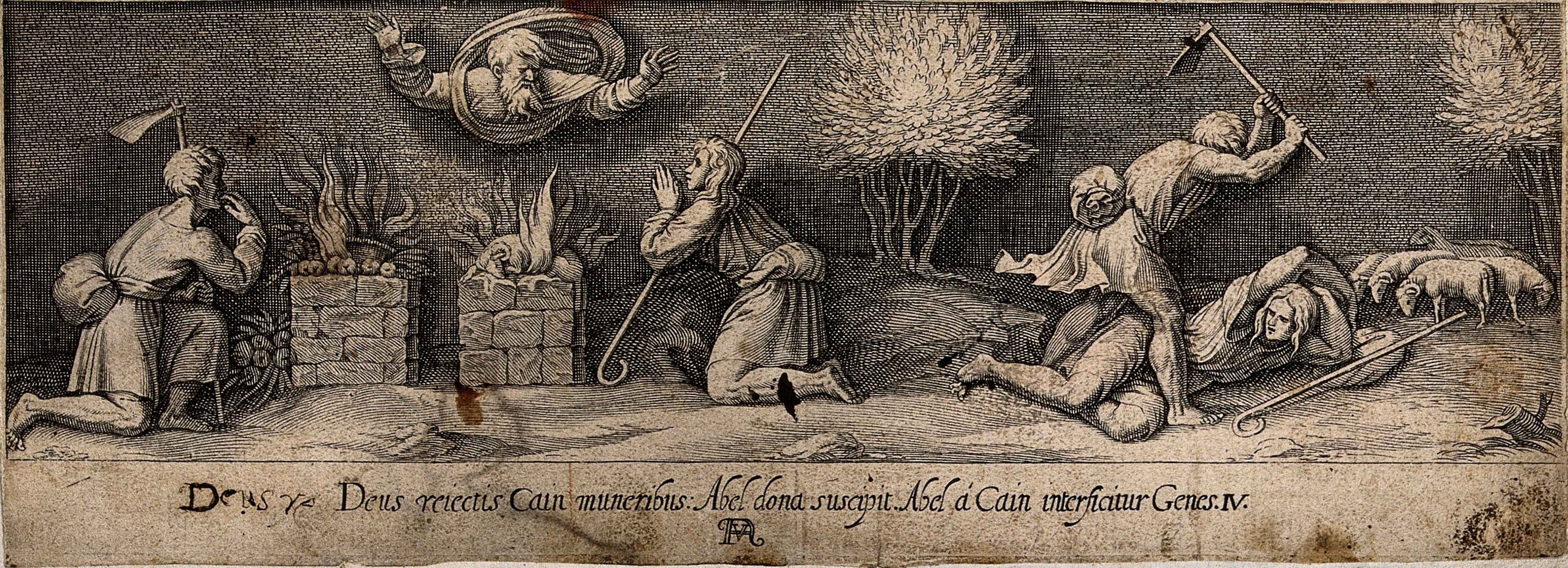
Of course, there are some people who claim that they can worship God in the manner that they decide upon.  If they feel like getting up on Sunday morning and ambling out to the middle of their pasture and watching the sunrise, well then, that’s their way of worshipping God.  What that approach fails to keep in mind is that from the beginning, God has told His People how to worship Him.  Remember that the first murder in human history—Cain killing his brother Abel—originated in the right and the wrong worship of God.

Throughout the Old Testament, God gave to His Chosen People increasingly more specific instruction about the right way to worship God:  that is, the way which would give God His due.  Then, in the fullness of time, God sent His own Son to become Flesh and dwell among us, and on the night before that Son was put to death, He took the Jewish Passover meal and transformed it into the Holy Sacrifice of the Mass, so that the Sacrifice that that divine Son offered on the Cross the following afternoon would become the form, the shape, of the worship offered by God’s Chosen People.

Many Christians, and even Catholics, don’t understand the Church’s teaching that when the Holy Sacrifice of the Mass is celebrated, the Sacrifice of Jesus on Calvary is made present before us.  Or, if you prefer, you can say that we in our day and time are transported mystically whenever Holy Mass is celebrated to the time and place of Jesus’ Sacrifice on Calvary.

God the Father has given us the most perfect form of worship on this earth:  not just proclaiming, preaching, and singing God’s Word, but being present when that Word becomes Flesh in the Eucharist.  God commands that we share in this Sacrifice each Sunday and Holy Day.  That’s why it’s a mortal sin to miss Sunday Mass unless we’re seriously ill or have a similarly serious reason:  because God deserves to be worshipped by joining our lives to the sacrifice of His Son on Calvary.  What’s more, it’s only by the strength of the Holy Eucharist that we can be strong enough to carry out the lives he wants us to lead in this world.


[1] Matthew 5:8.

[2] St. Augustine of Hippo, Confessions, trans. Henry Chadwick (Oxford: OUP, 1992), 3.

Sermon for The Sixth Sunday in Ordinary Time [C]

Sermon for The Sixth Sunday in Ordinary Time [C]
Jeremiah 17:5-8 + 1 Corinthians 15:12,16-20 + Luke 6:17,20-26
February 16, 2025

Lent starts soon.  Now is the time to be reflecting on how to make the most of Lent this year.

One suggestion, which you can incorporate along with your customary Lenten practices that you take up every year, is to make a weekly Holy Hour during each week of Lent.

Sometimes people will discourage themselves from the practice of a Holy Hour.  They tell themselves that you can only make a Holy Hour when there is Solemn Exposition of the Blessed Sacrament:  that is, when the Eucharist is solemnly shown in a gold monstrance that rests upon the altar, flanked by candles.

That solemn form of Adoration is a powerful means of prayer.  It’s a powerful means of communion with the Lord Jesus.  However, that solemn form of Adoration is not the only way to make a Holy Hour.  A simpler Holy Hour can be made simply by entering a church where Jesus is present in the tabernacle, and by spending an hour in a pew in His presence.

+     +     +

However, there’s also another reason by which people will sometimes discourage themselves from making a Holy Hour.  They ask themselves, “What in the world am I going to do for an entire hour?”  “I’m just supposed to sit there in church, for an entire hour?”

The fact is that no two Christians who make spiritually fruitful Holy Hours will do so in the same way.  Think of it like this:  imagine that a father has four children.  He sets a goal for himself.  Each week, he’s going to spend one hour with each of his children:  one hour alone each week with each of his children.

Now, how is he going to spend those four hours?  He’s not going to spend all four hours in the same way.  He’s going to spend each hour in a way that best allows him to bond with that particular child.  He might go fishing with the first child, but with the second spend time fixing something in the garage, with the third spend time reading a book, and with the fourth spend time in the kitchen.  It all depends on the uniqueness of the child.

This analogy helps us understand something important about the Holy Hour.  No two Christians are going to spend a Holy Hour in the same way.

Of course, from an exterior perspective—looking from the outside in—it might seem that two Christians spend their Holy Hours in the same way.  From an exterior point of view, those two persons both spend their hours in the pew, in the Presence of the Blessed Sacrament.  But the Holy Hour is not an exterior experience.  It’s an interior experience.

What takes place interiorly during a Holy Hour differs from person to person, for at least two reasons.

First, God the Father loves each of His children uniquely, because each child is unique.  So God the Father speaks to each of His children uniquely when each makes a Holy Hour.

Second, because each Christian is unique, she or he has her or his unique way of relating to God.  Each Christian has her or his own temperament and gifts, and these bear upon how she or he relates to, and speaks to, God.

+     +     +

With that in mind, consider four different ways that a Christian might spend time during a Holy Hour before the Blessed Sacrament.

The first is to spend time praying devotions.  Devotions include the Rosary; the Divine Mercy Chaplet; any number of litanies, such as the Litany of the Sacred Heart, the litany to Our Blessed Mother, known as the Litany of Loretto, and the Litany of Trust;  as well as any number of novenas, such as the Surrender Novena, the St. Thérèse Novena, and the St. Jude Novena.  Starting on the Sunday before Ash Wednesday, you’ll find copies of some of these devotions in the back of church.

The second way to spend time during a Holy Hour is spiritual reading.  Of course, the best spiritual reading is from the best book there is:  the Good Book.  But Sacred Scripture is in a category by itself, in the third way to spend time during a Holy Hour.  Here in this second way—which is simply called “spiritual reading”—the reading matter is any excellent book about the spiritual life.  A good rule of thumb is that if it’s still in print, the older it is, the better it is, especially if it was written by a canonized saint.  Examples include The Imitation of Christ by Thomas à Kempis, or The Autobiography of St. Teresa of Avila, or True Devotion to Mary by St. Louis de Montfort.

The third way to spend time during a Holy Hour is Sacred Scripture.  This is not simply “spiritual reading”.  Instead, through the twenty centuries of the Church’s history, saints have developed a four-step means of fully engaging oneself in—or you might say, “wrestling with”—God’s Word.  Briefly, these four steps are lectio, meditatio, oratio, and contemplatio:  that is, reading Scripture, meditating upon Scripture, praying from Scripture, and contemplation with the Word of God Himself.

That leads to the fourth and final way to spend time during a Holy Hour.  The first three ways that I mentioned are just suggestions.  They’re optional.  There are many other ways of spending time during a Holy Hour besides those three.  However, the fourth way is essential.  You might even say it’s the goal of spending time in Adoration:  namely, contemplation.  On the homepage of our parish website, I’ve put a link to a webpage from the Catechism of the Catholic Church, explaining the Church’s teaching on the stage of prayer called contemplation.  In the simplest terms, contemplation is what the saints in Heaven are engaged in:  direct, prayerful communion with God.  That’s what contemplation is, or at least, is meant to be.  Oftentimes, when we here on earth pray, we’re distracted by both good and bad things.  These diminish our focus.  But all of prayer, even if it’s simple and even if it’s weak while we’re on earth, is a preparation for, and a foretaste of, life with God forever in Heaven.

The Third Sunday in Ordinary Time [C]

The Third Sunday in Ordinary Time [C]
Nehemiah 8:2-4,5-6,8-10  +  1 Corinthians 12:12-30  +  Luke 1:1-4; 4:14-21

When you’re little, your imagination helps you fill in the gaps about all the things in the world that you don’t understand completely.  When I was a boy, I did not think very much about becoming a priest.  I never seriously thought about being a priest until my freshman year of college when I was at K-State.  Maybe one reason that I didn’t think much about entering the seminary when I was little was because of what my imagination told me that the seminary must be like.  For whatever reason, when I was a little boy I thought that life in the seminary consisted chiefly of two things:  kneeling on wooden kneelers for hours on end, and memorizing all the names of the popes.  When as a boy I learned that there were over two hundred sixty popes, I gave up thinking about the seminary.

Why does our imagination want to fill in the gaps about things that we don’t understand?  It’s pretty simple, really.  No one likes to be ignorant.  No one likes to be in the dark.  Everyone by nature desires to know.

Imagine that you were given a bag of 500 jigsaw puzzle pieces, but were not given the box displaying the picture that the pieces make.  You would probably be able to put many of those puzzle pieces together, two pieces at a time.  But eventually you would also form an idea about what the overall picture looks like, and if your imagination were correct, that would make it easier to find two pieces to fit together.  The point is that our imagination by nature fills out pictures that we only have pieces of.

This is true of our Catholic Faith, as well.  That makes sense.  After all, one of the key words of our Catholic Faith is the word “mystery”.  Understanding our Catholic Faith, and living the spiritual life that flows from it, are filled with mysteries that go beyond what our imagination can help us picture.

+     +     +

When I was a boy, I loved mysteries, but not the sort of mysteries that make up our Catholic Faith.  I read lots of mystery stories when I was a boy.  First I read all the stories of the Bobbsey Twins, and then the stories of the Hardy Boys, and then I graduated to Sherlock Holmes.  I devoured all fifty-six short stories and four novels about the world’s greatest detective.  Every mystery story presents a mystery that challenges the reader to piece together the clues leading to the solution of the mystery.

The great thing about such stories is that there always is a solution that we can thoroughly figure out.  I as the reader may not be smart enough to figure out what that solution is until the last page, but the solution is there all along.  The mystery is just a veil that hides the solution from my sight.

The mysteries of faith are different in an important way, because the mysteries of our Catholic Faith resist any ultimate solution.  If we go about reading God’s Word in one of the books of the Bible—like Ezra in today’s First Reading, or Our Lord Jesus in the Gospel passage—and if expect God’s mysteries to be solved by the end of the book, we’re going to be disappointed.

That’s not to say that the Bible makes no sense, or that we cannot make headway in exploring the mysteries of our Faith.  In the First Reading, “Ezra read plainly from the book of the law of God, interpreting it so that all could understand”.  Likewise, in his second letter to Timothy, St. Paul instructs us that the “sacred scriptures… are capable of giving you wisdom for salvation through faith in Christ Jesus.  All scripture is inspired by God and is useful for teaching, for refutation, for correction, and for training in righteousness” [2 Timothy 3:15-16].

So when it comes to God’s sacred mysteries, there’s a tension between what can be grasped and what remains elusive.  This tension was captured by the layman St. Thomas More.  About 1500 years after the New Testament was composed, St. Thomas More wrote that Holy Scripture is “so marvelously tempered, that a mouse may wade there…, and an elephant be drowned…” [Thomas More, A Dialogue Concerning Heresies, I, 25].

+     +     +

In the light of these sacred mysteries, with all its tension between reason and faith, how are we meant to live out our Catholic Faith?  There are two opposite extremes that we need to avoid.  The approach that the Church shows us to take falls between these two extremes.  But the more common extreme in our own day is the one we need to be more cautious of.

One extreme is the crutch of rejecting everything that is mysterious.  Those who resort to this extreme only deal with mysteries, if they do at all, in order to solve them and move beyond them.  Mystery as mystery has no value.

One of the chief examples in our modern culture of such extremists are secular scientists:  those who believe that the universe is made only of matter; only of what can be measured; only of what can be manipulated.  Of course, this sort of scientist also has a counterpart in ordinary society today.  This common man counterpart is skeptical of anything he cannot see and touch with his own senses; that he cannot judge and evaluate; that he cannot put in its place.

But you have to wonder:  what do these secular scientists and common man skeptics make of love?  After all, love is not made of matter.  You cannot examine love under a microscope.  You cannot put love in its place.  Does it not exist, then, or is it simply a mystery not worth bothering about?  Or is love just an illusion caused by neurons firing in the brain, with no real substance of its own?

Love is a mystery, and as St. John writes in his first New Testament letter, “God is love” [1 John 4:8 and 4:16].  So if God is infinite love, He is infinite Mystery.

God is infinite Mystery.  God in not made of matter.  You cannot examine God under a microscope.  You cannot put God in His place.

Unfortunately, there are many Christians who try to do just that.  Three are many Christians who believe that they can put God in a box, as if God is something that they can control, and measure, and figure out.  This way of dealing with God has many things wrong with it, but the most disastrous is the truth that God is absolute Mystery, and if my approach in life is to avoid whatever cannot be controlled, then I must forfeit a relationship with God Himself.

So how, then, can we approach and possibly even explore and enter into this Mystery?  It’s not possible through objective, rational knowledge, but through a heart-to-heart relationship that God initiates by speaking to us His Word.

Unfortunately, many Christians—and as a man, I will admit, many men—are not comfortable with talking about a relationship with God.  Many men, for whatever reason, have difficulty with relationships.  They prefer to live their lives according to the work that they accomplish, and the money that they earn.  Those are not bad things:  in fact, they’re necessary in this world here below.  But they don’t go to the heart of a relationship.

A relationship, by definition, is a mystery.  A relationship is a mystery because it involves an “other”:  that is to say, an other person.  Not a fact that I can memorize; not a problem to be solved; not a job to be accomplished; not a paycheck to be earned.  In a relationship, I stand before an “other”, who is a mystery and whom I cannot control.  Because of this, a relationship is always open-ended, as opposed to the way in which I relate to fact and figures, jobs and money.

This is part of what we see in today’s Gospel passage.  The passage about Jesus in the synagogue follows immediately after Satan tempting Jesus in the desert, which in turn follows the narrative of Jesus’ baptism.  In other words, this is the beginning of Jesus’ three years of public ministry.  In the town “where He had grown up”, Jesus goes “according to His custom into the synagogue on the sabbath day”.  In other words, He was in a place very familiar to Him, and He in turn was familiar to those in the synagogue that day.  No mystery here!  It’s all very comfortable.

But then something happens to break the sense of custom and familiarity.  Jesus proclaims a passage from the Old Testament prophet Isaiah, and after doing so He tells the others in the synagogue, “‘Today this Scripture passage is fulfilled in your hearing.’”  That’s a striking thing to say, that a passage of the Old Testament has been fulfilled right here and now.  This isn’t what the average Jewish person would have expected to hear when he went to the synagogue on the sabbath.  After Jesus proclaims the passage from Isaiah and sits down, “the eyes of all in the synagogue looked intently at Him.”  This was a mystery that they could not explain.

Still early on in this new Church year—today being just the Third Sunday in Ordinary Time—it’s good for us to focus on the fundamentals of our Catholic Faith.  The whole of our Faith focuses on this divine Person, Jesus of Nazareth, who is God’s Word made Flesh.  This Person is true God and true man, and founded a church that—He insisted—the gates of Hell would never prevail against.  This Person offered up on a cross His own Body and Blood, soul and divinity.  This is the same Person who becomes truly and substantially present on the altar in the Holy Sacrifice of the Mass, and from there within the soul of the person who enters into relationship with Him, and worthily receives Him.  God offers us this Word made Flesh.  How will you reply to Him?

The Eighth Sunday in Ordinary Time [B]

The Eighth Sunday in Ordinary Time [B]
Hosea 2:16,17,21-22  +  2 Corinthians 3:1-6  +  Mark 2:18-22

Twenty-one of out of the seventy-three books that make up the Bible are letters, written by the apostles (most of them were written by Saint Paul).  These letters—written during the first seven decades of the Church—are like the letters of settlers.  In these letters, if we listen to them openly and honestly, we hear very human anxieties, excitement, daily problems, and surprises being expressed by the apostles.

The second reading of today’s Mass is taken from the beginning of Second Corinthians.  Saint Paul writes this letter as a spiritual father to the Corinthians.  Saint Paul had been the one to bring them the Gospel for the first time.  Before Paul, the Corinthians had not heard of Christ.  Though Paul, the Corinthians began to follow Christ.  But then Paul had moved on.  He had missionary work to do elsewhere.  He founded the Church in Corinth, and then moved on.  But now, five years later, he was making contact with them again, because the Corinthians were facing a lot of pressures.  There were many influences that were tempting them to give false witness, or to give up altogether any effort to give witness to Christ by their lives.

+     +     +

This relationship between the Corinthians and Saint Paul, is similar to the relationship between Confirmation candidates and their parents.  Confirmation candidates are at a point in their lives when they are like settlers, making preparations to set out from their homes—where they are comfortable—in order to explore, and take a risk on new and unknown experiences in their lives.  And so Saint Paul, as their spiritual father, as the one who gave them this new life, is speaking to them with both joy and frustration.  He wants to encourage—and caution—his children at the very same time.

What a balancing act it is, for a parent to try and carry out.  When Saint Paul addresses the Corinthians again, he rhetorically asks them whether he needs a letter of introduction in order to begin a conversation with them again.  His point is:  “Don’t you remember?  I’m the one who gave you new life in Christ!”  He says to the Corinthians, “if you want a reminder of what I am to you, look at your lives as followers of Christ.”  Wanting to encourage his children by pointing to their faith, he expresses his pride in being their father:

You are our letter, written on our hearts, known and read by all, shown to be a letter of Christ ministered by us, written not in ink but by the Spirit of the living God, not on tablets of stone, but on tablets that are hearts of flesh.

These children are living witnesses of the faith that has been handed on to them.  Others in the world can see in them, the invisible Spirit of God.

These words echo a verse from the Old Testament reading, chosen by our Confirmation candidates to be the First Reading of the Confirmation Mass.  This reading is from Ezekiel, where the prophet speaks in the Name of the Lord.  The Lord speaks to His own children, and gives to them the same promise that He is giving to our Confirmation candidates, when He speaks to them in their prayer:

…from all your idols I will cleanse you. I will give you a new heart and place a new Spirit within you, taking from your bodies your stony hearts and giving you natural hearts. I will put my Spirit within you and make you live by my statutes, careful to observe my decrees. 

With this promise, a Christian can have confidence that whatever lies in the future, it’s through the Holy Spirit that anxiety can be overcome.  It’s through the Holy Spirit that problems can be resolved.  It’s through the Holy Spirit that the words “surprise” and “excitement” have new meaning.

+     +     +

Even though Saint Paul is a spiritual father, he is also a Christian, a follower of Jesus.  This might seem obvious, but Saint Paul takes the time to point out to the Corinthians that everything he’s done for the Corinthians, has also been done for God.  It was God, who gave Paul, the responsibility of being their spiritual father.  It was God, who gave Paul, the Corinthians to be his spiritual children.  In the same way, it was God, who gave our parents in this parish, the gifts of their children.  And as Saint Paul speaks to his spiritual children, our parents can speak to their children.  As Saint Paul expresses his gratitude for being their father, and his confidence in what his children will accomplish in the future, so our parents can speak the words of Saint Paul:

Such confidence, we have through Christ toward God. Not that of ourselves we are qualified to take credit for anything as coming from us; rather, our qualification comes from God.

The Seventh Sunday in Ordinary Time [B]

The Seventh Sunday in Ordinary Time [B]
Isaiah 43:18-19,21-22,24-25  +  2 Corinthians 1:18-22  +  Mark 2:1-12

Most of have difficulty dealing with sickness and disease.  No one likes being sick, and it’s difficult to be with others who are sick, or who are suffering.  We want to be compassionate, but we sometimes feel lacking, because — we can’t take away another person’s sickness or suffering.  And on the contrary, when someone recovers from sickness, or especially from a crippling disease, we share in their joy, though we know that the healing was not of our doing.

Even physicians are forced to admit that they do not heal people themselves.  They use things in the natural world to bring about healing within the human body.  All the more are physicians called to humility when all their textbooks leave them without an answer for someone in the hospital.  In the end, no one on this earth has power over death.  At the door of death, a physician’s job is over.

Today in the Gospel, we hear Jesus continue to use physical healings as signs, pointing people’s attention towards a greater healing.  Jesus worked many miracles of physical healing during the three years of his public ministry.

But Jesus made it clear that those miracles were not the real reason he was on this earth.  This is true not only of his healings, but even of those occasions when he raised people from the dead, such as Lazarus and the daughter of the royal official.  Yes, they were raised from the dead, but those occasions were not the same as what happened Easter Sunday.  The people whom Jesus raised from the dead died again at a later date, and Jesus was not there to raise them again.  Was he a failure, then?  If we thought that Jesus had come to this earth simply to restore physical health and life, then we’d have to say “Yes.”  But that’s not the case.  Let’s listen to what’s happening in today’s gospel.

+     +     +

The scribes insisted that only God could forgive sins, but Jesus, on this occasion, did not only forgive sins.  He showed that he had another power, one that also belongs to God alone:  the power to disclose the secrets of the heart.  The scribes, of course, did not reveal out loud what they were thinking.  Rather, some of the scribes were sitting there [saying to] themselves: “He is blaspheming.”  Jesus immediately knew in his mind what they were thinking to themselves, so he said: “Why are you thinking such things in your hearts?”

Now only God knows the secrets of a person’s heart.  And so, to prove his divinity and his equality with the Father, Jesus brought the scribes’ secret thoughts out into the open, which they had not dared to do for fear of the crowds, knowing that the crowds normally took Jesus’ side.

Yet in doing this, Jesus shows great compassion.  He says to the scribes, “Why are you thinking such things in your hearts?”  After all, if anyone had reason for complaint, it was the paralytic.  As though he were cheated, the paralytic might well have asked the scribes:  “Have you come to heal something else, then?  How can I be sure that my sins are forgiven?”  In fact, however, the paralytic said nothing, but entrusted himself to the care of Jesus.

The scribes, on the other hand, felt left out and envious.  So they plotted against the good of others.  So Jesus rebuked them, but with patience.  Jesus said to them, in effect:  “If you do not believe the first miracle—the forgiveness of sins—and think it is just an empty boast, then look, I will offer you another miracle by reading your minds and revealing your thoughts.  And to this I will also add a third miracle as a proof for you.”  The third miracle, of course, is the physical healing of the paralytic.

Jesus didn’t show his hand, so to speak, when he had first spoken to the paralytic.  He had not said, “I forgive you your sins,” but, “Child, your sins are forgiven.”  But when the scribes forced his hand, Jesus showed his power more clearly, “that you may know [he said,] that the Son of man has authority to forgive sins on earth.”

Before doing this Jesus asks the scribes:  “Which is easier, to say to the paralytic, ‘Your sins are forgiven,’ or to say, ‘Rise, pick up your mat and walk?”  This was the same as asking: “Which seems easier to you, to heal the body, or to forgive the soul its sins?  Obviously, it is easier to heal the body.  However, since the one is invisible, but the other visible, I will grant you also this lesser, visible miracle as proof of the miracle which is greater but invisible.”  And so Jesus showed by his deeds the truth that John the Baptizer had proclaimed:  “Behold, the Lamb of God, who takes away the sins of the world.”

So here we have three miracles on the part of Jesus, all showing us part of his divine powers.  Each of the three reveals to us, in its own way, who this Jesus is.  He is a healer, he is all-knowing, and he is a forgiver of sins.

But every time that Jesus works a miracle in someone’s life—whether in the first, or the twenty-first century—his intention is not to make our daily life perfect.  Jesus raised Lazarus from the dead, but Lazarus died a second time.  The paralytic, as well, lived an earthly life after picking up his mat and walking home, but he died all the same.  Was Jesus a failure because they died?

When a catechumen is washed clean of all his sins through the waters of Baptism, does he walk away from the baptismal font a perfect person, with all his vices and imperfections washed away?  When you pick yourself up off your knees, leave the confessional, and return home after receiving absolution, is it likely that you’re never going to sin again?

Our lives on this earth are a journey.  Along the way Jesus picks us up, sustains us, and encourages us to continue to follow him.  The three years of Jesus’ public ministry were a journey.  Jesus’ journey ended on the Cross.  You are invited to walk with Him towards Calvary.  Jesus is the Divine Physician:  by his death, you are healed.  Through sharing in his life, and by dying with him, you will hear Jesus say to you when we leave this earth, “Rise, and walk with me to Our Father.”

Healing of the Paralyzed Man at Capernaum by Jan Rombouts the Elder [c. 1480 – 1535]

The Thirtieth Sunday in Ordinary Time [B]

The Thirtieth Sunday in Ordinary Time [B]
Jeremiah 31:7-9  +  Hebrews 5:1-6  +  Mark 10:46-52

Today’s Second Reading—from the New Testament Letter to the Hebrews—points our attention to the priesthood of Jesus Christ.

This past week, the priests of our diocese gathered with the bishop for an annual conference.  It’s a time for continuing education, for prayer together, and for simple fraternity.  During the conference, as I thought about this weekend’s homily, the Second Reading came to mind. 

It’s important to preach occasionally about the priesthood:  Jesus’ priesthood, the ordained priesthood, and the priesthood of Baptism.  But when a priest stands in the pulpit, there’s generally a reluctance to preach about the ordained priesthood, because it might seem as attention-grabbing.  Yet during the conference, our main speaker—a Scripture scholar from Detroit—spoke about the New Testament’s Letter to the Hebrews, and an idea occurred about how to preach about the ordained priesthood.

I’d like to share with you part of my own vocation story.  The most important part of the story is the foundation that my parents set in our home:  the Christian home being what’s called “the domestic Church”.  But if I were to tell you everything that my parents did to foster my vocation, it would take much longer than the usual length of a Sunday homily.

So instead, let me share with you another part of my vocation story.  Let me tell you about three individuals who fostered my vocation to the ordained priesthood.

The first was my Second Grade CCD teacher, who prepared me for First Confession and First Holy Communion.  She was a Dominican nun, who still wore a traditional habit.  Sister Eloise taught us from a version of the Baltimore Catechism.  She taught us the Catholic Faith, pure and simple.  There were no felt banners, and we didn’t sing Kumbaya.  Sister taught us that Jesus died for our sins, that Jesus loved us enough to give His life for ours, and that the night before He died for us, He gave to the Church the gift of the Mass, so that we could be nourished and strengthened by His Body and Blood.

Above all, there’s one thing that Sister Eloise taught us Second Graders that has stayed with me ever since.  She taught us that when we were at Holy Mass, after the priest consecrates the bread and it becomes the Body of Christ, that as the priest elevates the Host, we ought to say silently to ourselves, “My Lord and my God!”:  the words that St. Thomas the Apostle spoke when he first saw the Risen Jesus.  Moments later, Sister taught us, when the priest elevates the chalice after the wine has been changed into the Blood of Christ, we ought to say silently to ourselves, “My Jesus, mercy!”  The earnestness and devotion with which Sister Eloise witnessed to us Second Graders about the importance of the Mass made an impact on my life that remains with me today.

A second person whose witness made an impact upon me was, like Sister Eloise, only part of my life for one year.  I met this second person ten years after my First Communion, when I was a freshman at Kansas State.  Father Norbert Dlabal was the chaplain at St. Isidore’s, the Newman Center for Catholic college students.

In the Spring semester of that school year, I attended a weekend retreat in Missouri.  When I returned to campus, I started attending weekday Mass in addition to Sunday Mass.  There in the chapel, as Father Dlabal preached and offered the Holy Sacrifice of the Mass, I asked myself and God whether I was supposed to enter the seminary.

One day at St. Isidore’s I ran into Father Dlabal.  As we visited, I mentioned what I was wrestling with in prayer, and his counsel helped me decide to enter the seminary the following semester.

About twenty years later, the priest who officiated at my parents’ wedding and who was my grandparents’ pastor for many years passed away.  I drove to the cathedral in Salina for the funeral, and in the room where all the concelebrants were vesting, I saw Father Dlabal.  I told him that I was a priest of the Wichita Diocese, and I told him how important his counsel had been to me, and as I went on and on, I could tell by the look on his face that he did not know me from the Man on the Moon.

At first, I was pretty disappointed.  But then I thought of how many hundreds of college students he must have had conversations with over the decades, and how many of them he had also inspired.  Likewise, I thought of the people who had come up to me over the years of my priesthood to thank me for something that I had said to them in conversation, in Confession, or in a homily.  When that happens, I rarely recall what I said.  But it’s not important whether a priest remembers what he said to others, as long as they do.

A third person who fostered my vocation to the ordained priesthood was one of my family’s pastors, Father Bob Kocour.  He was the man who sent me a letter inviting me to the retreat in Missouri that I attended during my freshman year of college.  He was the man who I had breakfast with every time that I returned home from the seminary, and who answered my questions about the priesthood.  From his wisdom I learned the difference between the answers you learn in the seminary and the answers you learn from a man who has been in the trenches as a parish priest for more than five decades.

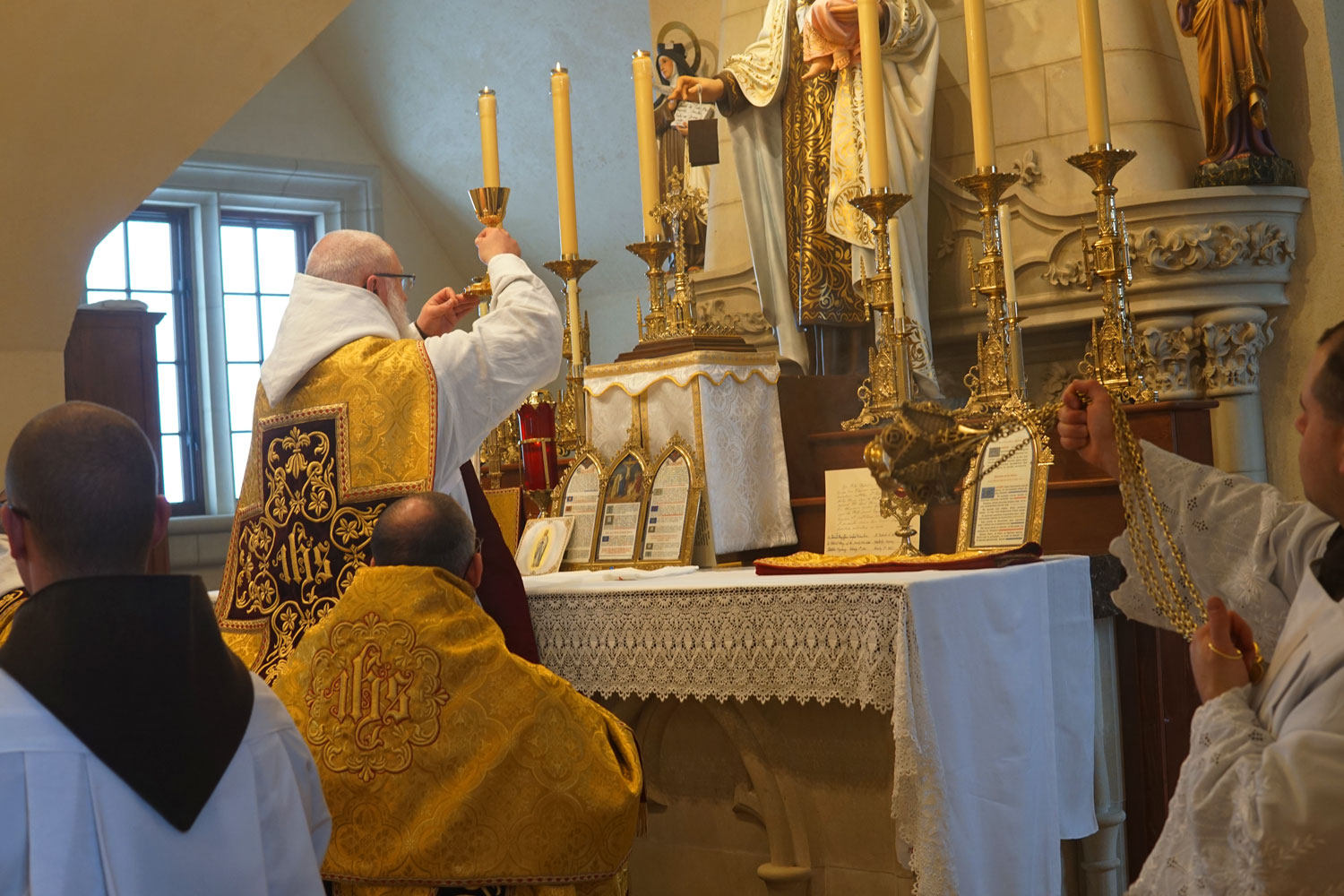
Father Bob Kocour was the man who, shortly before my ordination, gave me his own chalice, which he had had commissioned from a craftsman in Europe before his own ordination.  Usually when I offer Mass here, I use the parish’s chalice.  Today I will offer Mass with Father Kocour’s chalice.  It’s a reminder that all good things in our lives—and especially the most important ones—come both through God’s grace and the sacrifices of others.

Father Hoisington’s First Mass on May 28, 1995. He is elevating the chalice – containing the Precious Blood of Jesus – that Father Robert Kocour (third from the right) gave him.

The Twenty-FIFTH Sunday in Ordinary Time [B]

The Twenty-fifth Sunday in Ordinary Time [B]
Wisdom 2:12,17-20  +  James 3:16—4:3  +  Mark 9:30-37

The Cross is the heart of Jesus’ life.  We heard this in last Sunday’s Gospel passage, when Jesus declared:  “Whoever wishes to come after me must deny himself, take up his cross, and follow me.  For whoever wishes to save his life will lose it, but whoever loses his life for my sake and that of the gospel will save it.”  In today’s passage, Jesus in a similar way declares:  “The Son of Man is to be handed over to men, and they will kill him, and three days after his death the Son of Man will rise.”

Of course, last Sunday’s and today’s Gospel passages are not the only two times that Jesus taught how central the Cross is to His life.  So that raises a question.  Why does Jesus teach this lesson repeatedly?  One answer is that it’s such an important lesson.  Another answer is that His disciples are—to be honest—rather slow.  Jesus is a very patient teacher, willing to try over and over again to get His point across to us sinners.

But Jesus is not only a patient teacher.  He’s also a shrewd teacher.  Like any good teacher, He knows that if you repeat the same lesson over and over in exactly the same way, your odds of getting through to your students is lower.  However, if you teach the same lesson in different ways—from a slightly different perspective each time—more of your students will grasp your lesson.  Today’s Gospel Reading gives us an example of Jesus doing just that.

The first half of today’s Gospel passage is connected to the second half in a unique way.  In the first half, Jesus explains again to His followers about His having to suffer, die, and rise.  But in the second half of the passage, while Jesus seems to change the topic, in fact what He teaches in that second half sheds light on His teaching about the Cross.  Jesus helps us see His point from a new perspective.

“Taking a child, he placed it in the their midst, and putting his arms around it, he said to them, ‘Whoever receives one child such as this in my name, receives me; and whoever receives me, receives not me, but the One who sent me.’”  So how do these words of Jesus put His teaching about the Cross in a new light?

One of the saints of the Church can help us see this connection.  The Church will celebrate her feast day a week from this coming Tuesday, on October 1st.  This saint is one of the most popular saints of the Church, even though her teaching is very demanding.  Her name is St. Thérèse of Lisieux, or more simply, The Little Flower.

St. Thérèse speaks in her writings about bearing one’s cross in life with the faith of a little child.  She shows the connection between the two halves of today’s Gospel passage.

St. Thérèse does this in a very practical manner.  In this way, the Little Flower’s counsel is a lot like the counsel that Saint James offers in his New Testament letter.  The Second Reading at Sunday Mass has been coming from James for four weeks now, and will continue through next Sunday.

At first hearing, you might not imagine that St. Thérèse and St. James have much in common.  But they do.  They’re both, in the language of the Church, “doctors of the soul”.  As “doctors of the soul”, they’re both profoundly practical, just as your physician needs to be.

The difference between these two saintly doctors is that St. James focuses more on diagnosis:  he exposes the spiritual wound and underlying spiritual disease, making them clearly visible.  St. Thérèse, on the other hand, offers a treatment plan.  This plan she calls the Little Way of Spiritual Childhood.  She approaches the Cross, and embraces the Cross, through this Little Way of Spiritual Childhood.

In her autobiography, the Little Flower writes this:  “Our Lord told his apostles that they must be converted and become as little children….  In the natural order… little children show their love… [t]hrough little things.  A little child, just because it is little, is… unable to show its love in any other way.  … [V]ery little children will continually offer little things to their mother—a toy, a picture, a flower—as evidence of their love.  …  [T]he mother, although she has no need of the toy, the picture, or the flower, loves the child to make these offerings, because she wants the love that lies behind them.”[1]

She continues:  “Unless [you, as a Christian,] love Our Lord through ‘the toys, the pictures, [and] the flowers’ of everyday life, [you’ll] never really love him at all.”[2]  In a letter to one of her blood sisters—who was also her sister in the Carmelite Order—the Little Flower wrote, “You know well Céline, that Our Lord does not look so much at the greatness of our actions, or even at their difficulty, as at the love with which we do them.”[3]  Likewise, in her autobiography she plainly wrote:  “To strew flowers is the only means I have of showing my love.  That is to say I will let no little sacrifice escape me, not a look, not a work.  I will make use of the smallest actions and I will do them all for love.”[4] 

So then:  what sorts of occasions made up the Little Flower’s holiness?  They were the same occasions that your life is filled with.  In ordinary human life, these “occasions are provided by the interruptions of others, sometimes unavoidable but sometimes quite unnecessary; [by] the call to sacrifice our own point of view where no principle is involved, for the sake of peace; [by] the failure of the hopes we had placed in others; [by others’] lack of gratitude and lack of response [to our best efforts]; ….  From [occasions like] these there is no escape; we have to accept them in one way or another, and more often than not[,] we do so in the wrong way.”[5]  

The life of the Little Flower illustrates the right way.  St. Thérèse “shows us that these occasions of sacrifice [are not] something to be avoided, [but instead] are providentially arranged by Our Lord and… proportioned by Him to our” abilities.[6]  God calls us through these difficulties, not in spite of them.

———————————————————–——-

[1] St. Thérèse of Lisieux, Autobiography, quoted in Spiritual Childhood: The Spirituality of St. Thérèse of Lisieux, by Vernon Johnson (San Francisco, Ignatius Press, 2001), pages 127-128.

[2] Johnson, 128.

[3] Autobiography, quoted in Johnson, 128.

[4] Autobiography, quoted in Johnson, 130.

[5] Ibid.

[6] Ibid.

The Twenty-fourth Sunday in Ordinary Time [B]

The Twenty-fourth Sunday in Ordinary Time [B]
Isaiah 50:5-9  +  James 2:14-18  +  Mark 8:27-35

There are two types of death.  One is much worse than the other.  Lots of folks work hard to avoid the one type of death, but not the other, which is strange.  It’s strange because the death they work to avoid is actually unavoidable.  Yet the death they don’t worry about is completely avoidable.

The first death is the death of our body.  This is the death that God Himself suffered in the person of Jesus Christ on Good Friday.  This death is unavoidable.  You cannot run from it.  Inevitably, your body will die.  Just look at a crucifix:  there is your proof.  Even God died in the flesh.

This is the death of which Isaiah prophesies in today’s First Reading.  It’s not a coincidence that today’s First Reading is also proclaimed at Mass on Palm Sunday, in connection with the Passion narrative.  Isaiah’s prophecy in the First Reading clearly foreshadows the Passion and Death of Jesus Christ.

To reflect more deeply upon this, we ought to remember that Jesus had a faithful Jewish upbringing.  It’s likely that as the Blessed Virgin Mary and St. Joseph brought Jesus up, the child Jesus memorized large parts of the Scriptures.  Many years later, during the years of His public ministry, it’s likely that Jesus, while walking the dusty roads of Judea, Samaria and Galilee, meditated on the words of Isaiah that we heard a few minutes ago.  Jesus could see that these words referred to His own experiences of rejection:  for example, when He was expelled from the synagogue in His hometown, and when He was rebuked by the Scribes and the Pharisees.

Finally, as Jesus spent those three hours on the Cross at the top of Calvary, the words of Isaiah undoubtedly ran through His mind:  “The Lord God opens my ear that I may hear;  /  and I have not rebelled,  /  have not turned back.”  Jesus on Good Friday is completely faithful to the will of God the Father.

By contrast, Peter in today’s Gospel Reading is clearly not faithful to the will of God.  Peter’s lack of fidelity stems from his confusion about the two different types of death.

In turn, you need to ask if you will be faithful to the will of God.  In today’s Gospel Reading Jesus makes a demand of you:  “Whoever wishes to come after me must deny himself, take up his cross, and follow me.”  Do you, who call yourself a Christian, hear what Christ is saying to you?  Or are you like Peter?  Are you tempted to turn your back on the words spoken by Jesus?

Along the way to Caesarea Philippi, Jesus asks those following Him exactly who it is that they think they’re following.  Peter responds, “You are the Christ.”  Here’s where Peter’s trouble begins.

Peter has spoken the right words, but for the wrong reason.  It’s true that this Christ—this Anointed One—has come down from Heaven to save God’s People from certain death.  But Peter does not understand which death Christ has come to save us from.

Jesus begins teaching His disciples that the Son of Man must suffer greatly, be rejected, be killed, and rise after three days.  “He spoke this openly.”  But the ears of Peter are not open.  Peter turns his back on these words of Christ, and actually begins to rebuke the Son of God.  Peter cannot believe that the Christ must suffer greatly and die.  Peter cannot believe that any good can come out of human death.  Peter cannot believe that out of human death can come a share in the life of God.

Are you like Peter?  What do you make of death?  Do you believe that Christ suffered for us, but not with us?  If you’re older, you might remember the commercial for a product called Dow Scrubbing Bubbles.  The tag line was, “We work hard so you don’t have to.”  Is this how we think the Christian Faith works?  If Jesus came to earth today and made a commercial to advertise His Gospel, would he say, “I suffered greatly and died so you don’t have to”?

On the Cross, Christ destroyed the power of death by dying Himself.  When He died, death split in two.  Christ separated the death of the body from the death of the soul, so that the soul’s death would not inevitably follow the body’s death.  Christ didn’t die so that you wouldn’t have to.  Christ died so that the death that you will inevitably face—the death of the body—would not be the last word.

When you were baptized, and God the Father adopted you as His own child, you took on Christ’s life as your own, which also means taking on His death.  This is true because the meaning of Christ’s life—the mission of Christ’s life on this earth—was to destroy death.  So if you wish to share in Christ’s life, you must accept His mission—His death—as your own.  In other words, you must not rebel against the words that Christ speaks today:  “Whoever wishes to come after me must deny himself, take up his cross, and follow me.  For whoever wishes to save his life will lose it, but whoever loses his life for my sake and that of the gospel will save it.”

+     +     +

There are two types of death:  the death of the body, and the death of the soul.  The death of the body is unavoidable, while the death of the soul is completely avoidable.  The death of the body, which many people try so hard to avoid, is in fact the door that Christ has opened to eternal life.  Yet the death that people don’t worry much about is a death that lasts forever.

There is an old saying:  “If you are not struggling in your spiritual life, then one of two things is true:  either you are dead, or your soul is.”  We need to make sure that we’re working to avoid the death that is eternal, and to follow the Person whose death is the path to eternal life.