Wednesday of the Twenty-third Week in Ordinary Time

Wednesday of the Twenty-third Week in Ordinary Time
Luke 6:20-26

“Woe to you when all speak well of you.”

“Woe to you when all speak well of you.”  These words of Jesus seem at first hard to reconcile with the honors we confer on the canonized saints of the Church.  If we took the words of Jesus literally, then the praise given the saints would be wrong.  Then again, what of our speaking well of Christ Himself, and praising Him?  We don’t doubt that we ought to praise Christ, but given that fact, how do we understand His words in today’s Gospel passage?

What Jesus teaches in this passage—and in all the Lucan Beatitudes—is that a Christian can only find consolation in one place:  within the Holy Spirit.  None of the things which Jesus preaches against is bad.  Money, food, laughter, and praise are all good things.  The evil which distorts and perverts these good things, however, is the temptation to rest in them:  that is, to believe that these things can make us happy for any longer than a mere moment.

It is when we root good things such as money or praise within our earthly selves that they become that source of evil that Christ is preaching against.  May the grace of the sacraments help us to offer all our pleasures in life to God, and admit that none of them can save us from being rooted in this world.

The 24th Sunday in Ordinary Time [C]

The 24th Sunday in Ordinary Time [C]
Exodus 32:7-11,13-14  +  1 Timothy 1:12-17  +  Luke 15:1-32 [or 15:1-10]
Catechism Link: CCC 1465
September 11, 2022

Christ Jesus came into the world to save sinners.

Jesus’ vocation in this world was to die on the Cross.  Everything that Jesus taught was a means to that end.  So it is with the three parables we hear this Sunday.

Although the long version of today’s Gospel passage is very long, it includes one of the more profound examples of Jesus’ teaching ministry.  The Parable of the Prodigal Son is just that kind of parable that tempts us to believe that Jesus’ vocation was to be a teacher.  But we cannot finally unlock this parable until we recognize it as a means to reach the end of Calvary.  The first two “mini-parables” help us see this.  They whet our appetite, so to speak, for the “entrée” of the Parable of the Prodigal Son.

These two appetizers are served up to the Pharisees and scribes, not to the tax collectors and sinners.  This tells us something important about what Jesus is cooking up.  The Pharisees and scribes were complaining about Jesus, “saying, ‘This man welcomes sinners and eats with them.’”  So Jesus begins to serve the Pharisees and scribes by helping them see why He is where He is:  on the one hand, why He’s hanging around with tax collectors and sinners; but on the other hand, why He is in this world at all.

These two appetizers are simple in their presentation.  Each has just two key elements:  the shepherd and his lost sheep; the woman and her lost coin.  Within the brief drama of each parable, the focus of joy emerges:  the joy of the shepherd and the joy of the woman.

In other words, the focus really isn’t on the found sheep or the found coin, but on those who find them.  Jesus explains that the shepherd’s joy is like “the joy in Heaven over one sinner who repents”.  The woman’s joy over finding her lost coin points our attention to the “rejoicing among the angels of God over one sinner who repents”.

These opening parables, then, call us out of ourselves.  We are not the focus of these parables.  Although we’re clearly meant to identify ourselves with the lost sheep, and then with the lost coin, the focus of the parable is the “joy in Heaven” “among the angels of God” that results from your being found:  which is to say, being rescued from sin and death.

So with those two brief parables as appetizers, Jesus presents a lengthy parable for our spiritual feasting.  As we dig in to the Parable of the Prodigal Son, we should be mindful that here also, the focus is not upon the one who is lost, but upon the one who finds.

The parable’s second half shows why we ought to call it the Parable of the Prodigal Father.  If the younger son is prodigal, so is the father, though in an extremely different way.  The word “prodigal” means “lavish” or “extravagant”.  The son is extravagant in giving away money that is not his own, but the father is extravagant in giving away mercy from the wellsprings of his heart.

The joy of this father is the focus of Jesus’ teaching.  When you transpose this parable to your life, you need to recognize that God the Father’s joy is infinitely greater than your sins.

Many Christians get caught up on this.  They stay away from God because they do not believe that He is just as loving as the prodigal father.  This may be due to the example set by their earthly fathers.  This may be due to having committed mortal sins of such depth that they don’t believe that it’s possible for God to forgive them.  Regardless, they and we need to turn to the Father whom Jesus describes through this master parable.

We need first to have the honesty of the prodigal son.  We need, both in our nightly examination of conscience, and before our monthly confession, to say from our hearts, “Father, I have sinned against Heaven and against you; I no longer deserve to be called your son.”  But even more than needing to make the honest admission of our sins, we need to know who God the Father is.  We need to listen with faith in order to hear God our Father say from His heart, “let us celebrate with a feast, because this son of mine was dead, and has come to life again”.

Tuesday of the Twenty-third Week in Ordinary Time

Tuesday of the Twenty-third Week in Ordinary Time
Luke 6:12-19

Jesus departed to the mountain to pray, and He spent the night in prayer to God.

St. Luke the Evangelist seems to speak more about prayer than the other evangelists.  He does so both by giving us Jesus’ words about prayer, and by illustrating occasions on which Jesus prayed.  In today’s Gospel Reading we have an example of the latter.

In the example of Jesus’ prayer described today, two things stand out.  The first is that Jesus “spent the night in prayer”.  Most of us Catholics in the Western world live very spoiled lives.  We consider the making of a Holy Hour a great sacrifice on our part.  But Gospel accounts of Jesus’ life show how common it was for Him to spend an entire night “in vigil”.  The lives of the saints show men and women from various stations in life all taking up this practice of the Lord in order to be close to Him.

The second notable thing about Jesus’ prayer in today’s Gospel passage is that He is engaged in prayer before a significant choice.  This reveals that the choice that follows—here, the choosing of the Twelve—is a choice made together by the Father and the Son, in the unity of the Holy Spirit.  For ourselves, the choosing of the apostles shows that great sacrifices in prayer, such as nighttime vigils, ought to spent for the sake of God’s work, and not for our own personal interests.

Monday of the Twenty-third Week in Ordinary Time

Monday of the Twenty-third Week in Ordinary Time
Luke 6:6-11

But they became enraged and discussed together what they might do to Jesus.

Jesus in today’s Gospel passage (and on many other occasions during His earthly life, leading to the Cross) faced those who had turned the meaning of religion inside out.  Jesus in this passage heals the man with the withered hand, and the response of the scribes and Pharisees is to become enraged:  they discussed together what they might do to Jesus.

In this we see a similarity between Jesus’ day, and our day:  a similarity between the world of Jesus, and the world in which we live.  The world in which we live today may be much larger than Jesus’ world:  there may be more countries, and more peoples who have to speak with each other, and work to get along.  Likewise, the Church today extends throughout the world instead of consisting of a small band of disciples.

Yet there are today people, just as in Jesus’ day, who return evil for good:  whose actions make no sense.  Whether we reflect upon the example of the scribes and Pharisees in today’s Gospel passage, or Pontius Pilate, or Judas Iscariot, the question we have to ask is:  how did Jesus respond to those who hated Him, and nailed Him to the Cross?  Can we be like our Lord Jesus, even in a situation like this?

St. Gregory the Great, Pope and Doctor of the Church

St. Gregory the Great, Pope and Doctor of the Church
1 Corinthians 4:6-15  +  Luke 6:1-5
September 3, 2022

“What do you possess that you have not received?”

St. Paul in yesterday’s First Reading referred to Christians as “stewards of the mysteries of God”.  In today’s First Reading Saint Paul continues to preach on the topic of stewardship, noting that everything in our life is a “given”.  But if this is so, he rhetorically asks the Corinthians, why are they “boasting as if [they] did not receive it?”  In fact, the “givenness” of our lives and everything in them calls for humility from us.

But St. Paul goes further.  In describing himself and the other apostles, he debases himself for a specific purpose.  He describes the apostles as being “like people sentenced to death”, as “fools on Christ’s account”, and “like the world’s rubbish, the scum of all”.  At the same time, he raises up those whom he serves, saying that the apostles are weak, but the Corinthians are strong, and that the Corinthians are held in honor, but the apostles in disrepute.

These points are made to admonish the Corinthians as Paul’s spiritual children.  Here he reveals his motive in this passage of his letter:  to beget in his children the humility that will foster spiritual growth.  He concludes with a verse that contradicts those who say that Christians—such as priests—cannot serve as spiritual fathers:  “I became your father in Christ Jesus through the Gospel.”

Friday of the Twenty-second Week in Ordinary Time

Friday of the Twenty-second Week in Ordinary Time
Luke 5:33-39

“Rather, new wine must be poured into fresh wineskins.”

Depending on circumstances, two given cousins may resemble each other very closely, or not at all.  Today’s Gospel passage presents a contrast between Jesus and His cousin, John the Baptist.  Jesus confirms the differences between Him and John, although these differences lead in the same direction.

The context of this contrast is a complaint lodged against Jesus by the scribes and Pharisees.  They uphold the practice of fasting and prayer, but at the same time note that Jesus’ disciples don’t seem to engage in either.

Jesus responds with a metaphor and a parable.  Consider the former.  Jesus describes Himself as a bridegroom.  We as modern Christians understand that by this metaphor Jesus is referring to Himself as the bridegroom of the Church, though that part of the metaphor would have been lost on His original hearers.  But He continues by noting that when the bridegroom is taken away, then the wedding guests will fast.

The latter part of the metaphor can be applied in two ways.  The first we can reflect on in terms of Jesus’ earthly life, and the time of His Passion and death during Holy Week.  The second we can reflect on in terms of our own earthly lives as pilgrims on our way to Heaven:  that is to say, as members of the Church Militant.  We may only share fully in the wedding feast of the Lamb in Heaven, and so while still here below we fast and pray, hoping for complete union in Heaven with the Lord.

Thursday of the Twenty-second Week in Ordinary Time

Thursday of the Twenty-second Week in Ordinary Time
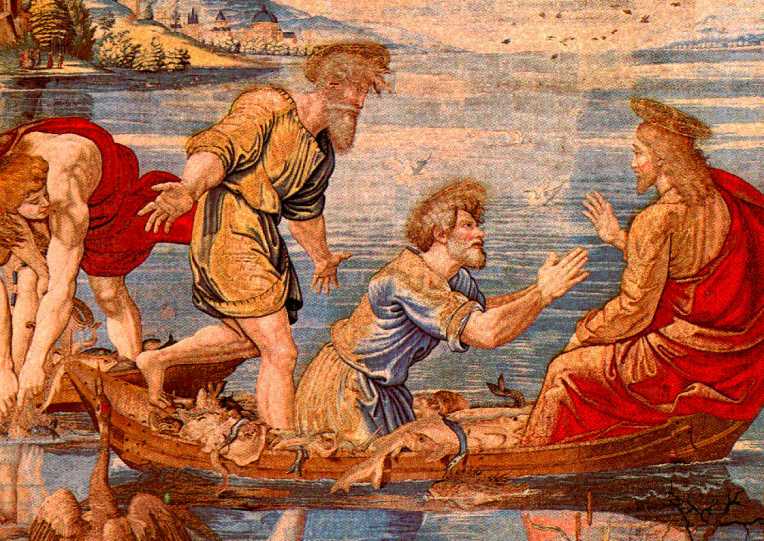
Luke 5:1-11

“But if you say so, I will ….”

In spite of Peter’s knowledge and experience in fishing, and in spite of his having been up all night long, Peter and his fishing partners had caught absolutely nothing.  Sometimes in what we do, also, we try our best, even at things we’ve done before and know a lot about, but things don’t work out for us.  That’s a natural part of life in this fallen world.

But in today’s Gospel passage, we hear about Jesus coming along.  Jesus was a carpenter, not a fisherman.  Jesus tells Peter to put out the fishing boat into deep water (not the best place to catch fish), and after the sun had risen (not the best time).  Peter starts out with a protest against Jesus’ idea, but then has second thoughts, and replies to Jesus, “But if you say so, I will….  I will lower the nets.”

Remember that God’s ways are not our ways.  Sometimes, when we pray, we end up telling God what He should be doing, and when God talks to us, we dismiss His ideas.  Instead, when Jesus asks us to do something for Him, we should listen.  Then, through the grace of His sacraments, we should speak as Peter speaks, and say to Jesus, “But if you say so, I will….”

Wednesday of the Twenty-second Week in Ordinary Time

Wednesday of the Twenty-second Week in Ordinary Time
Luke 4:38-44

At daybreak, Jesus left and went to a deserted place.

Today’s Gospel passage, as it’s divided in modern editions of the Bible, consists of three paragraphs. As we reflect on the passage, we see a movement like the ripples in a pond. Jesus in His desire to serve moves outwards towards more and more people: from healing Simon’s mother-in-law, to healing those in the area “with various diseases”, to his departure for ministry in “the other towns”.

As such, we can reflect on this passage as an illustration of the “catholicity” of Jesus’ mission on earth, and so also the catholicity of His Church’s mission. In that latter regard, we ought to reflect on ourselves—each of us—as one member of that Christ who acts in today’s Gospel passage.

Each of us rightly gives thanks and praise to Jesus for being our “personal Lord and Savior”. But such a confession of faith should never move us to think that our Christian Faith is simply about “me and Jesus”. Jesus is the Lord and Savior—or at least, wishes to be—of every human person who ever has, does now, or ever will live. In turn, the salvation that Jesus offers me ought to root itself in my service to others, to bring that about.

Each of us at times might enjoy the prayerful solitude that Jesus entered in a deserted place at daybreak. Perhaps we would prefer that solitude. For most, though, the solitude serves our active roles within the mission of the Church.

The Twenty-third Sunday in Ordinary Time [C]

The Twenty-third Sunday in Ordinary Time [C]
Wisdom 9:13-18  +  Philemon 9-10,12-17  +  Luke 14:25-33
Catechism Link: CCC 1806

“… when things are in Heaven, who can search them out?”

Asking God for things is a tricky business.  We might even say that of the four basic types of Christian prayer (that is, petition, adoration, contrition, and thanksgiving), the prayer of petition demands the most deliberation.

The First Reading addresses this challenge indirectly, asking rhetorically:  “Who can know God’s counsel, or who can conceive what the Lord intends?  For the deliberation of mortals are timid, and unsure are our plans.”  We might paraphrase these verses by asking, “When I pray, how can I get my human free will to align with God’s divine and providential will?”

So to “fine tune” our prayers in order to make them more effective, here’s a question for you.  But be careful, because it’s a trick question:  “When we petition God in prayer, should we pray for a good thing?”  The answer is “Yes… and No.”  Today’s Scripture passages explain why by giving us examples of, and by describing, the virtue of prudence.

To most persons, prudence does not seem the most compelling Christian virtue.  After all, it’s not as simple as humility, as bold as courage, or as sublime as charity.  As virtues go, prudence sort of seems like oatmeal.

Nonetheless, if someone were to ask you, “Should you pray for a good thing?”, then you should answer “No!”  The definition of prudence shows us why we should not pray just for a good thing.  Notice in this definition the two tasks that prudence enables us to carry out.

The Catechism of the Catholic Church defines prudence as “the virtue that disposes practical reason to discern our true good in every circumstance, and to choose the right means of achieving it” [CCC 1806].  Prudence empowers us to do two things:  first, to see our “true good” in a given circumstance; and second, to choose the means to reach this “true good”.  So prudence guides both our intellect (in seeing the true good), and our will (in choosing the true good).  Prudence is really the most practical of all the virtues, because it guides the marriage of our intellect and will in daily life.

Nonetheless, as insightful as this definition is, it begs an important question.  What is this “true good”?

Our Scripture passages today show us how this “true good” is not just the good as opposed to the bad.  The true good is the best good out of many good choices.

When we were little, our parents taught us to make moral choices by recognizing right from wrong; good from bad; what is holy from what is evil.  This is the first stage of moral wisdom.  This is the foundation of making moral choices.  It’s essential that we understand that difference.  In fact, to put it bluntly, this difference is the difference between Heaven and hell.  But as a Christian, you have to build upon that foundation.  God doesn’t leave us to do whatever good on earth we might choose.

So while the foundation of Christian morality is about good versus bad, we build upon that by hearing God call us beyond only choosing what is good.  God wants us to do far more:  He wants us to choose what is best over and above what is merely good.  It’s in this sense that God does not want you to choose a good thing:  God wants you to choose the best thing.  “Good” is not good enough.  Only “the best” is good enough for God, and for you and your vocation.

The Catechism of the Catholic Church uses a striking image to describe prudence, calling prudence the “charioteer” of all the other virtues.  In other words, you might think of prudence as being the “inner ear” of the Body of Christ.  As your inner ear controls your body’s sense of balance, so prudence controls the balance of your soul, including the balance of your moral choices.  You could be the strongest football player, the most poised ballerina, or the most agile sprinter in the world.  But if that one little part of your inner ear didn’t work, then you and your strength, poise, and agility would fall flat on your face.

Everyone needs a sense of balance:  not only physical balance, but even more so moral balance.  Other virtues may be more powerful and even more important.  But without prudence, they won’t allow you to reach for the greatest good in life.