Sts. Cornelius, Pope, & Cyprian, Bishop, Martyrs

Sts. Cornelius, Pope, & Cyprian, Bishop, Martyrs
1 Corinthians 15:12-20  +  Luke 8:1-3
September 16, 2022

Jesus journeyed from one town and village to another ….

Today’s Gospel passage doesn’t seem much like a passage!  There’s no narrative to speak of, but mostly a description of Jesus’ entourage as He journeys while preaching.  How is such a “cast of characters” meant to tell us something as it’s preached from the pulpit on this weekday in Ordinary Time?

Perhaps we might relate this cast to what in the Creed we profess as the “communion of saints”.  In Heaven this cast of thousands adores God perpetually, gathered together in voice to worship the Lamb who was slain for our salvation.  But on earth, during our pilgrimage, while we do pause occasionally for worship, we also have many practical matters to attend to.  On earth, while we’re journeying to where we can enjoy “the better part” alone, we have to attend like Martha to many simple needs.

Jesus, as He’s described in today’s Gospel passage, is surrounded by three types of persons.  There are the Twelve apostles, those who had been cured by Jesus, and those who provided for the crowd.  We might reflect on this assembly as the first parish, although journeying from one town and village to another!

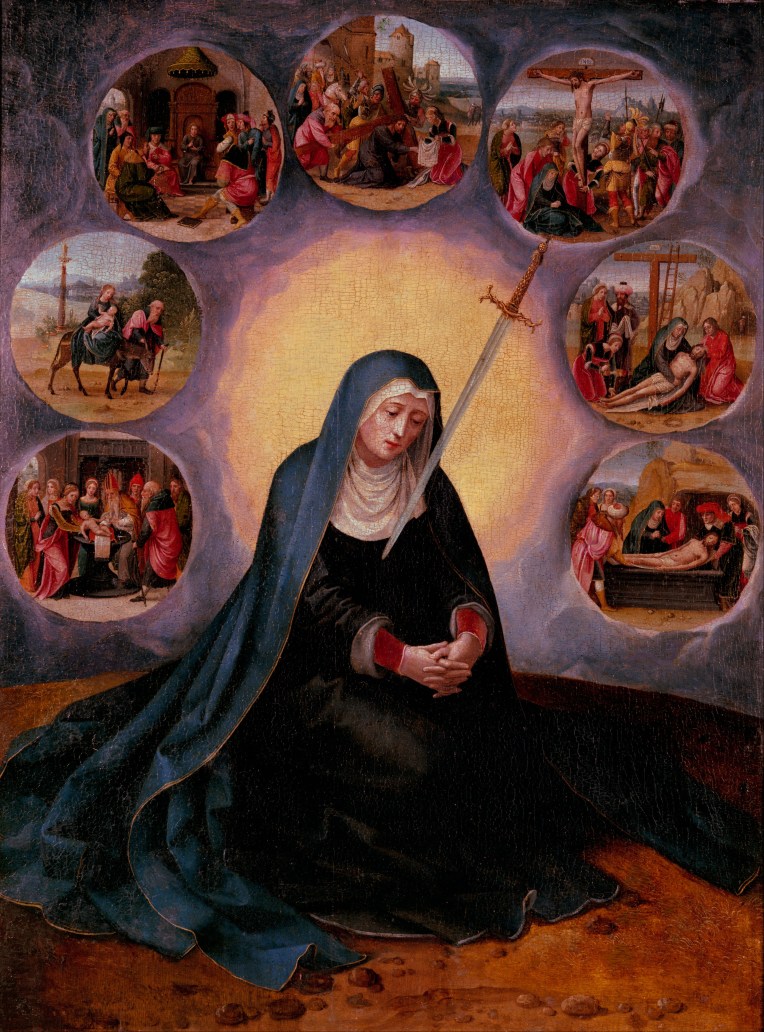
Our Lady of Sorrows

Our Lady of Sorrows
John 19:25-27 [or Luke 2:33-35]

“Woman, behold, your son.”

All our joys, all our sorrows, all our glory is only found in Christ:  that is to say, because we are members of Christ’s Body.  It is not true that you have your cross, and I have mine.  We all bear together—as individual members of Christ’s Body—the Cross of Jesus.  We all share in carrying His Cross.

Humanly speaking, sorrows tend to divide people more than joy or glory.  Loneliness and isolation are keenly felt by those who suffer.  Only in Christian faith can we find meaning even in the midst of suffering, because only God—who created everything out of nothing—can create good out of evil.

By approaching the Cross, we find Our Mother of Sorrows standing at its foot.  When we approach the Cross to take it up each day, she is there.  She remains there—at the heart of our Christian faith—to show us with a mother’s love that suffering cannot tear us from each other.

Our Lord Jesus taught us to pray the “Our Father”.  Jesus was not only teaching us that we have a Father in Heaven, because as a consequence of that truth, it’s also true that we are all brothers and sisters.  So then, it’s also true that Mary is the Mother of all of us.  We ask Our Lady of Sorrows, the Spouse of the Holy Spirit, to pray for us in all things.  Through her intercession, she helps us know that no matter what we face in life, her Son is there with us, showing us how to walk the only Way that leads to Heaven.

The Exaltation of the Holy Cross

The Exaltation of the Holy Cross
Numbers 21:4-9  +  Philippians 2:6-11  +  John 3:13-17

… He humbled Himself, becoming obedient to death, even death on a cross.

We know that silence can be deafening.  Sometimes silence is very embarrassing, as when a teacher asks a question about something that’s been studied for weeks, and no one knows the answer.

On the other hand, silence can be a very good thing.  It is in silence that the highest kind of prayer happens.  St. John of the Cross is supposed to have said that silence is God’s native language.  Regardless, there are many different ways to pray.  One of the first ways that we learn is prayers that others teach us, like the “Our Father”, the “Hail Mary” and the “Glory Be”.  Prayers like these let us pray together as a group, so that we’re praying the same thing at the same time.

Other times, though, we pray on our own, and so we make up our own words in prayer.  In this kind of prayer—which is like a conversation with God—we can say anything we want.  We don’t have to remember the right words to pray.  We just pray from our heart, and offer to God whatever is most on our mind.

But there’s another part of prayer that sometimes gets overlooked.  That is silence.  Actually, in our prayer, most of our time should be spent listening rather than speaking.  As the saying goes, this is why God gave each of us two ears, but only one mouth:  we are to listen twice as much as we talk.  This is as true of prayer as it of conversations with our fellow human beings.

It is in our silence—in listening to God—that our deepest prayer can take place.  This makes sense, if we think of it, because after all, isn’t what God wants to say to us probably more important than what we want to say to Him?

Humility is one of the virtues, and silence is one form of humility.  That’s why it’s often difficult to quiet ourselves down.  When we’re forced to be silent, we usually want to talk instead.

Even though we have lots of opportunity to grow in humility, as human beings our greatest call to be humble is when we face death:  the deaths of others whom we love, but eventually, our own death.  This is where Christ reveals to us God’s love.  This is what we celebrate today, on the Feast of the Triumph (or Exaltation) of the Holy Cross.

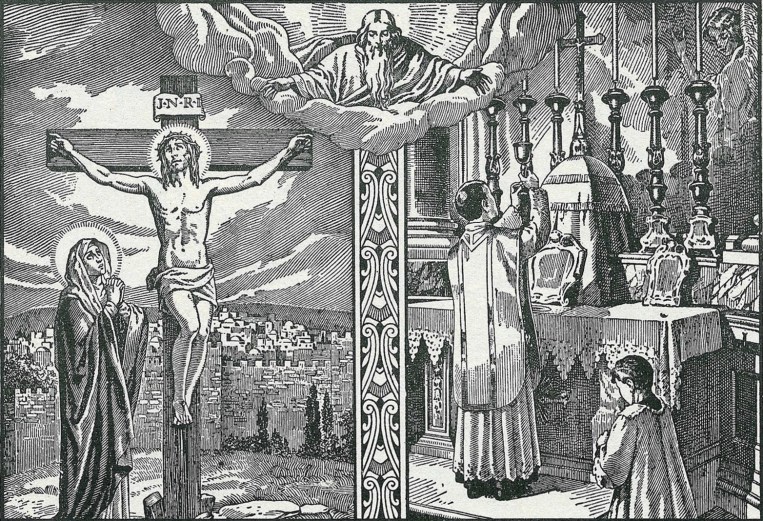
Picture in your mind the scene at Calvary.  Saint John was the only apostle who stood at the foot of the Cross in silence, and it was into his care that Christ, the only child of Mary, entrusted His Blessed Mother.  In turn, Christ entrusted John to the care of Mary.  In these words we hear the only teaching that is possible from the Cross:  that we must entrust ourselves to each other’s care, bound to each other by Our Father’s love.

Triumph of the Cross

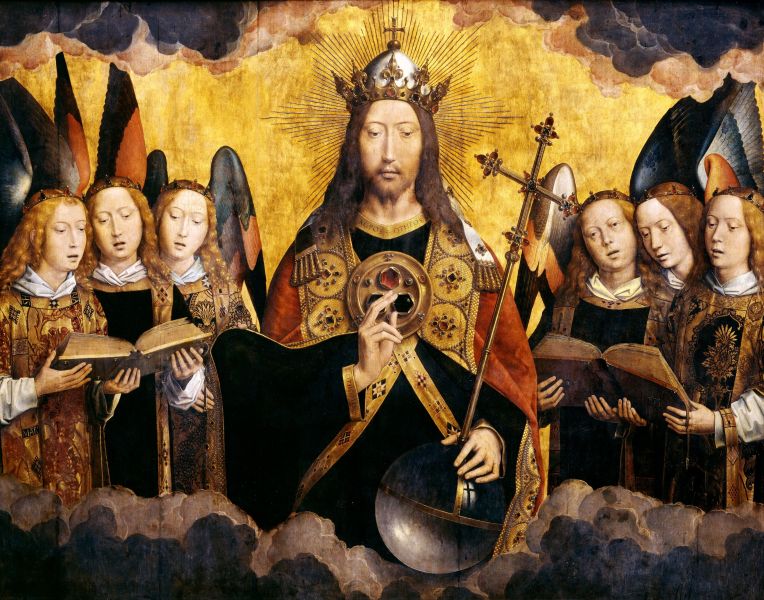
Christ Surrounded by Musician Angels [central panel], Altarpiece of Santa Maria la Real de Nájera, by Hans Memling (1430-1494)

The 25th Sunday in Ordinary Time [C]

The 25th Sunday in Ordinary Time [C]
Amos 8:4-7  +  1 Timothy 2:1-8  +  Luke 16:1-13
Catechism Link: CCC 2443
September 18, 2022

“You cannot serve both God and mammon.”

Jesus’ final words in today’s Gospel Reading—“You cannot serve both God and mammon”—are sometimes falsely interpreted.  They’re taken to mean that you cannot have both God and money in your life.  In other words, this false interpretation claims that there’s a competition in your life between God and money.  They battle against each other in a zero-sum game.  The holier you are, the less money you will have, and the more money you have, the less holy you must be.  This interpretation of Jesus’ words is false.

In fact, our spiritual well-being and our financial well-being are not in competition.  When Jesus plainly tells you that “You cannot serve both God and mammon”, the key word is “serve”“You cannot serve both God and mammon.”  You can serve God or you can serve mammon.  But you cannot serve both.

God, of course, wants us to serve Him alone.  He had declared to Israel many centuries before Christ:  “The Lord is our God, the Lord alone!  Therefore, you shall love the Lord, your God, with your whole heart, and with your whole soul, and with your whole strength.  Take to heart these words which I command you today” [Deuteronomy 6:4-6].  To love someone is to serve her.  This is true in our relationship with God, as well:  to love Him is to serve Him.

The beautiful thing about serving God is that through this form of love, we become more like Him.  After all, St. John taught the first Christians that “God is love” [1 John 4:8].  Serving God is as God wants, and in fact this is what you want in your heart.  God Himself planted that desire there when He created your heart:  the desire to serve Him, and so become more like Him.

On the other hand, what happens when you try to serve money?  One simple way to get at an answer is to ask yourself whether your self-image goes up and down with the amount of money that you have.  Do you feel worse when you lose a significant amount of money?  Do you feel better when you gain a significant amount of money?  If so, then there is a certain likeness between your money and you.

As your money grows, so you grow.  As your money diminishes, you diminish.  This is a false form of love, and a false servanthood.  It is a love of something beneath you.  God wants us to serve Him alone.

By contrast, money is meant to serve us, to facilitate our needs in this world:  not our desires, but our needs, and especially needs connected to our vocations.  In turn, financial wealth is a means by which we serve others.  If a person gains financial wealth, God intends for that wealth to be used for others.

That doesn’t mean that the wealthy person has to give it all away, like St. Francis of Assisi.  Despite what some socialists might say, there’s nothing inherently immoral about accumulating wealth.  The sin lies in not using one’s wealth for others, especially within the setting of one’s vocation.

We can speculate that God allows financial wealth to accumulate to those who have the skills to use that wealth for others.  Some persons just don’t—for whatever reason—have it in them to handle the responsibility that comes with significant wealth.  If those persons were to come into wealth—as happens, for example, with government lotteries—they would end up with ruined lives.  But some persons do have the skills required to deal with wealth in a way that not only allows them to grow that wealth, but also to use it to serve others.

Money when loved instead of being used for service stunts one’s growth in Christ.  The one who serves money closes himself off from others.  Money has no power to foster growth within persons.  Becoming like money by loving it can only be a downward path, a descent from the personal dignity with which God created us.

God gives us stewardship over all things—including money—for the sake of service.  This service fosters love among persons.  God gives us relationships with other persons—human and angelic—to foster a communion of saints.  God gives us Himself—Father, Son, and Holy Spirit—in order that we might enjoy eternal life amidst God’s very essence as a communion of the three divine Persons.
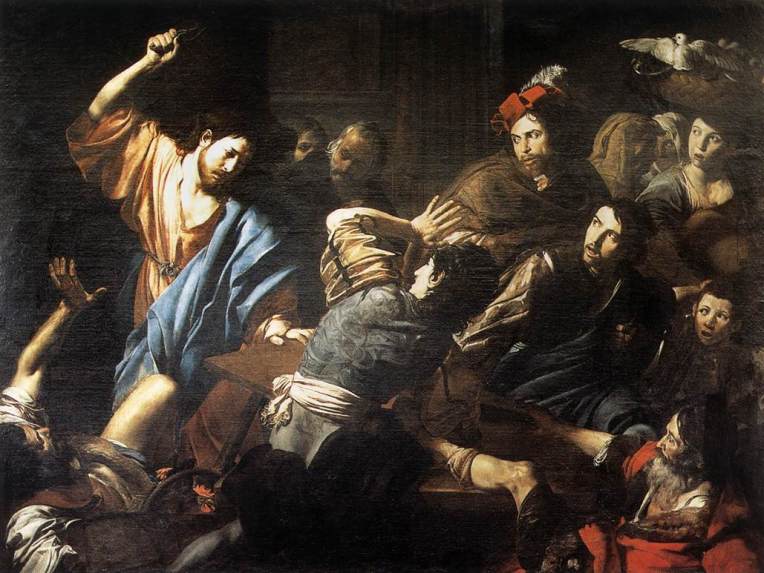
Christ Driving the Money Changers out of the Temple by Valentin de Boulogne
Tuesday of the Twenty-fourth Week in Ordinary Time

Tuesday of the Twenty-fourth Week in Ordinary Time
Luke 7:11-17

“God has visited His people.”

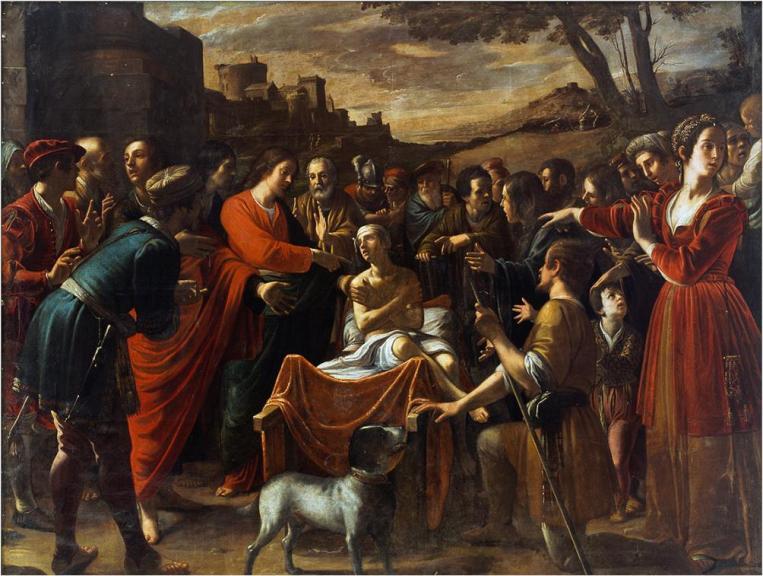
The mixture of fear and glory evoked by Jesus’ miracle in today’s Gospel passage is striking.  We might be tempted to think that fear and glory are mutually exclusive:  that if one were fearful of some person or thing or situation that one would flee.  Certainly we might wonder why someone who is fearful would give glory to God.  In fact, the evangelist states:  “Fear seized them all”.  He makes clear that it was not a slight fear that they experienced, but something much more compelling.

However, it might be that the fear noted by St. Luke the Evangelist is the “fear of the Lord” that we hear of elsewhere in Sacred Scripture (for example, Proverbs 1:7 and Isaiah 11:2).  This goes hand in hand with the other quote of the crowd noted by St. Luke:  “God has visited His people.”  This is another way of speaking about one of the names for Jesus that St. Matthew the Evangelist offers within the narratives about the birth of Jesus:  the name or title of “Emmanuel”, which means “God is with us” [Matthew 1:23].

In many cultures, and certainly in the Jewish world of the Old Testament, God is thought to be utterly transcendent, abiding in another world.  A manifestation of God in this world here below would be as sacred as it were rare.

For the crowd, then, to glimpse that, in some way, shape, or form, God had visited His people through this Jewish man Jesus would certainly evoke the fear of the Lord.  That some would then give glory to God attests to their spiritual insight.  Of course, we know from the end of Jesus’ life that others had an opposite response to Jesus.  Each of us has to reckon with our own responses to God visiting us, His people, in every aspect of our lives, including calling us to forgive others, to have hope when all seems hopeless, and to have faith even the size of a mustard seed.

Monday of the Twenty-fourth Week in Ordinary Time

Monday of the Twenty-fourth Week in Ordinary Time
Luke 7:1-10

“I tell you, not even in Israel have I found such faith.”

With few exceptions, the translation of the Mass introduced in 2011 has been hailed by bishops, scholars and folk in the pews for its advances over the hurried translation made soon after Vatican II.  One of the key improvements in the translation is its greater fidelity to Sacred Scripture.  Today’s Gospel passage offers an example.

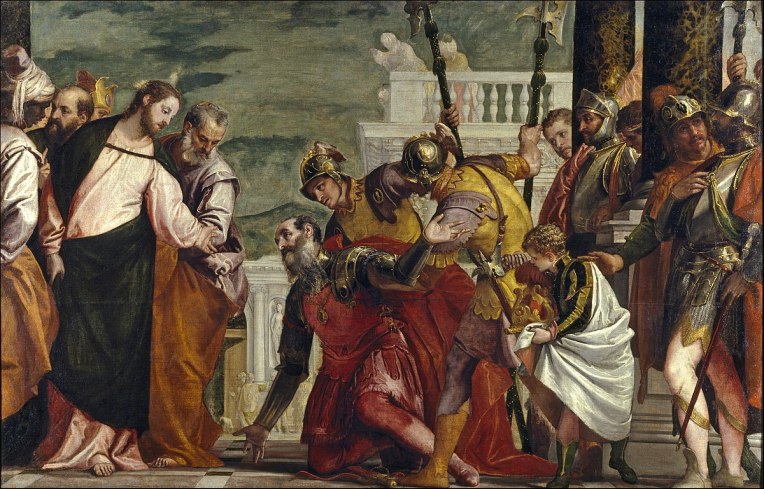
The centurion sends the message:  “Lord… I am not worthy to have you enter under my roof.  … but say the word and let my servant be healed.”  This very clearly is the origin for the invocation that each Catholic makes to Jesus shortly before Holy Communion.  Such clarity impels us today to reflect deeply on the context of these words, so that our invocation before Holy Communion is more meaningful each time we offer it.

Here, consider just one point of context.  While we might focus on the humility of the centurion, reflect by contrast on the power of the Lord.  The Lord’s power is such that physical proximity to the sick person is not necessary.  The Lord needs only to “say the word”.  This power evokes awe in the communicant because while in today’s Gospel passage Jesus did choose to heal from a distance, at Holy Mass Jesus deigns to enter into our very person, both body and soul.  This intimate indwelling is a mystery for which we cannot possibly finish giving thanks.

Saturday of the Twenty-third Week in Ordinary Time

Saturday of the Twenty-third Week in Ordinary Time
1 Corinthians 10:14-22  +  Luke 6:43-49
September 10, 2022

My beloved ones, avoid idolatry.

In today’s First Reading Saint Paul poses a juxtaposition that might at first seem odd.  He bids his beloved to “avoid idolatry”.  That certainly seems like a command to be found in Scripture.  But then he begins speaking about the Eucharist.  He rhetorically asks whether the Eucharist is indeed “a participation in the Blood of Christ” and the “Body of Christ”.  Why is he setting the offering of idolatry directly against the Eucharist?  What, practically, is St. Paul trying to get across to us?

Both idolatry and the Eucharist, of course, are offerings.  On the one hand, idolatrous offerings are made to “false gods”, some of whom do not exist, and some of whom are no more than created demons.  Such sacrifice is in vain inasmuch as religious offering are meant to pay honor or ask pardon from one to whom such offerings are due.

On the other hand, the Eucharist is offered to the Lord, the only and true God.  But that’s not the only difference.  The one true God became man, so as to be able to share in the act of sacrifice:  to offer His own Body and Blood, soul and divinity.  Demons only accept sacrifice from others; they will not descend to sacrifice of themselves.  In the Eucharist, the God-man gives us the very strength needed to share in the sacrifice of self.

Friday of the Twenty-third Week in Ordinary Time

Friday of the Twenty-third Week in Ordinary Time
Luke 6:39-42

“Remove the wooden beam from your eye first ….”

When you make your nightly examination of conscience, and prepare monthly for the Sacrament of Reconciliation, there’s a simple way to recollect yourself for the needed self-scrutiny.  After all, if it’s been a long day or month, we can feel overwhelmed and unsure how to assess our efforts to live (or our failures to live) in Christ.

This simple means is to recall that all the commandments of the spiritual life converge in Jesus Christ.  What does this mean?  Today’s Gospel passage offers a concrete example.  The imagery with which Jesus preaches today seems only to be about the challenge of loving our neighbor:  specifically, a sinful (“blind”) neighbor.  But the two great commands of Jesus—to love God fully, and to love our neighbor as our self—converge in Him.

We are not to look down on our sinful brother, but rather to look up to him.  This is possible because of our authentic need for humility.  Christian humility is in one sense nothing more than honesty.  Both my brother and I are sinners.  We are equal in this.  But Jesus calls me to serve as brother as if I were serving Jesus Himself.  For this reason, from my state of sinfulness, I look up to my sinful brother.  From this stance, I may help him remove the splinter from his eye.  Jesus, of course, never sinned, but He did “become sin”—in the phrase of St. Paul—so that in my sinful brother I can see the Jesus whom I am to serve.

The Nativity of the Blessed Virgin Mary

The Nativity of the Blessed Virgin Mary
Micah 5:1-4 [or Romans 8:28-30]  +  Matthew 1:1-16,18-23 [or Mt 1:18:23]

“She will bear a son and you are to name Him Jesus ….”

As the Church today celebrates the nativity of Mary, we reflect on human nature.  In the great universities of the Church, this is the study of theological anthropology:  that is, the study of man vis-à-vis God who is man’s Creator, Redeemer and Sanctifier.  God in Himself—as Father, Son and Holy Spirit—had no need whatsoever to create man.  Nor did He have need to care for fallen man.

But God chose, and still chooses, to redeem and sanctify individuals.  He does this through Christ Jesus, who entered our world through the life of Mary.  In the field of theological anthropology, Jesus and Mary stand at the head of our prayer, reflection, and study:  Jesus as a divine Person who took on a human nature, and the Blessed Virgin Mary as the perfect human creature.

Today we hear in the Gospel about the family tree of Jesus.  There were some great figures in Jesus’ family tree, such as King David.  But most of the people in Jesus’ family were very ordinary.  Maybe the most ordinary was Mary.

That might seem strange to say, because we might want to say that Mary was the most extraordinary.  Of course, Mary was the most holy of Jesus’ ancestors:  she was the only person to come before Jesus who had never sinned.  But still, at the same time, Mary was really the most ordinary person to come before Jesus.

If you were to walk down a busy street in a large city, and Mary walked by you, you probably would never recognize her.  That’s because Mary lived out the Gospel so fully.  She lived out the Gospel even before Jesus became a human being.  It’s because Mary lived out the Gospel so completely that Jesus became a human being.  But living out the Gospel is really very simple, very quiet, and very ordinary.  It doesn’t mean being famous, or looking for attention from others, or wanting to be better than those around you.

For me to live the Gospel means living like Mary:  listening for God’s voice every day, letting his Will for my life sink into my heart, and carrying out that will with the love of my own human heart.

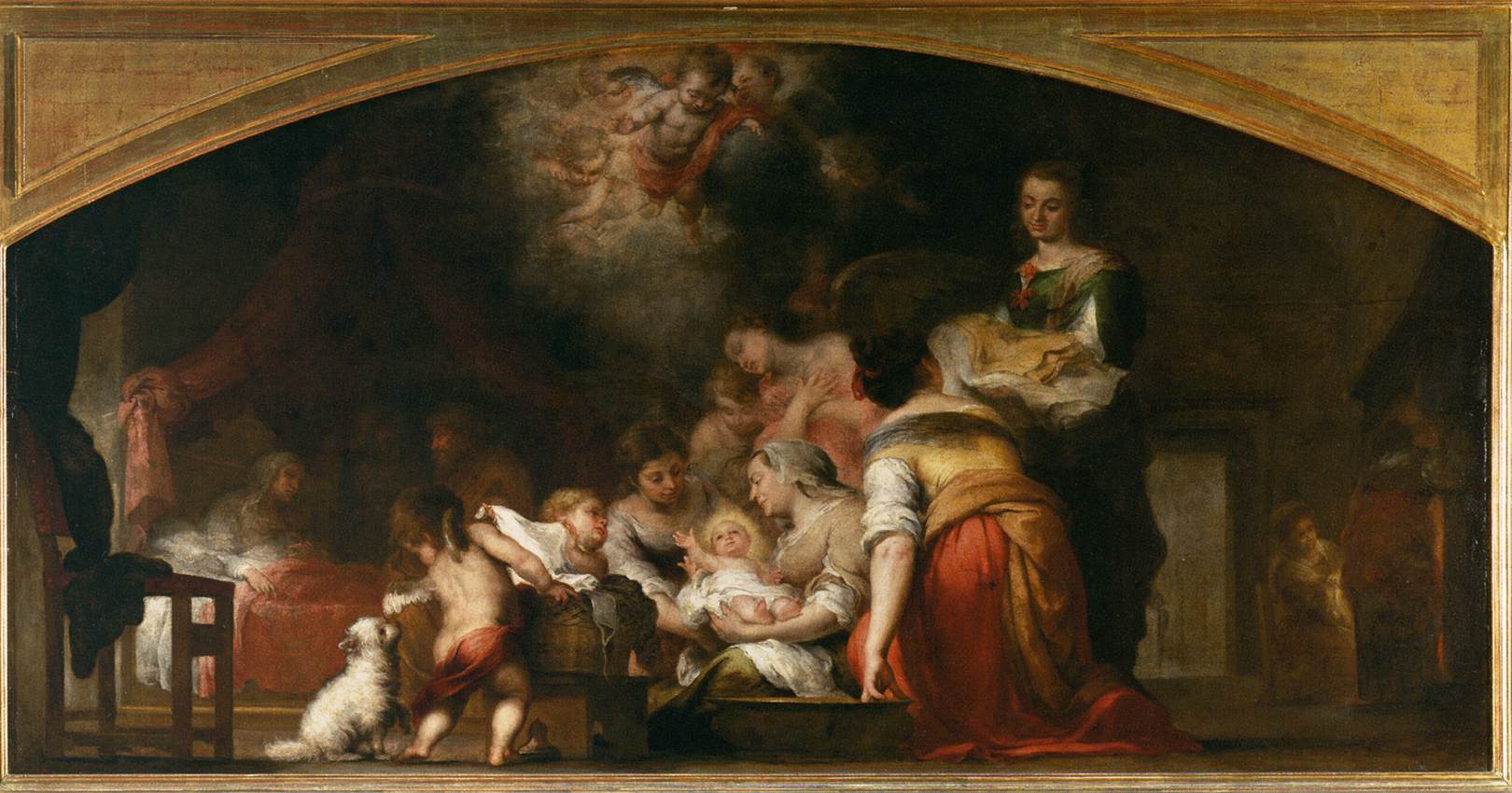
The Birth of the Virgin by Bartolomé Esteban Murillo (1617-1682)