Click one of the following for a specific menu:
CLICK HERE FOR FATHER HOISINGTON’S
YOUTUBE VIDEOS OF THE ROSARY WITH
SCRIPTURE AND SACRED ART
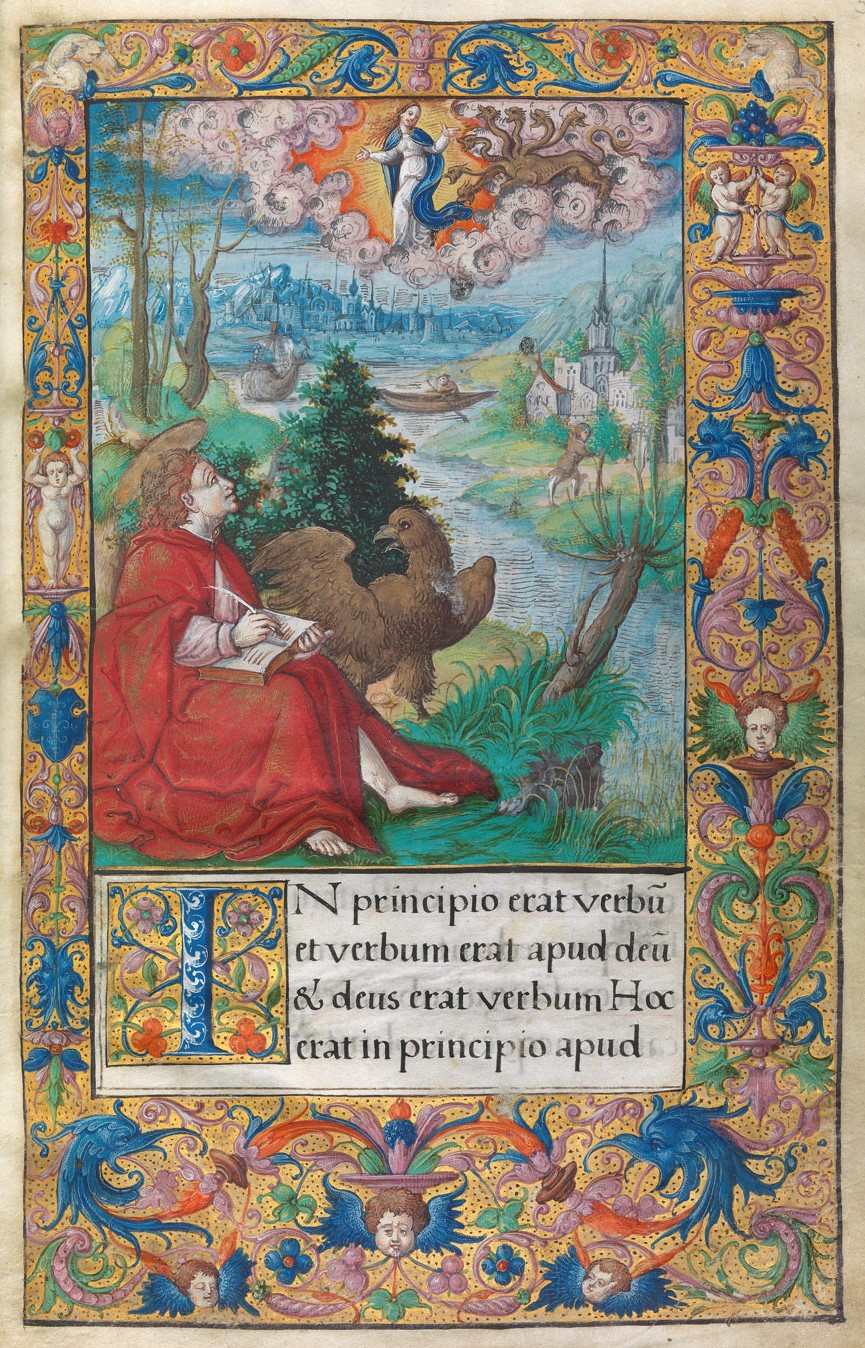
Homily for the feast of St. John, Apostle & Evangelist
December 27, 2023
Holy Mother Church privileges St. John’s Gospel account. At the Sacred Liturgy, she reserves the proclamation of John for the more important times of the Church year. While the Gospel accounts of Matthew, Mark, and Luke share many passages in common, much of St. John’s Gospel account is found only in John. In case you’re considering a New Year’s resolution of reading more Sacred Scripture in the new year, and in case you’re trying to decide which book of the Bible to start with, let me give you three reasons for giving your attention and reflection to the Gospel according to John.
The first is the start of St. John’s Gospel account, sometimes called the “prologue” of John. It’s the first eighteen verses of John 1. If you’re old enough to remember the Latin Mass celebrated before Vatican II, you might recall that this prologue of St. John’s Gospel account was read at the end of every celebration of Holy Mass. The high point of the prologue is verse 14, which is both profoundly incarnational and Eucharistic: “And the Word became flesh and dwelt among us, full of grace and truth; we have beheld his glory, glory as of the only Son from the Father.” You can read this brief prologue of just eighteen verses in a few minutes, yet you can meditate upon the meaning of these verses for many, many hours.
A second unique feature of St. John’s Gospel account is the sixth chapter of John. The entire chapter is 71 verses long, but the heart of the chapter is what’s usually called “The Bread of Life Sermon”. In this sermon, not found in Matthew, Mark, or Luke, Jesus gives us His most profound teaching about His Real Presence in the Eucharist. Reading through this chapter in private devotion is usually best done with a commentary from a solid Catholic scholar (such as the Ignatius Study Bible). Nonetheless, every hour spent meditating upon John 6 allows one to grow deeper in devotion to the Most Blessed Sacrament.
A third unique feature of St. John’s Gospel account is John’s account of the Last Supper. St. Matthew records his account of the Last Supper in eleven verses; St. Mark, in ten verses; St. Luke, in 25 verses. But St. John’s account of the Last Supper is found in five entire chapters, consisting of 155 verses. Put another way: St. John’s Gospel account consists of 21 chapters, and five of these 21 chapters are devoted to John’s account of the Last Supper.
All three of these features of St. John’s Gospel account show how deeply Eucharistic the fourth Gospel is. If you want to grow in your understanding of and devotion to Jesus in the Most Holy Sacrament of the Eucharist, then the Gospel according to St. John is the place to start.
With prayers today on his feast day for the repose of the soul of my father, John Riley Hoisington.
It’s easy to see how today’s Gospel passage can cause confusion. This passage describes the sacred event of the Annunciation: the First Joyful Mystery of the Rosary. We see St. Gabriel the Archangel and the Blessed Virgin Mary in this scene. St. Gabriel announces to Mary what God the Father wants to bring about through Mary. For her part, Mary gives her consent, declaring, “Behold, I am the handmaid of the Lord. May it be done to me according to your word.” Those beautiful words, spoken by the most beautiful woman to walk this earth, are the heart of today’s Solemnity of the Immaculate Conception.
However, the confusion that some people have about the Immaculate Conception is that they think that the conception being celebrated today is the conception of Jesus in the womb of the Blessed Virgin Mary. It’s hard to blame them. There are at least three reasons for this confusion.
First, the Gospel passage proclaimed on the Holy Day of the Immaculate Conception describes the sacred event of Mary conceiving Jesus. Second, this Holy Day falls near the start of the Season of Advent, and it makes perfect sense to prepare for the celebration of Christ’s birth by meditating upon His conception nine months earlier.
Nonetheless, in spite of the reasons for thinking that the Immaculate Conception refers to Jesus being conceived by Mary, the Immaculate Conception is in fact the mystery of Mary being conceived by her mother, St. Anne. What is the heart of this mystery?
The third reason for confusion is that some people think that the word “Immaculate” in the phrase “Immaculate Conception” is a synonym for “virginal”, because—as we heard in today’s Gospel passage—Mary conceived Jesus while still a virgin.
But that’s not what the word “Immaculate” means in terms of the Immaculate Conception of Mary. The conception of Mary within her mother St. Anne occurred through a natural act of married love between Mary’s parents, St. Anne and St. Joachim. The word “Immaculate” in the phrase “Immaculate Conception” refers to the fact that when Mary was conceived within St. Anne, God the Father made certain that Mary did not contract Original Sin.
Today’s First Reading reminds us of the commission of the Original Sin by Adam and Eve. From Adam and Eve, through every century of human history, from generation to generation, each human person, at the moment when she or he was conceived, inherited Original Sin. Original Sin is simply part and parcel of human nature: not as God created man “in the beginning”, but as man chose for himself when man—male and female—chose to commit the Original Sin.
From the first moment of human life—at conception—the human soul is weak and wounded. The human soul needs a Savior. The human person needs a Savior.
In fact, Mary needed a Savior. This is important to recall when reflecting upon the mystery of the Immaculate Conception, because some of our separated brethren within the Body of Christ make a false claim about Mary. They state that belief in Mary’s being preserved from Original Sin means that the salvation that Jesus won for fallen man was not universal: in other words, that Mary had no need for Jesus.
However, on the contrary, we have Mary’s own testimony in the Bible. At the scene of the Visitation—recorded in the first chapter of St. Luke’s Gospel account—Mary sings the hymn called the Magnificat, which starts with Mary declaring: “My soul magnifies the Lord, and my spirit rejoices in God my Savior, for he has regarded the low estate of his handmaiden.”[1]
Mary speaks of her “Savior”, because Mary was saved by God from sin. But she was not saved from sin like you and I, through the grace of Baptism and Confession.
Consider an example of what it means to be saved. Imagine this: imagine that you’re standing at the edge of a very large lake. In front of you is a pier that extends a long way into the lake. At the end of the pier, the water is fifty feet deep.
Now imagine that two friends are with you. These persons are both blind, and unable to swim. Now you’re setting up your campsite, when suddenly you hear a splash: one of your friends walked all the way to the end of the pier and fell into the water. Naturally, you run to the end of the pier, dive in, and drag the friend to safety. You have saved your first friend from drowning.
The next day, you’re scavenging near the campsite for firewood. At one point you pause, and look up. Your other friend has walked down the pier, and is close to its end. You make a mad dash for the pier, and you reach its end just as your friend is about to step off and fall into the fifty-foot deep water. You grab your friend by the back of his shirt and pull him back to safety before he can fall in. You have saved your second friend from drowning.
That second friend is like the Blessed Virgin Mary, who was saved by preventing her from ever falling into sin. The rest of the human race is offered salvation in the first way, by being pulled out of sin after having already fallen into it. Mary was never stained by sin, but she was saved from it.
Nonetheless, while it’s important to understand how God saved Mary, especially in order to dialogue with our separated brethren, it’s far more important to understand why God saved Mary in this unique way.
Why did God give Mary the gift of an immaculate conception? Why did God want Mary to be “full of grace”, as St. Gabriel describes Our Lady when he addresses her? We need first to reflect upon this salutation.
St. Gabriel says, “Hail, full of grace! The Lord is with you.” In modern English, we don’t use the word “hail” very much, except in regard to precipitation. As a form of greeting, the word “hail” is not just old fashioned, but antique. In modern English, we would never address someone by saying, “Hail, Joe”, or “Hail, Mary”. Instead, we would say, “Hey, Joe”, or “Hello, Mary”. The first word catches the other’s attention, and the second addresses the other by name.
However, St. Gabriel does not use the name of Mary to address her. We might overlook this, because we so often pray the prayer called the “Hail, Mary”. This prayer adds the name of Mary to St. Gabriel’s salutation. The prayer begins: “Hail, Mary, full of grace, the Lord is with you.” But in the biblical account, as we just heard in today’s Gospel Reading, St. Gabriel does not use the name of Mary to address her. Instead, he simply says, “Hail, full of grace! The Lord is with you.”
At first hearing, this might seem odd. The phrase “full of grace” certainly describes Mary accurately. But we don’t go around addressing people by saying, “Hey, six-foot-two”, or “Hello, 120 pounds.” Rather, we address people by name, saying, “Hey, Joe”, or “Hello, Mary”. So why does St. Gabriel address Our Lady with the words “Hail, full of grace!”?
It’s almost as if St. Gabriel is using this phrase “full of grace” as Mary’s name. It’s almost as if this phrase “full of grace” identifies Mary. It’s almost as if this phrase “full of grace” is the reason why Mary was born, and conceived, immaculately. Mary is “full of grace” for this moment that we witness in today’s Gospel Reading.
The Blessed Virgin Mary was immaculately conceived, and filled by God with grace, for the moment of the Annunciation. We might want to say that Mary was “full of grace” for the sake of her entire vocation, which began at the moment of the Annunciation, and then extended throughout her earthly life, and continued (and continues) after the end of her earthly life and her assumption into Heaven.
However, the rest of her vocation—the Visitation, the Nativity of her Son, the Sorrows of Jesus’ infancy and public ministry, her intercession at the wedding at Cana, her fidelity at Calvary, and her maternal care and prayer for the Church starting on the day of Pentecost—was entirely dependent upon this moment of the Annunciation. This moment was for Mary what the decision in the Garden was for Eve. But Mary’s choice was the opposite of Eve’s. Through Eve’s choice, sin entered the world, while through Mary’s choice, the Word of God became Flesh and dwelt among us.
This is why throughout history, the Church has addressed Our Lady as the New Eve. Mary is our Mother, but she is also our model. She is “full of grace”, and the first of those graces was the grace of her Immaculate Conception. By means of God’s graces, Mary models for us the way of discipleship, the way to accept Christ into our lives. The first step upon that way is for us to say at the start of each day: “Behold, I am the handmaid of the Lord. May it be done to me according to your word.”
[1] Luke 1:46-48. See Acts 4:12.
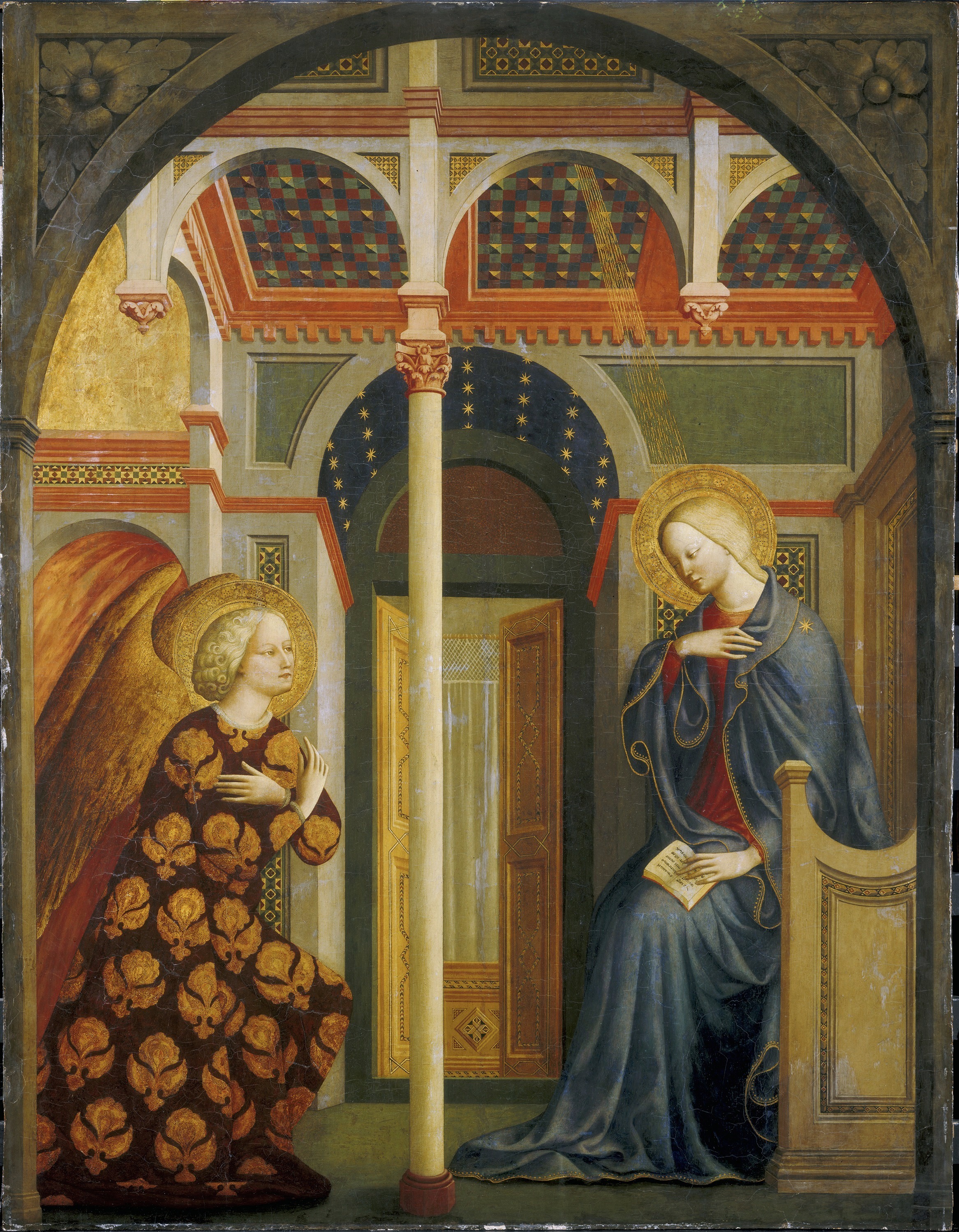
The Annunciation by Masolino da Panicale (c. 1383 – c. 1447)
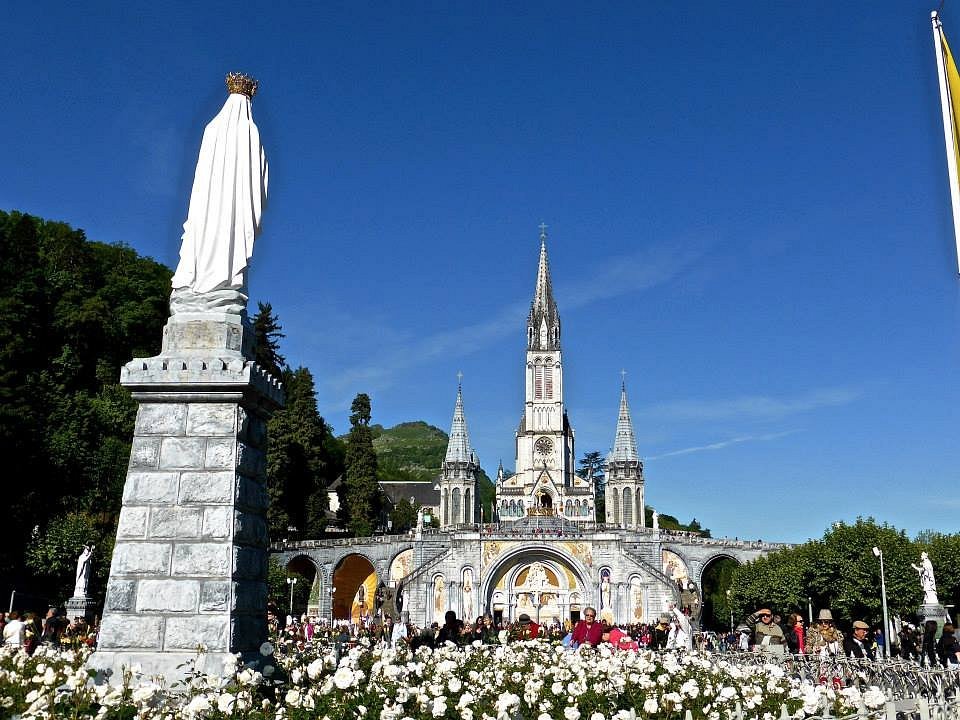
In southwestern France, alongside the Pyrenees mountains, rests a small town called Lourdes. In the year 1858, a fourteen year old girl named Bernadette started to see apparitions of a “small young lady” holding a rosary. It wasn’t until the sixteenth apparition that Bernadette learned the name of the lady, who told Bernadette: “I am the Immaculate Conception.”
Years after the final apparition, once the local bishop and civil authorities accepted Bernadette’s claims, the decision was made to create a statue of the Immaculate Conception. It stands today in the center of the main square in front of the basilicas in Lourdes. Preparations took a long time because Bernadette insisted that every detail of the statue correspond to what she had seen. The artist grew rather exasperated, but Bernadette was insistent.
Among the many details that Bernadette pointed out, one concerned the rosary that the Immaculate Conception held. Bernadette had to correct the artist because he initially portrayed the Immaculate Conception holding a five-decade rosary. Bernadette explained to the artist that when the Immaculate Conception appeared to her, she was holding a six-decade rosary, which is called a Carmelite Rosary.
+ + +
Many Catholics are unaware that there is such a thing as a six-decade rosary, or that it’s been prayed by Catholics for centuries, although the even-older five-decade rosary, called the Dominican rosary, is the form of the Rosary most often prayed.
The point is that there’s not a single form for the Rosary. The form of the Rosary is not regulated by the Church as the Holy Sacrifice of the Mass is. If someone wants to pray the six-decade Carmelite rosary instead of the five-decade Dominican rosary, that person is free to do so. Likewise, if someone wishes to read a verse or verses of Scripture at the start of each decade, that person is free to do so. Likewise, if a person wishes on Thursdays to pray the Luminous Mysteries that St. John Paul proposed, that person is free to do so. The form by which the Rosary is prayed is not essential. What is essential is to pray the Rosary.
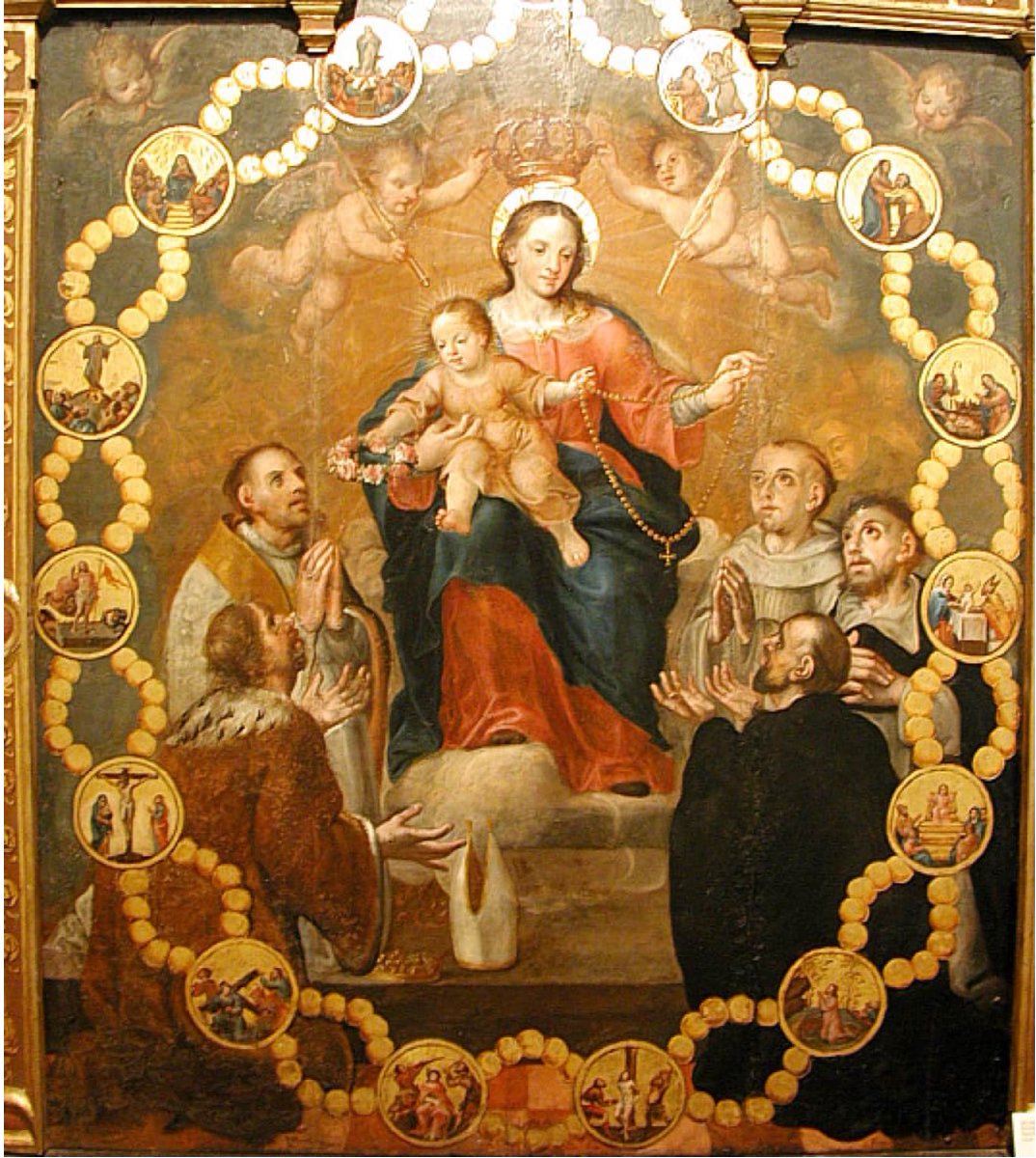
So since I’ve mentioned the Carmelite Rosary, let me say a little about the sixth mystery of each set of mysteries. Within the Joyful Mysteries, the additional mystery is added at the start, as the First Joyful Mystery. The First Joyful Mystery of the Carmelite Rosary is the Immaculate Conception of the Blessed Virgin Mary by her mother, St. Anne. Then the customary Joyful Mysteries follow, with the Annunciation being the Second Joyful Mystery, the Visitation being the Third Joyful Mystery, and so on.
Within the Sorrowful Mysteries of the Carmelite Rosary, the additional mystery is added at the end. So the sixth Sorrowful Mystery is the scene of the Thirteenth Station of the Cross: the Deposition of the Body of Christ into the arms of His Sorrowful Mother.
Within the Glorious Mysteries of the Carmelite Rosary, the additional mystery is also added at the end. So the sixth Glorious Mystery is The Patronage of Mary, Queen and Beauty of Carmel (“Carmel” being the name for the entire family of those friars, nuns, and laypersons who have dedicated their lives to Christ under the patronage of Our Lady of Mount Carmel).
+ + +
During this month of October, the Church calls all Christians to go out of their way to grow in their devotion to Our Blessed Mother through the prayer of the Rosary. Our Lady’s side altar is beautifully decorated during this month: a reminder of this call to the Rosary.
Consider a suggestion about one way to do this. While there are a lot of both pros and cons to the modern media, one of the pros that’s helped many Catholics grow in their Faith are Catholic apps available for smartphones or tablets. While there are surely several good apps that can help you grow in your Catholic Faith, I’d recommend the app called “Hallow”. There are both a free version and a paid version. Recently I gave my mother her first Christmas gift, a year’s subscription to Hallow. This app offers, in addition to audio recordings of the Rosary, the Divine Mercy Chaplet, and the entire Bible, reflections on Sacred Scripture and the teachings of the Catholic Faith. These features make it easy to use time travelling in your vehicle in a spiritually profitable way.
Venerable Sister Lucia, one of the visionaries of Fatima, said late in her life that “All people of good will can, and must say the Rosary every day.” By contrast, she continued by pointing out that “if God, through Our Lady, had asked us to go to Mass and receive Holy Communion every day, there would undoubtedly have been a great many people who would have said, quite rightly, that this was not possible. Some, on account of the distance separating them from the nearest Church where Mass was celebrated; others on account of the circumstances of their lives, their state in life, their job, the state of their health, etc.”
“On the other hand to pray the Rosary is something everybody can do, rich and poor, wise and ignorant, great and small.” It is “a prayer which is within our reach…”. The “Rosary … can be recited either in common or in private, either in church in the presence of the Blessed Sacrament or at home, either when traveling or while walking quietly in the fields.” “A mother of a family can say the Rosary while she rocks her baby’s cradle or does the house work.”
Venerable Sister Lucia continues by noting that “God, who is our Father and understands better than we do the needs of His children, chose to stoop to the simple ordinary level of all of us in asking for the daily recitation of the Rosary, in order to smooth for us the way to Him.”

Statue of Our Lady of Lourdes holding the Carmelite Rosary. The statue is located in the square in front of the main basilicas. In the photo below the same statue is shown from behind.
May is the month when the Church pays the greatest devotion to Our Blessed Mother Mary. After all, that’s why Western culture celebrates Mother’s Day during May: because the celebration is an offshoot of the Church’s devotion to Mary during the month of May.
After the month of May, though, the month of October is second in terms of devotion to Our Blessed Mother. The most important feast of Our Lady during October will be celebrated next Saturday on October 7th, the date of the feast of Our Lady of the Rosary. It’s because of this feast that the Church dedicates the entire month of October to the Holy Rosary.
There are two ways to honor Our Blessed Mother during October. The first is simply to pray the Rosary. Nothing complicated about that: pray the Rosary during October. If you don’t already pray the Rosary every day, start today. We pray the Rosary to honor Our Blessed Mother, which she of course deserves. Yet while we pray the Rosary to give honor to Mary, like so much in our Christian life, when we give, we receive. When we give honor to Mary by praying the Rosary, she draws us closer to her Son.
It’s very simple: if you want your family to grow spiritually stronger, then pray the Rosary together; if you want your parish to be strong, then pray the Rosary; if you want our world to be filled with God’s grace, then pray the Rosary, so that you and the members of your families and parish will take God’s grace into the world. So that’s the first way to honor Mary during October: by praying the Rosary.
The second way to honor Our Blessed Mother during October is to stop and reflect upon what exactly the prayer of the Rosary is all about. The Rosary is such a simple prayer that there’s a risk of praying it without giving our full attention to the Rosary’s meaning. In other words, there’s a risk of praying it mindlessly, and if we pray the Rosary mindlessly, then we pray it fruitlessly. But if we stop every now and again—say, during October—and step back and consider the depth of the Rosary, then when we pray it, our prayers will be more fruitful.
One feature of the Rosary that deserves our reflection is the sets of mysteries that we meditate upon while praying the Rosary. Consider the three traditional sets of mysteries: the Joyful, Sorrowful, and Glorious Mysteries. The fourth set of mysteries—the Mysteries of Light that St. John Paul II proposed in the year 2002—deserve separate attention because that set of mysteries is so unique. In the 2002 document that St. John Paul wrote about the Rosary, you can read his reflections upon the Mysteries of Light.
However, the three traditional sets of mysteries—the Joyful, Sorrowful, and Glorious Mysteries—have several traits in common. One is that each set of mysteries is liturgical in nature. That is to say, the Joyful Mysteries are the Advent and Christmas Mysteries. The Sorrowful Mysteries are the Lenten mysteries. Then it follows that the Glorious Mysteries are the Easter mysteries, with an “epilogue”, if you will, given to Our Blessed Mother in the last two Glorious Mysteries.
So the Rosary is liturgical in nature. That is to say, the Rosary tracks the major seasons of the Church year. But to say that the Rosary tracks the Church’s seasons is simply to say that the Rosary is dramatic in nature: the drama in question being the unfolding of salvation history.
In other words, on a given day—let’s say Monday—when we pray the Rosary, the five mysteries that we pray that day—in the case of Monday, the Joyful Mysteries—are not five random snapshots from the lives of Mary and Jesus. The five Joyful Mysteries are inter-connected. We could say that they make a five-act play, with the events of each act leading to the events of the next, and the entirety of the Joyful Mysteries telling a single story about how God brought joy into the world through Mary and Jesus. Likewise, the Sorrowful Mysteries tell the story about how God chose to suffer for our sins, while the Glorious Mysteries tell the story of God’s victory over death: a victory He offers to all mankind, beginning with the Blessed Virgin Mary.
The Blessed Virgin Mary is the first and best disciple of Jesus Christ. In response to Mary’s fidelity to all God asked of her, when her earthly days were completed, God rewarded Mary by means of her Assumption and Coronation. Nonetheless, we need to remember that while Mary is the first disciple of Jesus, she’s not meant to be the last. She’s not the “last word” on how to follow her Son. She’s our mother, and we, as her children, learn from our Mother how to follow Jesus.
Let me finish with one of St. John Paul’s recommendations in his 2002 document about the Rosary. His recommendation concerns the start of each decade of the Rosary. He writes: “In order to supply a Biblical foundation and greater depth to our meditation, it is helpful to follow the announcement of the mystery with the proclamation of a related Biblical passage, long or short, depending on the circumstances. No other words can ever match the efficacy of the inspired word. As we listen, we are certain that this is the word of God, spoken for today and spoken ‘for me’.”
So if necessary, because, for example, there’s a Mass to follow the Rosary, the Scripture passage for each decade can be as short as one verse long. But when the Rosary is prayed at home, a little longer Scripture passage can be used, and a moment of silence can follow the Scripture passage. This makes it easier to meditate upon the mystery as the decade proceeds.
We pray the Rosary to honor Our Blessed Mother, as she deserves. Yet while we pray the Rosary to give honor to Mary, when we honor Mary by praying the Rosary, she draws us closer to her Son. Meditating upon her life shows us how to make His life the path of our own life.
For the link to St. John Paul II’s 2002 apostolic letter about the Rosary, click HERE.
The Twenty-fourth Sunday in Ordinary Time [A]
Sirach 27:30—28:7 + Romans 14:7-9 + Matthew 18:21-35
Pride and anger have something in common. Both can be either good or evil.
Take pride, for example. A student ought to take pride in a report card with very good grades. A sports team ought to take pride in winning a championship. A farmer ought to take pride in completing the season’s harvest. All of these forms of pride are morally good, and deserved, even though each demands qualification. Each requires the exercise of the virtue of prudence.
After all, while the student can rightly take pride in his hard work and his intelligence, where did the capacity for hard work and intelligence come from? He was given those gifts—not to mention the gift of life itself—from his parents in cooperation with God’s providence. Furthermore, the student likely has other people as well, such as teachers, whom he needs to recognize as helping him if he’s going to take pride in his academic accomplishments. That’s why every morally upright act of pride demands that it not be completely self-centered, but instead that it gives credit to others where credit is due. Likewise for the athlete, the farmer, the businessman, the politician, the parent, the spouse, and so on.
Pride can be exercised in a morally upright way, but pride can also be a terrible sin and even a horrible vice when the human person is lacking in prudence and humility. Something very similar is true of anger. Anger can be exercised in a morally upright way. But anger can also be a terrible sin, and even a horrible vice. Today’s Scripture passages show us the dark underside of the sin and vice of anger.
However, before reflecting on today’s Scripture passages, we ought to consider a passage that shows us anger in a good light: in the light of Jesus Christ. All four of the Gospel accounts record Jesus’ cleansing of the Temple in Jerusalem. He overturns the money changers’ tables. He makes a whip of cords, and drives out both those selling animals, and the money changers. And He declares: “It is written, ‘My house shall be a house of prayer, but you have made it a den of thieves.’”[1]
The fact that all four evangelists recorded this event in their Gospel accounts drives home an important truth: that anger can be both morally good, and even holy. However, like with pride, the virtue of prudence has to guide a person’s anger. If prudence and humility do not guide a person’s anger, the anger becomes first sinful, and then a vice: the type of anger we hear about in today’s Scripture passages.
“Wrath and anger are hateful things, yet the sinner hugs them tight.” That opening sentence of today’s First Reading points to one of the paradoxes of the sin and vice of anger. Wrath and sinful anger are so harmful to the person who holds them inside, and yet there can be a harmful compulsion to hold on to them: or in the words of Sirach, to hug them tight. But why would anyone hug tight, next to oneself, things that are hateful? It makes no sense.
You might as well drive to the nearest pet store and purchase two porcupines. Take them home. Name one of the porcupines “Wrath”, and the other porcupine “Anger”. Then every night before you go to sleep, take your porcupines in your arms and hug them tight. Give them a great big hug. That would make more sense than hugging tight the sin of anger and the vice of wrath. It would make more sense because the porcupines would only harm your body, while the sin of anger and the vice of wrath harm your soul, and place your soul in jeopardy of eternal punishment.
So, if anger can be either righteous or sinful—virtuous or vicious—the question is: what makes the difference?
The key difference is the object. What is the object of one’s anger? What are you angry at? What are you angry about?
There are many people running around in the world who don’t know what they’re angry about, which results in them being angry at everything, and venting their anger at whatever or whoever happens to be in front of them. But for anger ever to be righteous—for anger ever to be morally good—there has to be a clear object of one’s anger, and there has to be a just reason for focusing one’s anger at that object. In the case of the Cleansing of the Temple, the object of Jesus’ anger was the money changers and those selling animals in the Temple. He had a just reason for being angry at them because they were profaning God’s Temple, and He took action against those who were doing wrong.
Of course, there are times in this world here below when it’s impossible to direct one’s anger at the true and just object of one’s anger. Imagine, for example, parents whose high school daughter is killed in a car accident by a drunk driver. The tragic situation is made even more difficult because the drunk driver was also killed in the accident, meaning that the parents have no way of seeking justice in a courtroom against the man who killed their daughter. The parents do not have their daughter. They do not have the means to seek justice on this earth. What can they do in the face of their anger?
Remember that when Jesus was asked by a Pharisee which commandment is the greatest, Jesus named two commandments, which sum up His entire Gospel: love God with your whole heart, soul, and mind, and love your neighbor as yourself.[2] Whenever you’re at a moral or spiritual impasse, that reminds you how to proceed.
For example, in the case of the parents whose daughter was killed, although they are unable to seek justice in the courtroom, they can love their neighbor by becoming advocates for those suffering as they have, or for those at risk by advocating in a preventive manner. In these sorts of ways, their anger can become productive and life-giving.
Yet in addition to loving their neighbors, the grieving parents need even more to love God, asking for a share in His strength and wisdom. When someone with a just reason for being angry has no way of seeking justice, it’s important for that person to ask God in prayer for guidance about the best way to direct one’s anger.
Of course, even when someone with just anger does have the means to address directly the object of his anger, it’s important to take one’s anger to God in prayer. Through prayer and the grace of the sacraments, God can increase within the justly angry person the virtues of prudence and humility, so that he can address the object of his anger in the most holy way possible.
However, today’s Gospel passage suggests that God might direct the angry person in a different direction: namely, to the exercise of mercy. The king in today’s parable clearly symbolizes God the Father, who mercifully forgives sins. It’s because the king had forgiven the servant who owed him a huge amount that the king expected that servant to “pay it forward”, to use a modern expression. When the servant does the opposite, the king justly grows angry, and “in anger… handed him over to the torturers until he should pay back the whole debt.” Then, Jesus, to drive home the symbolism of the parable, explains: “So will my heavenly Father do to you, unless each of you forgives your brother from your heart.”
So at the beginning of the parable, the king shows mercy, but at the end, he acts out of a just anger towards the servant who refused to show mercy to a fellow servant. Jesus does not explain the punishment of the servant who refused to imitate his king: does this punishment symbolize the eternal pains of Hell, or the temporal punishment of Purgatory, or maybe simply earthly punishment that has to be suffered in order to come to one’s senses? Jesus does not tell us.
But the point of the parable is clear. The point of the parable mirrors one of the lines of the only spoken prayer that Jesus taught. Often we pray the Our Father too rapidly, and don’t think about the meaning of each phrase. Each time we pray the Our Father, we need to be conscious of what we’re saying when we speak these words: “Forgive us our trespasses, as we forgive those who trespass against us”. That tiny word “as” in the middle of the sentence is incredibly important, because we’re asking God the Father to forgive us “as” we forgive those who sin against us. In other words, if we do not forgive our neighbor, then we’re telling God the Father not to forgive us, and if God the Father does not forgive us, then our punishment will certainly be without end.
In this world here below, there are times when we’re justifiably angry, and justified in seeking justice. If we never sought justice in this world, this world would be filled with chaos. But if we never extended mercy, this world would be filled with persons who never become like God the Father. Justice can bring us a measure of peace on earth. But only Divine Mercy can bring us to eternal peace in Heaven. If you’ve never prayed the Chaplet of Divine Mercy, take the time to learn about it, and to begin praying it. While sinful anger and wrath are hateful things, Divine Mercy is a godly thing. The sinner hugs anger and wrath tight to himself. Through Divine Mercy, God hugs the sinner tight to Himself.
[1] Luke 19:46; cf. Isaiah 56:7 and Jeremiah 7:11.
[2] Matthew 22:35-40.
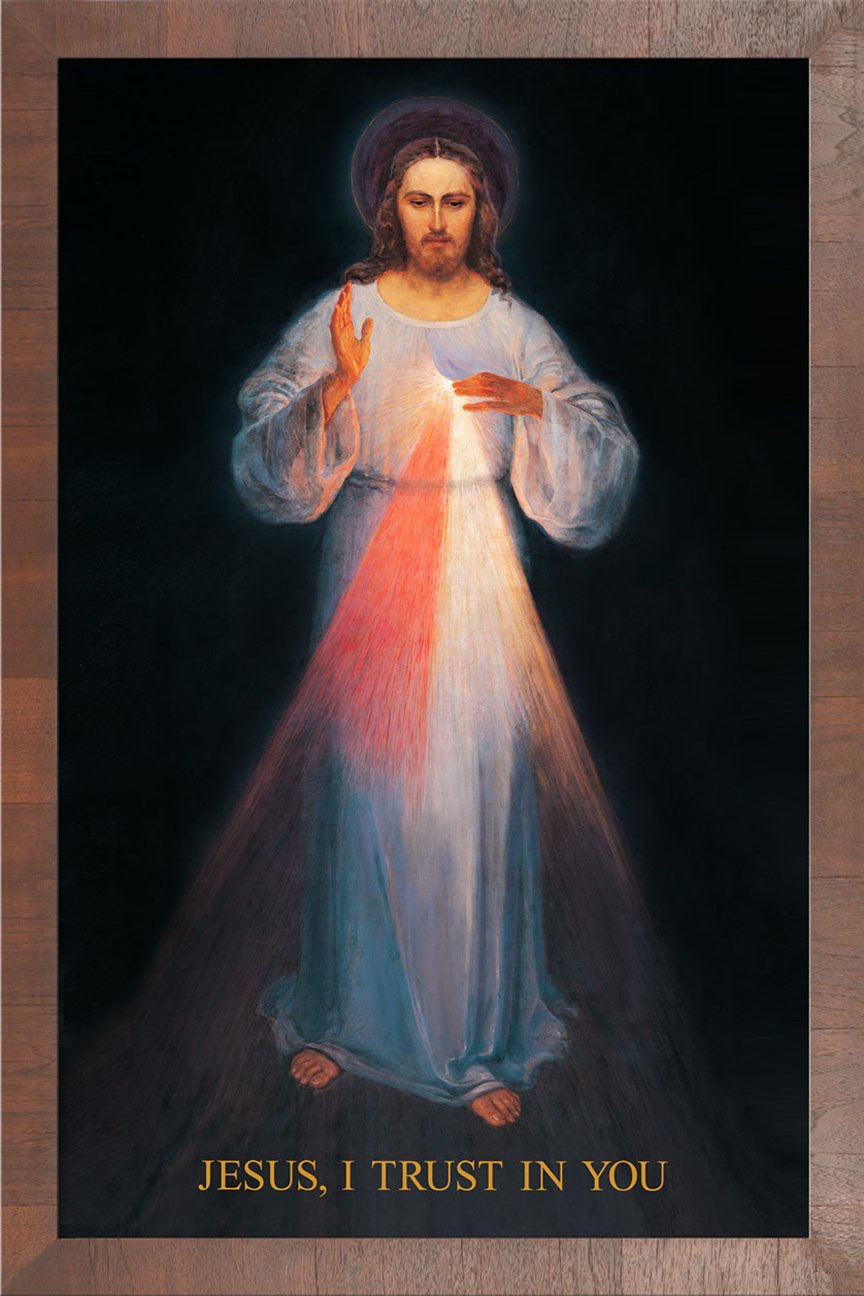
Click HERE to learn how to pray the Divine Mercy Chaplet.
The Seventeenth Sunday in Ordinary Time [A]
I Kings 3:5,7-12 + Romans 8:28-30 + Matthew 13:44-52
Saints are an important part of our lives as Catholics. We pray to a patron saint for a particular need. We name our children after saints. We celebrate, throughout the year, the feasts of saints who inspire us by their struggles as much as by their accomplishments.
If you were to look online at what’s called the “General Roman Calendar”, you’d see the list of saints whose feasts are celebrated at Holy Mass throughout the world. However, the list of saints on the General Roman Calendar is very selective. There are thousands and thousands of canonized saints, but only 365 days in the average year. So most of the Church’s canonized saints do not have their feasts celebrated at Holy Mass.
Fortunately, there is a resource that gives us the names, feast days, and brief biographies of the vast majority of the Church’s official saints. It’s called the Roman Martyrology, and although a printed copy is very expensive, it costs nothing at all to look through it online.
We might be inclined to think that the Church’s official saints lived only during the two thousand years of the Church’s history-to-date, from Pentecost onwards. Of course, we would have to admit that there are several saints mentioned in the New Testament who died before Jesus’ death, such as St. Joseph, St. John the Baptist, and Sts. Simeon and Anna. But what about holy men and women who died before the birth of Jesus Christ?
Within the pages of the Roman Martyrology are found the feast days of thirty-three saints from the pages of the Old Testament. These saints’ feasts are not celebrated at Holy Mass, but their feasts are commemorated during the Divine Office.[1] Many of them are the prophets after whom the prophetic books of the Old Testament are named: for example, the feast day of Saint Isaiah is May 9th, and the feast day of St. Ezekiel is July 23rd. Other saints of the Old Testament are key figures from the Pentateuch—the first five books of the Bible—such as St. Moses, whose feast day is September 4th, and St. Abraham, whose feast day is October 9th.
However, there’s one group of Old Testament figures that’s not highly represented among the Old Testament saints, and that’s the Kings of Israel. Among the thirty-three Old Testament saints, the only king is Saint David, whose feast day is December 29th. We might speculate about why only one Old Testament king is a saint, and if we were to speculate about this question, we might do so by looking at the example of Saint David’s successor, his son Solomon, who is at the center of this Sunday’s First Reading.
+ + +
We hear about the life of Solomon in the First Book of Kings.[2] In the first two chapters, King David dies, and his son Solomon becomes King of Israel. This Sunday’s First Reading is taken from Chapter 3, and the newly crowned King Solomon is unsure about how to rule his kingdom. But God decides to help him out by appearing to him in a dream.
Solomon had inherited great wealth and power from his father. But he was smart enough to know that there’s a big difference between what you inherit and what you earn by your own effort. Solomon had to be humble to speak to the Lord as he did. The Lord had plainly stated: “Whatever you ask I shall give you.” Not only had David given Solomon his wealth, his power, and his crown. Now the Lord God Himself offered Solomon a blank check: “Whatever you ask I shall give you.”
Solomon must have been humble to respond as he did. Solomon admitted, “I am a mere youth, not knowing at all how to act. … Give your servant, therefore, an understanding heart to judge your people and to distinguish right from wrong.”
“The Lord was pleased that Solomon made this request. So God said to him: ‘Because you have asked for this—not for a long life for yourself, nor for riches, nor for the life of your enemies, but for understanding so that you may know what is right—I do as you requested. I give you a heart so wise and understanding that there has never been anyone like you up to now, and after you there will come no one to equal you.’”
From this exchange between the Lord and Solomon, there are several points we might reflect upon. For example, we might reflect upon the things that Solomon chose not to ask for—such as a long life, riches, or victory over enemies—because he recognized their relative unimportance.
Instead, we might reflect upon the generosity of the Lord: that is, how after Solomon asked for understanding, the Lord gave him not only understanding, but wisdom as well. These two gifts are not the same thing. Understanding and wisdom are two separate Gifts of the Holy Spirit.[3] The Lord’s response to Solomon’s request shows us how generous God is when we approach Him with humility.
However, while you might want later on to reflect upon the gifts that Solomon did not request, and upon the gift God gave which Solomon had not requested, consider right now a different point of reflection. Consider why King Solomon is not a saint, as his father King David is.
+ + +
The most obvious explanation of why King Solomon is not a saint is found in Scripture. God had bestowed great wisdom upon Solomon. His wisdom was so great, in fact, that four books of the Old Testament bear the name of Solomon as author: Proverbs, Ecclesiastes, Song of Songs, and the Book of Wisdom. Yet Solomon was more than a man of words. He stands in Jewish history as the builder of the first Jewish Temple.
However, in spite of God’s gifts to him, in the end, Solomon gave himself over to gross idolatry, among other sins against the Commandments. In Chapter 11 of the First Book of Kings, we hear not only of Solomon’s sins, but also of the Lord’s punishment of him: the Lord broke the Kingdom of Israel in two, and after Solomon, the Kingdom was never united again.
But how could someone who started off so promising, with so many gifts given to him both by God and man, end up like this? The answer is not in the Old Testament, but in the New. St. Paul, in his First Letter to the Corinthians, explains the spiritual principle at stake when he writes:
“If I speak in the tongues of men and of angels, but have not love, I am a noisy gong or a clanging cymbal. And if I have prophetic powers, and understand all mysteries and all knowledge, and if I have all faith, so as to move mountains, but have not love, I am nothing. If I give away all I have, and if I deliver my body to be burned, but have not love, I gain nothing” [1 Corinthians 13:1-3].
This is the difference between a gifted man and a saint. In the spiritual life, humility is the start. The virtue of faith, which Old Testament saints like King David nurtured, opens the door of the soul to God’s graces. Gifts such as understanding and wisdom then strengthen us. But the love of God is what makes the difference in the end.[4] Only the love of God can change a person into a saint. This is the love that we speak of in the ancient prayer: “Teach me to love, Lord, that I may love. Show me your love, Lord, that I may love. Love me, Lord, that I may love.”
_____________________________________
[1] Before the Second Vatican Council, and even today where the 1962 liturgical books are used as authorized by Summorum Pontificum, the Roman Martyrology is read at the canonical Hour of Prime. If it is read in the post-Vatican II form, this is usually done after the concluding prayer of Lauds [Morning Prayer].
The entry for each date in the Roman Martyrology is read on the previous day. While reading it in choir is recommended, it may be done outside the Divine Office. For example, in seminaries, it’s traditional to read it after the main meal of the day.
[2] Also in the First Book of Chronicles, and briefly in the Second Book of Samuel.
[3] Cf. Isaiah 11:1–3; CCC 1830-1831; and St. Thomas Aquinas, Summa Theologiae IaIIae, Q. 68.
[4] In addition to idolatry, another of Solomon’s sins against the Covenant with the Lord was his many marriages to women of alien religions. In fact, it was these marriages that led to his idolatry: “Now King Solomon loved many foreign women: the daughter of Pharaoh, and Moabite, Ammonite, Edomite, Sidonian, and Hittite women, from the nations concerning which the LORD had said to the people of Israel, ‘You shall not enter into marriage with them, neither shall they with you, for surely they will turn away your heart after their gods’; Solomon clung to these in love. He had seven hundred wives, princesses, and three hundred concubines; and his wives turned away his heart” [I Kings 11:1-3]. Because of Solomon’s disordered heart, he could not finally bear the love of God needed to be a saint.
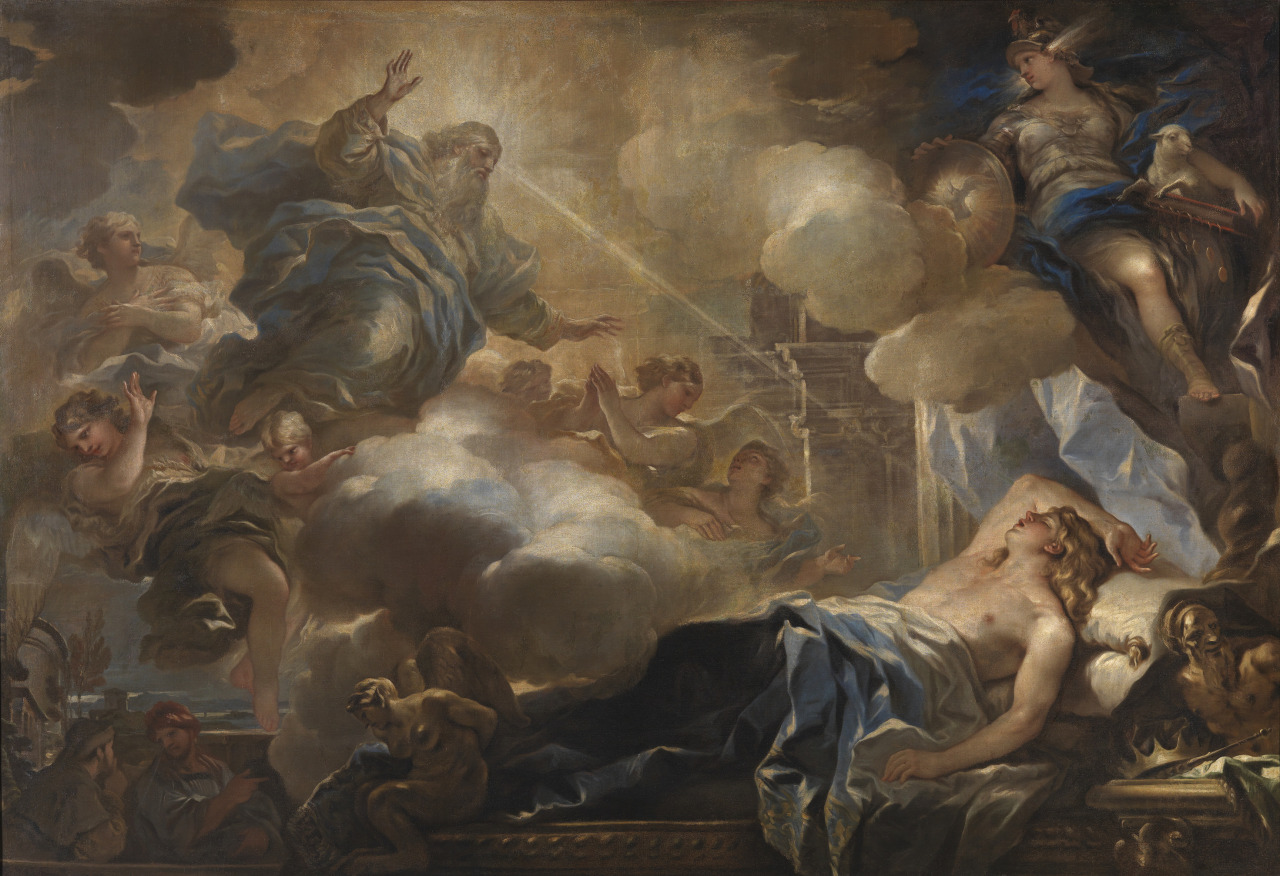
Dream of Solomon by Luca Giordano (1634–1705)
The Sixteenth Sunday in Ordinary Time [A]
Wisdom 12:13,16-19 + Romans 8:26-27 + Matthew 13:24-43
Very likely, at some point you’ve asked a priest to pray for you or one of your intentions. Whenever a priest is asked this, as he often is, he generally fulfills that request in one of a few ways.
The most powerful prayer that a priest can offer, of course, is the Holy Sacrifice of the Mass. Because Holy Mass is central to our lives as Catholics, there’s a formal schedule for Mass intentions that’s organized in the parish office weeks ahead of time.
However, if there’s a more immediate need for prayer, the priest might pray for the requested intention in one of three other ways.
The first is that the priest might, just as you might if someone asked you to pray for them, take up his rosary beads and offer that day’s rosary for the requested intention.
The second is that the priest might, just as you might, pray for the intention during a Holy Hour before the Blessed Sacrament. Though Eucharistic Adoration is not as central to our lives as the Holy Sacrifice of the Mass, Adoration flows directly from Holy Mass. Adoration is one of the fruits of Holy Mass.
The third way that the priest might pray for a requested intention is during one of the hours of the Divine Office, otherwise known as the breviary. Though the Divine Office is not as well-known as the Rosary, the Divine Office is a more important obligation in a priest’s life than the Rosary, because both at his ordination as a deacon, and then again at his ordination to the Priesthood, the man being ordained promises before the bishop to pray the Divine Office each day for the People of God.
+ + +
This past Tuesday morning, I was praying the Divine Office, and one of the Scripture passages in that particular hour of the breviary was taken from Chapter 26 of the Old Testament prophet Isaiah. The prophet proclaims: “Trust in the Lord forever! For the Lord is an eternal Rock” [Isaiah 26:4]. Reflecting on this verse can help us appreciate Jesus’ parable about the weeds and the wheat.
“For the Lord is an eternal Rock.” Is this statement from the Bible meant to be taken literally? Most of us, it’s fair to say, would not understand that statement from Isaiah literally, but instead as a metaphor. But if we don’t take this statement literally, what else in the Bible do we not have to take literally? Are the first two chapters of Genesis meant to be taken literally? Is Jesus’ discourse about the Bread of Life in John 6 to be taken literally? Is the Gospel account of Jesus’ Resurrection to be taken literally?
Interpreting Sacred Scripture individually results in a mass (and a mess) of contradictory interpretations. That’s one reason why Jesus founded a Church that has within it a teaching authority: that is, with the right and the responsibility to interpret Scripture definitively when a given passage touches upon a key teaching of the Catholic Faith.
One of the Church’s most important teachings about interpreting Sacred Scripture is that a passage of Scripture can have several different meanings at the same time. When a given passage has multiple meanings, they enrich our understanding and our love for God.
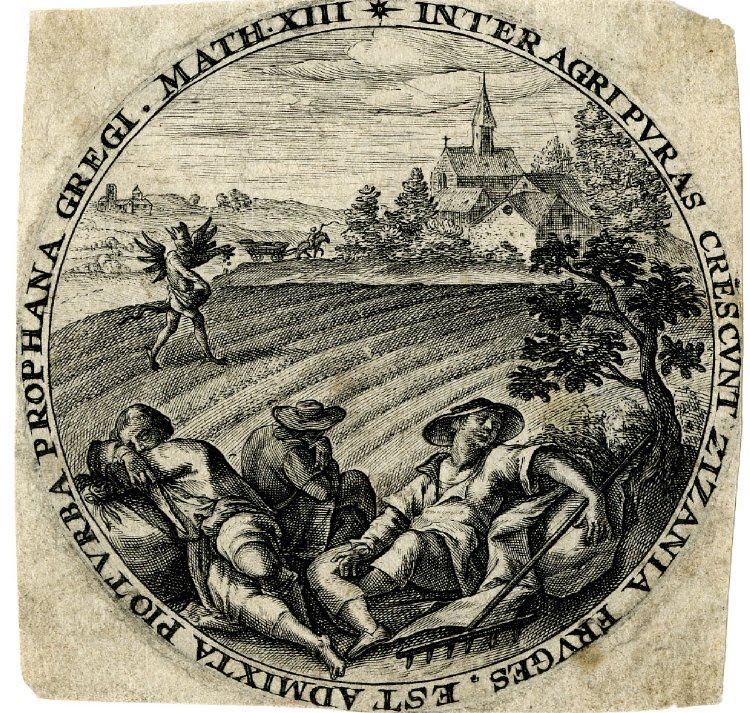
The Parable of the Weeds and the Wheat in this Sunday’s Gospel Reading offers us an example of a Scripture passage with several different meanings.
The literal meaning of the Parable of the Weeds and the Wheat is explained by Jesus Himself at the end of this Sunday’s Gospel Reading. Explaining the first part of the parable, He sets the stage and describes the main characters: “‘He who sows good seed is the Son of Man, the field is the world, the good seed the children of the kingdom. The weeds are the children of the evil one, and the enemy who sows them is the devil.’”
Jesus’ descriptions of this stage and these main characters in the first part of the parable are just as applicable to the Holy Land in the first century as they are to the United States in the twenty-first century. This first part of the parable is playing out today as it did all around Jesus: there are weeds and wheat; sinners and saints all mingling upon the same stage.
But the last part of the parable shifts our focus far into the future. “‘The harvest is the end of the age, and the harvesters are angels. Just as weeds are collected and burned up with fire, so will it be at the end of the age. … Then the righteous will shine like the sun in the kingdom of their Father.’”
In this last part of the parable, Jesus is describing the Final Judgement at the end of time. Many Scripture passages focus upon what the Church calls the “Last Things”: Heaven and hell, death and judgement.[1] This last part of the parable reminds us that our actions upon the stage of this world have not only worldly consequences, but also eternal consequences.
So the literal meaning of the Parable of the Weeds and the Wheat, explained by Jesus at the end of the Gospel Reading, has a two-fold focus. It focuses first on the present, when the weeds and the wheat grow together in the world. It focuses second on the end of time, when Christ will separate the wheat from the weeds in the Final Judgement.
However, in addition to this two-fold literal meaning of the parable, there’s also an interpretation of this parable that bears another meaning. This other meaning flows from what the Church’s Tradition calls the “moral sense of Scripture”.
The literal meaning of the parable that Jesus explains clearly connects to a sense of morality. But while the literal sense of this parable distinguishes between “the children of the kingdom” and “the children of the evil one”, the other meaning of the parable looks into the soul of an individual Christian, and the moral life of that Christian.
This other meaning of the parable looks more closely at the moral life of an individual, and considers that within that Christian’s soul, there are both weeds and wheat. In other words, “the children of the kingdom” are not without weeds in their souls (excepting Our Blessed Mother). At the same time, it’s entirely possible that one of “the children of the evil one” could bear the wheat of good works in his soul, at least on the natural level.
Each Christian is responsible for the world of his soul. While on the literal level of the parable “the end of the age” is the end of time, when the Last Judgment will take place, on the moral level “the end of the age” is the moment of death. God enacts a particular judgement of the individual at the moment of that person’s death, sending that person’s soul either to everlasting punishment, or towards everlasting salvation. Until the moment of that person’s death, throughout the course of that person’s earthly days, God shows the patience of the householder in the parable, allowing the free will of the individual to reign. During the course of that person’s earthly days, it is that person who bears responsibility for tending to the field of the soul. Building upon the graces of one’s Baptism into Christ, Jesus in the Sacrament of Confession helps us tend to the field of our soul so that, at the hour of our death, He will call us to join “the righteous” who “will shine like the sun in the kingdom of their Father.”
__________________________________
[1] This perspective in which a Scripture passage focuses upon the Last Things is technically called the “anagogical sense of Scripture”. See the Catechism of the Catholic Church 115-117.
The Fifteenth Sunday in Ordinary Time [A]
Isaiah 55:10-11 + Romans 8:18-23 + Matthew 13:1-23
If there’s one part of Sunday Mass that gets overlooked, it is the Gospel Acclamation. This sentence or two that’s sung before the Gospel Reading, in between the Alleluia being sung, is very brief. Because it occurs when people are still standing up and finding their place in the missalette, its words often escape our notice. But as a way to start reflecting upon today’s Gospel Reading, consider what today’s Gospel Acclamation declares.
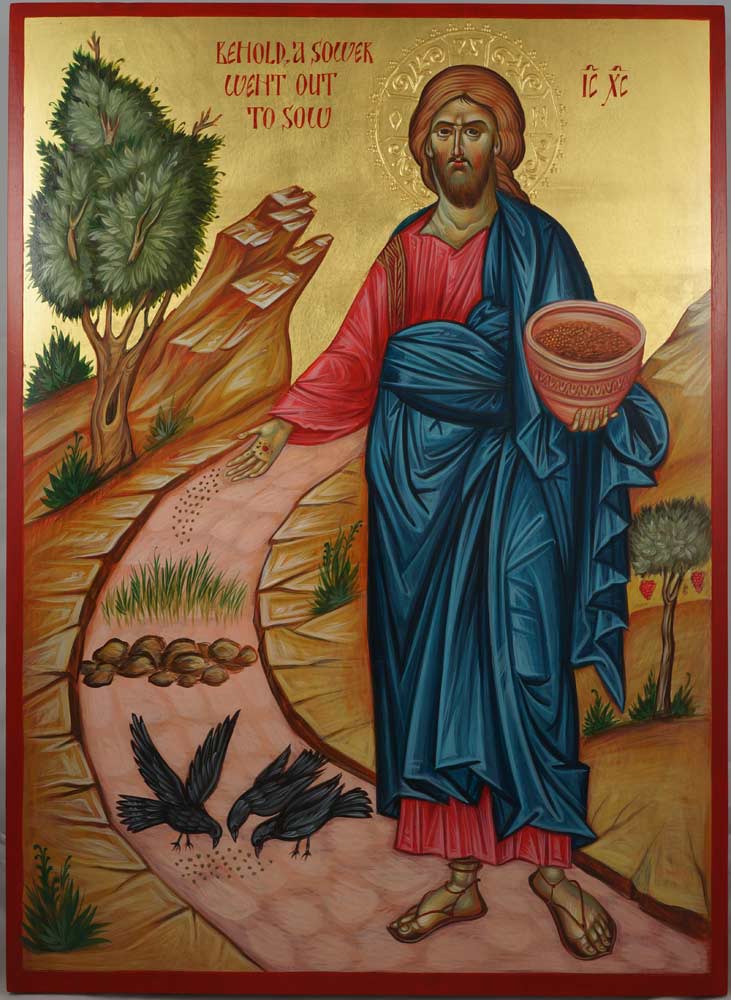
“The seed is the word of God, Christ is the sower.”
That certainly helps us understand the parable that Jesus preaches in today’s Gospel passage. Jesus, through this parable, is describing Himself and His mission on earth. But at the same time, this Gospel Acclamation raises a question.
Since Jesus is God, and since God is all-powerful and all-knowing, why is Jesus such a bad farmer? According to the parable, on this occasion, his batting average was only .250. Jesus sowed seed on a path and it was eaten by birds, He sowed seed on rocky ground where the soil had no depth, and He sowed seed where there were thorns that choked what actually did grow. Only the last section grew to abundance.
So is Jesus a bad farmer? Our instincts, of course, tell us that the answer is “No. Jesus is not a bad farmer.” But if that’s the case, how do we explain the fact that Jesus’ labor as a sower failed three times more often than it succeeded?
The short answer is that this parable is not chiefly about the sower. The chief focus of this parable is the variety among the sections of soil where the seed is sown. This focus is apparent in the explanation that Jesus gives at the end of today’s Gospel passage. In the last five verses of the passage, Jesus does not spend any time describing either the sower or the seed. Instead, He explains what was wrong with those first three sections of soil, in contrast to the fourth.
So while it’s helpful to learn from the Gospel Acclamation that the “seed is the word of God,” and that “Christ is the sower”, we have to give our chief focus to what Jesus tells us about these four sections of soil.
+ + +
If we wanted to complete today’s Gospel Acclamation by identifying what exactly soil symbolizes in this parable, then we would acclaim: “The seed is the word of God, Christ is the sower, and the soil is the human heart.”
The soil is the human heart. Jesus alludes to this in His explanation of the first bad section of soil: “The seed sown on the path is the one who hears the word of the kingdom without understanding it, and the evil one comes and steals away what was sown in his heart.” That explanation builds upon what Jesus had said just a few moments earlier, when answering His disciples’ question about why Jesus spoke in parables. Jesus quoted the Old Testament prophet Isaiah, who lamented: “Gross is the heart of this people, they will hardly hear with their ears, they have closed their eyes, lest they see with their eyes and hear with their ears and understand with their hearts and be converted, and I heal them” [see Isaiah 6:10].
This is the center of today’s Gospel passage: not its center in the sense of its midpoint, but in the sense of being the essence of what Jesus wants you to take away from today’s Gospel Reading. Jesus’ quotation of Isaiah answers not only the question of why Jesus preaches in parables. Jesus’ quotation of Isaiah also answers the question of whether Jesus is a bad farmer.
Why does Jesus sow seed on the impenetrable path, on rocky ground, and on ground covered with thorns? One way to reach the answer is to be clear about the difference between the human heart and physical soil. If physical soil is covered with thorns, studded with rocks, or hardened into a path, the physical soil cannot change the situation. But the human heart, into which Jesus sows the seed of God’s Word, is different.
Jesus sows the seed of God’s Word into human hearts that are inhospitable because the human persons who bear those hearts have made their hearts like that. But those same human persons, with the help of God’s grace, can clear away the thorns, dig up and haul off the rocks, and plow under the path so that their hearts will be capable of bearing abundant harvests.
To put it another way, Jesus sows seed on the impenetrable path, on rocky ground, and on ground covered with thorns because He loves each of us more than we love ourselves. We choose to be those persons described by the prophet Isaiah. We choose to be those persons who stop their ears, close their eyes, and refuse to understand with their hearts. But Jesus wants us to see, to hear, to understand, to be converted, and to be healed.
To put it yet another way, Jesus sows prodigally because He loves each of us more than we love ourselves. Jesus speaks to this point in His Sermon on the Mount:
“Love your enemies and pray for those who persecute you, so that you may be sons of your Father who is in heaven; for he makes his sun rise on the evil and on the good, and sends rain on the just and on the unjust. For if you love those who love you, what reward have you? Do not even the tax collectors do the same? … You, therefore, must be perfect, as your heavenly Father is perfect” [Matthew 5:44-46,48].
As God makes the sun to rise on the evil and the good; as He sends rain upon the just and the unjust; so also He sows seed into hospitable and inhospitable hearts, hoping that the inhospitable will co-operate with His grace.
Without God’s grace, our hearts are the impenetrable path, the rocky soil, and the soil covered with thorns because we do not love as God loves. But strengthened by His grace, we can love as He loves. God gives us that grace through all of the sacraments, but especially through the Sacrament of Confession.
+ + +
Unfortunately, the Sacrament of Confession is often not appreciated fully. We know that through Confession, God forgives our sins. But it’s often overlooked that Confession confers other graces in addition to the grace of forgiveness.
The Catechism lists all the graces that God gives to the penitent in Confession. Yet maybe the most important among them is “an increase of spiritual strength for the Christian battle” [CCC 1496]. This grace especially is why we ought to make a sacramental confession at least once a month, even if we don’t have any mortal sins to confess, but only venial sins.
So the Catechism explains that one of the graces that God gives in Confession is “an increase of spiritual strength for the Christian battle”. But what is one of hardest parts of “the Christian battle” if not forgiving those who have hurt you? One of the graces that we receive through Confession strengthens us to forgive in a Christ-like manner those who have wronged us.
The person who devoutly receives the Sacrament of Confession receives along with absolution the grace that strengthens one to forgive others in the same way that Jesus forgave on the Cross. Too often, when we’re faced with the need to forgive someone, we choose to forgive, but only half-heartedly. But God wants us to forgive those who have wronged us not half-heartedly, but whole-heartedly: in fact, with the sort of love that Jesus gave from His Sacred Heart to those who crucified Him. The Sacrament of Confession strengthens us with that kind of love, so that we can show that kind of love to others. When we do this, our hearts become like the Sacred Heart of Jesus, and are ready to bear God’s harvest one hundred-fold.
 Reflections on the Sacred Liturgy