Tuesday of the First Week of Advent

Tuesday of the First Week of Advent
Isaiah 11:1-10  +  Luke 10:21-24

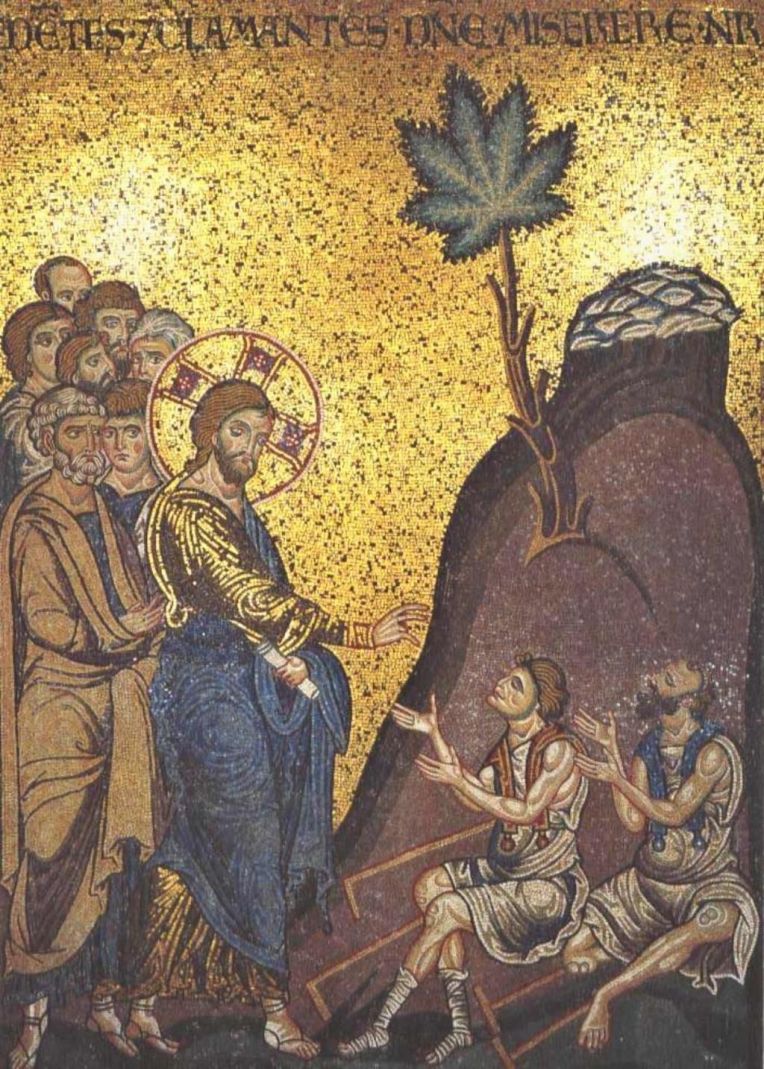
The root of Jesse, / set up as a signal for the nations, /The Gentiles shall seek out ….

Today’s First Reading is taken from the eleventh chapter of Isaiah, the prophet of Advent.  In this rich passage of only ten verses, Isaiah foretells:  the coming of the Messiah, the gifts with which this Messiah is anointed; and the extent of this Messiah’s kingdom upon earth.

Isaiah describes the Messiah who is to come in earthly (in fact, earthy) terms.  At the start of today’s First Reading we hear that “a bud shall blossom” from the roots of Jesse.  This Jesse, of course, is the father of King David, who himself was the greatly earthly king in Israel’s history.  Yet a greater king lay in Israel’s future.  David would be surpassed in glory by one of his own descendants.

The glory of this future king is connected to the gifts described in the next verses of Isaiah 11.  “The Spirit of the Lord shall rest upon” the blossom of Jesse’s roots.  This Spirit, who of course is the Holy Spirit, bears manifold gifts, including wisdom and understanding, counsel and strength, knowledge, and fear of the Lord.  The Messiah to come—the glorious successor of King David—not only bears these gifts but wills to extend them to the members of His Kingdom.

But who will populate this Kingdom?  To what ends will this kingdom extend?  Isaiah uses imagery from the animal kingdom to illustrate how the Messiah will reconcile those who seem natural enemies:  the wolf and the lamb, and the cow and the bear.  This imagery helps us understand the final verse of the First Reading.  “The Gentiles shall seek out” the “root of Jesse,” which will be “set up as a signal for the nations”.  Already on this third day of Advent, the Church points our attention to her celebration of Epiphany, which itself foreshadows the great feast of Pentecost.

Monday of the First Week of Advent

Monday of the First Week of Advent
First Reading, Year A:  Isaiah 4:2-6
First Reading, Years B & C: Isaiah 2:1-5
Gospel Reading: Matthew 8:5-11

Let us go rejoicing to the house of the Lord.

Psalm 122 describes the image of “the house of the Lord”.  In this Old Testament passage, “the house of the Lord” refers not to Heaven, but to the sacred, earthly city of Jerusalem.  The passage also mentions that Jerusalem sits atop a mountain (not on the scale of the Rockies or Himalayas, but a mountain as considered by the ancient peoples of the Holy Land).  That “the house of the Lord” sits atop a mountain implies an ascent, which in turn implies personal sacrifice.  One must stretch and climb to reach His house.  We can relate this ascent both to the long course of Old Testament salvation history, and to our own religious practices during the Season of Advent.  Keep in mind that Advent is a penitential season.

Today’s Gospel passage presents the Lord’s response to such human initiative.  The pagan centurion not only shows initiative in appealing to Jesus, but also faith.  This pagan utters the cry that each of us echoes before Holy Communion:  “‘Lord, I am not worthy to have you enter under my roof; only say the word and my servant will be healed.’”  Jesus responds to him with a prophecy that fulfills Isaiah’s:  “‘… many will come from the east and the west, and will recline with Abraham, Isaac and Jacob at the banquet in the Kingdom of heaven.’”  Jesus adds further to the direction given us by Psalm 122 and Isaiah 2, by pointing our attention beyond any earthly city to the heavenly Jerusalem.

This prophecy can be fulfilled in your own life only because God the Father took the initiative of sending His Son down to be our Messiah.  Jesus offers us the fruits of His sacrifice on the Cross through the Holy Sacrifice of the Mass.  Each of us, even if a member of Christ’s Body from birth, should not presume on God’s grace, but imitate the faith of the pagan centurion.  Make a two-fold prayer on this first weekday of Advent.  (1) Pray that many others will come to Jesus in Holy Mass.  (2) Pray that you will generously take the fruits of the Eucharist to many others though the sacrifices of your daily life.

Advent 1-1

Saturday of the Thirty-fourth Week in Ordinary Time [II]

Saturday of the Thirty-fourth Week in Ordinary Time [Year II]
Revelation 22:1-7  +  Luke 21:34-36

“For that day will assault everyone who lives on the face of the earth.”

The Responsorial Psalm on this final day of the liturgical year shows us how the Church’s year is cyclical in nature.  The psalm’s refrain is a link, tying together this final day of the year to the season of Advent with which the new year begins this evening.

“Marana tha!  Come, Lord Jesus!”  We cry for the coming of the Messiah, as it was in the beginning, is now, and ever shall be until the end of time.  In the beginning, mankind fell from his state of grace.  But God in loving solicitude for His fallen creatures promised to send a savior, and so man began his cry for the Messiah to come.

When He did come, His own people received Him not, as St. John the Evangelist proclaims in the prologue to his Gospel account.  His own people in fact put Him to death.  Yet it was for this that the Messiah had come.

He will come again at the end of time.  When He does, each member of the human family will be judged according to three points.  Do you believe that Jesus first came to destroy your sins?  Do you believe that Jesus will judge you in the end according to your choice to live for or against Him?  Do you believe at this moment that your life is His to live, and that you must cede it to Him?

Friday of the Thirty-fourth Week in Ordinary Time [II]

Friday of the Thirty-fourth Week in Ordinary Time [Year II]
Revelation 20:1-4,11—21:2  +  Luke 21:29-33

“Heaven and earth will pass away, but my words will not pass away.”

The last verse of today’s First Reading offers a key to understanding the entire Book of Revelation.  Mysterious as most of its imagery is, the image of “a bride adorned for her husband” is one that we readily understand.

The entire sentence where he describes this wedded couple is:  “I also saw the holy city, a new Jerusalem, coming down out of heaven from God, prepared as a bride….”  This bride is the Church, and her husband is Christ.  This might seem odd, since it’s a city that is the bride.  But a city is a collection of persons joined together by several ties.  Here St. John is insisting that the most important tie is that of its members being wedded to the bridegroom.  St. John is describing the Church as a city, whereas St. Paul uses the metaphor of “the Body of Christ”.  As members of this heavenly Jerusalem, how can we reflect on our own participation in the Church?

We must think of this city as having a divine center, and ask whether our participation in the life of this city is oriented to this center, or whether instead we live in a little back alley of the city, focused on our own interests, apart from the needs of others and the will of the city’s “mayor”, Christ.

“The holy city” is the Church, the Bride of Christ.  But on this next-to-last day of the Church’s year, as her reflection focuses intently on the Second Coming, two facts about this city of Jerusalem especially stand out.  The first is the historical fact that the city’s savior and bridegroom was crucified outside the city.  The second is the spiritual fact that in the vision of the Beloved Disciple, this “new Jerusalem, [comes] down out of heaven from God, prepared as a bride”.  This city is “prepared as a bride” as it comes “down out of heaven”.  That is to say, it’s God’s grace, and not man’s efforts, that make this bride what she is.  We need to disavow the falsehood of those who exhort:  “Let us build the city of God.”  This is the cry of Babel.  The cries of Heaven are cries of joy, that there, the last thing is the first thing, the Alpha and the Omega, the love which builds the city of God, washes away our sins, and makes us faithful citizens.

Thursday of the Thirty-fourth Week in Ordinary Time

Thursday of the Thirty-fourth Week in Ordinary Time
Luke 21:20-28

“Blessed are those who have been called to the wedding feast of the Lamb.”

Jesus issues a sharp challenge to you today.  His words might even be described as frightening.  Yet Jesus is not preaching fire and brimstone.  He’s not preaching, at least directly, about sin and damnation.  He is preaching, though, about the worldly desolation of Jerusalem, and signs above and upon earth that will cause people to “die in fright in anticipation of what is coming upon the world”.

Many people find the idea of the end of the world very frightening, especially when it’s dramatized in literature or film.  The drama is enhanced by the physical destruction of worldly monuments and temples.  But physical destruction, no matter how vast the scale, pales in comparison to the destruction of a single human soul.

That phrase is not quite accurate, of course, because a soul can never be destroyed.  It would be more accurate to speak of “the destruction of a single human soul’s opportunity for eternal bliss”, or more simply, “the eternal damnation of a single human soul”.  Thanks be to God for His sending the Son of Man to redeem man from his sins.  This final truth is the reason for Jesus to speak hopefully at the end of today’s Gospel passage.  In effect, Jesus preaches that we need not fear the end of the world, or the end of earthly life, because when we place our faith in the Son of Man, we can have full assurance that our redemption is at hand.

Wednesday of the Thirty-fourth Week in Ordinary Time

Wednesday of the Thirty-fourth Week in Ordinary Time
Luke 21:12-19

“By your perseverance you will secure your lives.”

So many people grow fearful thinking about a cataclysmic end of the planet, even though the vast majority will never face it.  Perhaps you’ve seen one of those movies where there’s a dramatic end to life on the planet Earth as we know it.  Movies like that can draw a great deal of attention, and sell a lot of tickets.  Nonetheless, it doesn’t matter if you die from an ice age covering the whole continent, or from old age in your very own home.  What comes next is the same.

This is what we reflect on at the end of each Church year.  Each November, we pray to the saints in Heaven, and for the faithful in Purgatory, and the Church reminds us of the “last things”:  heaven, hell, death and judgment.  All this give us perspective.

In today’s Gospel passage, Jesus declares to His disciples, “By your perseverance you will secure your lives.”  What does this mean?  Every day, God calls us to offer Him our lives in faith, and to live for others.  That’s how we can reach the hour of our death in God’s good graces.  In the end, C. S. Lewis once explained, there are two types of persons:  those who say:  “Heavenly Father, thy will be done”, and those to whom the Father will have to say, “My child, thy will be done.”

The First Sunday of Advent [A]

The First Sunday of Advent [A]
Isaiah 2:1-5  +  Romans 13:11-14  +  Matthew 24:37-44

references to the Catechism of the Catholic Church cited for today by the Vatican’s Homiletic Directory:

CCC 668-677, 769: the final tribulation and Christ’s return in glory
CCC 451, 671, 1130, 1403, 2817: “Come, Lord Jesus!”
CCC 2729-2733: humble vigilance of heart

“For you do not know on which day your Lord will come.”

“Mamma in her kerchief, and I in my cap, had just settled our brains for a long winter’s nap.”

There’s something extremely enjoyable about sleep.  The older we get, the more we appreciate something as simple as a nap.  If I were to paint a verbal picture for you of a Sunday afternoon in January, with snow falling outside and the fireplace roaring, with a feather pillow and one of Grandma’s quilts on the sofa, then if the idea of a long nap didn’t immediately appeal to you, you would have to be under the age of thirty.

Nonetheless, regardless of age, is there anyone who likes being woken from sleep?  I doubt there are many parents who like the chore of trying to wake a child.  Sleep is something we cling to.  Even if we can only have one more minute of sleep, and press the snooze button one more time …  We don’t want to leave our state of sleep.

Yet even as much as we prize our sleep, sleep is also used in our culture as a metaphor for very negative experiences.  If we say that someone’s “asleep at the wheel”, we’re not complimenting the person.  If an athlete is on the field or the court, and the coach yells at the athlete, “Wake up out there!”, you can assume that the coach is not happy with the athlete’s performance.

In those settings, “sleep” implies some sort of “disconnect”, while its opposite—wakefulness—implies being connected, being “plugged in”, being alert to and engaged in what’s going on around oneself.  The person who is asleep is not aware of what’s going on around him.  He cannot see the “big picture”.

Even more confusing is that these two opposite ways of using the metaphor of “sleep”—as something that is very enjoyable and comfortable, and also as something implying a disconnect in our lives—are not mutually exclusive.  That is, we often enjoy being disconnected from the bigger picture.  One of the reasons that we want to remain asleep is so that we won’t have to look at the big picture.

We hear about this double meaning of sleep within today’s Scriptures.  Focus upon Jesus’ command in the Gospel Reading.  What kind of sleep is Jesus talking about when he commands, “Therefore, stay awake!”?  In order to reach an answer, reflect upon different degrees to which one can or cannot awaken oneself.

First, there is the sort of sleep that you can wake yourself from directly.  For example, an athlete can monitor his stats, recognize when he’s sleeping out on the field or the court, and take concrete steps to wake himself from his slumber.

Second is the kind of sleep from which we can only wake ourselves indirectly.  An example would be the sleep that we settle into each night when we put our head on our pillow.  You can’t consciously rouse yourself from the middle of this sleep.  But you can wake yourself indirectly by setting an alarm clock before falling asleep.

Then there is a third type of sleep, from which we cannot wake ourselves at all.  The most obvious example of this is death:  human death.

In our moral and spiritual life, we have to face all three types of sleep.

First is the sleep of vice.  A vice is a bad moral habit that we choose to cultivate, but which we can also uproot if we so choose.  Moral effort by itself can alleviate vices, although God’s grace makes the process much easier.

Second is the sleep caused by sin.  Sin destroys grace within us, leading to a sort of spiritual sleep.  We can only uproot sin—both mortal and venial—indirectly, by turning to God to wake us up.  We can make restitution for our sins, but not atonement.

Third is the sleep of death.  Human death, unlike vices and sins, is irreversible (outside of a miracle).  Ordinarily, no human person can raise herself or himself from death.  Only Jesus, who declared, “I am the Resurrection and the Life”, can wake one from death.

To stay awake, then, is to wait for the coming of Christ with hope and assurance.  We trust that His advent will bring freedom from vice, atonement for sin, and a door leading through human death into a life greater than we can imagine here below.

Tuesday of the Thirty-fourth Week in Ordinary Time

Tuesday of the Thirty-fourth Week in Ordinary Time
Luke 21:5-11

“Teacher, when will this happen?”

Everything that’s built by human beings can be destroyed.  That’s why something like the Great Pyramids of Egypt are so awesome:  not simply because they are so colossal, but because they have—to an amazing extent—survived the ravages of time.  You can think of one of the large cities on the West Coast of our own country (Los Angeles, for example):  from the air, as you fly into the area, you can be filled with awe.  Yet an earthquake could destroy everything in the area in a matter of minutes.

In this last week of the Church’s liturgical year, we hear Jesus contrasting “today” with “tomorrow”.  The Jewish people took pride in the physical beauty of the Temple in Jerusalem, but Jesus is cautioning them to think also of that “tomorrow” when the Temple would be no more.  Perhaps such talk was blasphemy to some of the Jews.  Perhaps they simply thought Jesus was being irrelevant, since the people of Jesus’ day would have had good reason to think that the Temple would stand for thousands of years.  In fact, Jesus was simply being a realist.

The reality is that this world is meant by God to be temporary.  It is meant to pass away.  Yet we are tempted to think of the passing away of the world, or of ourselves from this world, as something tragic.  Instead, Jesus wants us to embrace it as the opportunity He offers us for everlasting life.

The Presentation of the Blessed Virgin Mary


The Presentation of the Blessed Virgin Mary
Zechariah 2:14-17 + Matthew 12:46-50

“For whoever does the will of my heavenly Father is my brother, and sister, and mother.”

Why did Sts. Joachim and Anne present Mary in the Temple?  We could give different correct reasons.  It would surely be true to say that Joachim and Anne, as God-fearing Jews, wished to abide by the Law.  It would likely be true to say that over the courses of their own lives, Joachim and Anne had grown to have an immense devotion to the Temple as the dwelling place of God amongst the Lord’s People, Israel.  As Joachim and Anne presented Mary there, many memories of previous pilgrimages to the Temple must have flooded their minds.

You might meditate on any or all of those true motives in Joachim and Anne’s hearts.  But if you only have time to meditate on one of their motives, I would suggest that you consider that Joachim and Anne presented Mary in the Lord’s Temple that day for the sake of Mary.  For the sake of Mary.

Faith, certainly, moved the hearts of Joachim and Anne that day:  faith in the Lord and His holy Law.  Hope, no doubt, moved the hearts of Joachim and Anne that day:  hope for Mary’s future as the Lord determined it for her.  But love!  Love filled the hearts of Joachim and Anne.  Love created the very person of Mary through an Immaculate Conception.  Love carried Mary to the Temple that day.  Love motivated Mary, some decade and a half later, to respond “Fiat!” to the message borne by Saint Gabriel.  Love is Who Mary conceived when she responded “Fiat!”