Sts. Basil the Great & Gregory Nazianzen, Bishops & Doctors of the Church

Sts. Basil the Great & Gregory Nazianzen, Bishops & Doctors of the Church
January 2
1 John 2:22-28  +  John 1:19-28

All the ends of the earth have seen the saving power of God.

Just as Eastertide culminates in the feast of Pentecost, so Christmastide culminates in the feast of the Epiphany.  The purpose of a liturgical season is not to celebrate a single feast—in the case of Christmastide, the Nativity—over and over again.  The season’s purpose is gradually to shift one’s focus from one feast to another feast.  A liturgical season is a panorama of feasts.

You can hear such a shift in today’s scriptures.  For example, the refrain of today’s Responsorial is:  “All the ends of the earth have seen the saving power of God.”  This refrain could just as fittingly be proclaimed on Pentecost Sunday as on the feast of the Epiphany.  In turn, that fact points out that the culminating feasts of Christmastide and Eastertide—that is, the Epiphany and Pentecost—have an important point in common:  “the nations”.  Everything that God seeks to accomplish throughout salvation history is for “the nations”, not merely for a single nation or people.  This is the mission of the Church that Jesus founded.  The Church’s mission is “catholic”:  which is to say, “universal”.

However, there’s an additional contrast to be noted when reflecting upon this Responsorial refrain.  Not only must “the nations” be contrasted against any single nation or people of the earth.  Within the current Western culture, it’s important to reflect upon how “the nations” stand in contrast to the individual.  God Himself wills that no individual enter into covenant—that is, relationship—with Him unless it be through His people.  His people are all “the ends of the earth”, where His Church continues the saving work of Jesus Christ.

Format change in February 2023

The reflection for the day before Ash Wednesday (February 21, 2023) will be the last post that subscribers will receive.

On February 14th, this website will shift to a new format.  Starting on that day, archived reflections will be organized by menus.  The main menu will route you to the various seasons of the Church year, and each season will have further menus directing you to specific, archived reflections.  When these menus first appear in February, only Lent and Eastertide will be available.  Archived reflections for each season will eventually be available through the menus.

The Seventh Day within the Octave of Christmas

The Seventh Day within the Octave of Christmas
1 John 2:18-21  +  John 1:1-18

And the Word became flesh and made his dwelling among us ….

In terms of the Gospel Reading at weekday Mass, today is something of a hinge within the Christmas Season.  Yesterday’s Gospel Reading concluded the narratives of the Presentation, ending by referring to the Holy Family’s return to Nazareth, where Jesus grew in His sacred humanity.

Today’s Gospel Reading is the prologue of St. John’s Gospel account.  This prologue alternates between poetic descriptions of the divine Word of God who became flesh, and narrative descriptions of the ministry of St. John the Baptist.  These two forms come together, however, in the last three verses of the prologue [John 1:16-18].  The one whom John foretold manifests Himself as the source of grace for all who believe in Him.

Throughout the remainder of Christmastide, the Gospel Reading at weekday Mass presents Jesus as an adult during the three years of His public ministry.  This might seem out of place during Christmastide, although understandable from a practical perspective since the narratives of Jesus’ conception, birth, and infancy are relatively few.

The narratives of Jesus’ public ministry that we hear during the rest of Christmastide in fact have an important purpose.  They point our attention forward to the purpose of the Incarnation:  that is, the purpose of Christmastide.  That purpose is to manifest the divine presence in the world in the Person of Jesus.  This is why Christmastide culminates in feasts of the Lord Jesus’ epiphany.  The word “epiphany” means “revelation”, and the epiphanies of the Lord call for a response from each person who witnesses them.

The Holy Family of Jesus, Mary & Joseph [A]

The Holy Family of Jesus, Mary & Joseph [A]
Sirach 3:2-6, 12-14  +  Colossians 3:12-21 [or Colossians 3:12-17]  +  Matthew 2:13-15,19-23

He rose, took the child and his mother, and went to the land of Israel.

Today the Church celebrates the feast of the Holy Family.  Throughout all of Christmastide, God calls Christians to reflect upon the Gift of the Child Jesus.  Yet today’s feast has a specific focus.  This focus helps us by considering how Mary and Joseph responded to the child Jesus.

When we reflect upon God the Father’s Gift of His only-begotten Son, we realize that it is not an “unrestricted gift”, as a charitable organization might put it.  When God the Father gave the Gift of His Son to mankind, He did so with a special intention.  If we don’t honor God the Father’s intention when we accept the Gift of Jesus, we are rejecting the Gift as given, and being dishonest with God the Father.

Mary and Joseph had certainly not accepted God the Father’s Gift dishonestly.  Nonetheless, it did take time for God the Father’s intention to dawn fully upon them.  From the beginning, they understood that this child was a gift conceived by the power of the Holy Spirit.  This child was to be called “Son of the Most High”.  But why had God the Father sent Him to earth?

Every parent wonders and worries about the future of each of their children.  But every child, as a gift from God, comes with an intention that God has for each child.  God has an intention in mind, not just from the moment a child is conceived, but from all eternity.  God’s ultimate intention is for each child to reach Heaven.  Yet that’s much less likely to happen without the cooperation of parents.

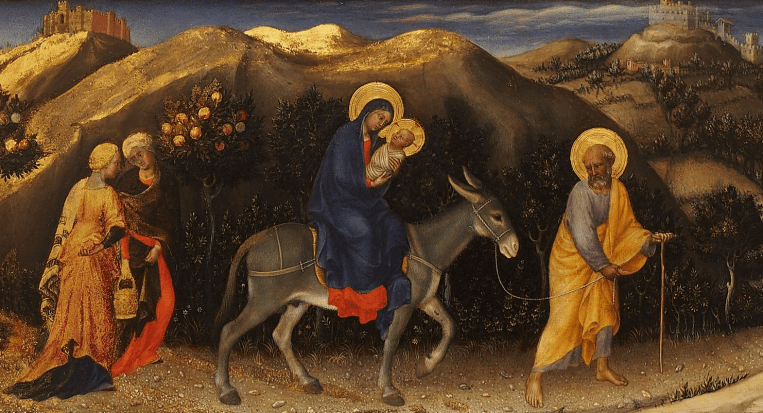
Yet parents face a daunting challenge:  in all things to align their human wills with the providential will of God the Father.  In this Sunday’s Gospel Reading, God the Father calls Mary and Joseph to great self-sacrifice.  They leave behind family and homeland, not knowing how long they might dwell in a foreign land.  Only after a second dream may they return to their homeland of Israel, settling in Nazareth.

In this regard, St. Matthew the Evangelist quotes one of the Old Testament prophets.  He quotes only the second half of Hosea 11:1 in order to give context to the Holy Family’s return from Egypt.  But the entire verse offers even more context:  “When Israel was a child I loved him, out of Egypt I called my son.”

This verse is a clear allusion to Israel’s Exodus from Egypt to the Promised Land.  Yet two persons in the Gospel Reading play roles connected to this allusion.  The first is the foster-father of Jesus, whose actions in the Gospel Reading mirror the Old Testament patriarch Joseph, whose journey to Egypt under compulsion led many years later to the Exodus.

The second is Jesus Himself.  In the light of Hosea 11:1, Jesus is a mirror of the Old Testament patriarch Israel, and so also of the people who bore Israel’s name.  It was for Israel that the land that was the goal of the Exodus was named.  But Jesus’ earthly vocation was to involve an Exodus that transcends earth.

Jesus’ words when His mother and foster-father found Him in the Temple echoed in the hearts of Mary and Joseph.  “Did you not know that I must be in my Father’s House?”  They echoed because their meaning wasn’t limited to that one occasion when Jesus was twelve years old.  Those words of Jesus echoed in Mary’s heart, mind and soul throughout His public ministry, and especially as she followed her Son up the hill of Calvary.

When Jesus was twelve years old, the words “my Father’s House” specifically meant the Jewish Temple in Jerusalem, where Mary and Joseph found Him.  But Mary and Joseph began to see that those words also had a second, deeper meaning.  “My Father’s House” is the Promised Land of Heaven.  That’s why Jesus was born, and that’s what this Christmas Season is about.  Jesus was born in Bethlehem in order to die on Calvary, so to open the gates of Heaven.  The gifts of the human family and the Holy Family help us make our way there.

Holy Family - flight to egypt 04

The Fifth Day within the Octave of Christmas

The Fifth Day within the Octave of Christmas
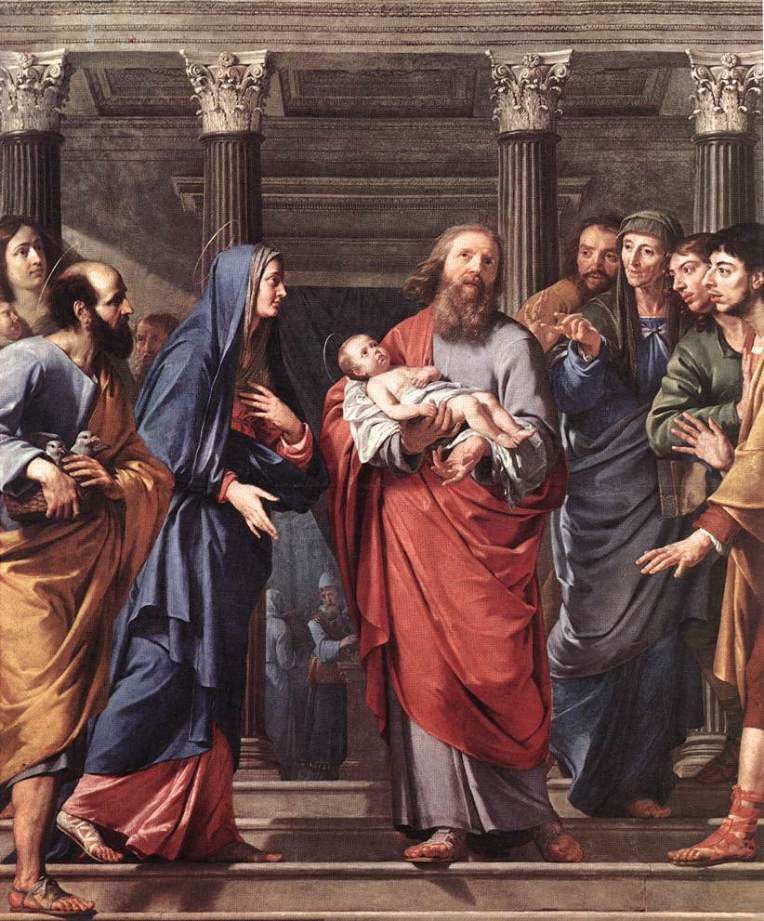
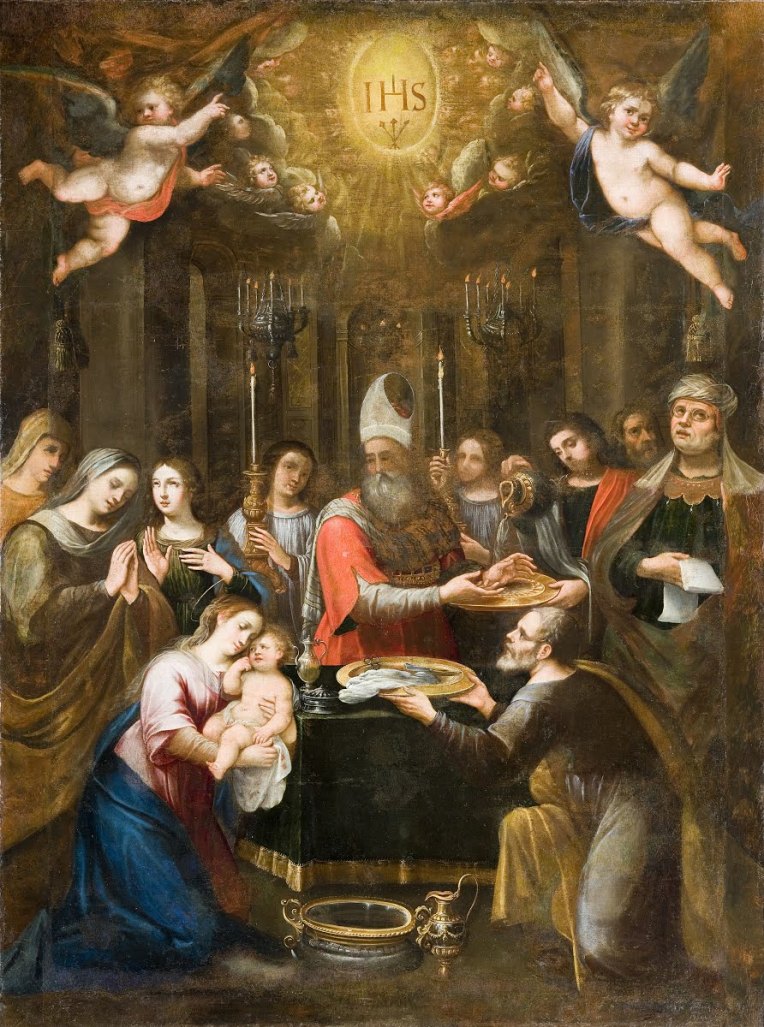
1 John 2:3-11  +  Luke 2:22-35

“Behold, this child is destined … to be a sign that will be contradicted ….”

If Saint Joseph were ever to relinquish his title as the patron saint of happy deaths, Saint Simeon might well take it up.  In the Gospel Reading’s account of the Presentation, Simeon twice speaks.  His words on the first occasion have been canonized by the Church as a hymn that’s proclaimed every night in the Divine Office.  This final hour of the day’s Office, called Compline, helps the Christian to close each day by meditating upon what the Church calls “the Last Things”.  St. Simeon helps us make this meditation fruitfully.

Simeon’s words are the words of one who knows that his earthly life is at its end.  He proclaims words that every human person might wish to utter upon his or her deathbed:  “Lord, now let your servant go in peace.”  Yet Simeon continues by speaking to the source of that peace.  As Simeon holds the Christ Child in his arms, he proclaims to the Lord:  “my own eyes have seen the salvation which you prepared in the sight of every people”.

It’s in his second discourse that Simeon elaborates upon the mission of this child, and the salvation that that mission will accomplish.  Simeon explains that the “child is destined to be a sign that will be contradicted”.  What is this sign?  Simeon may not have understood that this child would fulfill His earthly mission by dying upon a cross.  Nonetheless, the sign of the Cross is the key to understanding everything Simeon foretold at the Presentation, and indeed everything that is said and done throughout the Gospel.

The Holy Innocents, Martyrs

The Holy Innocents, Martyrs
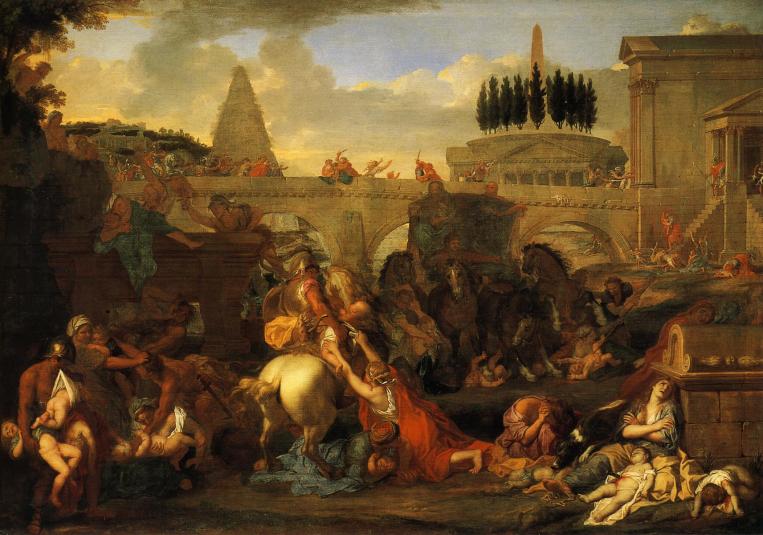
1 John 1:5—2:2  +  Matthew 2:13-18

If we say, “We have not sinned,” we make him a liar, and his word is not in us.

There are two ways to remove sin from people’s lives.  The first, as the Beloved Disciple preaches in today’s First Reading, is to bring one’s sins before God so that the Blood of Jesus might wash them away.  The second is to claim that there neither is nor ever has been any such thing as sin.

The modern world that surrounds us seeks credibility by claiming that there is no such thing as sin.  Some moderns go so far as to claim that there is nothing spiritual at all in existence:  not even God.  Sin and the Almighty are nothing but fables, they claim.

Yet if nothing spiritual exists, then love does not exist.  Pure love is nothing if not spiritual.  Love can take certain material forms, of course, such as loving words or loving works.  Yet pure love is what animates those words and works, and pure love is what can endure after words grow silent and works fade.  This love, the Beloved Disciple explains to us in his epistles, is who God Himself is.  It is this love Who, if “we acknowledge our sins,” will “cleanse us from every wrongdoing.”

Solemnity of the Blessed Virgin Mary, the Mother of God

Solemnity of the Blessed Virgin Mary, the Mother of God
Numbers 6:22-27  +  Galatians 4:4-7  +  Luke 2:16-21

“When eight days were completed for His circumcision, He was named Jesus, the Name given Him by the angel ….”

+     +     +

references to the Catechism of the Catholic Church cited for this solemnity by the Vatican’s Homiletic Directory:

CCC 464-469: Jesus Christ, true God and true Man
CCC 495, 2677: Mary is the Mother of God
CCC 1, 52, 270, 294, 422, 654, 1709, 2009: our adoption as sons
CCC 527, 577-582: Jesus submits to the Law, and perfects it
CCC 580, 1972: the New Law frees from restrictions of the Old Law
CCC 683, 689, 1695, 2766, 2777-2778: in the Holy Spirit we can call God “Abba”
CCC 430-435, 2666-2668, 2812: the name of Jesus

+     +     +

The story of the sisters Martha and Mary receiving Jesus into their home is one of the touchstones of Catholic spirituality.  The contrast between Martha and Mary as Jesus visits them brings from Him a declaration which He makes not just for Martha, but for the sake of each of us.  You and I would start this year off right if we took to heart the Lord’s counsel to Martha:  “… you are worried and anxious about many things.  Only one thing is necessary.  Mary has chosen the better part, and it shall not be taken from her.”

What a peaceful year the next twelve months would be if, every single day, the first thought in your mind upon waking was, “Today I will choose the better part”:  the “better part” being attentiveness to Jesus Christ.  Jesus wants to be more than just a part of our lives.

He wants to be our very life.  He wants us to say with Saint Paul:  “The life I lead now is not my own.”  My life belongs to Christ.  This new year will be a year of peace as I imitate Martha’s sister, Mary, sitting at the feet of Jesus and drinking in His words.

This sister of Martha, of course, is not the same Mary whom the Church honors todays.  We honor today, on this eighth day of Christmas, the holy Mother of God.  But in today’s Gospel passage, St. Luke the Evangelist says something that evokes that Gospel story about Martha and Mary.  As St. Luke describes both the Birth of Jesus as well as the shepherds making known the message they received from the angels, he notes that “Mary kept all these things, reflecting on them in her heart.”

Of course, for anyone to speak about reflecting on things “in one’s heart” is to speak metaphorically.  Does a person really reflect “in one’s heart”?  Doesn’t a person reflect in one’s brain?

Maybe St. Luke the Evangelist is pointing out a difference between two very different types of thinking.  Maybe when we’re calculating our finances, we’re thinking inside our brain.  Maybe when we’re tending to the household chores, like Martha, we’re thinking inside our brain.  Our brain is where we think about accomplishing things in the here and now.

On the other hand, maybe our heart is where we think about the past and the future.  Maybe our heart is where the present moment finds some room to breathe, and expand beyond the simple here and now.

Maybe our heart is where we need to live more of this new year than we did during the last.  The Mother of God is our Mother, also.  We are her children, and if we follow her example over the next fifty-two weeks, she will lead us in all things to Jesus.  Reflect on all these things in your heart throughout this new year: “all these things” being the Gospel, the Good News that God has proclaimed on this earth in order to transform the meaning of every event, relationship, and action in your life.

Many persons’ resolutions for a new year regard physical health, such as joining a gym or changing one’s diet, or quitting smoking.  Even more important, however, is our spiritual health.  The start of this year is a great opportunity to make a change for the better in our spiritual habits.

On today’s feast in honor of Mary, the Mother of God, we celebrate the spiritual truth that it’s through Mary that Jesus received human life, and it’s through her intercession that you and I have spiritual life.  Mary, in all things, leads us to her Son.  So when we turn to Mary, she says those words that she spoke at the wedding of Cana:  “Do whatever He tells you.”

Mary is for us not only an intercessor, but a model as well.  She is a model disciple, which means that she herself did whatever Jesus told her.  But that right action on her part was only possible because she always first listened to Jesus.  This is true in the spiritual life of each of us striving to be a faithful disciple:  doing follows hearing.  Both our doing and our hearing have to be in accord with the Lord’s will, but in the right order:  hearing first, and doing second.
St. John, Apostle & Evangelist

St. John, Apostle & Evangelist
1 John 1:1-4  +  John 20:1,2-8

“… the life was made visible; we have seen it and testify to it ….”

The First Reading and the Gospel Reading for today’s feast of St. John the Beloved Disciple stand in contrast in an intriguing way.  The contrast relates to vision or sight.

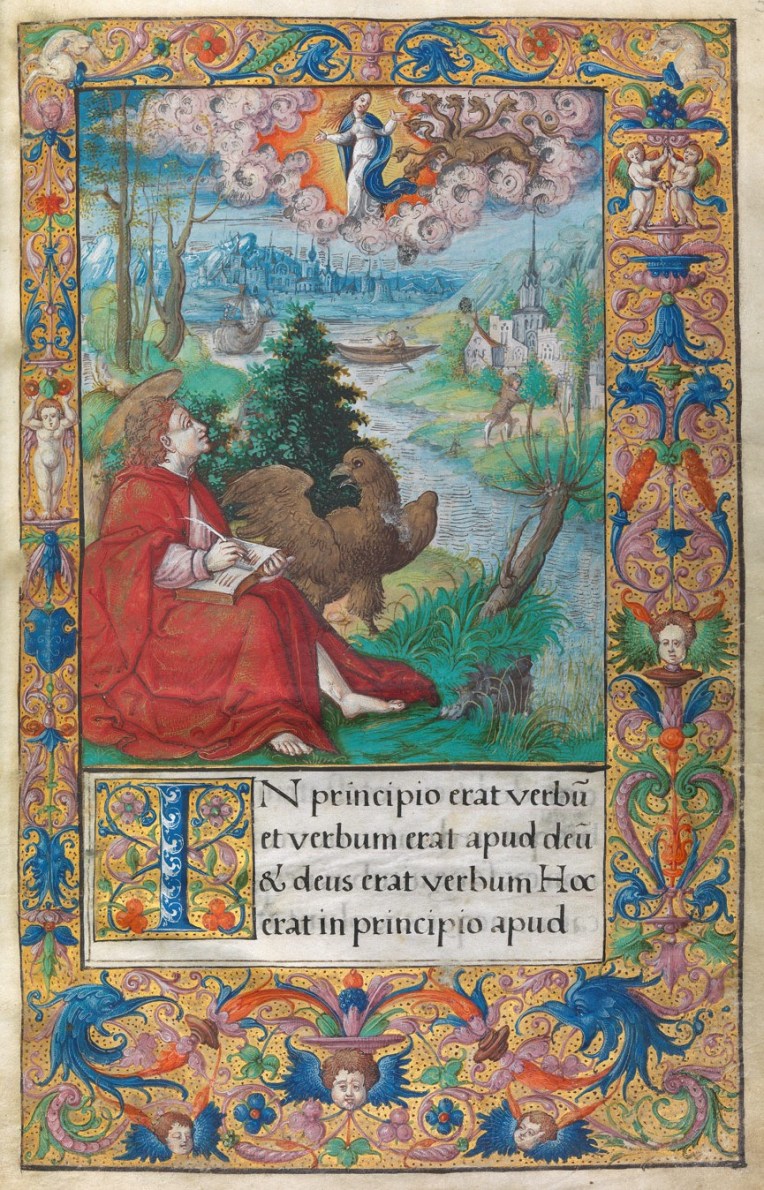
Today’s First Reading comes from the first of the three New Testament letters written by today’s saint.  In the First Letter of John, the Beloved Disciple speaks about “the Word of life”.  This clearly refers to Jesus, whom St. John in the prologue to his Gospel account describes as the divine Word:  “the Word was with God, and the Word was God” [John 1:1].  This divine Word became Flesh and dwelt among us [see John 1:14].  Keep in mind that it’s the same scriptural author who in his Gospel account records Jesus stating:  “I am the way, and the truth, and the life; no one comes to the Father, but by me” [John 14:6].

About this “Word of life”, the Beloved Disciple in today’s First Reading states that “the life was made visible; we have seen it and testify to it and proclaim to you the eternal life that was with the Father and was made visible to us.  Of course, the divine Word becoming Flesh and dwelling among us—the very mystery at the heart of Christmastide—is what makes it possible to see this divine Word.  The spoken word cannot be seen, but the Word made flesh can.

Yet in today’s Gospel Reading, which is set on Easter Sunday morning, there is a literal lack of sight.  The Word made flesh, risen from the dead, is nowhere to be seen.  Mary Magdalen ran to St. Peter and today’s saint, “and told them, ‘They have taken the Lord from the tomb, and we do not know where they put him.’”  These two apostles enter the empty tomb and see the burial cloths.  The beloved disciple “saw and believed”.  Contrast St. John here with St. Thomas the Apostle.  St. Thomas would not believe until he saw the Risen Jesus and His wounds.  But the Beloved Disciple does not see the Risen Jesus and yet believes.  What Jesus said a week after His Resurrection after appearing to St. Thomas applies to the Beloved Disciple, and hopefully also to us:  “Blessed are those who have not seen and have believed.”


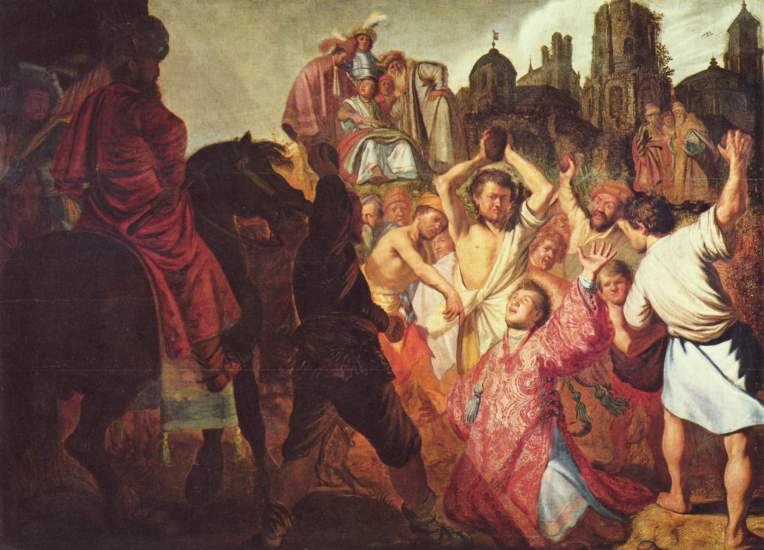
St. Stephen, First Martyr

St. Stephen, First Martyr
Acts 6:8-10;7:54-59  +  Matthew 10:17-22

“Lord Jesus, receive my spirit.”

The dying words of St. Stephen—“Lord Jesus, receive my spirit”—help us understand why the Church celebrates the feast day of the Church’s first martyr on the second day of Christmastide.  These first two days of Christmas, celebrating the birth of Jesus and the martyrdom of St. Stephen, seem oddly juxtaposed unless we consider Stephen’s last words as revealing something important not just about him, but also about Our Lord and, indeed, ourselves who are disciples of Jesus.

First, it’s helpful to fix in our minds that, as the old saying goes, “the wood of the crib is the wood of the Cross.”  In other words, Jesus was born at Bethlehem so that He could die at Calvary.

Second, we have to consider what, by extension, that first truth reveals.  Dying for fallen man’s sins is the earthly vocation of Jesus Christ.  Communicating to fallen man the graces that Jesus won at Calvary is the vocation of Jesus’ Church on earth.  St. Stephen’s vocation as the Church’s “proto-martyr” makes clear that Jesus didn’t suffer and die so that fallen man wouldn’t have to.

Instead, the victory of Jesus on Calvary, for which purpose He was born at Bethlehem, invests the suffering and deaths of Jesus’ disciples with new meaning.  The dying words of St. Stephen, then, are not a mere surrender on the occasion of his murder.  They conclude a life of faith, in which each day is lived by the same words.  Each day is a surrender to the Lord Jesus.  Each day is a dying to self.  The day of death, then, is the conclusion of earthly self-giving and the day of new life:  entrance into God’s eternal presence and everlasting sharing in the love of His Holy Spirit.