
Saturday of the Third Week in Ordinary Time


Saturday of the Third Week in Ordinary Time
Mark 4:35-41

“‘Who then is this whom even wind and sea obey?’”

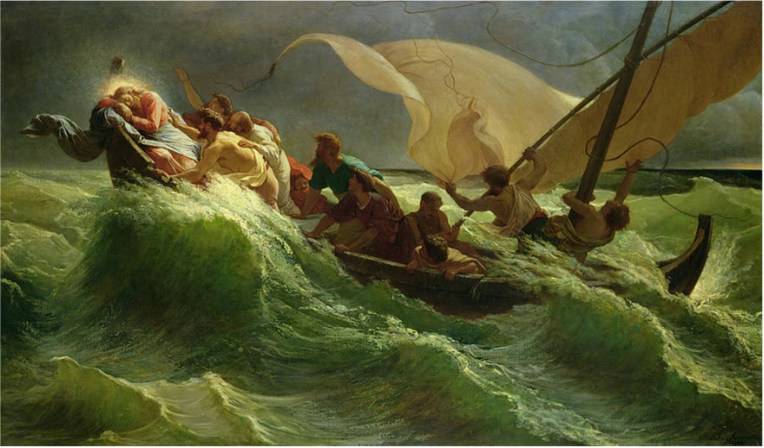
Is today’s lesson not to wake Jesus?  The miracle in today’s Gospel passage seems to be Jesus rebuking the wind and sea, resulting in “great calm”.  However, it’s not only the wind and sea that Jesus rebukes.  Perhaps more important is Jesus’ rebuke of His disciples.

Jesus chooses not to calm the disturbance in His disciples’ souls in the same manner that He calms the sea and wind.  But He does challenge them:  “Do you not yet have faith?”  His rebuke of the elements and of His disciples seems to have a meritorious effect on them.  “They were filled with awe” at His power over the elements.  But is this the faith He demanded of them?

It’s only natural to be impressed at the power of nature, and of God’s power over nature.  It’s something supernatural, however, to allow God to have power over oneself.  This is the sort of faith Jesus is asking for from His disciples.  Faith is a gift freely given, but it’s also a gift that must be freely accepted.  Jesus will not calm our souls without our consent, or rather, our faith in His power to do so.  The disciples marvel at Jesus as one “whom even wind and sea obey”.  Even more marvelous, however, is a disciple who obeys Jesus as His Lord.

Friday of the Third Week in Ordinary Time


Friday of the Third Week in Ordinary Time
Mark 4:26-34

With many such parables He spoke the word to them as they were able to understand it.

Jesus today proclaims two parables about the Kingdom of God.  With St. John Paul adding the Mysteries of Light to the Rosary, we meditate in the Third Luminous Mystery upon Jesus proclaiming the Kingdom of God.  St. John Paul did not go into great detail about the meaning of each of the new Luminous Mysteries, but—to me at least—that third mystery is the most mysterious of the Luminous Mysteries.  After all, it’s very clear how, for example, the Institution of the Holy Eucharist or the Transfiguration shed light upon—illuminate—who Jesus is.  But how does Jesus proclaiming the Kingdom of God do so?  We’re forced to meditate upon what exactly the connection is between Jesus and the Kingdom of God.

Jesus never directly addresses this question.  His parables are meant to be suggestive, not exhaustive.  But even without defining “the Kingdom of God”, we can say that the kernel of each “Kingdom parable” describes in some way the reality of Heaven, and/or the Church, and/or the Christian’s soul.  Each of these three have a clear relation to Jesus:  the reality of Heaven, the life of the Church, and the nature of the Christian soul.

Take Jesus’ second parable in today’s Gospel passage.  The change from the “smallest of all the seeds” to “the largest of plants” seems more easily applied to the Church and the Christian soul than to Heaven.  Tertullian wrote that “the blood of the martyrs is the seed of the Church”, a phrase through which we can see how this parable applies to the Church.  With God, all things are possible:  from a natural death, springs supernatural life.

Sts. Timothy & Titus, Bishops


Sts. Timothy & Titus, Bishops
2 Timothy 1:1-8 [or Titus 1:1-5]  + Mark 4:21-25
January 26, 2023

“The measure with which you measure will be measured out to you ….”

Jesus proclaims two truths for reflection today.  Both might at first hearing seem to discourage the virtue of humility.  But each prepares us for greater service.

When Jesus in today’s Gospel passage notes that a lamp is meant to be “placed on a lampstand”, He does not specifically refer to His disciples here as “the light of the world”, as He does in Matthew’s account of the Sermon on the Mount [Matthew 5:14-16].  Nonetheless, Mark’s text makes the inference clear.  Disciples are not meant to hide themselves, their belief, or Christ from others in the world.  On the contrary, they are called to share the Good News!  This clearly stands in conflict with a culture dominated by moral and religious relativism.

Also, when Jesus in today’s Gospel passage notes that to “the one who has, more will be given” and “from the one who has not, even what he has will be taken away”, some might accuse Jesus of being unfair.  But what God gives, He gives for others:  if He gives me a grace or charism, it is for others.  Only in being faithful to serving others with what I have may I hope someday to reach Heaven.  So in someone being given more, he is commanded to greater service of God and His people.

The Conversion of St. Paul the Apostle


The Conversion of St. Paul the Apostle
Acts 22:3-16 [or Acts 9:1-22]  +  Mark 16:15-18

“Go into the whole world and proclaim the Gospel to every creature.”

The Conversion of St. Paul might seem difficult for us to relate to, especially if we are cradle Catholics.  St. Paul’s conversion was from a strict Pharisaical form of Judaism to a living faith in Jesus Christ.  But we could expand on this by saying that Paul’s conversion was from one understanding of sacrifice to another.  Saul was not a Levite:  a member of Israel’s priestly line.  But his concept of sacrifice as a faithful Jew would have been based on temple sacrifices.

Christian sacrifice, however, is not of exterior things, but of what is most interior and personal.  It’s a sacrifice not of animals, but of one’s very self, and of one’s whole self:  body, soul and spirit.  We might say that when you convert to Christ, your life is over.  You live no more, but Christ lives in you [see Galatians 2:20].  This is exemplified impressively in the Order of Saint Benedict, which at religious professions has those new members lay prostrate in the sanctuary of the abbey church.  Then they are covered by a large funeral pall.

What all three readings today (including the Responsorial Psalm) profess is the link between conversion and mission.  “Go out to all the world and tell the Good News.”  One of the worst afflictions within the Church today is a privatization of the Faith:  that is, believing that one’s faith should only be a personal matter, something best kept to oneself, and which is merely for the sake of getting oneself to Heaven.  There are countless forms in which a baptized Christian might evangelize others, but every baptized Christian is called to evangelize those without faith.

The 4th Sunday in Ordinary Time [A]


The 4th Sunday in Ordinary Time [A]
Zephaniah 2:3;3:12-13  +  1 Corinthians 1:26-31  +  Matthew 5:1-12
Catechism Link: CCC 1716
January 29, 2023

“He began to teach them, saying:  ‘Blessed are the poor in spirit ….’”

Today’s Gospel passage is the first twelve verses of the fifth chapter of Matthew:  the start of the Sermon on the Mount.  In our own day, preachers often start a sermon with a story or a joke.  Jesus decided to begin His Sermon on the Mount with the Beatitudes.

However, before he starts giving us Jesus’ sermon, St. Matthew the Evangelist mentions a few interesting details about Jesus.  The evangelist relates to us that when “Jesus saw the crowds, He went up the mountain, and after He had sat down, His disciples came to Him.”  Consider just two points here:  that Jesus went up the mountain, and that He sat down there.

Why did Jesus have to go up a mountain in order to preach a sermon?  Obviously, He didn’t have to.  Jesus preached many other sermons during the three years of His public ministry, and most of them were preached in other settings.  But in St. Matthew’s account of the Gospel, the Sermon on the Mount is Jesus’ first sermon, so Jesus is teaching us here not only by His words, but also by the setting that He chose, and by choosing to sit down.

Why did Jesus choose a mountain to be the site of His first sermon?  St. Matthew clarifies this throughout the course of his Gospel account.  Through the way he structures his Gospel account, St. Matthew portrays Jesus as a New Moses.  Both the mountain setting and act of sitting to reach His disciples reflect this.  One reason for portraying Jesus as the New Moses is that unlike many other New Testament books, Matthew’s Gospel account was written for converts from Judaism.

Moses was, for the Jewish people, the Prophet without peer.  In the last chapter of the last book of the Jewish Law—Deuteronomy Chapter 34—following the description of Moses’ death, the Bible says that “there has not arisen a prophet since in Israel like Moses, whom the Lord knew face to face, none like him for all the signs and the wonders which the Lord sent him to do in the land of Egypt, … and for all the mighty power and all the great and terrible deeds which Moses wrought in the sight of all Israel” [Deut 34:10-12].

Yet even more important than all the signs and wonders and all the great and terrible deeds which Moses worked was the fact that the Lord chose him—Moses—to bear the Ten Commandments to His People.  During the course of their Exodus from slavery in Egypt to freedom in the Promised Land, God’s People stopped at Mount Sinai.  There, while the rest of God’s People remained below, Moses alone ascended Sinai to receive from God His Ten Commandments.  Moses then had to descend the mountain to give to God’s People this Law, the means by which His People might keep right with God.

But here in St. Matthew’s account of the Gospel, it’s not only Jesus who ascends the mountain.  Jesus draws His disciples up with Him.  In turn, it’s not a voice from the heavens that speaks there to a prophet.  Instead, the New Moses, God in the Flesh, speaks to His people face to face.  Jesus gives to us, His people, not ten commandments, but nine beatitudes.

There is a wealth of spiritual riches within the beatitudes.  But keep in mind that Jesus put the Beatitudes at the start of the Sermon on the Mount because a good teacher puts the most important lesson first.  Likewise, then, we ought to consider the first of the nine beatitudes as being first for a reason.

Maybe as you ponder all nine of the Beatitudes, another of them—not the first—will strike you.  Meditate on that beatitude during the week.  But meditate nonetheless on the first beatitude:  first to fall from Our Lord’s lips because He wants it first to shape our hearts.

The Lord has given us everything we need for the journey to Heaven.  He’s given us life, grace to strengthen us for the journey, and the journey’s roadmap in these nine beatitudes.  The first, upon which all the others rest, is humility:  poverty of spirit.  The Lord has even helped us to acquire humility.  We do so by gazing upon the humility He shows in His compassion, His Divine Mercy, and His self-sacrifice on the Cross.

Tuesday of the Third Week in Ordinary Time


Tuesday of the Third Week in Ordinary Time
Mark 3:31-35

“For whoever does the will of God is my brother and sister and mother.”

The heart of today’s Gospel passage is “the will of God”.  Jesus explains that doing the will of God is what forms the bonds of kinship within God’s family.  In doing so, Jesus is not downplaying the significance of His Blessed Mother or any other blood- or legal relatives.

Consider the distinctions that Jesus is and is not making here.  Ask yourself why God the Father chose the young Mary to be the Mother of God.  Wasn’t it because her response at the Annunciation—“Let it be done unto me according to thy word”—is the perfect embodiment of understanding and carrying out the will of God?

When you pray the rosary today and meditate on the Sorrowful Mysteries, ask Our Lady for an outpouring of grace from her Son.  Ask her that you might use this strength not for your own desires, but only to accomplish what the Lord deems necessary in your life to draw you and those you love closer to Him.

Monday of the Third Week in Ordinary Time

Monday of the Third Week in Ordinary Time
Mark 3:22-30

“And if a house is divided against itself, that house will not be able to stand.”

Jesus’ parables most often describe the Kingdom of God.  But today He preaches about the Kingdom by what in theology is called a “via negativa”:  that is, describing someone or something by what he, she or it is not, rather than what he, she or it is.  Jesus today describes what the Kingdom of God is not in rebutting the claims of the scribes.

The chief point of the parables we hear Jesus preach today is that Satan can have no place in the Kingdom of God.  He begins by debunking the scribes’ claim with simple logic.  But Jesus moves by the end of today’s passage to a “via positiva”, in which He points out why Satan can have no place within the Kingdom:  because the Kingdom is the dwelling place of the Holy Spirit, the new creation in which the Holy Spirit hovers over the face of the Kingdom [see Genesis 1:2].

Still, in our own day we have to put Jesus’ parables in context.  We cannot help but realize that the Kingdom of God which Jesus so often preaches about is not strictly identical with the Church that Jesus founded when He walked this earth.  Would that it were so!  How clearly we can see the sins of members of the Church.  Through these sins, the absence of the Holy Spirit makes itself known.  Our sins can be forgiven, and our charity can point to the Kingdom of God, but both are possible only through the power of the Holy Spirit.

Ot 03-1

Saturday of the Second Week in Ordinary Time

Saturday of the Second Week in Ordinary Time
Mark 3:20-21

“He is out of His mind.”

Today’s Gospel passage is only two verses long.  But what it lacks in length, it makes up for with punch!  Jesus’ relatives “set out to seize Him, for they said, ‘He is out of His mind.’”

What were these relatives thinking, and who exactly were they?  We cannot imagine the Blessed Virgin Mary doing and saying such things.  But Jesus of course was from a large extended family, a fact made clear by the Gospel narrative of the finding of the boy Jesus in the Temple.  Being related by blood to Jesus clearly was no guarantee of understanding His identity.

Then again, most of those whom Jesus chose to be His Apostles abandoned Jesus in disbelief during Holy Week, after having followed Jesus for three years, witnessing His miracles and hearing His preaching of the Gospel.  So perhaps we need to cut His relatives some slack.  We might, then, realize that while you and I may not exactly be in “good” company when we ignore Jesus’ Lordship over our lives, we at least can point to a biblical precedent, and give thanks for Jesus’ patience with the failures of even those closest to Him.

Friday of the Second Week in Ordinary Time

Friday of the Second Week in Ordinary Time
Mark 3:13-19

He appointed Twelve, whom He also named Apostles ….

The Gospel account of Saint Mark the Evangelist is by far the shortest of the four accounts of the Gospel.  The brevity of Mark’s account is complemented by its fervor.  Jesus in this account appears as a man of action.  Consider today’s Gospel passage in this context.

From the third of Mark’s 16 chapters, we hear today of Jesus calling His Twelve.  They are meant themselves to be men of action.  Jesus names them “Apostles, that they might be with Him and He might send them forth to preach and to have authority to drive out demons.”

There are two points one might note in this sentence.  Given that the word “apostle” literally means “one who is sent”, the evangelist describes the type of mission these twelve will have.  But more primary than this being sent forth is the One who sends them.  Their “apostleship” is rooted not only in the person of Christ, but in their being “with Him”.  In our own manner, each of us as a baptized member of the Church is called to serve, but is called first to be “with Him” each day.