
The Fourth Sunday of Lent [A]
I Samuel 16:1,6-7,10-13 + Ephesians 5:8-14 + John 9:1-41
St. Anthony’s Catholic Church, Garden Plain, KS
March 15, 2026
Every year, the Fourth Sunday of Easter is called “Good Shepherd Sunday”. But today, on this Fourth Sunday of Lent, we also hear about the Good Shepherd. The most obvious image of the Good Shepherd in today’s Scriptures is in the Responsorial Psalm: that is, the 23rd Psalm.
But when we first reflect upon how all of today’s Scriptures fit together, the 23rd Psalm might not seem to connect with the other three Scripture passages. It’s true that in today’s First Reading, the young man David is described as “tending the sheep”. David is plucked from this role to be anointed the king—that is, the shepherd—of God’s People. Nonetheless, for the most part, today’s Scripture passages seem to focus on another theme: blindness.
However, if we look closely, we can see a connection between the two Lenten themes of the Good Shepherd and our blindness as sinners. This connection can help us to con-fess our own blindness more willingly, and to pro-fess our willingness to follow the Good Shepherd wherever He might lead us.
+ + +
Today’s First Reading is a good place to start looking for the connection between our blindness and the Good Shepherd. Consider something that happens early in the passage. Samuel searches for the Lord’s anointed from among the sons of Jesse. Samuel does eventually find him, but it takes him eight tries to do so. What is it that hinders Samuel’s search? It’s Samuel’s blindness. Yet Samuel’s blindness is not physical blindness, like the man whom Jesus heals in today’s Gospel Reading.
Samuel judges wrongly. Why? Samuel judges wrongly because he is blind to what God’s shepherd ought to look like. The Lord explains this to Samuel plainly, saying: “Not as man sees does God see, because man sees the appearance but the Lord looks into the heart.” This is a profound statement. In fact, this blindness that the Lord exposes lies at the root of each of your own sins. So this is a key point for our reflection during Lent. But we have to be careful, because in the Lord’s words to Samuel, the Lord is not just making a general statement about looking beyond surface appearances.
The Lord here in our First Reading is condemning something more specific. The Lord is condemning the blindness that keeps you from recognizing your Good Shepherd. Again: the Lord is condemning the blindness that keeps you from recognizing your Good Shepherd. With that in mind, consider the blindness on display in today’s Gospel Reading.
+ + +
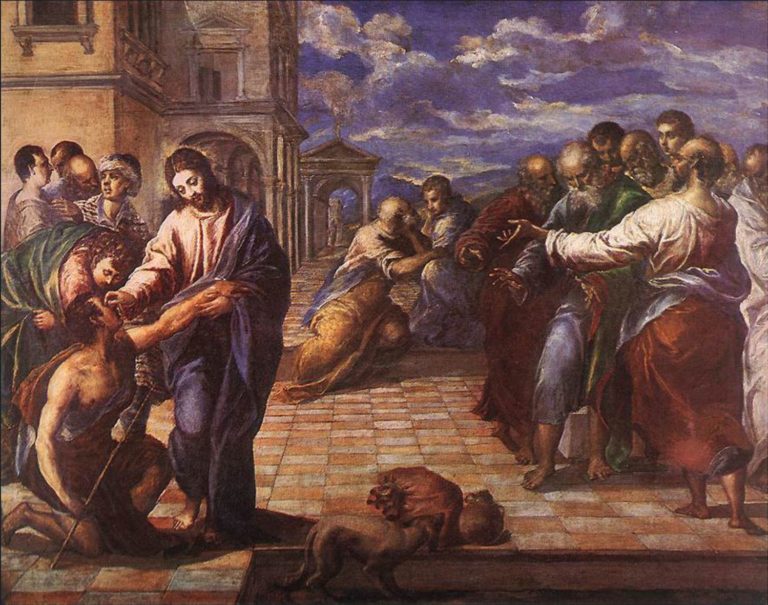
In fact, we see several types of blindness in this Gospel passage from the Gospel according to St. John. The first is more apparent because it is a physical blindness, which naturally is hard to hide. So the man born blind takes up our attention at the beginning of the Gospel passage, before we encounter those suffering from the far worse types of blindness.
This man born blind is the object of the disciples’ accusations. They don’t ask if the man’s blindness was caused by sin. They presume this, asking instead whose sins caused his blindness. Jesus has to clarify the matter by explaining that “[n]either he nor his parents sinned”. Rather, the man was born blind “so that the works of God might be made visible through him”. These “works of God” are the works of the Good Shepherd. When Jesus and the man born blind meet, the two themes of blindness and the Good Shepherd come together. But what is the result of this meeting?
After Jesus restores the sight of the man born blind, Jesus faces accusations from those who cannot see Him as the Good Shepherd. Here’s where the deeper level of the passage comes into focus. Jesus meets those who, like Samuel in the First Reading, cannot see the Good Shepherd for who he is.
The Pharisees say about Jesus: “This man is not from God, because he does not keep the Sabbath.” Then there are others who give a command to the man given sight: “Give God the praise! We know that this man[, Jesus,] is a sinner.”
But as Jesus’ enemies scorn Him, the man given sight by the Good Shepherd speaks more boldly. At first this man only reports the facts of what Jesus had done for him. A little later, he says of Jesus that “He is a prophet.” Soon after that, he speaks out against the religious authorities, insisting that “[t]his is what is so amazing, that you do not know where he is from, yet he opened my eyes. … It is unheard of that anyone ever opened the eyes of a person born blind. If this man were not from God, he would not be able to do anything.” The man given sight sees Jesus for who He is: the Good Shepherd. The man given sight sees truly.
Yet moments later, he acts truly. When Jesus seeks out this man to whom He had given sight, the healed man confesses that he sees Jesus as Lord, and he worships Jesus.
+ + +
Now this event—the man given sight worshipping Jesus—would make a beautiful end to today’s Gospel passage. It would wrap up the story nicely with a pretty bow. However, after the man given sight worships Jesus, the story continues. It turns again to the Pharisees.
We need to look at these Pharisees, and ask whether today’s Gospel passage is a mirror, through which we can see ourselves in the Pharisees. This is important to do, because like the Pharisees, if we don’t see as ourselves as the sinners we truly are, we won’t be able to recognize our Good Shepherd for who He truly is.
The Pharisees in fact bear several kinds of blindness. Not only are they spiritually blind. They are also blind to the fact of their blindness. At least the man born blind knew he was blind!
But Jesus sees into the Pharisees’ hearts, and seeing their blindness, He loves them from His Sacred Heart. On Good Friday, from the Cross, the Good Shepherd offers His life for the sake of the Pharisees as much as for the Blessed Virgin Mary, St. John, St. Peter, and His other disciples. Through His death, light shines in order to illuminate, heal, and strengthen sinners.
+ + +
In these last three weeks of Lent, we must work at overcoming all three forms of blindness. First, we need to see the sins that regularly darken our lives, as much as we like to turn a blind eye to them. In addition to seeking forgiveness in the Sacrament of Confession, we need to carry out works of penance that target these sins: for example, against sins of pride, works of humility; against sins of lust, serious fasting; against sins of wrath, praying Rosaries for those we despise; against sins of envy, praying Rosaries for those we falsely put above ourselves; against sins of sloth, good works on behalf of the poor.
Second, we need to recognize the sins we do not see. Each of us is well aware of certain persistent sins in our lives. But each of us also suffers from sins that we don’t even recognize.
But how can we get outside ourselves, so to speak, in order to see what these sins are? Well, you could ask the most charitable of your friends to pray with you, and then speak to you about a sin that you yourself do not see within your life. Or you could pray a Novena to the Holy Spirit, asking Him to enlighten you about the sins of which you are blind.
Third, we need to see our Good Shepherd for who He truly is. This might seem the easiest of the three, but in fact it’s the hardest. It’s easy to pray the 23rd Psalm. It’s easy to call upon our Good Shepherd when we’re struggling within “the valley of the shadow of death”.
But it’s very difficult to see our Good Shepherd for who He truly is. Why did eleven out of the twelve apostles not stand on Calvary during Jesus’ Passion and Death? Those eleven apostles could not stand to face Jesus during His Crucifixion because they could not see their Good Shepherd in that man hanging on the cross. They could not understand—they could not see—that Jesus’ Passion and Death are God’s revelation of His love for us, and something we need to embrace as the price of our salvation.
In these last three weeks of Lent, on Tuesdays and Fridays pray the Sorrowful Mysteries of the Rosary slowly, and at the start of each decade, spend a minute in silence, imagining the scene which that decade focuses upon. Watch the movie titled The Passion of the Christ, and watch it with those in your family who are junior high age or older. Each day of Holy Week, pray the Stations of the Cross at home. Ask Jesus to open your mind and heart to see more clearly the depth of His love for you, and the depth of His suffering for the sake of your salvation.
CLICK HERE FOR THE NOVENA TO THE HOLY SPIRIT.
 Reflections on the Sacred Liturgy