
The First Sunday of Lent [A]
Genesis 2:7-9; 3:1-7 + Romans 5:12,17-19 + Matthew 4:1-11
St. Anthony’s Catholic Church, Garden Plain, KS
February 22, 2026
The word “sacred” is not used much anymore. As Catholics, we know instinctively that certain persons, places, and things are sacred, but what does that mean? Being clear on the meaning of the word “sacred” will help us appreciate today’s Gospel Reading.
Consider some examples of sacred objects. What would you think if you visited a neighbor, and noticed that he propped his back screen door open with a bible? When you ask your neighbor why he’s doing that, he replies that that particular bible is just the right size to fit under the door, to hold it in place. None of the other books in his house would do the trick.
Then the next day you go over to your cousin’s house for supper. She tells you that you’re having chicken soup for dinner. The smell is delicious. But when it’s time to start serving, your cousin takes an old chalice, and uses it to ladle the soup. When you ask why she’s doing that, she says that her old ladle broke, and she had this chalice laying around because a deceased uncle was a priest and bequeathed it to her.
In both cases, you would likely be shocked. But when you tell your neighbor and cousin that they were doing something wrong, they ask you “Why? Why is it wrong?” How would you answer them?
The answer would boil down to the meaning of the word “sacred”. The word “sacred” means “set apart for God”: set apart from others of the same for God.
Think back to your neighbor using his bible to prop open his door. He said that the bible is “just the right size” for keeping his door open. He thinks the bible is fitting for that purpose. But a bible is sacred. It is a book bearing the written Word of God, in order to be read (whether liturgically or devotionally). This book is not to be used as a doorstop, or a paperweight, or any other purpose, even if it seems well suited to other purposes. Any other use is an act of sacrilege. The sin of sacrilege is using something sacred for a purpose other than its divine purpose.
What about your cousin using her uncle’s chalice to ladle chicken soup? She might argue that the chalice serves well as a ladle. But a chalice is sacred. Each chalice, before it’s used for the first time, is consecrated by means of prayer. It’s consecrated for the purpose of bearing the wine that is changed into the Precious Blood of Jesus. The chalice must not be used as a ladle, or as a cup for drinking beverages, or for any other purpose. Any other use is sacrilege.
+ + +
Now this might seem obvious to anyone brought up Catholic. But we don’t live in a world today that understands the meaning of the word “sacred”. Our day and age doesn’t get the notion of “consecration”. The world that surrounds us does not believe that there is anything called “sacrilege”. The motto of the modern world is “anything goes”. Or to use a more technical word, the modern world believes that every thing, and every person in this world is nothing more than “secular”. That is to say: the only meaning of any thing or any person is the meaning that it has in this world. There is no world beyond this world that sheds further meaning on any thing or any person.
The challenge for you as a Christian comes from the fact that it’s not just a printed bible and a consecrated chalice that are sacred. There’s something else in your life that’s sacred, which in fact you carry with you everywhere you go, including to the store, the workplace, on vacation, and so on. That is your very self.
Your very self—your body, your mind, and your soul, all united as the person who is you—is sacred. At the moment of your baptism, you as a person were consecrated to God and for God. Of course, that begs a question: for what purpose were you “set aside” as sacred? If a bible’s purpose is to let God’s Word be revealed, and if a chalice’s purpose is to let God’s Precious Blood be consumed, then what is the purpose for which you yourself were consecrated at your baptism? Or course, there are different vocations within the Church—married persons, priests, and consecrated religious—but God gives every Christian the same overarching goal. The different Christian vocations all reach for the same end.
The end for which you were consecrated as a Christian person is to love: to love your God and to love your neighbor, and—what’s more—to do both as Jesus Christ loves.
God calls you to love in this way not only in church on the weekend, but also in the midst of the world every day. This is a difference between a sacred chalice and you as a baptized Christian. The chalice is used only within the sanctuary of the church, while you can live out the Gospel anywhere in the world. Every day, and in every place, Jesus calls you—as He proclaimed in His Sermon on the Mount—to be “the salt of the earth” and “the light of the world” [Matthew 5:13,14].
Today’s First Reading is about the corruption of God’s plan for the human family to share fully in God’s love. But the Gospel Reading is about Jesus starting to set things back on course. In this passage from Matthew, Jesus helps us appreciate the challenge that each of us received on the day of baptism: the vocation to be loving in all of our thoughts, words, and actions towards both God and neighbor, as Jesus loves.
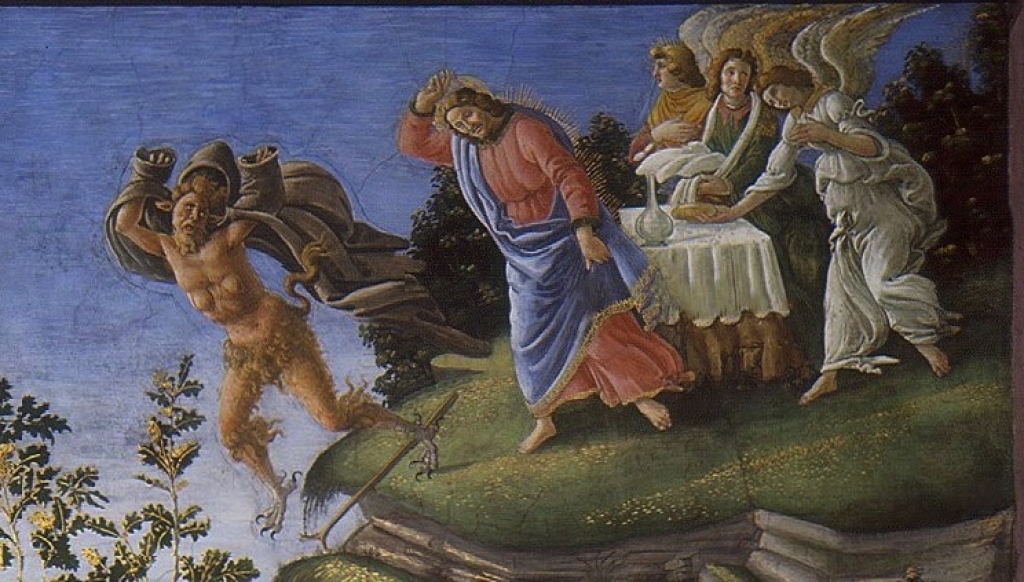
More specifically, today’s Gospel passage is about one specific roadblock to loving in a Christ-like manner. This roadblock is called temptation. Today’s Gospel passage is about the different ways in which we’re tempted not to be loving, or rather, to love in ways that are not Christ-like.
+ + +
Consider, then, the insights of one of the Church’s spiritual masters: St. Francis de Sales, who was the bishop of Geneva (in what today is Switzerland) in the early 1600’s. In commenting upon today’s Gospel passage, St. Francis de Sales points out that “many prefer the end of today’s Gospel to its beginning.” In other words, people are happy to be with Jesus when He’s surrounded by angels who bring Him comfort and consolation. But are we willing to be with Jesus in the trials of the desert? St. Francis explains that we will never be invited to His heavenly “banquet… if we [do not share in] His labors and sufferings”.[1]
St. Francis de Sales continues by pointing out that in the here and now, we should “busy ourselves in steadfast resistance to the frontal attacks of our [moral and spiritual] enemies. For whether we desire it or not[,] we shall be tempted.”[2]
St. Francis de Sales forcefully denies the common misconception that the more dedicated we are to God, the less we will experience temptation. He explains that just the opposite is to be expected: “it is an infallible truth that no one is exempt from temptation [once] he has truly resolved to serve God.”[3]
This is clearly illustrated by today’s Gospel Reading. The divine Son of God was tempted by the devil just before the start of His three years of public ministry. The devil sought out Jesus at this point because Jesus was ready to start His earthly mission, putting behind Him thirty years of living quietly with His family in the home at Nazareth.
So if you take up this season of Lent with strong resolve, expect pushback from those who do not want you to become more like God. With this expectation in mind, there are two more points from St. Francis de Sales about what it means for a Christian to experience temptation.
First, St. Francis points out “that although no one can be exempt from temptation, still[,] no one should seek it[,] or go of his own accord to the place where it may be found”[4]: that place is called “the near occasion of sin”.
Second, given the fact that every Christian will face temptation, it’s “a very necessary practice to prepare our soul for temptation.” This is one of the most important works of the Christian spiritual life: to prepare oneself to battle against temptations. St. Francis de Sales puts it like this: “we ought to … provide ourselves with the weapons necessary to fight valiantly in order to carry off the victory, since the crown is only for the combatants and conquerors.”[5]
In saying this, he’s echoing the language of Saint Paul the Apostle, who frequently throughout his New Testament letters describes the Christian virtues using metaphors of military gear. It’s only modern thinkers who falsely claim that military language has no place in the Christian life. Modern thinkers take for granted that we enjoy the blessings of modern life only through the blood, sweat and tears of those who went before us. As the bumper sticker puts it, “freedom isn’t free”. Freedom comes at a price, even if you are not the one who had to pay it.
The same is true in the Christian spiritual life. Jesus Christ paid the ultimate price to open the gates of Heaven for you. Only Jesus Christ—as the only-begotten divine Son of the Father—could accomplish that. Yet every Christian must follow Him there on the same Way. Every Christian must reject the temptation to wander off the Way of the Cross that leads to Heaven. Certainly, following Christ faithful along this Way is often a battle.
That truth is reflected in the opening prayer of Holy Mass on Ash Wednesday. Listen again to the words of this prayer, and ask Jesus for the grace to fight temptation, in order to be faithful to your sacred call to be loving as Jesus is loving: “Grant, O Lord, that we may begin with holy fasting / this campaign of Christian service, / so that, as we take up battle against spiritual evils, / we may be armed with weapons of self-restraint.” Amen.
[1] St. Francis de Sales, The Sermons of St. Francis de Sales for Lent (Rockford, Ill.: Tan Books, 1987), 31.
[2] Ibid., 32.
[3] Ibid., 15.
[4] Ibid., 15.
[5] Ibid., 17.
 Reflections on the Sacred Liturgy