The Fourth Sunday in Ordinary Time [A]
Zephaniah 2:3;3:12-13 + 1 Corinthians 1:26-31 + Matthew 5:1-12
St. Anthony’s Catholic Church, Garden Plain, KS
February 1, 2026
The Bible is not a single book. The Bible is a library. Just as a library has many different types of books in it, so also the Bible. When you visit a library, you find different sections in the library, and each section has different books. If you visit a library, and visit four different sections, and take from different shelves a cookbook, a collection of poems, a presidential biography, and a science fiction novel, you don’t read those four books in the same way. For example, if you open a cookbook expecting it to read like a science fiction novel, you’re going to end up with a very strange supper.
The Bible is the same way, and this variety among the books of the Bible is important to remember during Holy Mass. As you know, the first chief part of the Mass focuses upon passages from the Bible. But when we listen to them, if we don’t understand the differences among the Old Testament Prophets, the New Testament letters of the Apostles, and the four Gospel accounts, we’re not going to get the most out of the Scripture readings.
What’s more, when it comes to the four accounts of the Gospel—written by Matthew, Mark, Luke, and John—we need to recognize the many differences among these four books of the Bible. One way to understand these many differences is to think of your own life. Let’s say that I myself wanted to commission a biography of your life. I hire four different journalists to write four different biographies of your life. But each of these four journalists interviews a different person. One journalist interviews your spouse. Another interviews one of your bosses from the jobs you’ve had over the years. Another interviews one of your sisters, and the last journalist interviews one of your high school friends. Do you think that those four biographies are going to say the same thing? Or are these four biographies going to illustrate different aspects of your life? In fact, they are going to illustrate four different aspects of your life. In a similar manner, each of the four Gospel accounts illustrates Jesus’ life, death, and Resurrection from different vantage points because the four different authors had four different sources.
I mention all this because we are early in the Season of Ordinary Time, and have just heard today one of the most important passages of the Bible. Before reflecting specifically on this passage—from Matthew 5—we need some context.
Lent starts early this year, on February 18. So including today, we only have three Sundays in Ordinary Time before Lent begins. On these three Sundays, the Gospel passage comes from Matthew Chapter 5. This chapter is the first of three chapters that give us Jesus’ Sermon on the Mount. If you’d like a recommendation for spiritual reading during these next three weeks before Lent begins, I’d encourage you to read the Sermon on the Mount from the Gospel according to St. Matthew.
+ + +
Today’s Gospel passage is the first twelve verses of Matthew Chapter 5: the very beginning of the Sermon on the Mount. In our own day, preachers often begin a sermon with a story or a joke. Jesus decided to begin His Sermon on the Mount with the Beatitudes.
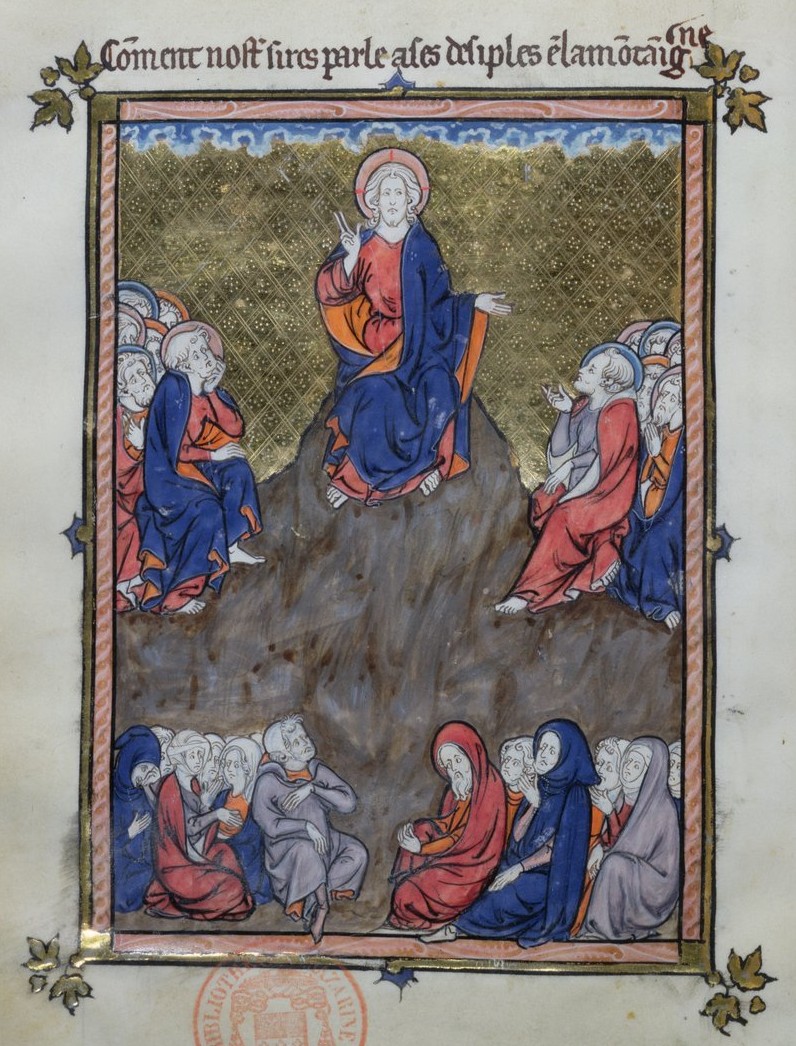
However, before he starts giving us Jesus’ sermon, St. Matthew the Evangelist mentions a few interesting details about Jesus. The evangelist mentions that when “Jesus saw the crowds, He went up the mountain, and after He had sat down, His disciples came to Him.” Consider just two points here: that Jesus went up the mountain, and that He sat down there.
Why did Jesus have to go up a mountain in order to preach a sermon? Obviously, He did not have to. Jesus preached many sermons during the three years of His public ministry, and most of them were preached in all sorts of settings. But in St. Matthew’s account of the Gospel, the Sermon on the Mount is Jesus’ first sermon, so Jesus is teaching us here not only by His words, but also by the setting that He chose, and by the choice to sit down.
So why did Jesus choose a mountain to be the site of His first sermon? St. Matthew clarifies this throughout the course of his Gospel account. Through the words and works of Jesus that St. Matthew includes, and in the way he structures his Gospel account, St. Matthew portrays Jesus as a “New Moses”. One reason St. Matthew does this is that unlike many other New Testament writings, Matthew’s Gospel account was written for converts from Judaism.
So here you need to notice another difference among the four accounts of the Gospel. The four accounts of the Gospel differ because the four evangelists were writing for four difference audiences. Imagine again the biography of your own life. Instead of myself commissioning four different journalists to write four biographies, imagine that four different persons commission four biographies of your life. Furthermore, imagine—and granted, this will take quite a bit of imagination—that the four persons who commission these four biographies are four very different persons. The first of those who commissions a biography of you is a farmer from Kingman County. The second is a businessman from New York City. The third is a tribesman from the Amazon of South America. And the fourth—again, use your imagination—is an astronaut from the 26th century who lives in a colony on Saturn.
When those four different biographies of your life are written for those four very different people who commissioned the biographies, the authors are going to have to write differently. The author writing for the tribesman from the Amazon is going to have to explain details and circumstances about your life that the farmer in Kingman County is not going to need to have explained. The audiences of the books shape the way that the same story is told. It’s similar with the four accounts of the Gospel.
Matthew’s Gospel account was written for converts from Judaism. This is why Matthew “refers to Jewish customs and institutions without explanation” of their backgrounds, because the original Jewish audience of Matthew’s Gospel account would already have known those backgrounds. That’s also why St. Matthew “works nearly two hundred references to the Jewish Scriptures into his narrative”.[1] That’s also why St. Matthew draws parallels between Jesus and Moses.
Moses was, for the Jewish people, the greatest Old Testament Prophet. His life as a prophet including working signs and wonders during the Exodus. But during that Exodus came the most important event of Moses’ life as a prophet. During the course of their Exodus from Egypt to the Promised Land, God’s People stopped at Mount Sinai. There, while the rest of God’s People remained below, Moses alone ascended Mount Sinai to receive from God His Ten Commandments. Moses then had to descend the mountain to give to God’s People this Law. This Law was the means by which His People could—we might say today—“keep right” with God. That key truth about Moses is reflected in how St. Matthew records his account of the Gospel, portraying Jesus as a “New Moses”. Jesus is like Moses in many ways, but also fulfills and completes the ministry of Moses.
In today’s Gospel Reading, it’s not only Jesus who ascends the mountain. Jesus draws His disciples up with Him. And it’s not a voice from the heavens that speaks there to a prophet. Instead, the New Moses—God in the Flesh—speaks to His people face to face. And Jesus gives to us, His people, not ten commandments, but nine beatitudes.
+ + +
Jesus put the Beatitudes at the start of the Sermon on the Mount in order to put the most important lesson first. Likewise, the first of the nine Beatitudes is the key to understanding and living out all nine. So we ought to consider the first of the nine beatitudes as being the first for a reason.
“‘Blessed are the poor in spirit, for theirs is the Kingdom of Heaven.’” St. Augustine preaches about this first—this key—beatitude by asking what “poor in spirit” means. He answers that it means “[b]eing poor in wishes, not in means. One who is poor in spirit, you see, is humble; and God hears the groans of the humble, and doesn’t despise their prayers. That’s why the Lord begins His sermon with humility, that is to say with poverty. You can find someone who’s religious, with plenty of this world’s goods, and not [because of that] puffed up and proud. And you can find someone in need, who has nothing, and won’t settle for anything. … the [former] is poor in spirit, because humble, while [the latter] is indeed poor, but not in spirit.”[2]
The Lord Jesus has given us what we need to reach Heaven. He has given us life; grace to strengthen us for the journey; and the roadmap in these nine beatitudes. The first, upon which all the others rest, is humility: poverty of spirit. Ask the Holy Spirit to help you to make a concrete resolution regarding the practice of humility, maybe by serving those in need through either the Corporal or Spiritual Works of Mercy, or by giving up something that you have and do not need.
[1] “Introduction to the Gospel according to Saint Matthew”, in The Ignatius Catholic Study Bible (San Francisco: Ignatius Press, 2010), 4.
[2] St. Augustine of Hippo, Sermon 53A, in The Works of Saint Augustine, Part III, Vol. III, 78.
 Reflections on the Sacred Liturgy