
The First Sunday of Lent [A]


The First Sunday of Lent [A]
Genesis 2:7-9; 3:1-7  +  Romans 5:12,17-19  +  Matthew 4:1-11
St. Anthony’s Catholic Church, Garden Plain, KS
February 22, 2026

The word “sacred” is not used much anymore.  As Catholics, we know instinctively that certain persons, places, and things are sacred, but what does that mean?  Being clear on the meaning of the word “sacred” will help us appreciate today’s Gospel Reading.

Consider some examples of sacred objects.  What would you think if you visited a neighbor, and noticed that he propped his back screen door open with a bible?  When you ask your neighbor why he’s doing that, he replies that that particular bible is just the right size to fit under the door, to hold it in place.  None of the other books in his house would do the trick.

Then the next day you go over to your cousin’s house for supper.  She tells you that you’re having chicken soup for dinner.  The smell is delicious.  But when it’s time to start serving, your cousin takes an old chalice, and uses it to ladle the soup.  When you ask why she’s doing that, she says that her old ladle broke, and she had this chalice laying around because a deceased uncle was a priest and bequeathed it to her.

In both cases, you would likely be shocked.  But when you tell your neighbor and cousin that they were doing something wrong, they ask you “Why?  Why is it wrong?”  How would you answer them?

The answer would boil down to the meaning of the word “sacred”.  The word “sacred” means “set apart for God”:  set apart from others of the same for God.

Think back to your neighbor using his bible to prop open his door.  He said that the bible is “just the right size” for keeping his door open.  He thinks the bible is fitting for that purpose.  But a bible is sacred.  It is a book bearing the written Word of God, in order to be read (whether liturgically or devotionally).  This book is not to be used as a doorstop, or a paperweight, or any other purpose, even if it seems well suited to other purposes.  Any other use is an act of sacrilege.  The sin of sacrilege is using something sacred for a purpose other than its divine purpose.

What about your cousin using her uncle’s chalice to ladle chicken soup?  She might argue that the chalice serves well as a ladle.  But a chalice is sacred.  Each chalice, before it’s used for the first time, is consecrated by means of prayer.  It’s consecrated for the purpose of bearing the wine that is changed into the Precious Blood of Jesus.  The chalice must not be used as a ladle, or as a cup for drinking beverages, or for any other purpose.  Any other use is sacrilege.

+     +     +

Now this might seem obvious to anyone brought up Catholic.  But we don’t live in a world today that understands the meaning of the word “sacred”.  Our day and age doesn’t get the notion of “consecration”.  The world that surrounds us does not believe that there is anything called “sacrilege”.  The motto of the modern world is “anything goes”.  Or to use a more technical word, the modern world believes that every thing, and every person in this world is nothing more than “secular”.  That is to say:  the only meaning of any thing or any person is the meaning that it has in this world.  There is no world beyond this world that sheds further meaning on any thing or any person.

The challenge for you as a Christian comes from the fact that it’s not just a printed bible and a consecrated chalice that are sacred.  There’s something else in your life that’s sacred, which in fact you carry with you everywhere you go, including to the store, the workplace, on vacation, and so on.  That is your very self.

Your very self—your body, your mind, and your soul, all united as the person who is you—is sacred.  At the moment of your baptism, you as a person were consecrated to God and for God.  Of course, that begs a question:  for what purpose were you “set aside” as sacred?  If a bible’s purpose is to let God’s Word be revealed, and if a chalice’s purpose is to let God’s Precious Blood be consumed, then what is the purpose for which you yourself were consecrated at your baptism?  Or course, there are different vocations within the Church—married persons, priests, and consecrated religious—but God gives every Christian the same overarching goal.  The different Christian vocations all reach for the same end.

The end for which you were consecrated as a Christian person is to love:  to love your God and to love your neighbor, and—what’s more—to do both as Jesus Christ loves.

God calls you to love in this way not only in church on the weekend, but also in the midst of the world every day.  This is a difference between a sacred chalice and you as a baptized Christian.  The chalice is used only within the sanctuary of the church, while you can live out the Gospel anywhere in the world.  Every day, and in every place, Jesus calls you—as He proclaimed in His Sermon on the Mount—to be “the salt of the earth” and “the light of the world” [Matthew 5:13,14].

Today’s First Reading is about the corruption of God’s plan for the human family to share fully in God’s love.  But the Gospel Reading is about Jesus starting to set things back on course.  In this passage from Matthew, Jesus helps us appreciate the challenge that each of us received on the day of baptism:  the vocation to be loving in all of our thoughts, words, and actions towards both God and neighbor, as Jesus loves.

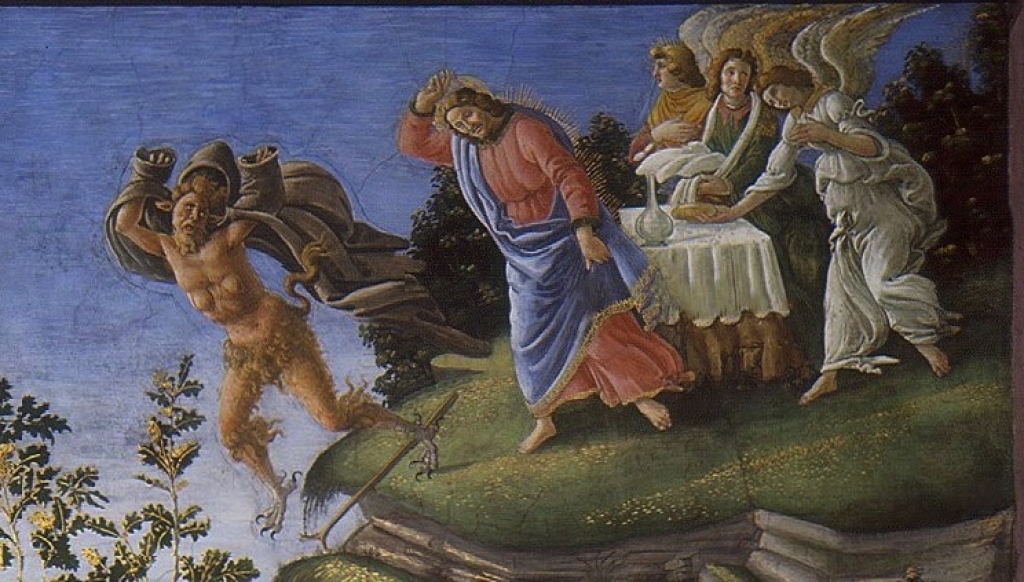
More specifically, today’s Gospel passage is about one specific roadblock to loving in a Christ-like manner.  This roadblock is called temptation.  Today’s Gospel passage is about the different ways in which we’re tempted not to be loving, or rather, to love in ways that are not Christ-like.

+     +     +

Consider, then, the insights of one of the Church’s spiritual masters:  St. Francis de Sales, who was the bishop of Geneva (in what today is Switzerland) in the early 1600’s.  In commenting upon today’s Gospel passage, St. Francis de Sales points out that “many prefer the end of today’s Gospel to its beginning.”  In other words, people are happy to be with Jesus when He’s surrounded by angels who bring Him comfort and consolation.  But are we willing to be with Jesus in the trials of the desert?  St. Francis explains that we will never be invited to His heavenly “banquet… if we [do not share in] His labors and sufferings”.[1]

St. Francis de Sales continues by pointing out that in the here and now, we should “busy ourselves in steadfast resistance to the frontal attacks of our [moral and spiritual] enemies.  For whether we desire it or not[,] we shall be tempted.”[2]

St. Francis de Sales forcefully denies the common misconception that the more dedicated we are to God, the less we will experience temptation.  He explains that just the opposite is to be expected:  “it is an infallible truth that no one is exempt from temptation [once] he has truly resolved to serve God.”[3]

This is clearly illustrated by today’s Gospel Reading.  The divine Son of God was tempted by the devil just before the start of His three years of public ministry.  The devil sought out Jesus at this point because Jesus was ready to start His earthly mission, putting behind Him thirty years of living quietly with His family in the home at Nazareth.

So if you take up this season of Lent with strong resolve, expect pushback from those who do not want you to become more like God.  With this expectation in mind, there are two more points from St. Francis de Sales about what it means for a Christian to experience temptation.

First, St. Francis points out “that although no one can be exempt from temptation, still[,] no one should seek it[,] or go of his own accord to the place where it may be found”[4]:  that place is called “the near occasion of sin”.

Second, given the fact that every Christian will face temptation, it’s “a very necessary practice to prepare our soul for temptation.”  This is one of the most important works of the Christian spiritual life:  to prepare oneself to battle against temptations.  St. Francis de Sales puts it like this:  “we ought to … provide ourselves with the weapons necessary to fight valiantly in order to carry off the victory, since the crown is only for the combatants and conquerors.”[5]

In saying this, he’s echoing the language of Saint Paul the Apostle, who frequently throughout his New Testament letters describes the Christian virtues using metaphors of military gear.  It’s only modern thinkers who falsely claim that military language has no place in the Christian life.  Modern thinkers take for granted that we enjoy the blessings of modern life only through the blood, sweat and tears of those who went before us.  As the bumper sticker puts it, “freedom isn’t free”.  Freedom comes at a price, even if you are not the one who had to pay it.

The same is true in the Christian spiritual life.  Jesus Christ paid the ultimate price to open the gates of Heaven for you.  Only Jesus Christ—as the only-begotten divine Son of the Father—could accomplish that.  Yet every Christian must follow Him there on the same Way.  Every Christian must reject the temptation to wander off the Way of the Cross that leads to Heaven.  Certainly, following Christ faithful along this Way is often a battle.

That truth is reflected in the opening prayer of Holy Mass on Ash Wednesday.  Listen again to the words of this prayer, and ask Jesus for the grace to fight temptation, in order to be faithful to your sacred call to be loving as Jesus is loving:  “Grant, O Lord, that we may begin with holy fasting / this campaign of Christian service, / so that, as we take up battle against spiritual evils, / we may be armed with weapons of self-restraint.”  Amen.


[1] St. Francis de Sales, The Sermons of St. Francis de Sales for Lent (Rockford, Ill.:  Tan Books, 1987), 31.

[2] Ibid., 32.

[3] Ibid., 15.

[4] Ibid., 15.

[5] Ibid., 17.
The Sixth Sunday in Ordinary Time [A]

The Sixth Sunday in Ordinary Time [A]
Sirach 15:15-20  +  1 Corinthians 2:6-10  +  Matthew 5:17-37 [or Matthew 5:20-22a,27-28,33-34a,37]
St. Anthony’s Catholic Church, Garden Plain, KS
February 15, 2026

Three years ago, I made a pilgrimage to Portugal, Spain, and France.  Both bookends of the pilgrimage were in honor of Our Blessed Mother, starting at Fatima in Portugal, and ending two weeks later at Lourdes in France.  In between, the bulk of the pilgrimage was spent in Spain.

I visited many different places in Spain connected to the lives of two 16th century saints.  St. Teresa of Jesus and St. John of the Cross lived at a time of great chaos.  Part of this chaos was caused by corruption within the Catholic Church.

St. Teresa of Jesus decided to confront the corruption within the Church differently than the Protestant leaders whose efforts started during the 16th century.  Instead of leading Christians out of the Church, she decided to remain within the Church, and to change the Church from within.  St. Teresa belonged to the Carmelite religious order, which had grown lax since their foundation in the 12th century.  So she started a new branch of the Carmelites called the Discalced Carmelites.  (The word “discalced” means “barefoot”, because the Discalced Carmelites, as part of their vow of poverty, went without shoes.)

+     +     +

Now, why do some religious orders like the Carmelites grow lax and weak over time, or even corrupt?  It’s much the same reason that a relationship grows weak.  You cannot take relationships for granted.  You have to dedicate time and effort to relationships.  Husbands need to take their wives out on “date nights”.  Parents and grandparents “make memories” with their children and grandchildren.

Something similar is also true of the spiritual life.  This is part of the battle that St. Teresa of Jesus faced in her reform of the Carmelite order.  You cannot take your soul’s health for granted.  Unless you tend to it, like a gardener or a farmer, weeds will grow, disease will set in, and death will follow.  If not tended to in this world, that death will last forever in the next.  What’s true of an individual soul is just as true for a religious community of monks or nuns:  if growth is not fostered, the spiritual life becomes lax, and decay sets in.

That brings us to the conflict in today’s Gospel passage.  This conflict reflects the conflict that St. Teresa of Jesus and St. John of the Cross faced in 16th century Spain.  This conflict reflects the struggle that’s present in every Christian’s spiritual life, including your own.

+     +     +

Today’s Gospel passage is from the middle of Matthew 5.  Jesus’ Sermon on the Mount is found in Chapters 5-7 of Matthew.  Today is the third Sunday in a row on which the Gospel Reading comes from Jesus’ Sermon on the Mount.  Since Lent starts this week, we won’t hear the rest of the Sermon on the Mount over the next few Sundays.  However, at home you can place a bookmark in your bible at the start of Matthew 5.  Slowly read and meditate upon Matthew Chapters 5, 6 & 7 over the weeks from now until Easter Sunday.

Now if tackling the entire Sermon on the Mount seems daunting, just take Matthew 5.  Even though Matthew 5 is just one-third of the Sermon on the Mount, the chapter is rather self-contained.  Matthew 5 starts with the Beatitudes, and ends with Jesus saying, “So be perfect, as your heavenly Father is perfect” [Mt 5:48].  So at the start of Matthew 5, when He starts the Sermon on the Mount, the Beatitudes are the roadmap that Jesus hands to us, so that we can follow Him on a spiritual journey.  At the end of Matthew 5, Jesus reveals the goal of our spiritual journey:  to “be perfect, as your heavenly Father is perfect”.

In between, Jesus describes several conflicts that we’re likely to face on this spiritual journey:  road bumps, you might say, on the path to becoming perfect as our heavenly Father is perfect.  The spiritual conflicts that Jesus describes in Matthew 5 are similar to the conflicts that St. Teresa of Jesus and St. John of the Cross faced in their efforts to reform the Carmelite order.  Consider what happened to St. John of the Cross in the year 1577.

John was kidnapped by members of the older Carmlite order.  They imprisoned him for eight months in a cell that measured ten feet by six feet, and they lashed him once a week.  In the midst of this, he was also bribed.  The bribes were unsuccessful, John eventually escaped, and the reform efforts of St. John and St. Teresa continued successfully.

+     +     +

So consider the conflict in today’s Gospel passage.   

Jesus does not describe a conflict between the Jewish Law and His Gospel.  In fact, He declares, “Do not think that I have come to abolish the law or the prophets.  I have come not to abolish but to fulfill.”

The conflict is between—on the one hand—the righteousness of the scribes and the Pharisees, and—on the other hand—the righteousness that Jesus offers.

The righteousness of the scribes and the Pharisees was limited to the literal meaning of the 613 laws of the Jewish Torah.  Jesus demanded more.  Jesus demands that if you’re going to follow Him, you have to go to the heart of God’s laws.  Ask where evil starts in the human heart.  Don’t just consider where it ends.  Every man who murders a man commits the murder twice:  first in his heart, by way of desire, and then a second time in fact.  The Scribes and Pharisees thought they could be righteous if they only murdered a man once, as long as it was only in their heart, because in their reading of God’s Law, God did not make demands of their hearts.

Jesus is making a demand of you:  “unless your righteousness surpasses that of the scribes and Pharisees, you will not enter the kingdom of heaven.”  As you start the Season of Lent this week, allow God’s demands to reach into your heart, and touch every desire that you hold there.  Offer to Christ every desire in your heart that’s contrary to His love, and ask Him in exchange to give you the Love that can re-shape and re-form your heart to be like the Sacred Heart of Jesus.

The Fourth Sunday in Ordinary Time [A]

The Fourth Sunday in Ordinary Time [A]
Zephaniah 2:3;3:12-13  +  1 Corinthians 1:26-31
  +  Matthew 5:1-12
St. Anthony’s Catholic Church, Garden Plain, KS
February 1, 2026

The Bible is not a single book.  The Bible is a library.  Just as a library has many different types of books in it, so also the Bible.  When you visit a library, you find different sections in the library, and each section has different books.  If you visit a library, and visit four different sections, and take from different shelves a cookbook, a collection of poems, a presidential biography, and a science fiction novel, you don’t read those four books in the same way.  For example, if you open a cookbook expecting it to read like a science fiction novel, you’re going to end up with a very strange supper.

The Bible is the same way, and this variety among the books of the Bible is important to remember during Holy Mass.  As you know, the first chief part of the Mass focuses upon passages from the Bible.  But when we listen to them, if we don’t understand the differences among the Old Testament Prophets, the New Testament letters of the Apostles, and the four Gospel accounts, we’re not going to get the most out of the Scripture readings.

What’s more, when it comes to the four accounts of the Gospel—written by Matthew, Mark, Luke, and John—we need to recognize the many differences among these four books of the Bible.  One way to understand these many differences is to think of your own life.  Let’s say that I myself wanted to commission a biography of your life.  I hire four different journalists to write four different biographies of your life.  But each of these four journalists interviews a different person.  One journalist interviews your spouse.  Another interviews one of your bosses from the jobs you’ve had over the years.  Another interviews one of your sisters, and the last journalist interviews one of your high school friends.  Do you think that those four biographies are going to say the same thing?  Or are these four biographies going to illustrate different aspects of your life?  In fact, they are going to illustrate four different aspects of your life.  In a similar manner, each of the four Gospel accounts illustrates Jesus’ life, death, and Resurrection from different vantage points because the four different authors had four different sources.

I mention all this because we are early in the Season of Ordinary Time, and have just heard today one of the most important passages of the Bible.  Before reflecting specifically on this passage—from Matthew 5—we need some context.

Lent starts early this year, on February 18.  So including today, we only have three Sundays in Ordinary Time before Lent begins.  On these three Sundays, the Gospel passage comes from Matthew Chapter 5.  This chapter is the first of three chapters that give us Jesus’ Sermon on the Mount.  If you’d like a recommendation for spiritual reading during these next three weeks before Lent begins, I’d encourage you to read the Sermon on the Mount from the Gospel according to St. Matthew.

+     +     +

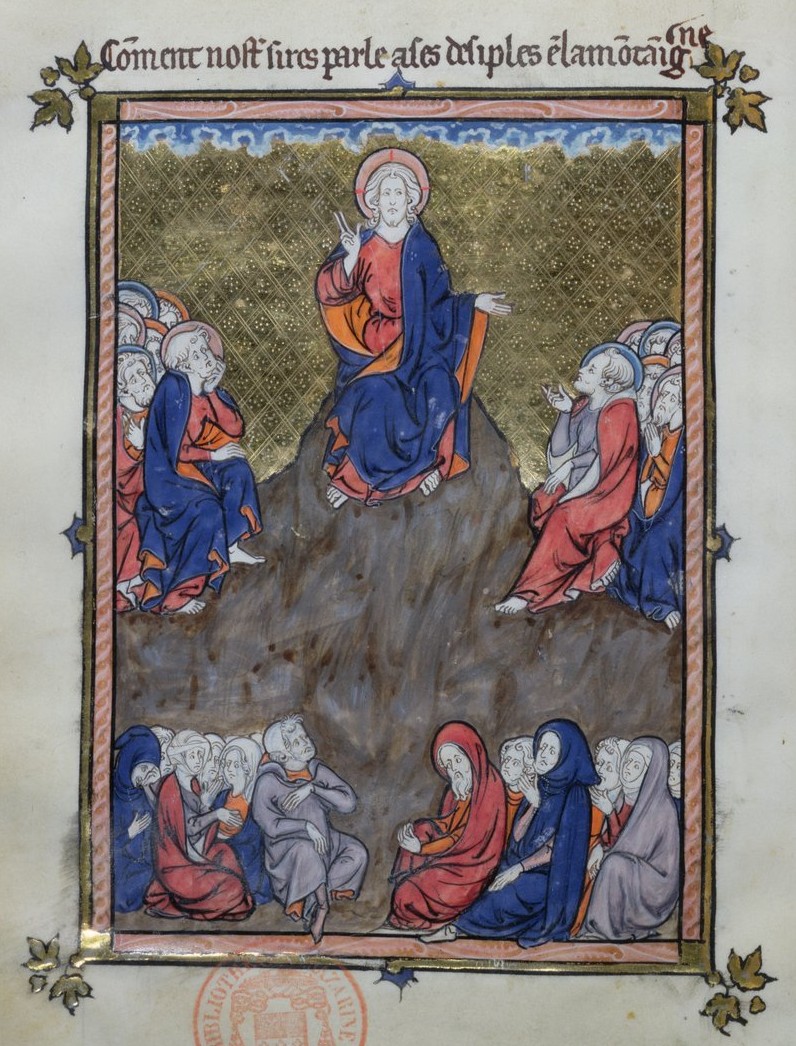
Today’s Gospel passage is the first twelve verses of Matthew Chapter 5:  the very beginning of the Sermon on the Mount.  In our own day, preachers often begin a sermon with a story or a joke.  Jesus decided to begin His Sermon on the Mount with the Beatitudes.

However, before he starts giving us Jesus’ sermon, St. Matthew the Evangelist mentions a few interesting details about Jesus.  The evangelist mentions that when “Jesus saw the crowds, He went up the mountain, and after He had sat down, His disciples came to Him.”  Consider just two points here:  that Jesus went up the mountain, and that He sat down there.

Why did Jesus have to go up a mountain in order to preach a sermon?  Obviously, He did not have to.  Jesus preached many sermons during the three years of His public ministry, and most of them were preached in all sorts of settings.  But in St. Matthew’s account of the Gospel, the Sermon on the Mount is Jesus’ first sermon, so Jesus is teaching us here not only by His words, but also by the setting that He chose, and by the choice to sit down.

So why did Jesus choose a mountain to be the site of His first sermon?  St. Matthew clarifies this throughout the course of his Gospel account.  Through the words and works of Jesus that St. Matthew includes, and in the way he structures his Gospel account, St. Matthew portrays Jesus as a “New Moses”.  One reason St. Matthew does this is that unlike many other New Testament writings, Matthew’s Gospel account was written for converts from Judaism.

So here you need to notice another difference among the four accounts of the Gospel.  The four accounts of the Gospel differ because the four evangelists were writing for four difference audiences.  Imagine again the biography of your own life.  Instead of myself commissioning four different journalists to write four biographies, imagine that four different persons commission four biographies of your life.  Furthermore, imagine—and granted, this will take quite a bit of imagination—that the four persons who commission these four biographies are four very different persons.  The first of those who commissions a biography of you is a farmer from Kingman County.  The second is a businessman from New York City.  The third is a tribesman from the Amazon of South America.  And the fourth—again, use your imagination—is an astronaut from the 26th century who lives in a colony on Saturn.

When those four different biographies of your life are written for those four very different people who commissioned the biographies, the authors are going to have to write differently.  The author writing for the tribesman from the Amazon is going to have to explain details and circumstances about your life that the farmer in Kingman County is not going to need to have explained.  The audiences of the books shape the way that the same story is told.  It’s similar with the four accounts of the Gospel. 

Matthew’s Gospel account was written for converts from Judaism.  This is why Matthew “refers to Jewish customs and institutions without explanation” of their backgrounds, because the original Jewish audience of Matthew’s Gospel account would already have known those backgrounds.  That’s also why St. Matthew “works nearly two hundred references to the Jewish Scriptures into his narrative”.[1]  That’s also why St. Matthew draws parallels between Jesus and Moses.

Moses was, for the Jewish people, the greatest Old Testament Prophet.  His life as a prophet including working signs and wonders during the Exodus.  But during that Exodus came the most important event of Moses’ life as a prophet.  During the course of their Exodus from Egypt to the Promised Land, God’s People stopped at Mount Sinai.  There, while the rest of God’s People remained below, Moses alone ascended Mount Sinai to receive from God His Ten Commandments.  Moses then had to descend the mountain to give to God’s People this Law.  This Law was the means by which His People could—we might say today—“keep right” with God.  That key truth about Moses is reflected in how St. Matthew records his account of the Gospel, portraying Jesus as a “New Moses”.  Jesus is like Moses in many ways, but also fulfills and completes the ministry of Moses.

In today’s Gospel Reading, it’s not only Jesus who ascends the mountain.  Jesus draws His disciples up with Him.  And it’s not a voice from the heavens that speaks there to a prophet.  Instead, the New Moses—God in the Flesh—speaks to His people face to face.  And Jesus gives to us, His people, not ten commandments, but nine beatitudes.

+     +     +

Jesus put the Beatitudes at the start of the Sermon on the Mount in order to put the most important lesson first.  Likewise, the first of the nine Beatitudes is the key to understanding and living out all nine.  So we ought to consider the first of the nine beatitudes as being the first for a reason.

“‘Blessed are the poor in spirit, for theirs is the Kingdom of Heaven.’”  St. Augustine preaches about this first—this key—beatitude by asking what “poor in spirit” means.  He answers that it means “[b]eing poor in wishes, not in means.  One who is poor in spirit, you see, is humble; and God hears the groans of the humble, and doesn’t despise their prayers.  That’s why the Lord begins His sermon with humility, that is to say with poverty.  You can find someone who’s religious, with plenty of this world’s goods, and not [because of that] puffed up and proud.  And you can find someone in need, who has nothing, and won’t settle for anything. … the [former] is poor in spirit, because humble, while [the latter] is indeed poor, but not in spirit.”[2]

The Lord Jesus has given us what we need to reach Heaven.  He has given us life; grace to strengthen us for the journey; and the roadmap in these nine beatitudes.  The first, upon which all the others rest, is humility:  poverty of spirit.  Ask the Holy Spirit to help you to make a concrete resolution regarding the practice of humility, maybe by serving those in need through either the Corporal or Spiritual Works of Mercy, or by giving up something that you have and do not need.


[1] “Introduction to the Gospel according to Saint Matthew”, in The Ignatius Catholic Study Bible (San Francisco: Ignatius Press, 2010), 4.

[2] St. Augustine of Hippo, Sermon 53A, in The Works of Saint Augustine, Part III, Vol. III, 78.