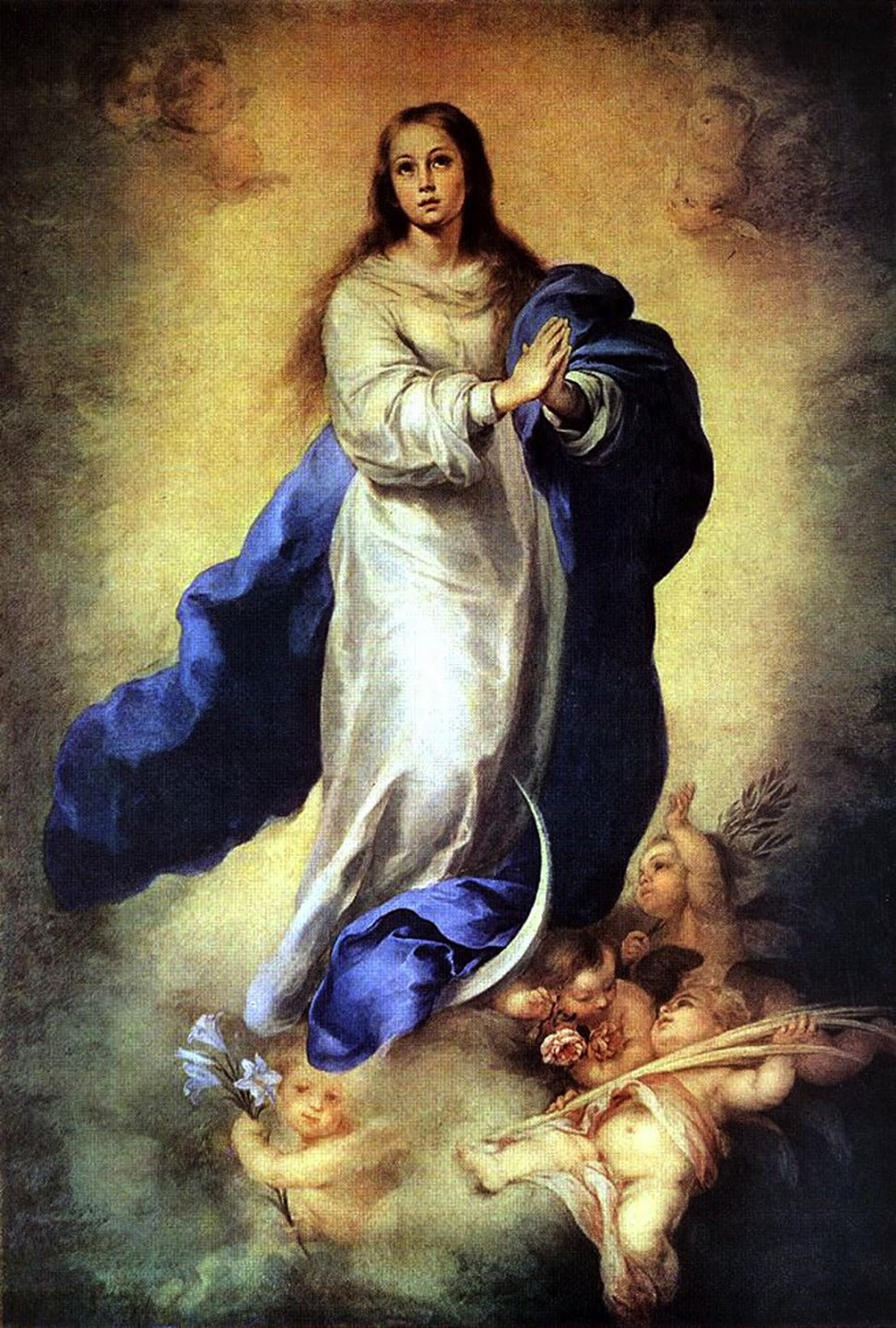
The Immaculate Conception of the Blessed Virgin Mary
Genesis 3:9-15,20 + Ephesians 1:3-6,11-12 + Luke 1:26-38
St. Anthony’s Catholic Church, Garden Plain, KS
December 8, 2025
The Blessed Virgin Mary needed a Savior. This is important to recall when reflecting upon the Immaculate Conception: that is, Mary being conceived by her mother, St. Anne, without inheriting Original Sin. This is important, among other reasons, because some of our separated brethren within the Body of Christ make a false claim about Mary. They argue that believing in Mary’s being preserved from Original Sin means that the salvation that Jesus won for fallen man on Calvary was not universal: in other words, that Mary had no need for salvation. She was sinless, so Jesus did not save her: that’s the false claim that we have to be able to answer.
In truth, we have Mary’s own testimony in the Bible. The scene of the Visitation of Mary to her cousin Elizabeth is recorded in the first chapter of St. Luke’s Gospel account. In that scene, Mary proclaims the hymn called the Magnificat, which starts with Mary declaring: “My soul magnifies the Lord, and my spirit rejoices in God my Savior, for he has regarded the low estate of his handmaiden” [Luke 1:46-48; see Acts 4:12].
Mary speaks of her “Savior”, because Mary was saved by God from sin. But she was not saved from sin like you and I, through the grace of Baptism and Confession.
Consider an example of what it means to be saved. Imagine this: imagine that you’re standing at the edge of a very large lake. In front of you is a pier that extends a long way into the lake. At the end of the pier, the water is fifty feet deep.
Now imagine that two friends are with you. These persons are both blind, and unable to swim. Now you’re setting up your campsite, when suddenly you hear a splash: one of your friends walked all the way to the end of the pier and fell into the water. Naturally, you run to the end of the pier, dive in, and drag the friend to safety. You have saved your first friend from drowning.
The next day, you’re scavenging near the campsite for firewood. At one point you pause, and look up. Your other friend has walked down the pier, and is close to its end. You make a mad dash for the pier, and you reach its end just as your friend is about to step off and fall into the fifty-foot deep water. You grab your friend by the back of his shirt and pull him back to safety before he can fall in. You have saved your second friend from drowning.
That second friend is like the Blessed Virgin Mary, who was saved by preventing her from ever falling into sin. The rest of the human race is offered salvation in the first way, by being pulled out of sin after having already fallen into it. Mary was never stained by sin, but she was saved from it.
So that analogy helps us understand how God saved Mary. However, it’s far more important to understand why God saved Mary in this unique way.
The Blessed Virgin Mary was immaculately conceived, and filled by God with grace, for the moment of the Anunciation. In fact, Mary was “full of grace” for the sake of her entire vocation, which began at the moment of the Annunciation, and then extended throughout her earthly life, and continued (and continues) after the end of her earthly life and her assumption into Heaven.
However, the rest of her vocation—the Visitation, the Nativity of her Son, the Sorrows of Jesus’ infancy and public ministry, her intercession at the wedding at Cana, her fidelity at Calvary, and her motherly care for the Church starting on the day of Pentecost—was entirely dependent upon this moment of the Annunciation. This moment was for Mary what the decision in the Garden was for Eve. But Mary’s choice was the opposite of Eve’s. Through Eve’s choice, sin entered the world, while through Mary’s choice, the Word of God became Flesh and dwelt among us.
This is why throughout history, the Church has addressed the Blessed Virgin Mary as the New Eve. Mary is our Mother, and also our model. She is “full of grace”, and the first of those graces was the grace of her Immaculate Conception. By means of God’s graces, Mary models for us the way of discipleship, the way to accept Christ into our lives. The first step upon that way is for us to say at the start of each day: “Behold, I am the [servant] of the Lord. May it be done to me according to your word.”
 Reflections on the Sacred Liturgy