The Third Sunday of Advent [A]

The Third Sunday of Advent [A]
Isaiah 35:1-6, 10  +  James 5:7-10  +  Matthew 11:2-11
St. Anthony’s Catholic Church, Garden Plain, KS
December 14, 2025

In today’s Second Reading, the apostle Saint James encourages us to:  “[t]ake as an example of hardship and patience … the prophets who spoke ….”  Then the Gospel Reading sets before us the greatest of the prophets:  Saint John the Baptist, whose life reveals the wisdom of what St. James encourages us to take up.

“Hardship and patience” don’t come easily to most of us.  Of course, most people can see the value of patience more easily than the value of hardship.  We know from daily experience how much we need patience in order to get along in this world (not to mention in order to have a shot at Heaven!).  As we grow up, we need patience with our brothers, and with our sisters.  Parents need patience with their children, and children with their parents.  Employees need patience with their bosses, and bosses with their employees.

We even need to have patience with God!  Maybe that sounds strange.  Of course, the reason for needing patience with God is very different than why we need patience with our children, parents, boss, and so on.  For the most part, we need patience with our brothers and sisters because of their imperfections, faults, and sins.  But with God we need patience for different reasons.

We need patience with God first of all because His time is not our time.  God looks at us and our lives from the perspective of eternity, while we—like children—look only at a very narrow span of time.  In other words, our field of vision is restricted by blinders that we have placed upon ourselves.

Or we might say that we need patience with God because God is a farmer, while for our part, we—all too often—only want to reap what we have not sown.  So patience is one of the key virtues of Advent, and we beg God for an increase in the virtue of patience, with both God and neighbor.

+     +     +

But on the other hand, do we really need the hardship that St. James speaks about in the Second Reading?  Or is hardship just something that has to be tolerated?  Is hardship actually of value, or should we instead work to cultivate a soft, comfortable, easy, restful life?

We know, of course, that some penance is inevitable in this world where we live.  In His Sermon on the Mount, Jesus reminds us that God makes the rain to fall on the just and the unjust.

Saint John the Baptist speaks about the hard fact that hardship is necessary.  In fact, hardship is not just necessary.  Hardship has great value.  Saint James says the same.  Both saints point our attention to Jesus, who shows us repeatedly that hardship is a precious means by which to draw closer to the Father.  Hardship is a means of allowing Him to embrace us as a father embraces his little child.

+     +     +

Of course, another word for “hardship” is “penance”.  But the word “penance” is not always fully appreciated.  For some Catholics, the word “penance” suggests only the Sacrament of Penance, with all of the examination of conscience, confession, and amendment of life that are part and parcel of that sacrament.  For other Catholics, the word “penance” suggests a medieval monastery, where monks use whips and cords, a diet of hard bread and cold soup, and allow themselves three hours of sleep on a hard floor in order to tell God, year after year, how sorry they are for being such miserable wretches.  Unfortunately, false caricatures of “penance” such as that medieval monastery lead some Christians to the opposite extreme, where the grace of Christ, which has already won the victory over human sin, leads them to reject penance as having any place within the spiritual life.

Holy Mother Church, however, not only teaches her children to practice some penance on Fridays in honor of that Good Friday when Jesus carried His Cross and died upon it for us.  The Church not only offers the Sacrament of Penance every week of the year so that sins, both large and small, mortal and venial, can be washed away by the Blood of Christ.  In fact, the Church goes further in sowing the seeds of penance in our spiritual lives.  The Church each year sets aside two seasons of the year as seasons of penance.  Advent and Lent are seasons of preparation:  Lent prepares us for Eastertide, and Advent prepares us for Christmastide.  Penance, then, is one of the tools with which to prepare for the great seasons of Christmas and Easter.

However, although Advent and Lent are similar in many ways, they focus our hearts and minds differently.  Lent will come again in a few months, and during Lent we can reflect on how Lent is unique in calling Christians to penance.  But Advent’s unique “take” on penance has its origin in the experience of new life:  new life, of course, being what lies at the heart of the Christmas mystery.

Those of you who are mothers can recall all the sacrifices involved in bearing new life, and bringing it into the world, not to mention the countless sacrifices involved in shepherding your child through the first decades of his or her life.  New life and sacrifice are part and parcel of each other.  New life and sacrifice go hand in hand.  You can’t have one without the other.

But you will still find some Christians who insist that new life in the spiritual life is different:  they insist that because grace is free, that it demands no sacrifice of the one to whom it’s given.  As Catholics, though, we know better, because the Church leads us in the practices of penance throughout the year, but especially during Advent and Lent.

Along with the practices of poverty and silence, the practice of penance helps us prepare to celebrate Christmas in a deeply spiritual manner.  If you’d like an image to reflect on throughout this third week of Advent, here are three images:  picture our Blessed Mother at the Annunciation, during the journey to Bethlehem, and in the stable after Jesus’ birth.  Reflect on our Blessed Mother practicing poverty, silence, and sacrifice, and give thanks that through the grace of her Son, you and I can draw closer to God the Father.

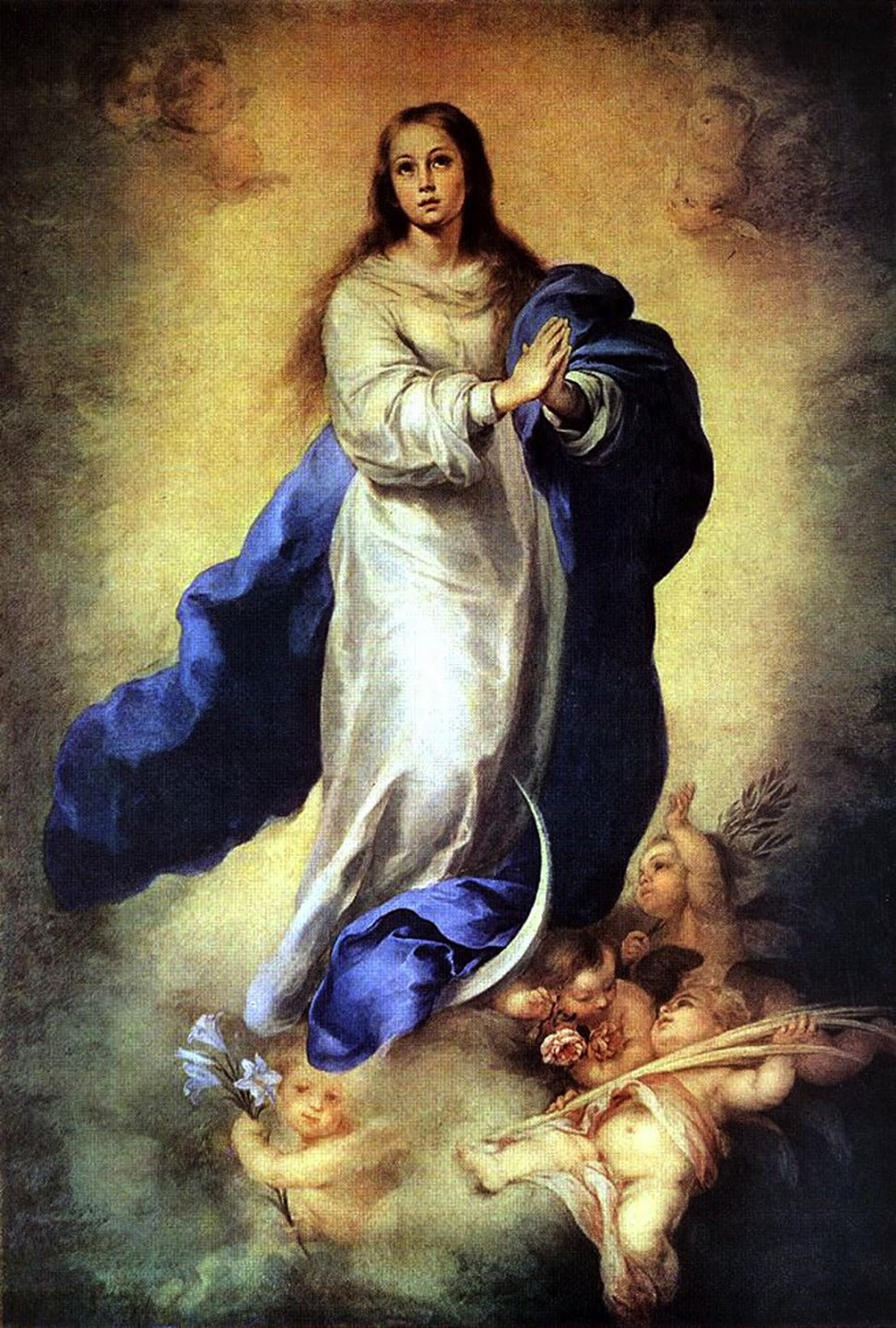
The Immaculate Conception of the Blessed Virgin Mary

The Immaculate Conception of the Blessed Virgin Mary
Genesis 3:9-15,20  +  Ephesians 1:3-6,11-12  +  Luke 1:26-38
St. Anthony’s Catholic Church, Garden Plain, KS
December 8, 2025

The Blessed Virgin Mary needed a Savior.  This is important to recall when reflecting upon the Immaculate Conception:  that is, Mary being conceived by her mother, St. Anne, without inheriting Original Sin.  This is important, among other reasons, because some of our separated brethren within the Body of Christ make a false claim about Mary.  They argue that believing in Mary’s being preserved from Original Sin means that the salvation that Jesus won for fallen man on Calvary was not universal:  in other words, that Mary had no need for salvation.  She was sinless, so Jesus did not save her:  that’s the false claim that we have to be able to answer.

In truth, we have Mary’s own testimony in the Bible.  The scene of the Visitation of Mary to her cousin Elizabeth is recorded in the first chapter of St. Luke’s Gospel account.  In that scene, Mary proclaims the hymn called the Magnificat, which starts with Mary declaring:  “My soul magnifies the Lord, and my spirit rejoices in God my Savior, for he has regarded the low estate of his handmaiden” [Luke 1:46-48; see Acts 4:12].

Mary speaks of her “Savior”, because Mary was saved by God from sin.  But she was not saved from sin like you and I, through the grace of Baptism and Confession.

Consider an example of what it means to be saved.  Imagine this:  imagine that you’re standing at the edge of a very large lake.  In front of you is a pier that extends a long way into the lake.  At the end of the pier, the water is fifty feet deep.

Now imagine that two friends are with you.  These persons are both blind, and unable to swim.  Now you’re setting up your campsite, when suddenly you hear a splash:  one of your friends walked all the way to the end of the pier and fell into the water.  Naturally, you run to the end of the pier, dive in, and drag the friend to safety.  You have saved your first friend from drowning.

The next day, you’re scavenging near the campsite for firewood.  At one point you pause, and look up.  Your other friend has walked down the pier, and is close to its end.  You make a mad dash for the pier, and you reach its end just as your friend is about to step off and fall into the fifty-foot deep water.  You grab your friend by the back of his shirt and pull him back to safety before he can fall in.  You have saved your second friend from drowning.

That second friend is like the Blessed Virgin Mary, who was saved by preventing her from ever falling into sin.  The rest of the human race is offered salvation in the first way, by being pulled out of sin after having already fallen into it.  Mary was never stained by sin, but she was saved from it.

So that analogy helps us understand how God saved Mary.  However, it’s far more important to understand why God saved Mary in this unique way.

The Blessed Virgin Mary was immaculately conceived, and filled by God with grace, for the moment of the Anunciation.  In fact, Mary was “full of grace” for the sake of her entire vocation, which began at the moment of the Annunciation, and then extended throughout her earthly life, and continued (and continues) after the end of her earthly life and her assumption into Heaven.

However, the rest of her vocation—the Visitation, the Nativity of her Son, the Sorrows of Jesus’ infancy and public ministry, her intercession at the wedding at Cana, her fidelity at Calvary, and her motherly care for the Church starting on the day of Pentecost—was entirely dependent upon this moment of the Annunciation.  This moment was for Mary what the decision in the Garden was for Eve.  But Mary’s choice was the opposite of Eve’s.  Through Eve’s choice, sin entered the world, while through Mary’s choice, the Word of God became Flesh and dwelt among us.

This is why throughout history, the Church has addressed the Blessed Virgin Mary as the New Eve.  Mary is our Mother, and also our model.  She is “full of grace”, and the first of those graces was the grace of her Immaculate Conception.  By means of God’s graces, Mary models for us the way of discipleship, the way to accept Christ into our lives.  The first step upon that way is for us to say at the start of each day:  “Behold, I am the [servant] of the Lord.  May it be done to me according to your word.”

The Second Sunday of Advent [A]

The Second Sunday of Advent [A]
Isaiah 11:1-10  +  Romans 15:4-9  +  Matthew 3:1-12
St. Anthony’s Catholic Church, Garden Plain, KS
December 7, 2025

The Old Testament prophet Isaiah, who lived seven centuries before Jesus, prophesied about a day that was to come.  Isaiah preached about that future day on which the Messiah—the Savior of the Jews—would appear and set things right in the world.  But Isaiah’s prophecy is a little strange.

Isaiah begins his prophecy with the words:  “On that day ….”  That day, Isaiah foretells, will be a day of unexpected sights and sounds.  The images that Isaiah describes seem to be contradictions:  the lion eating hay, and the wolf as the guest of the lamb.  But then comes the most disturbing image, especially if we think of the manger in Bethlehem:

“The baby shall play by the cobra’s den, and the child lay his hand on the adder’s lair.”  We would never expect to see this image in real life.  In fact, if you are a parent, it’s the last image you’d want to see. 

The Lord probably gave Isaiah the image of the baby because of a baby’s innocence and weakness, and how it contrasts with the serpent’s cunning and danger.  But whether Isaiah knew it or not, his image also sums up the meaning of Christmas.  God the Son, who existed from all eternity with the Father and the Holy Spirit, entered this world of ours as a tiny baby.  And what kind of a world is it?

The world we live in—the world God the Son entered as a baby—is a world of sin and sickness.  The Gospel accounts make clear that the world into which Jesus is born is a world where justice is denied to the innocent, and kings are liars.  This world of ours is turned upside-down, and this is the world into which God the Father sent Jesus as an innocent baby.

Why would God the Father do that?  God the Father, who is perfect, and without any needs, chose to send His Son from Heaven to earth:  from Heaven—a place of perfection, the Kingdom where His Will is done—to earth—a place where sin has the upper hand, and a lair of the serpent where everyone gives in to his temptations.

The baby Isaiah prophesies about is the baby Jesus, and the snake is the Devil.  Isaiah’s prophecy echoes what God had warned the serpent in the Garden about after Adam and Eve had committed the Original Sin.  God said to the serpent:  “I will put enmity between you and the woman, and between your offspring and hers;  He will strike at your head, while you strike at his heel” [Genesis 3:15].

No matter how poorly you and I offer our lives to God, day in and day out, He still loves us.  God’s love is mysterious and unexpected, and is the same love that we are preparing to celebrate at Christmas.  This is the love which God the Father incarnates when He sends His only Son into this world of sin, to take that sin upon Himself on the Cross.

These truths can be hard for us to fully accept.  We may say we believe these truths of our Faith, but the Church knows how hard it is for us truly to accept not only how much the Father loves us, but also to accept this truth’s consequences.  That’s why we fallen human beings need an entire season of four weeks to prepare for Christmas.

Last week I mentioned three practices that are a good way to prepare during Advent.  We can remember them with the initials P-S-P.  These three letters—P-S-P—stand for the practices of poverty, silence, and penance.  These three practices can help us to accept more readily the gift God wants to give us, and to accept also the consequences of this gift.  That’s especially true of the practice of silence.

Silence is hard to come by these days.  A lot of people who live in the country appreciate silence.  However, with the nature of mass media today, it doesn’t matter if you live at the top of a mountain:  radio signals, TV signals, wireless Internet and more can be beamed to you, or maybe we should say at you.  To create an atmosphere of silence, you have to go on the offense.  You have to unplug, disconnect and turn off a lot of devices.

Of course, there’s also another difficulty when it comes to silence.  Sometimes we don’t like silence.  Noise has a way of blocking out, or distracting us from, our own thoughts and concerns, which at times we’d rather not face.

But maybe we need to accept silence as a gift.  In fact, in our spiritual life silence is a two-fold gift.  The first aspect of the gift of silence is that it’s a gift we give ourselves, so as to hear one’s own true self, even when that’s uncomfortable.  But the importance of silence also goes beyond our selves.

You remember the Old Testament story about Elijah, to whom the Lord God spoke, not through fire or an earthquake, but through a tiny whisper.  In the Christian spiritual life, silence is not an end in itself.  Silence is a means, or rather, a medium through which to hear the Word of God.  This is takes us to one of the most important truths of our Catholic Faith.  This truth will be proclaimed on Christmas morning in the Gospel Reading from John 1.  You might want to look it up and make it part of your Advent spiritual reading.

The Word of God is not a book.  The Word of God is a Person:  the Second Person of the Most Blessed Trinity.  In John 1, St. John proclaims that this divine Word, which was in the beginning, became Flesh and dwelt among us.  He became flesh and blood—one of us—in order to offer that Body and Blood, with His soul and divinity, on the Cross at Calvary.  His Sacrifice on the Cross is made present to us sacramentally in the Holy Sacrifice of the Mass.

This is a message we sinners need to hear, and we need silence to be able to hear it, to appreciate it, and to start making changes in our lives in order to accept this gift more fully.