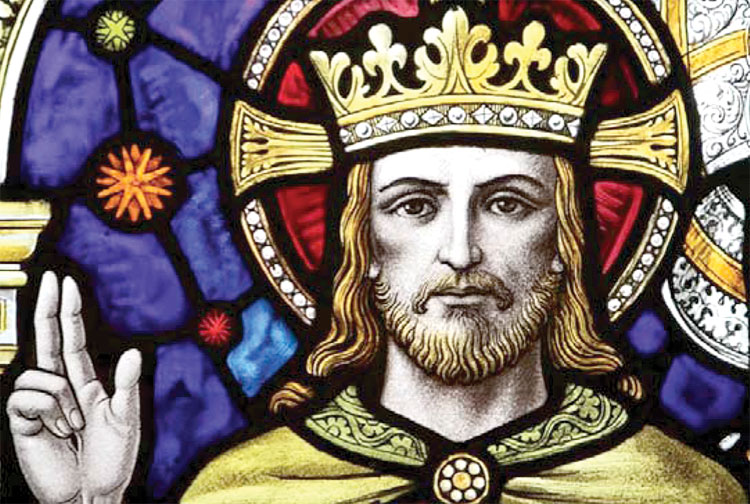
Our Lord Jesus Christ, King of the Universe [C]
II Samuel 5:1-3 + Colossians 1:12-20 + Luke 23:35-43
St. Anthony’s Catholic Church, Garden Plain, KS
November 23, 2025
One day an old professor spoke to large corporations about time management. Standing before a group of CEOs, he pulled out from under the table a large, empty glass vase.
Then he carefully placed a dozen rocks the size of tennis balls inside the vase. When he could not add any more, he asked the crowd: “Does the vase look full to you?”, and they all nodded in agreement.
He waited a moment, and then he pulled a box full of pebbles from under the table. He poured the pebbles into the vase, moving the vase back and forth so that the pebbles shifted downwards. Then he asked, “Is the vase full?” In the audience, several shook their heads, “No.”
The professor picked up a bag of sand and poured it into the vase. The sand filled all the crevices between the rocks and the pebbles. He asked again: “Is the vase full now?”, and the crowd all answered “No.” Then the professor took the pitcher of water from the table and poured it into the vase up to the brim.
At this point he looked up at his audience and asked: “What great truth does this experiment show us?” The most successful CEO in the audience stood up and declared: “This shows us that even when our schedule is full, with some effort we can always add another task.”
The professor replied, “You are exactly wrong. You are looking at what happened from exactly the wrong perspective. What you’ve just seen in fact demonstrates that, if you don’t put the big rocks in the vase first, then you will never be able to put them in after.”
There was a moment of silence, and the professor continued: “What are the big rocks—the priorities—in your life? The important thing is to put these big rocks at the top of your agenda. If you give priority to a thousand other little things—the pebbles, and certainly the sand—your life will be filled with things of small meaning, and you will never fit in what’s most important.”
+ + +
Not many of us are CEOs, but each of us makes choices each day about our priorities. On this final Sunday of the Church year, the Church is very sober is speaking about Christ the King. As a king, Christ judges. This Sunday focuses our attention on what the Church refers to as “the four Last Things”: Heaven and hell, death and judgment. Christ the King judges us in the light of these four Last Things: Heaven and hell, death and judgment.
+ + +
When God created the heavens and the earth, including Adam and Eve, God set a plan in motion. In this plan, Adam and Eve and their descendants could have been perfectly joyful. However, this plan was derailed by Adam and Eve’s Original Sin. Adam and Eve chose to divert God’s grace from flowing through this world as God had planned.
So at that point, God had several choices: He could have said, “These human beings are just not working out: I’ll think I’ll just destroy the human race and start over.” In all justice, God had the right to say this.
Or God could have said, what in fact He did say. God in fact said: “Unfortunately, Adam and Eve ruined my plan for them. But I love them. I will not leave them. So it’s time to offer them my ‘Plan B’.”
That ‘Plan B’ is what we call “salvation history”. God’s grace is like a mighty river flowing through the course of human history, which of course includes each human life on this earth. God was willing to allow His grace to be diverted from His original plan in Eden. But He also was willing to channel that grace in another direction, so that it could still offer salvation to those whom He loves.
On this feast of Christ the King, we celebrate the victory of God over sin and death, which Christ won on the Cross. In Christ, who reigns from the Cross, we see the King who wants us to share in His victory by our entering into His life, and through His life, to imitate Him.
However, God only offers you His grace: He does not force it upon you. God’s grace will flow around you if you divert it from your life. Yet God’s grace is always there, ready to flood your life, to destroy sin and the power of death, and to fill you with the graces you need to carry out what He asks of you. That’s why we have to make God our first priority. Otherwise, like in the professor’s demonstration to the CEOs, we won’t be able to give God His place into our lives later. He just won’t fit.
God’s offers His grace to us through the Sacraments and through prayer. God’s grace conforms your life to the life of Christ. But you must accept that gift. That’s where priorities come into play in our lives.
There’s an old saying about life’s priorities. It’s only six words long: “Play hard. Work harder. Pray hardest.”
These priorities are not about how much time we give to each. Someone who works to feed the family has to work as much as the job requires, and that’s likely more time than one has for prayer. Prayer being a higher priority than work doesn’t mean giving more time to prayer. It means that prayer is a non-negotiable each day. The priority of prayer also means that while work is done for the family, prayer is done with the family (in addition to being offered at times in solitude).
Work may be, for example, five days a week, but prayer is seven days a week. Work also lasts, hopefully, only until the age of 65 or 70 or 75. But prayer only becomes more important each year of one’s life on this earth. There are two reasons why prayer becomes so important in the later years of life: first, one’s health becomes a frequent concern, and a subject of prayer; second, the older one is, the more children, grandchildren, and great-grandchildren one has, and that means more people to pray for. Yet if a Christian doesn’t in his 20s and 30s and 40s dedicate time to prayer, the foundation of prayer won’t be there to build upon in the later years of life.
+ + +
Advent starts a week from today. The four weeks of Advent are a good time to make some changes based on those six simple words: “Play hard. Work harder. Pray hardest.”
Besides, of course, making an Advent confession, and making sure to plan for the Holy Day of Obligation of the Immaculate Conception on Monday, December 8, one very good goal for each week of Advent is to spend time each week here in church in front of the Blessed Sacrament. It doesn’t have to be on a Monday or Tuesday morning when Exposition of the Blessed Sacrament takes place. If Christ is in the tabernacle, and you are praying here in church, then you are praying in His Presence. It doesn’t have to be an entire hour, either. If you believe you can only sacrifice thirty minutes each week, then make a “Holy Half-Hour”. Like in Jesus’ parable, Jesus can take the mustard seed of your time and accomplish great things through your efforts to make Him a stronger priority in your life on this earth.
 Reflections on the Sacred Liturgy