The Nineteenth Sunday in Ordinary Time [C]
Wisdom 18:6-9 + Hebrews 11:1-2,8-19 + Luke 12:32-48
August 10, 2025
Faith comes in many shapes and sizes. One type of faith is what we call trust. Even agnostics and atheists have this type of faith. They have faith that the sun will rise tomorrow, and that the national banking system will not collapse. They have faith that their business partners and spouses will be true to their word.
So trust is one type of faith. But biblical faith—the faith that’s at the heart of the Catholic spiritual life—involves something more.
To appreciate biblical faith, we have to look at it in context. That is to say, we first have to understand that biblical faith is a virtue. Then, we have to understand that biblical faith is a divine virtue.
+ + +
The word “virtue” comes from the Latin word “virtus”, which means “strength”. Another translation of the word “virtus” (not a literal translation, but a helpful one) might be “muscle” . A virtue is a spiritual muscle. A virtue is one of the soul’s muscles.
Reflect on some parallels between the soul and the body, since both the soul and the body have muscles. I’m guessing that if conditioning has not already started for fall sports, that it will soon. So imagine a high school athlete who plays three sports each school year. This athlete is in the exercise room every month of the school year, if not more.
But now imagine something strange about this athlete. Imagine that during this athlete’s freshman, sophomore, and junior years, the athlete only ever exercised their upper body, never exercising the muscles of the lower body. What kind of athlete would that person be after three years of that exercise regimen? They would have very strong biceps, pecs, and abs, but scrawny little thighs and calves (what my sister used to call “chicken legs”). They’d be at a real disadvantage on the field or the court.
We can apply this analogy to the life of the soul. The virtues are the muscles of the soul. These spiritual muscles are not interchangeable, any more than you could have surgery and swap the biceps and the calf muscles. Each muscle is unique. Each muscle has its own shape, size, and purpose.
+ + +
With all of that as background, what do we need to know about the divine virtue of faith? What is the shape, and size, and purpose of the spiritual muscle of faith?
The first thing to know about the spiritual muscle of faith is that it’s one of the three most important muscles of the soul. St. Paul speaks about these three in a bible passage often read at weddings. It’s from the thirteenth chapter of St. Paul’s First Letter to the Corinthians, where the Apostle writes: “Love never ends; as for prophecies, they will pass away; as for tongues, they will cease; as for knowledge, it will pass away. …. So faith, hope, love abide, these three; but the greatest of these is love” [1 Cor 13:8,13].
Faith, hope, and love are the three most important virtues of the spiritual life. Faith, hope, and love are the three most important spiritual muscles of the Christian’s soul. But the flip side of this is: if these three muscles are neglected, the lesser muscles—the lesser virtues—are not enough to live on, spiritually. The divine virtues of faith, hope, and love are essential to the health of the Christian soul.
These three are called “divine virtues” because all three of these have a direct connection to God. Lesser virtues, such as prudence, justice, temperance, and fortitude, can be exercised even by people who do not believe in God. But the three divine virtues directly connect the Christian to God, and each in a unique way.
How is each unique? The divine virtue of faith connects us to God in the past. Hope connects us to God in the future. Love connects us to God in the present moment. All three of these are vital to our Christian life, but since our First and Second Readings today draw our attention to the virtue of faith, that’s the one we need to focus on here and now.
+ + +
How does the divine virtue of faith connect us to God in the past? How does the divine virtue of faith differ from the similar practice called trust, by which I trust that the sun will rise tomorrow, or that my bank will still be solvent tomorrow?
The divine virtue of faith connects us to God in the past, because in the past, God made a promise to us. He established a covenant with us. He gave us His Word, and we believe that God is always faithful to that Word which He promised us.
God’s promise to you was made on the day of your baptism. What He promised you is summed up in the Creed. God promised us that He is the Creator of Heaven and earth. He promised us that His only-begotten Son was born of the Virgin Mary, was crucified for our sins, and rose on the third day. He promised us the Holy Spirit, who is the Lord and Giver of Life, and who—starting on the day of Pentecost and through to today—forms Jesus’ disciples into One Mystical Body, which is the Body of Christ, the Church.
The beliefs that we profess in the Creed we believe because God promised these truths to us, and we believe in the fidelity of the God who revealed them to us. In other words, the divine virtue of faith is profoundly personal. It’s not so much that we believe in the truths of the Creed themselves; instead, we believe in the personal God who promised us that the truths of the Creed are true.
We can understand this point—that divine faith is belief in what some person has promised us—by considering a more earthly example. This example is lived out every day by countless Christians in the Sacrament of Holy Matrimony.
I mentioned that someone might trust that the sun will rise tomorrow, and that the national banking system will not collapse, and that their business partners and spouses will be true to their word. But the last of these is unique, because the fidelity that each spouse expects from the other spouse is rooted in the past: it’s rooted in the promise made by that person when he or she professed the vows of marriage. Those vows are challenging, of course, especially in the culture that surrounds us today. The words of Jesus in today’s Gospel passage are especially demanding in this regard, not only for Christian spouses, but for all Christians, to whom Jesus says: “Much will be required of the person entrusted with much, and still more will be demanded of the person entrusted with more.”
Those words of Jesus might fill us with fear or anxiety, if not for the divine virtue of faith. No matter how great the demands of our Christian life—the demands that follow from the promises we made to God and others—even greater are God’s promises to us. These promises include His promise to offer us the grace that can make us strong enough to live our Christian lives faithfully.
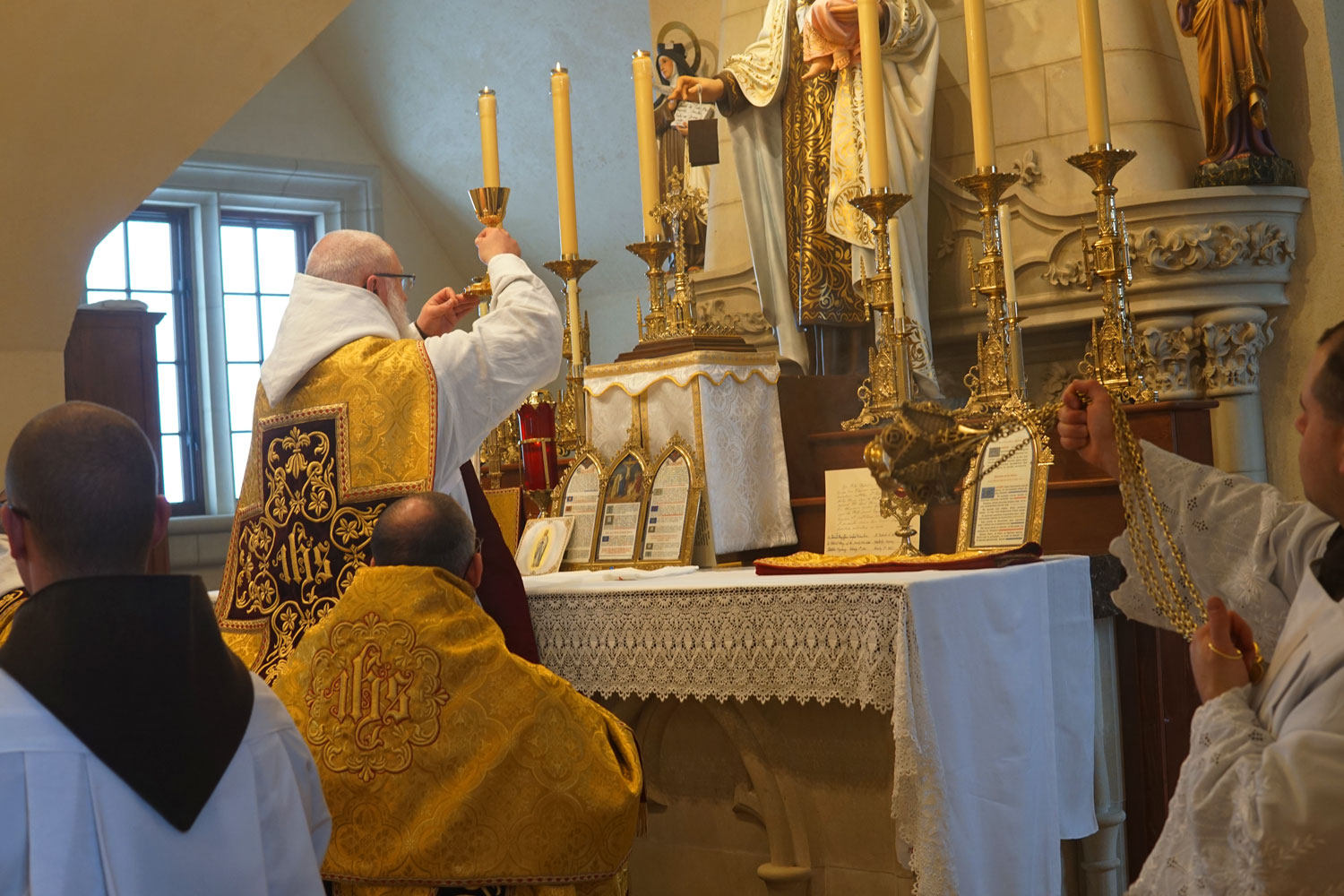
God never fails to be faithful to His promises. Each of us sometimes does fail to be faithful to what we’ve promised God and our loved ones. But God’s Divine Mercy is always greater than our human sins. Jesus’ Self-sacrifice on the Cross is the fountain of Divine Mercy, and nowhere on earth are we closer to that fountain of mercy, grace, and strength than in the Holy Sacrifice of the Mass, where the Word that God gave us becomes Flesh. In the Holy Sacrifice, we are not only present as Jesus offers Himself for us. We also are invited to share in—to enter into communion with—this faithful God—this Word made Flesh—so that the strength of God’s divine life will help us be faithful in our simple, earthly, human lives.
 Reflections on the Sacred Liturgy