The Twenty-second Sunday in Ordinary Time [C]

The Twenty-second Sunday in Ordinary Time [C]
Sirach 3:17-18,20,28-29   +   Hebrews 12:18-19,22-24   +   Luke 14:1,7-14
St. Anthony’s Catholic Church, Garden Plain, KS
August 31, 2025

During the three years leading up to His Passion and Death, Jesus taught throughout the Holy Land.  All four of the Gospel accounts show Jesus as a teacher, but St. Matthew in his Gospel account highlights Jesus’ teaching.

Sometimes Jesus teaches by means of short parables, and at other times by long sermons.  The first and greatest of Jesus’ sermons is His Sermon on the Mount, which takes up three of the 28 chapters of St. Matthew’s account of the Gospel.  This sermon, which you can find in Chapters 5, 6 and 7 of Matthew, makes for excellent spiritual reading.

Jesus, like any good teacher, knows that a teacher’s first words are key.  The first words that a teacher speaks to his students—at the start of a school year, or on any given morning when class begins—can set the tone and set the stage for all that’s going to be taught.  Jesus makes use of this principle.

So what are the very first words that Jesus speaks in His first and greatest public sermon, the Sermon on the Mount?  “Blessed are the poor in spirit, for the Kingdom of Heaven is theirs.”[1]

These words are the foundation of Jesus’ teaching, upon which the rest of the Sermon on the Mount is built.  And since the Sermon on the Mount is the greatest of Jesus’ sermons, you could argue that these words are the foundation of all Jesus’ teachings:  “Blessed are the poor in spirit, for the Kingdom of Heaven is theirs.”

+     +     +

So what exactly is Jesus referring to when He talks about being “poor in spirit”?  What does your daily life look like if you are “poor in spirit”?  The fourth-century bishop St. Gregory of Nyssa explained that when Jesus preached about “poverty in spirit”, He was speaking about humility. Specifically, St. Gregory wrote that Jesus “speaks of voluntary humility as ‘poverty in spirit’; the Apostle [Paul] gives an example of God’s poverty when he says:  ‘For your sakes He became poor.’[2]

So the key to reflecting upon today’s Scriptures is that humility is a kind of poverty.

In that quote of St. Gregory there are two points to help us focus on today’s Scriptures.

+     +     +

The first point is to recognize the importance of the word “voluntary”.  Jesus teaches us that voluntary humility is poverty of spirit.  Jesus is not speaking about the kind of humility that’s forced upon us.  Poverty in spirit is only the kind of humility that we freely choose.

In today’s Gospel passage, “Jesus went to dine at the home of one of the leading Pharisees”.  It’s interesting:  at this home, everyone is observing everyone else.  The evangelist tells us that, on the one hand, “the people there were observing [Jesus] carefully”.  But on the other hand, Jesus tells His parable “to those who had been invited” because Jesus had noticed “how they were choosing the places of honor at the table”.  They were choosing, not humility, but humility’s opposite:  self-promotion.

Within Jesus’ parable, He shows us how there are two kinds of humility.  Jesus begins by describing the kind of humility that’s forced upon oneself.  Jesus describes someone seating himself “in the place of honor, and then being forced by the host to embarrass himself by moving down to “the lowest place”.  This is what’s called “humble pie”:  involuntary humility.  Life serves up to each of us lots of helpings of humble pie.  Humble pie is not the humility that Jesus wants us to cultivate, although we can respond to humble pie in a virtuous manner.

But then, Jesus describes the kind of humility that can be virtuous when we cultivate it.  What does Jesus tell us to do?  “[T]ake the lowest place[,] so that when the host comes to you[,] he may say, ‘My friend, move up to a higher position.’”  In other words, practice the virtue of voluntary humility.  Don’t get frustrated with how often life serves you “humble pie”.  Take the initiative:  practice the virtue of voluntary humility, and you’ll find yourself eating much less humble pie, or at least, having less spiritual indigestion from the humble pie that life serves you.

+     +     +

Still, even if we understand the need to practice humility voluntarily, there’s a problem.  It’s very difficult to do.  As in Jesus’ parable, there’s often embarrassment connected to acting humbly.  To take the initiative of voluntary humility is difficult.  To humble oneself before, not only God, but also others is difficult.  How can we overcome the difficulties connected with acting humbly?

The answer, of course, is Jesus.  The Apostle Paul gives us an example of God’s own voluntary poverty when Paul says to the Corinthians:  “For your sakes [Jesus] became poor.”  St. Paul is referring to God the Son leaving the riches of the Kingdom of Heaven, and entering our poor world within the womb of the Blessed Virgin Mary, assuming our frail human nature.  In terms of His human life, this was Jesus’ first act of voluntary humility.  We meditate on this first act of humility in the First Joyful Mystery of the Rosary:  the Annunciation.

But of course the reason that Jesus entered our sinful world was to offer His Body and Blood, soul and divinity for us on Calvary.  We meditate on this second act of humility in the Fifth Sorrowful Mystery of the Rosary:  the Crucifixion.

So Jesus gave us two great examples of humility:  both being conceived at the Annunciation, and dying on Calvary; both becoming human, and offering His humanity on the Cross.  But how could you or I possibly be strong enough to imitate such examples?  The answer is a third example of humility that Jesus offers us.

Maybe we ought to recall the rest of that verse from Second Corinthians that St. Gregory of Nyssa quotes.  Here’s the entire verse:

“For you know the grace of our Lord Jesus Christ[:]  that though He was rich, yet for your sake He became poor, so that by His poverty you might become rich.”

It’s not the mere example of Jesus’ poverty that makes you rich.  It’s by entering into Jesus’ life—His Body and Blood, soul and divinity—that you become rich in God’s grace.  Only this grace can make you strong enough to practice the virtue of humility on a par with Jesus’ own humility.  This is only possible through the Eucharist, which Jesus instituted at His Last Supper.  We meditate on this third act of humility in the Fifth Luminous Mystery of the Rosary:  the Institution of the Holy Sacrifice of the Mass at Jesus’ Last Supper, where the Son of God takes bread and wine and changes them into His very Self.

In today’s First Reading, Sirach counsels you to “[h]umble yourself the more, the greater you are.  Through Baptism, you are a child of God.  So indeed you are.  That is a profoundly great vocation:  a demanding one.  To be faithful to that vocation, your humility must be the humility of God’s only-begotten Son.  Thanks be to God, He has called you as His child to the head of the Banquet Table of the Eucharist, to devoutly and humbly receive Jesus’ own life, so that He might truly live in you, and through each of your thoughts, words, and actions.

_______________________________________________


[1] Matthew 5:3.

[2] Catechism of the Catholic Church 2546, quoting St. Gregory of Nyssa, De Beatitudinibus 1; cf. 2 Corinthians 8:9.

The Twenty-first Sunday in Ordinary Time [C]

The Twenty-first Sunday in Ordinary Time [C]
Isaiah 66:18-21  +  Hebrews 12:5-7,11-13  +  Luke 13:22-30
August 24, 2025

It might be hard to believe, but not everyone loves going to school.  In fact, even an enthusiastic student might find something not to like.  For some students that might be walking a long distance to school.  Growing up, our parents refused to drive my sisters and brother and me to school unless the temperature was below freezing.  I looked it up on Google Maps:  the distance from our home to the primary school was 0.7 mile.  That’s practically a marathon!  Actually, most of the time I enjoyed walking to school.  But if the weather were ever bad and I complained to my father, he’d just say:  “It’s good for you.  Builds character.”

Another reason some people don’t like school is the discipline.  I attended the public schools in Goddard for twelve years, so I did not have the benefit of Catholic schools, or Catholic schools’ nuns, or Catholic schools’ nuns’ rulers.  But given that my elementary education started fifty years ago in a small town in Kansas, our principal still used corporal punishment.

But while punishment can take many forms (some more prudent than others), it’s more important to recognize that punishment itself is just one form of discipline.

+     +     +

Discipline has two different forms.  The second is punishment, and at times that’s certainly needed:  in the classroom, in the home, in civil courts, on the practice field and the court, and at the moment of death.  However, you’re going to have a hard time growing in the Christian life if you don’t recognize another form of discipline that’s even more important than punishment.

While the second and lesser form of discipline is punishment, the first and more important form of discipline is what we might call the “trials of training”, as Saint Paul proclaims in today’s Second Reading.

These “trials of training” are not punishment.  But they are necessary for success.  This is true regarding lots of  earthly endeavors.  For example, think of a football team.  A player might tell his parents that the coach put the team through a “punishing workout”, but the player doesn’t mean that the coach was punishing the team for doing something wrong.  Just the opposite:  the coach was training them through trials to help them achieve a victory, because success demands the trials of training.

Consider what Saint Paul explains in today’s Second Reading about:  first, trials; and then, training.

+     +     +

The discipline that prepares for success is a trial.  St. Paul writes to the Hebrews about this:  “Endure your trials as ‘discipline’; God treats you as sons.  For what ‘son’ is there whom his father does not discipline?” 

Fathers discipline their children in two different senses.  Fathers administer punishment when needed, but they also apply discipline in the first and more important sense, so that their children don’t become soft, and waste their childhood on things like video games and smartphones.

“Endure your trials as ‘discipline’”.  These words of St. Paul are spoken to each of us.  However, we need to think about the many different kinds of trials that you’re likely to face during your earthly life.

The word “trial” has many meanings.  One meaning relates to the courtroom—a courtroom trial—but clearly that’s not what St. Paul is referring to when he insists that the Hebrew Christians ‘endure their trials as discipline’.

Another sense of the word “trial” means a bad experience, as in the phrase “trials and tribulations”.  That kind of trial is simply part of life’s constant ups and downs.  This is part of what St. Paul is getting at, but there’s still something more specific that he also wants us to think about.

A third sense of the word “trial” is part of the phrase “trial and error”.  This kind of “trial” is connected to the simple verb “try”, as in the old adage:  “If at first you don’t succeed, try, try again.”  This kind of “trial”—connected to the word “try”—is an important part of our Christian life.  How many people never succeed at something because they never try at something, because they don’t want to fail, and don’t want to be a “failure”?  They don’t understand that in life on this earth, anything that’s difficult enough to be worth doing will demand your failure, as part of the price for success.

This kind of trial—the “trial” that comes from having to “try, try, again”—is something very simple.  It’s like the trial of learning your multiplication tables, or the trial of learning how to drive a stick shift, or the trial of learning how to throw a football accurately to a receiver fifty yards away.  This kind of “trial” is a basic building block of success, and that includes success in the Christian life.

+     +     +

So this phrase “the trials of training” has two parts:  trials and training.  St. Paul wrote about trials when he counseled us to “[e]ndure your trials as ‘discipline’”.

But what about training?  In today’s Second Reading, St. Paul does refer to discipline as training when he writes to the Hebrews:  “At the time, all discipline seems a cause not for joy but for pain, yet later it brings the peaceful fruit of righteousness to those who are trained by it.”

The verb “train”, like the verb “try”, is not very exciting.  To train for a new job at work, or for a new position on the team, or for the role of altar server at Holy Mass, is simple.  It’s not very exciting and in fact is pretty routine.  But routine is also at the heart of success.

Consider an example.  Athletes get tired of, and maybe even bored with, running the same drills and plays over, and over, and over again.  Why do the same drills and plays have to be run so many times?  Most of us know the answer to that question from our experiences in life:  the discipline of the “trials of training” make it so that what we’re doing—running a play, solving an equation, driving a stick shift—becomes second-nature, so that we don’t have to think about each and every step.

The problem is that many people don’t think that the trials of training—that the connection between trial, training, and success—has any connection to the entire Christian life:  most especially, to Christian prayer, to Christian morality, and to frequent, devout reception of the Sacraments.

+     +     +

Many Christians simply think that if you get baptized, and don’t commit mortal sin, that you will go to Heaven.  In fact, that is true:  if you are baptized, and don’t commit mortal sin, you certainly will go to Heaven.  But is that all there is to the Christian life?

If the Christian life amounts to no more than these three steps—get baptized as a baby, don’t commit mortal sin during your life, and from your deathbed go to Heaven—then everything between your day of baptism and your day of death just boils down to avoiding mortal sin.  Is that all that the Christian life amounts to?  We know that the answer must be “No”, but we might not be sure why the answer is “No”.

If the Christian life on earth did amount to nothing more than avoiding mortal sin, then discipline would only relate to that middle stage of avoiding mortal sin.  On the one hand, to avoid falling into sin, we need to be disciplined to become strong enough to resist temptation.  But when we do commit sin, then we are disciplined through punishment.

So is that all that discipline is for in the Christian life:  to avoid temptation, and to be punished when we do sin?  Some Christians actually do reduce discipline to Christian morality, and their Christian life is flat because of it, like a can of pop that’s opened in the evening and tasted the next morning.

+     +     +

Discipline is meant to be part of our entire Christian life, including the devout practice of the Sacraments, daily prayer, as well as morality.  Nonetheless, all of that discipline in your Christian life has a higher aim:  namely, allowing the heart of your Christian life to flourish instead of withering.  The heart of your Christian life is life in Christ.  Not just a life modeled after Christ’s, but a life lived in Christ, so that Christ lives in you and through you:  not just for an hour on the weekend, but flourishing every day of the week, bearing grace into your family, your work, your community, and even your struggles and failures.

The Twentieth Sunday in Ordinary Time [C]

The Twentieth Sunday in Ordinary Time [C]
Jeremiah 38:4-6,8-10  +  Hebrews 12:1-4  +  Luke 12:49-53
August 17, 2025

When I was a boy and a new school year would start, my new teacher would ask my name.  When I told her, without fail she would say, “Oh!  You’re Angie and Janelle’s little brother!”  And then she would add, “Did you know that Angie accomplished this and that in high school?  And did you know that Janelle accomplished that and this in high school?”  Well, of course I knew, because every night for 18 years at the supper table my brother and I heard all about our sisters’ latest accomplishments (and their latest boyfriends, and their latest fashion choices).

A brother or sister often wrestles with the fact that he’s so much like his siblings, yet does not want to be just a carbon copy of his siblings.  He wants to stand on his own two feet and distinguish himself as an individual.

This is just as true in the spiritual life as in the life of the family, the domestic church.  That’s what Saint Paul is talking about in today’s Second Reading when he writes to the Hebrews that “[s]ince we are surrounded by so great a cloud of witnesses, let us rid ourselves of every burden and sin that clings to us[,] and persevere in running the race that lies before us[,] while keeping our eyes fixed on Jesus, the leader and perfecter of faith.”

+     +     +

Within the Church, this “cloud of witnesses” is another way to describe our “siblings in the Catholic Faith”.  In the Apostles’ Creed, we call them the “communion of saints”.

In today’s Second Reading, St. Paul preaches about the connection between the communion of saints and the divine virtue of faith.  In the verses leading up to the Second Reading, St. Paul offered examples of what the virtue of faith looked like in the lives of several Old Testament patriarchs:  Abel, Enoch, Noah, and most especially, Abraham.

In his description of Abraham, St. Paul uses a particular phrase over and over to describe what faith helped Abraham accomplish.  St. Paul writes:  “By faith Abraham obeyed when he was called to go out to a place” unknown to him.  “By faith he sojourned in the promised land as in a foreign country”.  St. Paul goes on until he reaches the greatest example:  “By faith Abraham, when put to the test, offered up Isaac” in sacrifice.[1]

These verbs “obeyed”, “sojourned”, and “offered” are all action verbs.  In fact, the virtue of faith is not faith until it moves into action.  St. James insists on this even more bluntly than St. Paul.  In the Letter of James he rhetorically asks:  “What does it profit, my brethren, if a man says he has faith but has not works?  Can his faith save him?”  “[F]aith by itself, if it has no works, is dead.”[2]

+     +     +

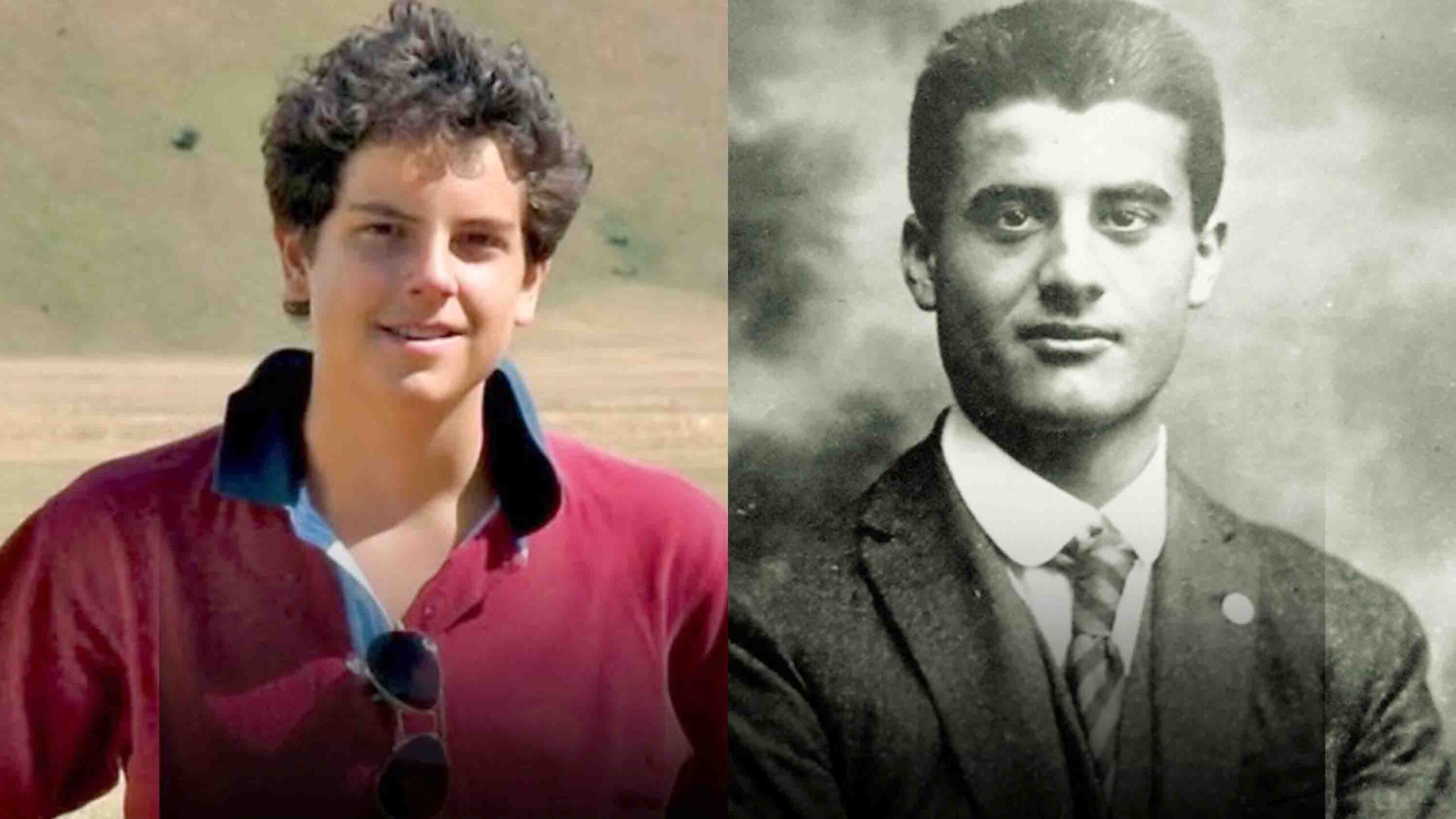
As we in the 21st century listen to the Second Reading, we ought to recognize how blessed we are.  We are blessed because we have more “siblings in the Faith” than the author of the Second Reading did.  We can reflect upon our elder siblings in the Faith from the twenty centuries of the Church’s history:  from our Blessed Mother and St. John the Beloved Disciple to St. John Paul II and the soon to be canonized saints:  Pier Giorgio Frassati and Carlo Acutis.  All of the saints—all who make up the “cloud of witnesses”—show what it means to put faith into action.

Last Sunday—August 10th—was the feast day of an older sibling who shed his blood for Christ.  Saint Lawrence was a deacon of the Church of Rome.  He personally served Pope Sixtus II, as well as the poor of Rome.  Because he refused to violate his faith when the pagan empire demanded, he was burned to death in the year 258.

In the Breviary on St. Lawrence’s feast day, the Church prays from a sermon that St. Augustine preached about St. Lawrence.  St. Augustine lived not too long after St. Lawrence, but after Christianity had become the official religion of the empire.  St. Augustine’s congregation were the younger siblings, while St. Lawrence was the older brother in the faith who had won the crown of martyrdom during pagan rule.  Listen to what St. Augustine preached about being an “ordinary Christian”:

“I tell you again and again, my brethren, that in the Lord’s garden are to be found not only the roses of his martyrs.  In [the Lord’s garden] there are also the lilies of the virgins, the ivy of wedded couples, and the violets of widows.  On no account may any class of people despair, thinking that God has not called them.

“Let us understand, then, how a Christian must follow Christ even though he does not shed his blood for Him, and his faith is not called upon to undergo the great test of the martyr’s sufferings.  The apostle Paul says of Christ our Lord:  ‘Though he was in the form of God He did not consider equality with God a prize to be clung to. … But He emptied Himself, taking on the form of a slave, made in the likeness of men’.

“Christ humbled Himself.  Christian, that is what you must make your own.  ‘Christ became obedient.’  How is it that you are proud?  When this humbling experience was completed and death itself lay conquered, Christ ascended into Heaven.  Let us follow Him there”.[3]

+     +     +

“Christ humbled Himself.”  Those words of St. Augustine point us in the right direction.  Those words—“Christ humbled Himself”—show us how to root the divine virtue of faith more deeply into our lives.

The virtue of humility helps us realize that it’s not possible to be too small for God to worry about.  In fact, God wants us to be small:  like little children.  Jesus actually warned that  “unless you become like little children, you shall not enter the kingdom of heaven.”[4]  God wants us, in all our littleness, to run the good race of faith, and to put our faith into action.  It doesn’t matter if we are not great.  God only needs our faith to be great, so that He accomplish through us whatever He wills.

___________________________________


[1] Hebrews 11:8,9,17.  There is a strange discrepancy in English translations of Hebrews 11:11.  The NAB (which the Roman Missal in the USA currently follows) reads:  “By faith he received power to generate, even though he was past the normal age—and Sarah herself was sterile—for he thought that the one who had made the promise was trustworthy.”  Yet the RSV, Second Catholic Edition reads:  “By faith Sarah herself received power to conceive, even when she was past the age, since she considered him faithful who had promised.”

[2] James 2:14,17.

[3] St. Augustine of Hippo, Sermon 304§1-4, quoted in the Ordinary Form Breviary, Office of Readings for the feast of St. Lawrence, Deacon & Martyr (August 10).

[4] Matthew 18:3.

On September 7, 2025, Blessed Carlo Acutis and Blessed Pier Giorgio Frassati will be canonized.
Read more HERE.

The Nineteenth Sunday in Ordinary Time [C]

The Nineteenth Sunday in Ordinary Time [C]
Wisdom 18:6-9 + Hebrews 11:1-2,8-19 + Luke 12:32-48
August 10, 2025

Faith comes in many shapes and sizes.  One type of faith is what we call trust.  Even agnostics and atheists have this type of faith.  They have faith that the sun will rise tomorrow, and that the national banking system will not collapse.  They have faith that their business partners and spouses will be true to their word.

So trust is one type of faith.  But biblical faith—the faith that’s at the heart of the Catholic spiritual life—involves something more.

To appreciate biblical faith, we have to look at it in context.  That is to say, we first have to understand that biblical faith is a virtue.  Then, we have to understand that biblical faith is a divine virtue.

+     +     +

The word “virtue” comes from the Latin word “virtus”, which means “strength”.  Another translation of the word “virtus” (not a literal translation, but a helpful one) might be “muscle” .  A virtue is a spiritual muscle.  A virtue is one of the soul’s muscles.

Reflect on some parallels between the soul and the body, since both the soul and the body have muscles.  I’m guessing that if conditioning has not already started for fall sports, that it will soon.  So imagine a high school athlete who plays three sports each school year.  This athlete is in the exercise room every month of the school year, if not more.

But now imagine something strange about this athlete.  Imagine that during this athlete’s freshman, sophomore, and junior years, the athlete only ever exercised their upper body, never exercising the muscles of the lower body.  What kind of athlete would that person be after three years of that exercise regimen?  They would have very strong biceps, pecs, and abs, but scrawny little thighs and calves (what my sister used to call “chicken legs”).  They’d be at a real disadvantage on the field or the court.

We can apply this analogy to the life of the soul.  The virtues are the muscles of the soul.  These spiritual muscles are not interchangeable, any more than you could have surgery and swap the biceps and the calf muscles.  Each muscle is unique.  Each muscle has its own shape, size, and purpose.

+     +     +

With all of that as background, what do we need to know about the divine virtue of faith?  What is the shape, and size, and purpose of the spiritual muscle of faith?

The first thing to know about the spiritual muscle of faith is that it’s one of the three most important muscles of the soul.  St. Paul speaks about these three in a bible passage often read at weddings.  It’s from the thirteenth chapter of St. Paul’s First Letter to the Corinthians, where the Apostle writes:  “Love never ends; as for prophecies, they will pass away; as for tongues, they will cease; as for knowledge, it will pass away. …. So faith, hope, love abide, these three; but the greatest of these is love” [1 Cor 13:8,13].

Faith, hope, and love are the three most important virtues of the spiritual life.  Faith, hope, and love are the three most important spiritual muscles of the Christian’s soul.  But the flip side of this is:  if these three muscles are neglected, the lesser muscles—the lesser virtues—are not enough to live on, spiritually.  The divine virtues of faith, hope, and love are essential to the health of the Christian soul.

These three are called “divine virtues” because all three of these have a direct connection to God.  Lesser virtues, such as prudence, justice, temperance, and fortitude, can be exercised even by people who do not believe in God.  But the three divine virtues directly connect the Christian to God, and each in a unique way.

How is each unique?  The divine virtue of faith connects us to God in the past.  Hope connects us to God in the future.  Love connects us to God in the present moment.  All three of these are vital to our Christian life, but since our First and Second Readings today draw our attention to the virtue of faith, that’s the one we need to focus on here and now.

+     +     +

How does the divine virtue of faith connect us to God in the past?  How does the divine virtue of faith differ from the similar practice called trust, by which I trust that the sun will rise tomorrow, or that my bank will still be solvent tomorrow?

The divine virtue of faith connects us to God in the past, because in the past, God made a promise to us.  He established a covenant with us.  He gave us His Word, and we believe that God is always faithful to that Word which He promised us.

God’s promise to you was made on the day of your baptism.  What He promised you is summed up in the Creed.  God promised us that He is the Creator of Heaven and earth.  He promised us that His only-begotten Son was born of the Virgin Mary, was crucified for our sins, and rose on the third day.  He promised us the Holy Spirit, who is the Lord and Giver of Life, and who—starting on the day of Pentecost and through to today—forms Jesus’ disciples into One Mystical Body, which is the Body of Christ, the Church.

The beliefs that we profess in the Creed we believe because God promised these truths to us, and we believe in the fidelity of the God who revealed them to us.  In other words, the divine virtue of faith is profoundly personal.  It’s not so much that we believe in the truths of the Creed themselves; instead, we believe in the personal God who promised us that the truths of the Creed are true.

We can understand this point—that divine faith is belief in what some person has promised us—by considering a more earthly example.  This example is lived out every day by countless Christians in the Sacrament of Holy Matrimony.

I mentioned that someone might trust that the sun will rise tomorrow, and that the national banking system will not collapse, and that their business partners and spouses will be true to their word.  But the last of these is unique, because the fidelity that each spouse expects from the other spouse is rooted in the past:  it’s rooted in the promise made by that person when he or she professed the vows of marriage.  Those vows are challenging, of course, especially in the culture that surrounds us today.  The words of Jesus in today’s Gospel passage are especially demanding in this regard, not only for Christian spouses, but for all Christians, to whom Jesus says:  “Much will be required of the person entrusted with much, and still more will be demanded of the person entrusted with more.”

Those words of Jesus might fill us with fear or anxiety, if not for the divine virtue of faith.  No matter how great the demands of our Christian life—the demands that follow from the promises we made to God and others—even greater are God’s promises to us.  These promises include His promise to offer us the grace that can make us strong enough to live our Christian lives faithfully.

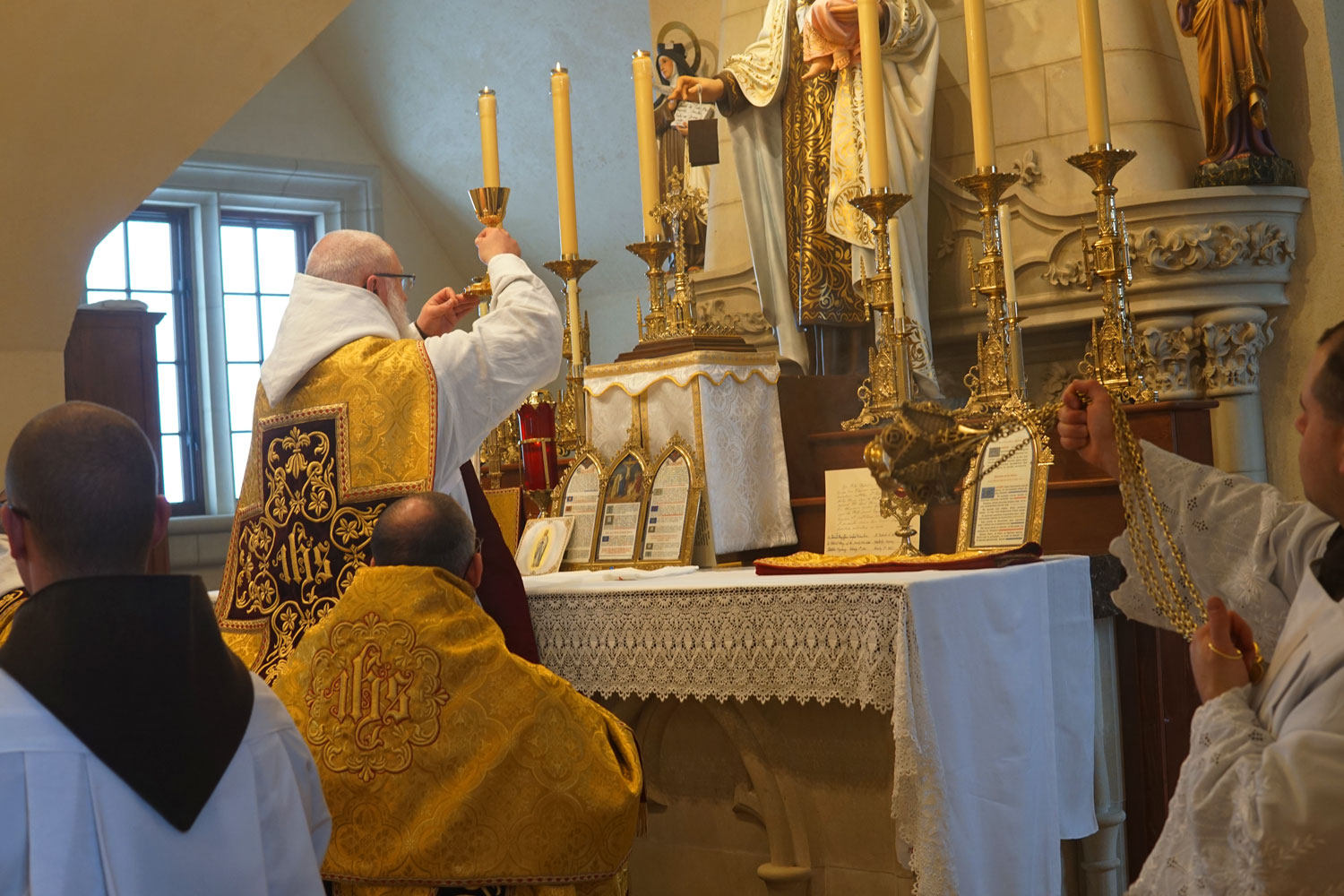
God never fails to be faithful to His promises.  Each of us sometimes does fail to be faithful to what we’ve promised God and our loved ones.  But God’s Divine Mercy is always greater than our human sins.  Jesus’ Self-sacrifice on the Cross is the fountain of Divine Mercy, and nowhere on earth are we closer to that fountain of mercy, grace, and strength than in the Holy Sacrifice of the Mass, where the Word that God gave us becomes Flesh.  In the Holy Sacrifice, we are not only present as Jesus offers Himself for us.  We also are invited to share in—to enter into communion with—this faithful God—this Word made Flesh—so that the strength of God’s divine life will help us be faithful in our simple, earthly, human lives.