The Fourth Sunday in Ordinary Time [A]
Zephaniah 2:3;3:12-13 + 1 Corinthians 1:26-31 + Matthew 5:1-12
“He began to teach them, saying: ‘Blessed are the poor in spirit….’”
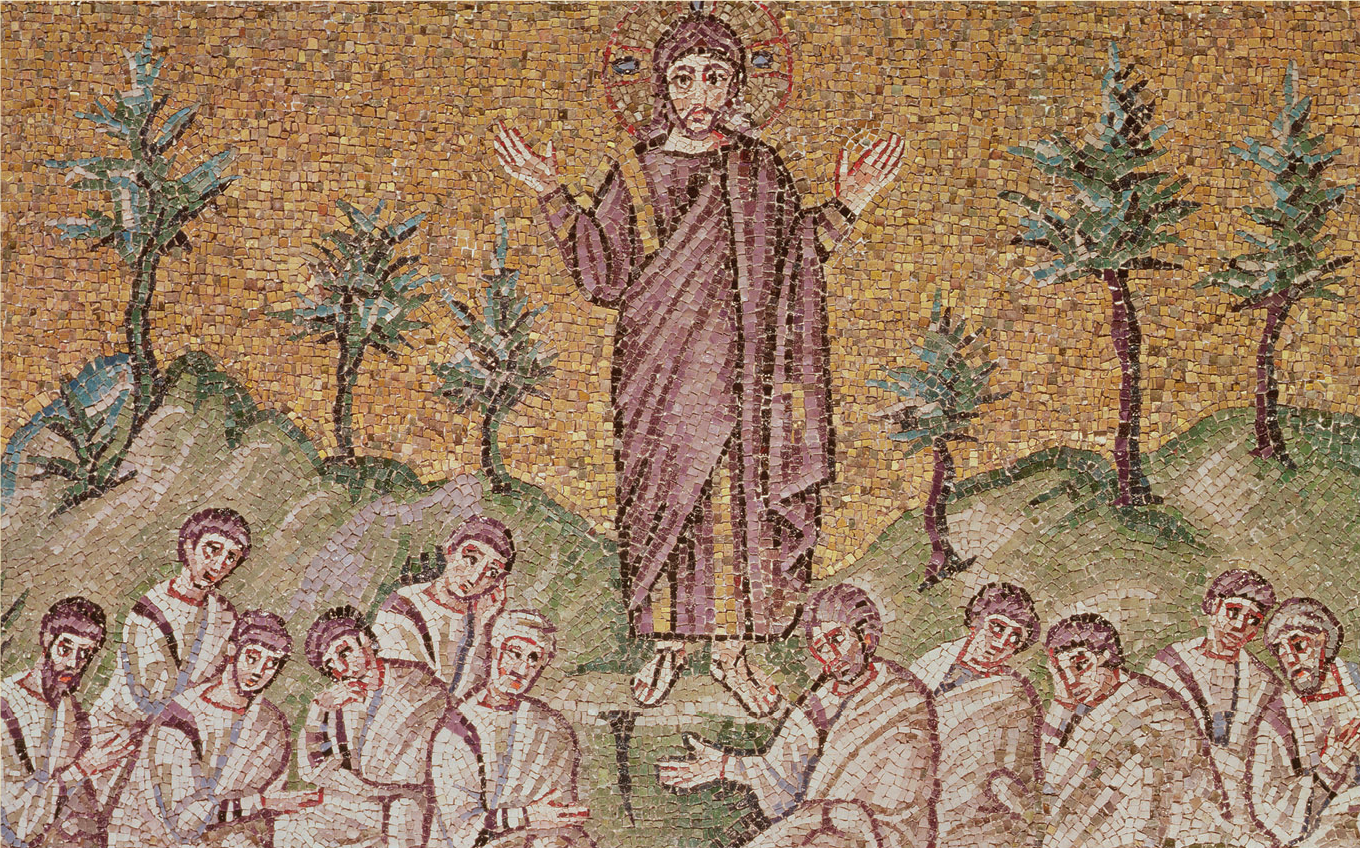
Today’s Gospel passage is the first twelve verses of Matthew Chapter 5: the very beginning of the Sermon on the Mount. In our own day, preachers often begin a sermon with a story or a joke. Jesus decided to begin His Sermon on the Mount with the Beatitudes.
However, before he starts giving us Jesus’ sermon, St. Matthew the Evangelist mentions a few interesting details about Jesus. The evangelist relates to us that when “Jesus saw the crowds, He went up the mountain, and after He had sat down, His disciples came to Him.” Consider just two points in what St. Matthew explains: that Jesus went up the mountain, and that He sat down there.
Why did Jesus have to go up a mountain in order to preach a sermon? Obviously, He didn’t have to. Jesus preached many other sermons during the three years of His public ministry, and most of them were preached in other sorts of settings. But in St. Matthew’s account of the Gospel, the Sermon on the Mount is Jesus’ first sermon, so Jesus is teaching us here not only by His words, but also by the setting that He chose, and by choosing to sit down.
Why did Jesus choose a mountain to be the site of His first sermon? St. Matthew clarifies this throughout the course of his Gospel account. Through his own observations, through the words and works of Jesus that he chooses to include, and through the way he structures his Gospel account, St. Matthew portrays Jesus as a “New Moses”. One reason for doing this is that unlike many other New Testament writings, Matthew’s Gospel account was written for converts from Judaism. This is why Matthew “refers to Jewish customs and institutions without explanation [of their backgrounds], and why he works nearly two hundred references to the Jewish Scriptures into his narrative”.[1]
Moses was, for the Jewish people, the Prophet without peer. In the last chapter of the last book of the Jewish Law—Deuteronomy Chapter 34—following the description of Moses’ death, the Bible says that “there has not arisen a prophet since in Israel like Moses, whom the Lord knew face to face, none like him for all the signs and the wonders which the Lord sent him to do in the land of Egypt, … and for all the mighty power and all the great and terrible deeds which Moses wrought in the sight of all Israel.”[2]
Yet even more important than all the signs and wonders and all the great and terrible deeds which Moses worked was the fact that the Lord chose him—Moses—to bear the Ten Commandments to His People. During the course of their Exodus from slavery in Egypt to freedom in the Promised Land, God’s People stopped at Mount Sinai. There, while the rest of God’s People remained below, Moses alone ascended Sinai to receive from God His Ten Commandments. Moses then had to descend the mountain to give to God’s People this Law, the means by which His People could—we might say today—“keep right” with God.
But here in St. Matthew’s account of the Gospel, it’s not only Jesus who ascends the mountain. Jesus draws His disciples up with Him, and it’s not a voice from the heavens that speaks there to a prophet. Instead, the New Moses, God in the Flesh, speaks to His people face to face. Jesus gives to us, His people, not ten commandments, but nine beatitudes.
+ + +
Saint Augustine, in a sermon on Jesus’ promises of blessedness to those who follow Him, points out that “you couldn’t find anyone who doesn’t want to be… blessed. But oh, if only people were as willing to do the work as they are eager to get the reward! They all run up eagerly when they are told, ‘You will be [blessed]’; let them listen willingly when they are also told, ‘if you do this.’ Don’t decline the contest if you have set your heart on the prize…. What we want, what we desire, what we are aiming at, will come afterward; but what we are told to do[—]for the sake of what is coming afterward[—]must come now.”[3]
Meditate nonetheless on the first beatitude: first to fall from Our Lord’s lips because He wants it first to shape our hearts. “‘Blessed are the poor in spirit, for theirs is the Kingdom of Heaven.’” St. Augustine preaches on the first beatitude by asking what “poor in spirit” means. He answers that it means “[b]eing poor in wishes, not in means. One who is poor in spirit, you see, is humble; and God hears the groans of the humble, and doesn’t despise their prayers. That’s why the Lord begins His sermon with humility, that is to say with poverty. You can find someone who’s religious, with plenty of this world’s goods, and not [because of that] puffed up and proud. And you can find someone in need, who has nothing, and won’t settle for anything. … the [former] is poor in spirit, because humble, while [the latter] is indeed poor, but not in spirit.”[4]
It could be fearful for you to imagine dying and hearing the Lord say to you, “Why did you not become the person I created you to be?” This question could be fearful because the Lord has given us everything we need to reach Heaven. The Lord has given us life. The Lord has given us grace to strengthen us for the journey. And the Lord has given us the roadmap in these nine beatitudes. The first, upon which all the others rest, is humility: poverty of spirit. The Lord has even helped us to acquire humility, by gazing upon the humility He shows in His compassion, Divine Mercy, and self-sacrifice on the Cross.
[1] “Introduction to the Gospel according to Saint Matthew”, in The Ignatius Catholic Study Bible (San Francisco: Ignatius Press, 2010), 4.
[2] Deuteronomy 34:10-12 [RSV-CE].
[3] St. Augustine of Hippo, Sermon 53, in The Works of Saint Augustine, Part III, Vol. III (Brooklyn: New City Press, 1991), 66.
[4] St. Augustine of Hippo, Sermon 53A, in The Works of Saint Augustine, Part III, Vol. III, 78.
 Reflections on the Sacred Liturgy