The Twelfth Sunday in Ordinary Time [C]
Zechariah 12:10-11 + Galatians 3:26-29 + Luke 9:18-24
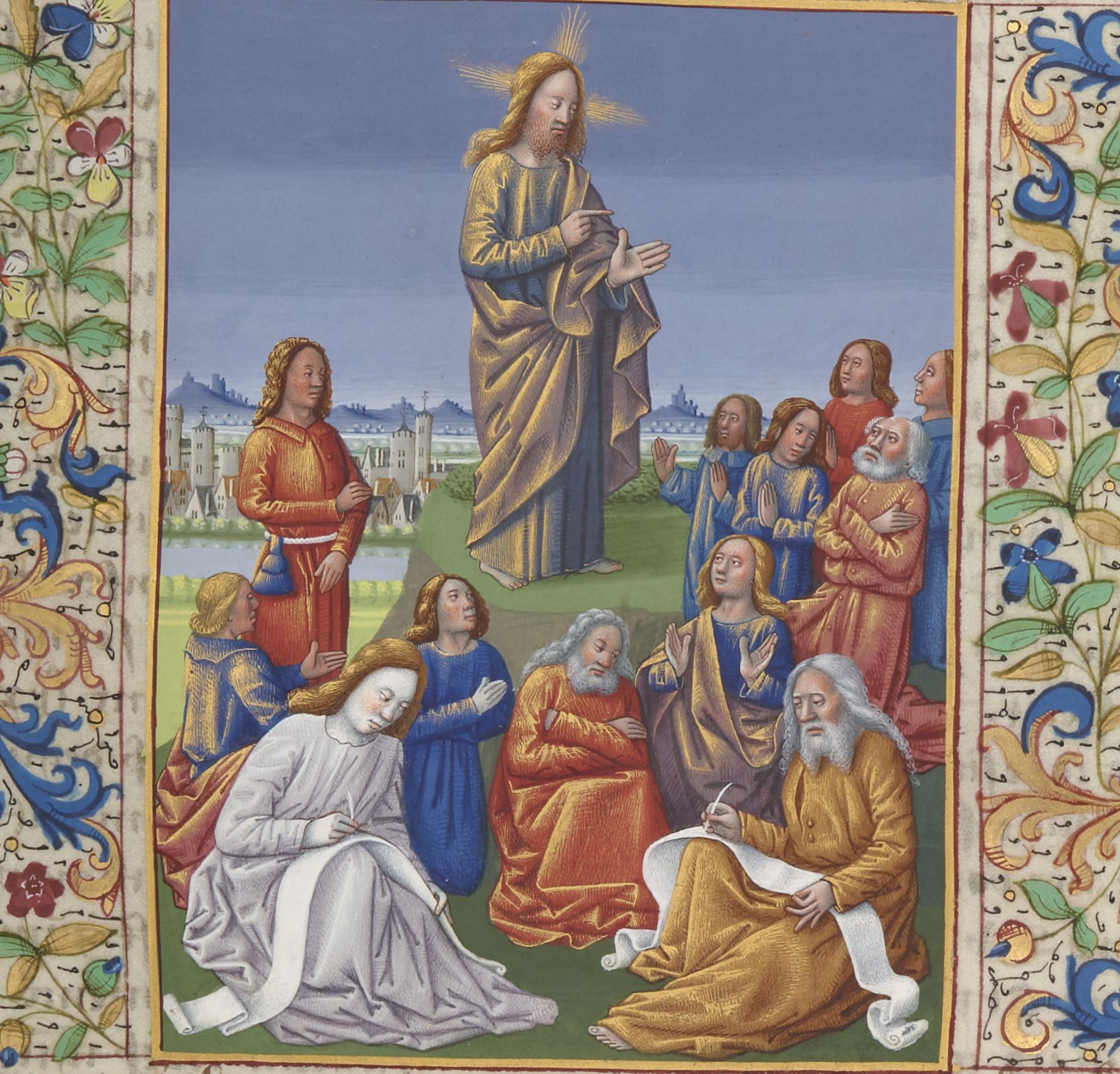
“Deny your self / and take up your cross daily / and follow me.”
That’s what our Savior Jesus Christ says that you must do in order to be His disciple. He’s very straightforward. There are only three things. Deny your self. Take up your cross daily. Follow Jesus.
One difficulty in letting these words sink deep into our hearts is that these three can seem interchangeable. We might say to our self, “Isn’t ‘taking up your cross daily’ the same thing as ‘following Jesus’? Isn’t ‘denying your self’ the same thing as ‘taking up your cross’?” And so on. It takes an intentional act on our part to stop, listen to, and make our own the words of Holy Scripture. That’s why at least once every five years, each adult Catholic ought to commit herself or himself to a study of Scripture, whether that’s with a group in one’s parish, or for those who are self-starters, an individual study of a particular book of the Bible, or a particular group of books, like the letters of Saint John the Evangelist.
Deny your self. Take up your cross daily. Follow Jesus. While these three are pieces that join to form a whole, they’re not interchangeable. Each makes different demands of you, and requires a different spiritual skill-set, as it were.
Consider the first command that Jesus lays at your feet today. “Deny your self.” What does the word “deny” mean? Another word for “denial” is “renunciation”. Both words are clearly negative, which lends itself to a common criticism of Catholicism: namely, that Catholicism bears a strand of pessimism or gloominess. That’s why some non-Catholics look with suspicion on practices such as hanging a crucifix in one’s home, or praying the Stations of the Cross.
So what’s the reason for the Church’s insistence on negative practices such as “denial” and “renunciation”? In grade school math, we were taught that the negative of a negative is a positive. “Negative two” times “negative two” equals “positive four”. So while it’s true that denial and renunciation are negative practices, their purpose in the Catholic Faith is to reverse course on the negative effects of Original Sin. In one word, these effects can be summed up as “selfishness”, but the saints who became masters of the Christian moral life and prayer life realized that selfishness comes in many different forms, such as pride, wrath, greed, sloth, lust, envy, and gluttony. So to “deny your self” means to deny your “fallen self”, the false self that results from allowing the effects of Original Sin to coalesce into personal sins, which over time can harden into vices.
The negative of a negative is a positive, and so when we practice self-denial in order to root out moral vices, we till the good soil of our soul for God to water with His grace. Through God’s grace and our efforts, the Image of God can come to the fore in our soul. To the Image of God can be joined a likeness to God. Virtues can result, leading to the summit of virtue: a life lived in divine charity, both on earth and in Heaven. This is why we deny our self.
Consider, then, the second command that Jesus lays at your feet today. “Take up your cross daily.” How is this command different than the command to “deny your self”? Both seem negative, but each has its own aim. The second is really the aim of the first. The first prepares for the second. If self-denial is pulling the weeds from your soul, then taking up your cross is planting and cultivating the seeds that will bloom there. Or consider an analogy to athletics. Both the months of training and the day of competition are very difficult. Both demand much that’s negative: training involves strenuous workouts, and competition involves tension and anticipation of the opponent’s moves. But the difference is that the practice prepares for the competition, and in the same way, denying our self is rooting out the weaknesses in our soul, in order that we can take up the cross.
But the competition that we enter as Christians is not just on Friday, or just for a season. Jesus reminds us that taking up our cross is a daily event. That means it’s with us when we wake up, whether we want it to be there or not. We can’t call in sick (or if we do, we should do so by going to confession for healing). “Take up your cross daily.” Some days, of course, the burden weighs heavier than others. Part of the burden can come from the form that our cross takes. Sometimes its form changes with the circumstances of our lives. Regardless, in the midst of carrying our cross each day, and especially on the days it’s so difficult, we need to recall why. We need to recall why we deny our self, and why we take up our cross daily.
Consider, then, the third command that Jesus lays at your feet today. “Follow me.” I hope that those are the first words you hear every morning when you wake up. These are words of encouragement and promise. One way to imagine the meaning of these words is to picture the Fifth Station of the Cross, where Simon of Cyrene walks with Jesus up Calvary, bearing the cross of mankind. This is one way to picture what Jesus is commanding us in today’s Gospel. We are helping Jesus. We are struggling daily alongside Jesus. The company of Jesus, even in the midst of trial, brings far more lasting peace than anything that the comforts of this world can give. Jesus is the best company we can have in this world.
It’s for the sake of Jesus’ company, in this world and the next, that we bear everything we bear in this world. You’re familiar with the modern poem titled, “Footprints in the Sand”. What this poem drives at is Jesus’ company through thick and thin. Jesus is there, even if we are not present to Him, or even aware of His Presence next to us, or bearing us in His arms. “I would never leave you,” Jesus says to us on those days when carrying our cross seems difficult. “During your times of trial and suffering, when you see only one set of footprints, it was then that I carried you.”
In our Catholic Faith, the more religious word for “company” is “communion”. Being in communion with Jesus, with His Church, and with all the members of the Church, requires grace even more than our efforts (those our efforts are necessary). It’s in order to help our unbelief, so that we might believe more, that Christ gives us His Body and Blood as true food. This Holy Communion strengthens us for the seven days that now lay before us in the world, before the Lord calls us to His altar again. We give thanks for having a God who is gracious, who understands our many weaknesses, and who loves us enough to sacrifice His life for us, so that each day we can find meaning in our own sacrifices.
 Reflections on the Sacred Liturgy