The Fifth Sunday of Lent [C]
Isaiah 43:16-21 + Philippians 3:8-14 + John 8:1-11
April 6, 2025
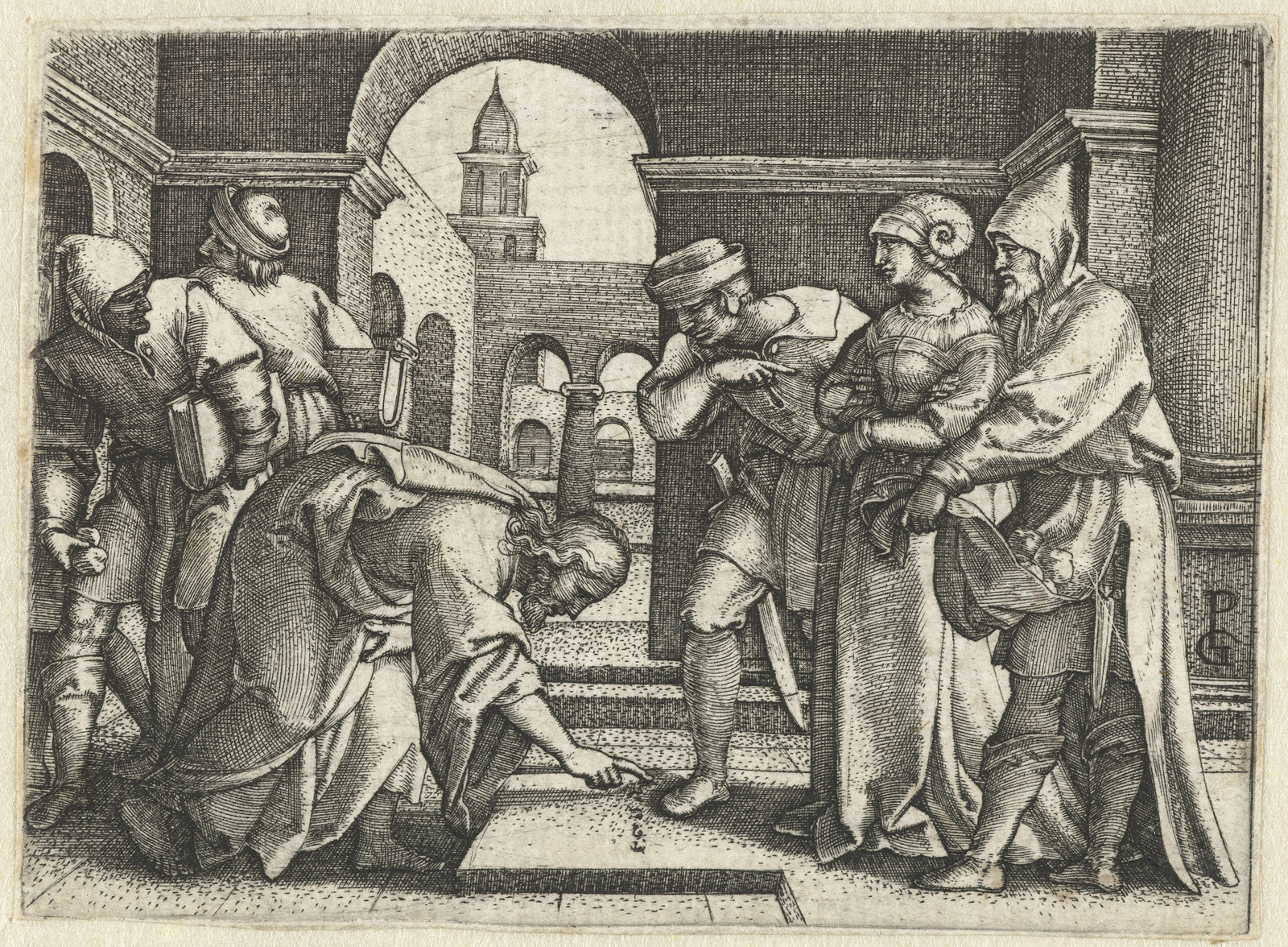
Jesus’ compassion towards the woman caught in adultery focuses our attention, on the one hand, upon human sin. At the same time, though, Jesus always wants us to think about sin within the perspective of divine mercy. Never think about your sins without reflecting on God’s merciful love for you. At the same time, never think of God’s love for you without remembering the depths to which Jesus sank to pour that love into your heart.
It’s in light of this two-fold perspective—human sin and divine mercy—that we listen to Saint Paul today. In today’s Second Reading, St. Paul preaches to the Philippians about several stark contrasts: about loss and gain; suffering and power; death and resurrection. All of these help each of us understand what Jesus wanted the woman caught in adultery to understand.
In our ordinary lives, we tend towards thinking of morality only in terms of good and evil. That is a foundational distinction: to do the good and to reject the evil. If we don’t accept in our minds this most basic moral distinction, and shape our choices accordingly, we have little hope of reaching Heaven. On the other hand, that most basic moral distinction between good and evil is a foundation, on top of which we as Christians are meant to build. St. Paul gives us tools to build our moral lives towards Heaven (or as he puts it, “to continue [our] pursuit toward the goal, the prize of God’s upward calling, in Christ Jesus.”).
In his Letter to the Philippians, Saint Paul makes very sharp contrasts. For example, he explains to them: “I consider everything as a loss because of the supreme good of knowing Christ Jesus my Lord.” This is a stark contrast: between the ‘loss of everything’ and the ‘supreme good of knowing Jesus’. However, St. Paul continues with an even starker contrast: “For His sake I have accepted the loss of all things, and I consider them so much rubbish, that I may gain Christ and be found in Him…” “Rubbish” and “Christ”: that’s the second contrast that St. Paul describes for your meditation as we draw closer to Holy Week.
Saint Paul’s challenge to us is to build upon the foundation of doing good and rejecting evil. The challenge in rising to a higher level of moral growth is to be single-hearted in our pursuit of God. To be “single-hearted” is—in the words of Jesus’ beatitudes—to be “pure of heart”. Of course, some might assume that Jesus’ statement “Blessed are the pure of heart, for they shall see God”[1] is referring to sexual purity. In fact, Jesus is saying not only that, but a lot more as well.
When gold is tried in fire, impurities are burned away. The gold becomes more pure, which is to say that it becomes more “gold-like”, which is to say that it becomes more itself. It’s the same with an individual human person—such as yourself—when you purify your heart of foreign desires: desires foreign to the very nature of the human heart as God designed it.
In the language of the First of the Ten Commandments: when you purify your heart of “strange gods” (or “alien gods”), your heart becomes more pure: more “human-like”, which is to say that you become more who God created you to be. It’s as simple as Saint Augustine’s famous confession to God: “You stir man to take pleasure in praising You, because You have made us for Yourself, and our heart is restless until it rests in You.”[2]
+ + +
It’s a common temptation to dismiss the First Commandment as irrelevant. After all, who among us actually worships “alien gods”? We’re not like the ancient Greeks and Romans who worshipped Aphrodite and Jupiter, Mercury and Athena. So how can you and I usefully hold up the First Commandment before our lives, to see if our hearts are single-hearted: that is, pure in being focused upon God alone?
Before even answering, some might reply that it’s impossible for a regular Christian—especially one who is married and has children—to be focused on God alone. There are too many other things to worry about in life! A similar reply might be made by a parish priest, who can hardly spend all day in prayer given his administrative responsibilities. However, those replies would miss the point. The First Commandment does not command us to be monks and nuns.
The First Commandment guides our lives in commanding that everything must be held up to the “light of the Lord”. This includes everyone and every thing in our lives, including sports, jobs, academics, socializing and vacationing. Jesus demands of us as His followers that we put God first. You know, that’s why the First Commandment is the first of the Ten Commandments.
When God gave Moses the Ten Commandments, God did not list them in a random order. As with everything that God does, He listed the Ten Commandments in an order that has structure and design. That’s why the first three of the Ten Commandments are about loving God, because loving God has to be our first priority: if we don’t get that right, then we’re not going to get anything that follows right.
In the list of the Ten Commandments, what follows the first three are the Fourth through Tenth Commandments, which are about loving our neighbor. Loving God is first. Loving our neighbor follows, flows from, and is possible to the extent that we love God authentically.
The Second and Third Commandments, then, are two specific ways of loving God as He deserves, and in fact as He commands. It’s not enough not to have false gods, as the First Commandment addresses. Even if we only have one God—the true God—at the center of our lives, we then have to engage with Him, and the two most important ways of doing that are our words and our worship. The Second Commandment is about giving God His due regarding our speech, while the Third Commandment is about giving God His due regarding our religious practice.
Both the Second and Third Commandments are especially challenging for those living in the modern Western world. The Second Commandment—about honoring God’s holy Name—is a challenge because of the modern mass media. The Third Commandment—about giving God due worship—is a challenge because modern man has so many diversions, and—relatedly—because modern man is so mobile, so on-the-move today. Nonetheless, being on the move is not a valid reason for not honoring the Sabbath by giving God the worship that He has asked of us.
Of course, there are some people who claim that they can worship God in the manner that they decide upon. If they feel like getting up on Sunday morning and ambling out to the middle of their pasture and watching the sunrise, well then, that’s their way of worshipping God. What that approach fails to keep in mind is that from the beginning, God has told His People how to worship Him. Remember that the first murder in human history—Cain killing his brother Abel—originated in the right and the wrong worship of God.
Throughout the Old Testament, God gave to His Chosen People increasingly more specific instruction about the right way to worship God: that is, the way which would give God His due. Then, in the fullness of time, God sent His own Son to become Flesh and dwell among us, and on the night before that Son was put to death, He took the Jewish Passover meal and transformed it into the Holy Sacrifice of the Mass, so that the Sacrifice that that divine Son offered on the Cross the following afternoon would become the form, the shape, of the worship offered by God’s Chosen People.
Many Christians, and even Catholics, don’t understand the Church’s teaching that when the Holy Sacrifice of the Mass is celebrated, the Sacrifice of Jesus on Calvary is made present before us. Or, if you prefer, you can say that we in our day and time are transported mystically whenever Holy Mass is celebrated to the time and place of Jesus’ Sacrifice on Calvary.
God the Father has given us the most perfect form of worship on this earth: not just proclaiming, preaching, and singing God’s Word, but being present when that Word becomes Flesh in the Eucharist. God commands that we share in this Sacrifice each Sunday and Holy Day. That’s why it’s a mortal sin to miss Sunday Mass unless we’re seriously ill or have a similarly serious reason: because God deserves to be worshipped by joining our lives to the sacrifice of His Son on Calvary. What’s more, it’s only by the strength of the Holy Eucharist that we can be strong enough to carry out the lives he wants us to lead in this world.
[1] Matthew 5:8.
[2] St. Augustine of Hippo, Confessions, trans. Henry Chadwick (Oxford: OUP, 1992), 3.
 Reflections on the Sacred Liturgy