The Seventh Sunday in Ordinary Time [B]
Isaiah 43:18-19,21-22,24-25 + 2 Corinthians 1:18-22 + Mark 2:1-12
Most of have difficulty dealing with sickness and disease. No one likes being sick, and it’s difficult to be with others who are sick, or who are suffering. We want to be compassionate, but we sometimes feel lacking, because — we can’t take away another person’s sickness or suffering. And on the contrary, when someone recovers from sickness, or especially from a crippling disease, we share in their joy, though we know that the healing was not of our doing.
Even physicians are forced to admit that they do not heal people themselves. They use things in the natural world to bring about healing within the human body. All the more are physicians called to humility when all their textbooks leave them without an answer for someone in the hospital. In the end, no one on this earth has power over death. At the door of death, a physician’s job is over.
Today in the Gospel, we hear Jesus continue to use physical healings as signs, pointing people’s attention towards a greater healing. Jesus worked many miracles of physical healing during the three years of his public ministry.
But Jesus made it clear that those miracles were not the real reason he was on this earth. This is true not only of his healings, but even of those occasions when he raised people from the dead, such as Lazarus and the daughter of the royal official. Yes, they were raised from the dead, but those occasions were not the same as what happened Easter Sunday. The people whom Jesus raised from the dead died again at a later date, and Jesus was not there to raise them again. Was he a failure, then? If we thought that Jesus had come to this earth simply to restore physical health and life, then we’d have to say “Yes.” But that’s not the case. Let’s listen to what’s happening in today’s gospel.
+ + +
The scribes insisted that only God could forgive sins, but Jesus, on this occasion, did not only forgive sins. He showed that he had another power, one that also belongs to God alone: the power to disclose the secrets of the heart. The scribes, of course, did not reveal out loud what they were thinking. Rather, some of the scribes were sitting there [saying to] themselves: “He is blaspheming.” Jesus immediately knew in his mind what they were thinking to themselves, so he said: “Why are you thinking such things in your hearts?”
Now only God knows the secrets of a person’s heart. And so, to prove his divinity and his equality with the Father, Jesus brought the scribes’ secret thoughts out into the open, which they had not dared to do for fear of the crowds, knowing that the crowds normally took Jesus’ side.
Yet in doing this, Jesus shows great compassion. He says to the scribes, “Why are you thinking such things in your hearts?” After all, if anyone had reason for complaint, it was the paralytic. As though he were cheated, the paralytic might well have asked the scribes: “Have you come to heal something else, then? How can I be sure that my sins are forgiven?” In fact, however, the paralytic said nothing, but entrusted himself to the care of Jesus.
The scribes, on the other hand, felt left out and envious. So they plotted against the good of others. So Jesus rebuked them, but with patience. Jesus said to them, in effect: “If you do not believe the first miracle—the forgiveness of sins—and think it is just an empty boast, then look, I will offer you another miracle by reading your minds and revealing your thoughts. And to this I will also add a third miracle as a proof for you.” The third miracle, of course, is the physical healing of the paralytic.
Jesus didn’t show his hand, so to speak, when he had first spoken to the paralytic. He had not said, “I forgive you your sins,” but, “Child, your sins are forgiven.” But when the scribes forced his hand, Jesus showed his power more clearly, “that you may know [he said,] that the Son of man has authority to forgive sins on earth.”
Before doing this Jesus asks the scribes: “Which is easier, to say to the paralytic, ‘Your sins are forgiven,’ or to say, ‘Rise, pick up your mat and walk?” This was the same as asking: “Which seems easier to you, to heal the body, or to forgive the soul its sins? Obviously, it is easier to heal the body. However, since the one is invisible, but the other visible, I will grant you also this lesser, visible miracle as proof of the miracle which is greater but invisible.” And so Jesus showed by his deeds the truth that John the Baptizer had proclaimed: “Behold, the Lamb of God, who takes away the sins of the world.”
So here we have three miracles on the part of Jesus, all showing us part of his divine powers. Each of the three reveals to us, in its own way, who this Jesus is. He is a healer, he is all-knowing, and he is a forgiver of sins.
But every time that Jesus works a miracle in someone’s life—whether in the first, or the twenty-first century—his intention is not to make our daily life perfect. Jesus raised Lazarus from the dead, but Lazarus died a second time. The paralytic, as well, lived an earthly life after picking up his mat and walking home, but he died all the same. Was Jesus a failure because they died?
When a catechumen is washed clean of all his sins through the waters of Baptism, does he walk away from the baptismal font a perfect person, with all his vices and imperfections washed away? When you pick yourself up off your knees, leave the confessional, and return home after receiving absolution, is it likely that you’re never going to sin again?
Our lives on this earth are a journey. Along the way Jesus picks us up, sustains us, and encourages us to continue to follow him. The three years of Jesus’ public ministry were a journey. Jesus’ journey ended on the Cross. You are invited to walk with Him towards Calvary. Jesus is the Divine Physician: by his death, you are healed. Through sharing in his life, and by dying with him, you will hear Jesus say to you when we leave this earth, “Rise, and walk with me to Our Father.”
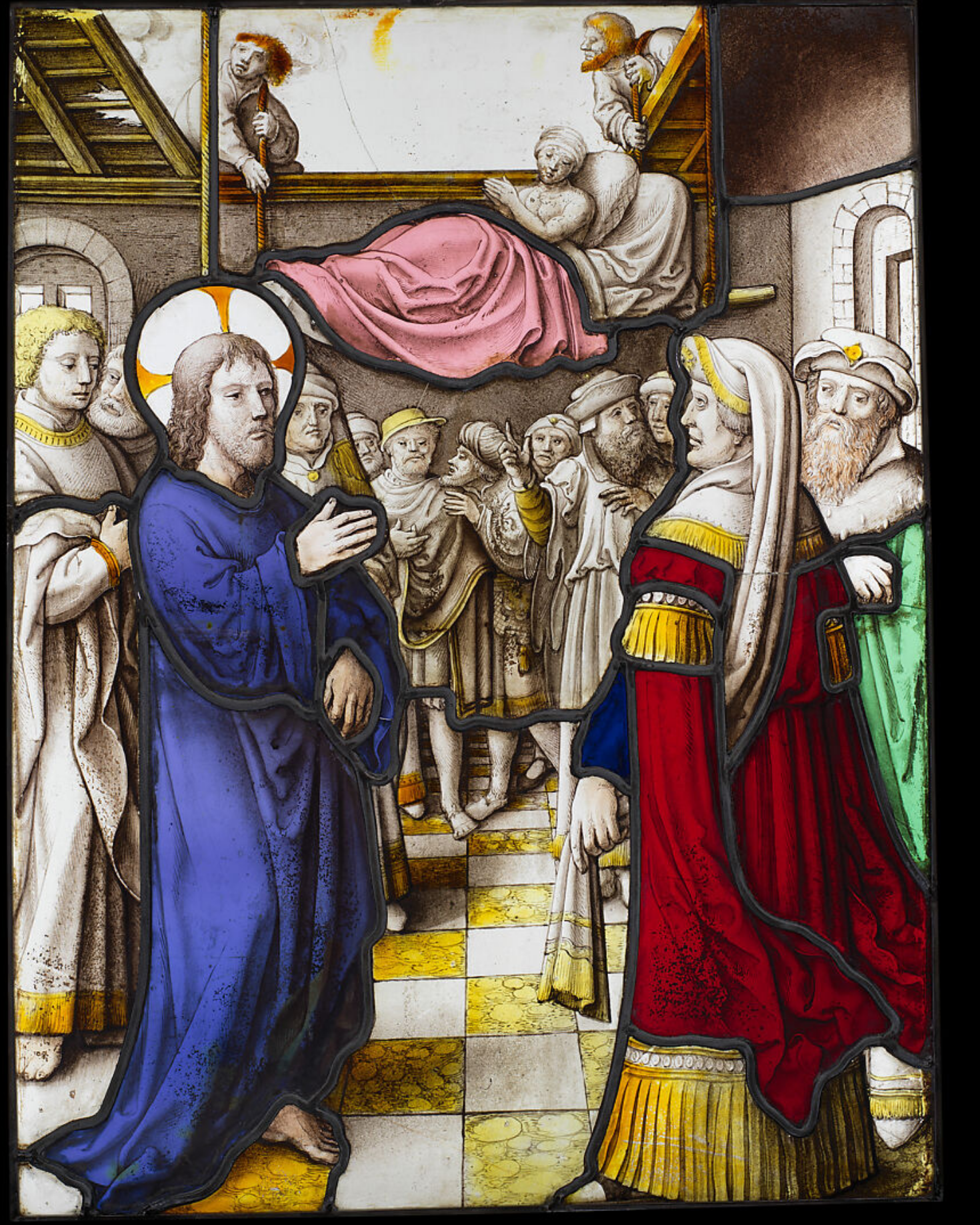
Healing of the Paralyzed Man at Capernaum by Jan Rombouts the Elder [c. 1480 – 1535]
 Reflections on the Sacred Liturgy