The Twenty-fifth Sunday in Ordinary Time [B]
Wisdom 2:12,17-20 + James 3:16—4:3 + Mark 9:30-37
The Cross is the heart of Jesus’ life. We heard this in last Sunday’s Gospel passage, when Jesus declared: “Whoever wishes to come after me must deny himself, take up his cross, and follow me. For whoever wishes to save his life will lose it, but whoever loses his life for my sake and that of the gospel will save it.” In today’s passage, Jesus in a similar way declares: “The Son of Man is to be handed over to men, and they will kill him, and three days after his death the Son of Man will rise.”
Of course, last Sunday’s and today’s Gospel passages are not the only two times that Jesus taught how central the Cross is to His life. So that raises a question. Why does Jesus teach this lesson repeatedly? One answer is that it’s such an important lesson. Another answer is that His disciples are—to be honest—rather slow. Jesus is a very patient teacher, willing to try over and over again to get His point across to us sinners.
But Jesus is not only a patient teacher. He’s also a shrewd teacher. Like any good teacher, He knows that if you repeat the same lesson over and over in exactly the same way, your odds of getting through to your students is lower. However, if you teach the same lesson in different ways—from a slightly different perspective each time—more of your students will grasp your lesson. Today’s Gospel Reading gives us an example of Jesus doing just that.
The first half of today’s Gospel passage is connected to the second half in a unique way. In the first half, Jesus explains again to His followers about His having to suffer, die, and rise. But in the second half of the passage, while Jesus seems to change the topic, in fact what He teaches in that second half sheds light on His teaching about the Cross. Jesus helps us see His point from a new perspective.
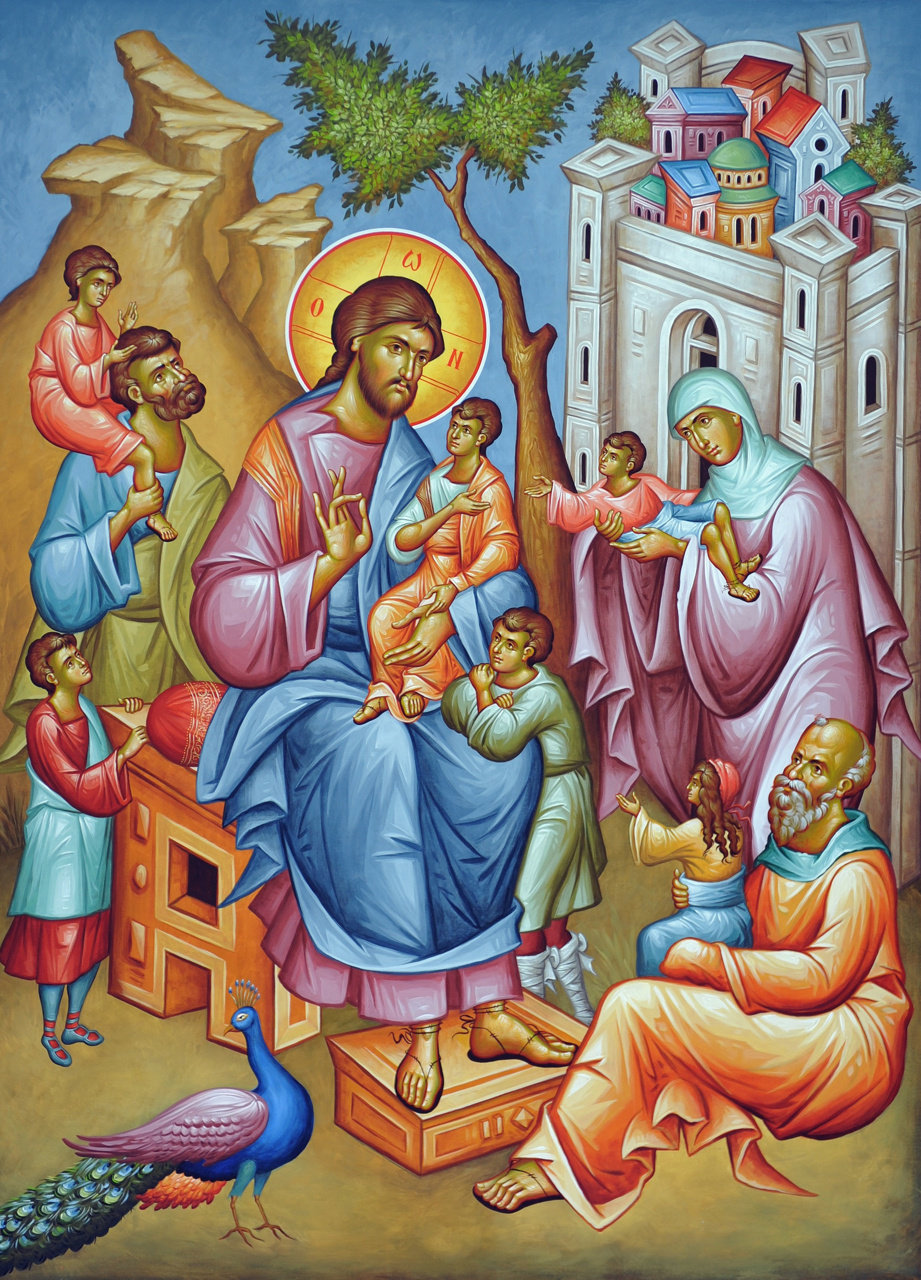
“Taking a child, he placed it in the their midst, and putting his arms around it, he said to them, ‘Whoever receives one child such as this in my name, receives me; and whoever receives me, receives not me, but the One who sent me.’” So how do these words of Jesus put His teaching about the Cross in a new light?
One of the saints of the Church can help us see this connection. The Church will celebrate her feast day a week from this coming Tuesday, on October 1st. This saint is one of the most popular saints of the Church, even though her teaching is very demanding. Her name is St. Thérèse of Lisieux, or more simply, The Little Flower.
St. Thérèse speaks in her writings about bearing one’s cross in life with the faith of a little child. She shows the connection between the two halves of today’s Gospel passage.
St. Thérèse does this in a very practical manner. In this way, the Little Flower’s counsel is a lot like the counsel that Saint James offers in his New Testament letter. The Second Reading at Sunday Mass has been coming from James for four weeks now, and will continue through next Sunday.
At first hearing, you might not imagine that St. Thérèse and St. James have much in common. But they do. They’re both, in the language of the Church, “doctors of the soul”. As “doctors of the soul”, they’re both profoundly practical, just as your physician needs to be.
The difference between these two saintly doctors is that St. James focuses more on diagnosis: he exposes the spiritual wound and underlying spiritual disease, making them clearly visible. St. Thérèse, on the other hand, offers a treatment plan. This plan she calls the Little Way of Spiritual Childhood. She approaches the Cross, and embraces the Cross, through this Little Way of Spiritual Childhood.
In her autobiography, the Little Flower writes this: “Our Lord told his apostles that they must be converted and become as little children…. In the natural order… little children show their love… [t]hrough little things. A little child, just because it is little, is… unable to show its love in any other way. … [V]ery little children will continually offer little things to their mother—a toy, a picture, a flower—as evidence of their love. … [T]he mother, although she has no need of the toy, the picture, or the flower, loves the child to make these offerings, because she wants the love that lies behind them.”[1]
She continues: “Unless [you, as a Christian,] love Our Lord through ‘the toys, the pictures, [and] the flowers’ of everyday life, [you’ll] never really love him at all.”[2] In a letter to one of her blood sisters—who was also her sister in the Carmelite Order—the Little Flower wrote, “You know well Céline, that Our Lord does not look so much at the greatness of our actions, or even at their difficulty, as at the love with which we do them.”[3] Likewise, in her autobiography she plainly wrote: “To strew flowers is the only means I have of showing my love. That is to say I will let no little sacrifice escape me, not a look, not a work. I will make use of the smallest actions and I will do them all for love.”[4]
So then: what sorts of occasions made up the Little Flower’s holiness? They were the same occasions that your life is filled with. In ordinary human life, these “occasions are provided by the interruptions of others, sometimes unavoidable but sometimes quite unnecessary; [by] the call to sacrifice our own point of view where no principle is involved, for the sake of peace; [by] the failure of the hopes we had placed in others; [by others’] lack of gratitude and lack of response [to our best efforts]; …. From [occasions like] these there is no escape; we have to accept them in one way or another, and more often than not[,] we do so in the wrong way.”[5]
The life of the Little Flower illustrates the right way. St. Thérèse “shows us that these occasions of sacrifice [are not] something to be avoided, [but instead] are providentially arranged by Our Lord and… proportioned by Him to our” abilities.[6] God calls us through these difficulties, not in spite of them.
———————————————————––——-
[1] St. Thérèse of Lisieux, Autobiography, quoted in Spiritual Childhood: The Spirituality of St. Thérèse of Lisieux, by Vernon Johnson (San Francisco, Ignatius Press, 2001), pages 127-128.
[2] Johnson, 128.
[3] Autobiography, quoted in Johnson, 128.
[4] Autobiography, quoted in Johnson, 130.
[5] Ibid.
[6] Ibid.
 Reflections on the Sacred Liturgy