The Twentieth Sunday in Ordinary Time [B]
Proverbs 9:1-6 + Ephesians 5:15-20 + John 6:51-58
Praying each set of mysteries of the Rosary is like climbing a mountain.
The five mysteries of each set—whether you’re talking about the Joyful, Luminous, Sorrowful, or Glorious Mysteries—are not five random, unconnected mysteries. The five mysteries of each set tell a single story, and they climb to a peak, which is reached in the fifth mystery. In each set, the fifth mystery is set on a mountaintop.
For example, the fifth Sorrowful Mystery is literally and geographically set on a mountaintop. The Fifth Sorrowful Mystery of the Crucifixion is set upon Mount Calvary. Of course, it’s true that this mount is not on the scale of the Rockies or the Alps, but only 2,500 feet above sea level, less than half the altitude of Denver.
However, it wasn’t the physical climb of Mount Calvary, but the spiritual climb that was so steep for Jesus. That ascent was not only the act of walking up the mount, but was also in the raising of His life to God the Father during the three hours that He was nailed to the Cross. The ascent of Mount Calvary is steep because Jesus was steeped in the sins of every human person throughout history—past, present, and future—from Adam and Eve in the beginning to the last sinner to trespass against God before the Second Coming at the end of human history. Atop Mount Calvary on Good Friday, the God-man Jesus Christ reconciled God and man by offering up His life in sacrifice, to God the Father, for the sake of fallen man.
In a similar way, the Fifth Joyful Mystery is also set on a mountain. The fifth Joyful Mystery is the Finding of the Child Jesus in the Temple. The Temple Mount, built upon what in the Book of Genesis is called Mount Moriah, was and is the holiest site in Judaism, because the Jewish Temple was built upon this mount. It was within the Jewish Temple—more specifically, within the Temple’s Holy of Holies—that God descended to earth and manifested His divine Presence. It was there that the Word made made Flesh—a mere boy of twelve—said to Mary and Joseph, “Did you not know that I had to be in my Father’s House?”
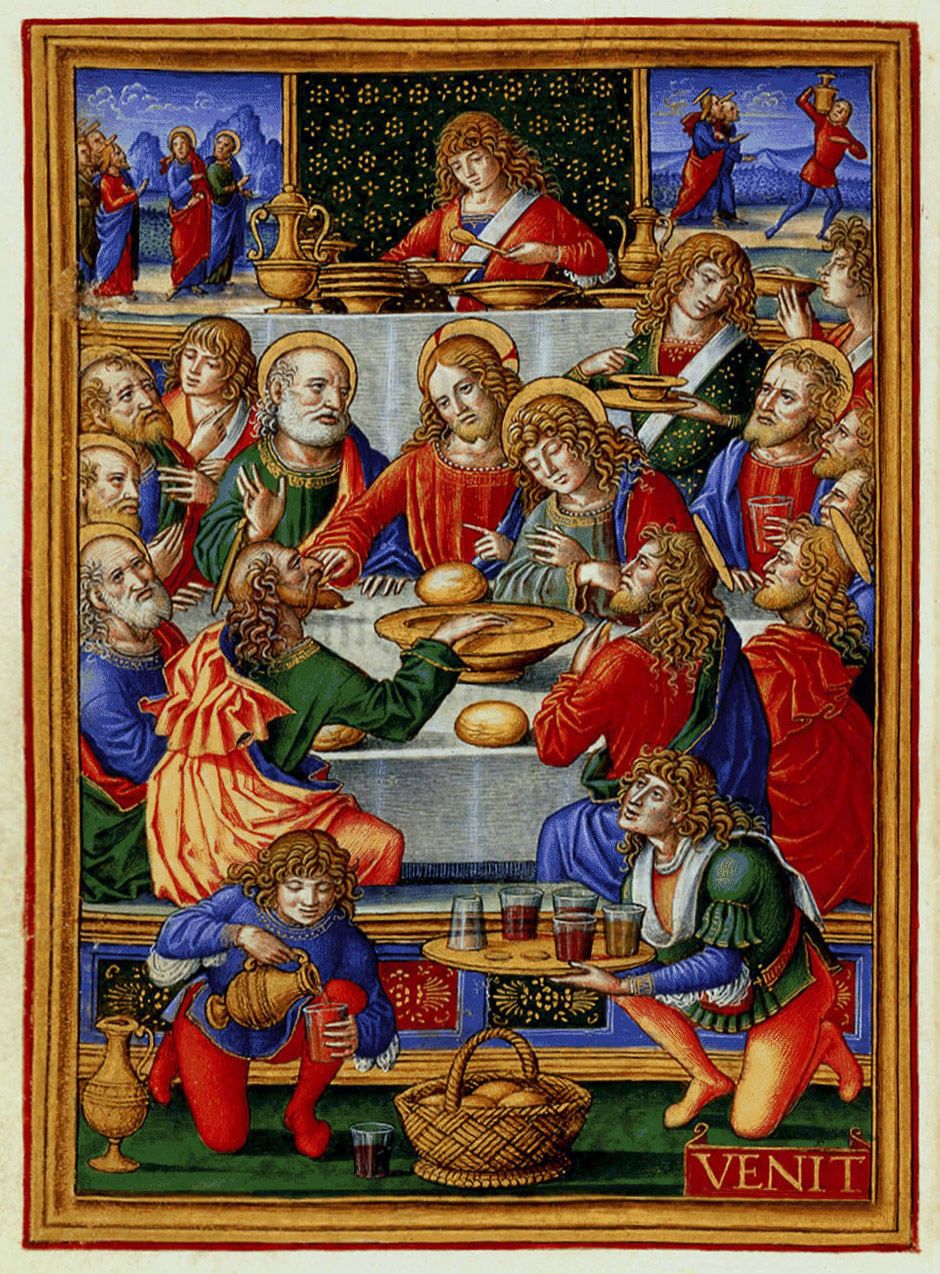
In a similar way, the Fifth Luminous Mystery is set on a mountain: not geographically, but spiritually. The Fifth Luminous Mystery is Jesus instituting the Eucharist at His Last Supper. The Catechism of the Catholic Church, quoting one of the documents of the Second Vatican Council, declares that the Eucharist is “the source and summit of the Christian life” [CCC 1324, quoting Lumen Gentium 11]. This summit—this mountaintop—is the peak of the Christian life here on earth. Nowhere on earth is Christ more powerfully present than in Jesus’ complete gift of Self, which He gave us as a sacrament on the night before He offered Himself on the Cross. At the Last Supper, Jesus instituted the Sacrament of the Eucharist.
+ + +
This is the gift of Self that Jesus preaches about in today’s Gospel passage. Jesus, in this sixth chapter of John’s Gospel, has been speaking about bread for some time. But His intentions are constantly misunderstood.
The first confusion that Jesus has to clear up is the belief that Jesus is present in the crowd’s midst in order to fill their stomachs. Of course, it’s true that Jesus did perform a miracle of feeding five thousand men with just five loaves. But that miracle was a sign, pointing to something even greater.
The first words that He speaks in today’s Gospel passage are: “I am the living bread”. Now if Jesus had just stopped there, John 6 would have ended just fine (spoiler alert: the end of John 6, as we’ll hear next Sunday, does not end just fine). In any case, these first words that Jesus speaks in today’s Gospel passage are innocent enough: “I am the living bread”. That could mean just about anything you might want it to mean. Many Christians can accept those words as referring to Jesus’ teaching, or more generally, to the Word of God. But is that what Jesus is chiefly directing our attention towards in His Sermon on the Bread of Life? Jesus’ declaration that He is “the living bread” are a sign, pointing to something even greater.
Jesus declares to the crowd: “the bread that I will give is my flesh for the life of the world.” This astounds the crowd. But it hardly astounds Christians in our day and age, because to us it’s a clear foreshadowing of Good Friday. It seems obvious that Jesus is foretelling His sacrificial death on the Cross when He declares, “the bread that I will give is my flesh for the life of the world.” All Christians can accept these words in that way. But Jesus does not stop there. These words point us further, into an even deeper belief in Christ Jesus. The chief meaning of His Sermon on the Bread of Life is still to come. He has something more to give us. Jesus through His preaching of this sermon is ascending a mountain, and He has to continue climbing, and continue to invite us to follow Him to the sermon’s peak.
When Jesus declares, “the bread that I will give is my flesh for the life of the world”, His words are a sign that point to a sacrament: the Sacrament of the Eucharist; the Sacrament of the Real Presence of Christ Jesus, which comes into our midst through the Holy Sacrifice of the Mass. Jesus speaks of this Most Blessed Sacrament when He preaches these words to you:
“unless you eat the flesh of the Son of Man and drink his blood, you do not have life within you. Whoever eats my flesh and drinks my blood has eternal life, and I will raise him on the last day. For my flesh is true food, and my blood is true drink. Whoever eats my flesh and drinks my blood remains in me and I in him.”
Here at the mountaintop of His Sermon on the Bread of Life, Jesus is not speaking about bread that fills the stomach. He’s not speaking about the bread that’s preached through the Word of God. He’s not even speaking chiefly about the historical event of His impending Crucifixion, because the Crucifixion in an historical event, far back in the historical past. He’s speaking about the Sacrament of the Eucharist, which makes His believers present at His Crucifixion, even if they live 2,000 years after the historical event that took place on Good Friday. This Sacrament makes us not just witnesses to the event of His Crucifixion, but invites us to partake of the Crucifixion by worthily eating the Flesh and drinking the Blood of the Word made Flesh.
The mountaintop of the Sermon on the Bread of Life is in invitation from Jesus to His disciples to believe in His Real Presence in the Eucharist, and to worthily partake in this Sacrifice. Next Sunday we will hear about the disappointing fallout that occurred 2,000 years ago when Jesus first preached this sermon. Today, you and I have to decide whether to accept Jesus at His Word, and accept the Gift of His very Self in the Eucharist as His means of our abiding in Him, and living our lives with His very strength inside us.

 Reflections on the Sacred Liturgy