The Sixteenth Sunday in Ordinary Time [B]
Jeremiah 23:1-6 + Ephesians 2:13-18 + Mark 6:30-34
A few weeks ago, on June 25, I drove from my former parish to Eureka in order to drop off boxes of my belongings. At the Copper Kettle in Eureka, three of us had lunch together: the then-current, the newly appointed, and a previous pastor of Greenwood County: namely, Father Nic, myself, and Father Mike Klag. Some of the folks in the Copper Kettle might have called us the Three Amigos. Some might have called us the Three Stooges. But in fact, we were and are three brothers, like the brothers in today’s Gospel passage.
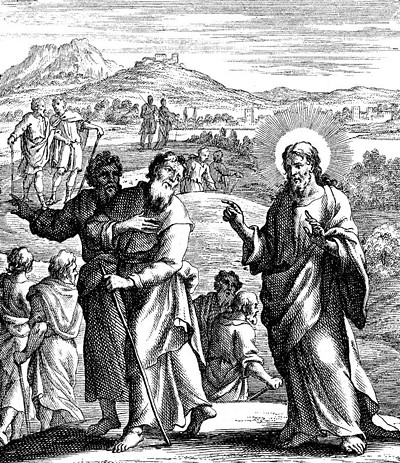
If you open your Bible to Mark Chapter 6, you’ll find this Sunday’s Gospel passage right after last Sunday’s. They’re two parts of the same narrative. They describe the Twelve Apostles: first, being sent by Jesus to do His work; and later, returning to the Lord Jesus after completing their work, in order to rest. However, Chapter 6 is fairly early on in St. Mark’s account of the Gospel, long before the events of Holy Week. Jesus here is not sending the apostles out to preach the Good News of His Death and Resurrection, because His Death and Resurrection have not yet happened. So for what purpose is Jesus sending the apostles out in today’s Gospel passage?
In any given part of the world, the Church is led there by the local bishop. Each bishop is a successor of the Apostles. Each bishop is sent to a given part of the world by the Pope, who is the successor of St. Peter. Just as Jesus appointed Peter to act in His Name after Jesus ascended to Heaven, so also the Pope at any given time acts of behalf of Jesus. One job of the Pope, then, is to send out bishops, just as Jesus sent the Twelve Apostles.
However, the world is a large place. So the Sacrament of Holy Orders, which Jesus instituted at the Last Supper, includes not just the role of bishop, but also the role of priest. Priests, as the Catechism describes them, are the bishop’s “co-workers” [CCC 1595].
When a young man enters the seminary in order to find out if God is calling him to be a priest, that young man has to be sponsored by a bishop, and the bishop sends him to a seminary of the bishop’s choosing. If the young man perseveres in the seminary, he’s ordained by that bishop for that bishop’s diocese, and can be assigned by that bishop to serve anywhere in his diocese.
Yet as important as a priest’s relationship with his bishop is, his relationships with his brother priests is just as important. In seminary they had a saying: “The priest who rides like the Lone Ranger doesn’t make it far down the trail.” In other words, a priest needs the support of his brothers.
Religious order priests, such as Benedictines and Franciscans, have built-in fraternity since they usually reside in community, pray together several times a day, take their meals together in the refectory, and carry out their labor alongside each other. By contrast, secular priests—sometimes called diocesan priests—have to work harder at fostering priestly fraternity, and often have to travel long distances to do so.
That’s part of what Father Nic, Father Mike Klag, and I were up to on June 25. I got to know Father Klag when he followed me as the pastor of St. Martin of Tours Parish in Caldwell. After he moved there, he would call me at least once a month to visit about his new parish, and if he made a trip to Wichita we would have lunch, and visit not only about his new parish, but also about his carpentry and his gardening. When he learned that I’d been appointed pastor in Greenwood County, he generously offered the use of his trailer to move my belongings, and said that he’d like to see the renovated rectory.
On June 25, during the lunch that the three of us had at the Copper Kettle, Father Klag did most of the talking, the majority of our conversation being about the parishes and parishioners of Greenwood County. Father Nic would often chime in to confirm an observation that Father Mike made. For my part, I mostly kept quiet, listening to my brothers and learning from them.
So why did Jesus send out the Twelve Apostles as we heard in last Sunday’s and today’s Gospel Readings? The most obvious answer is to preach repentance, drive out demons, and anoint and cure the sick. However, at the same time, we can see another purpose.
At the start of last Sunday’s Gospel Reading from Mark 6, the evangelist noted that Jesus sent them out two by two. Jesus sent the Apostles two by two to learn to rely not only on God’s grace, but also on a brother’s shoulder.
+ + +
Practically speaking, where does this connect to your life? It might be interesting to hear about the life of a priest, or for that matter, about the Twelve Apostles. But does any of that relate practically to the daily life of a lay person?
It does, because no Christian—whether layperson, consecrated religious, or priest—is meant to be a Lone Ranger. Even the Lone Ranger had Tonto to help him out of a jam. By God’s express design, the Christian disciple is meant to depend on his or her fellow Christians. This is part of what in the Apostles’ Creed we call the “Communion of Saints”.
The Romans, when they crucified Jesus, could not have known that the instrument of torture and death that they utilized to shame and eliminate their enemies would become the Sign by which God would offer salvation to man. The Sign of the Cross is part and parcel of our Catholic Faith for many reasons.
One reason is that the two arms of the Cross—the vertical arm and the horizontal arm—symbolize what Jesus taught us about God’s commands to His disciples. All the commands of God’s Law are summed up in two commands: love your God, and love your neighbor. Loving our God is symbolized by the vertical arm of the Cross, which is grounded in the earth, but rises up to Heaven. Loving our neighbor is symbolized by the horizontal arm of the Cross, which stretches from left to right, bad to good, unlovable to lovable, reminding us to love our neighbor not because they are or are not like us, but because they were created in God’s Image and likeness.
Today’s Gospel passage, though, reminds us about another point that’s symbolized by the Sign of the Cross. That’s the point that Jesus wanted His Twelve Apostles to learn when He sent them out two-by-two in order to carry out God’s work. The vertical arm of the Cross reminds us that it’s by God’s grace that we—like the Apostles—accomplish any good works that we carry out for the sake of our families, our parish, or our community.
The horizontal arm of the Cross reminds us that, by God’s design and desire, each of us carries out his or her work alongside, and relying upon, our neighbors. To give a specific example: in marriage, husband and wife have to work together, and to teach their children how to be part of the team that is the family, also called the domestic church. Likewise, God designs a parish family, and a local community, with different individuals with individual gifts who learn to work together for the good of others and the glory of God.
Having said that about our needs to rely on others, a heads-up about our Gospel passages for the next five Sundays. This Sunday Jesus wants us to understand our need to depend on those around us. Over the next five Sundays, the Gospel passage at Sunday Mass will come from John 6, helping us to appreciate better the gift of the Most Blessed Sacrament of the Eucharist. The Body and Blood of Jesus Christ—who is true God and true man, who is the God and the neighbor whom we are to love—gives us His very self to depend upon: Jesus, our Good Shepherd, who makes us to rest in green pasture, and to be nourished at His sacred banquet.
 Reflections on the Sacred Liturgy