The Seventeenth Sunday in Ordinary Time [Year B]

The Seventeenth Sunday in Ordinary Time [B]
II Kings 4:42-44  +  Ephesians 4:1-6  +  John 6:1-15

Some years back, three brother priests and I set out east along the highways and interstates of America to attend a conference in Louisville, Kentucky.  The round trip was more than 1500 miles, so the four of us prayed the Rosary often during the trip, and for several different reasons.

One reason for praying the Rosary was disagreements about directions.  I’m sure you’ve heard the old joke:  “Why did it take Moses and Joshua forty years to lead the Israelites through the desert?  Because men hate to ask for directions.”  That was true on our trip to Louisville.  Each of us read the signs of the road differently.

However, there was an additional problem.  Each of the other three priests had an electronic device which could look up directions.  Now, you would think that this abundance of technology would mean fewer disagreements about reading the signs of the road.  You would be wrong.

With each brand of technology—three different high-tech devices, and one Rand McNally Road Atlas—came a slightly different set of directions.  Each piece of technology read the signs of the road in its own way.  We had one driver and four navigators, which was three navigators too many.  When all these directions became too much for the driver, he would usually suggest that we pray the Rosary… again.

+     +     +

Signs are important in today’s Gospel passage.  Signs appear at the beginning and at the end of this Gospel passage.  But before looking closely at today’s Gospel passage, consider signs in general.

Of course, there are many different types of signs.  There are television ads, traffic signs, interstate markers along the side of the road, and billboards farther back from the road; there are signs of weather in the sky, and written signs on a page.

However, regardless of what type of sign you’re talking about, if a sign is going to be effective, it has to accomplish two goals.  A sign has to first catch your attention by diverting it away from whatever currently holds your attention.  The advertising industry spends billions of dollars each year in order to succeed at this.  Advertisements use color, bright light, cute children and animals, and also appeal to man’s baser instincts:  all in order to turn your attention away from what you’re focusing on.  A sign needs to captivate you.

For example, a stop sign uses the bold color of red in order to catch your attention, in order to focus your attention on your legal requirement to stop.  This requirement is very serious—it can easily be a matter of life or death—so the stop sign is as bold as a road sign can be.  Other road signs—for example, along the side of a highway that have less important messages—might be green, blue, or brown.  The signs are not as bright as a stop sign, because if you miss the green, blue or brown sign, you may be inconvenienced—you may, for example, have to take a 45-minute detour—but it’s not likely to be a life or death matter (unless someone strangles you in frustration) .

The second goal of a sign is to fix your attention on the object of the sign:  the goal.  The sign is not a sign for its own sake.  A sign points your attention beyond itself to something more important.  That’s where today’s Gospel passage poses a challenge.

+     +     +

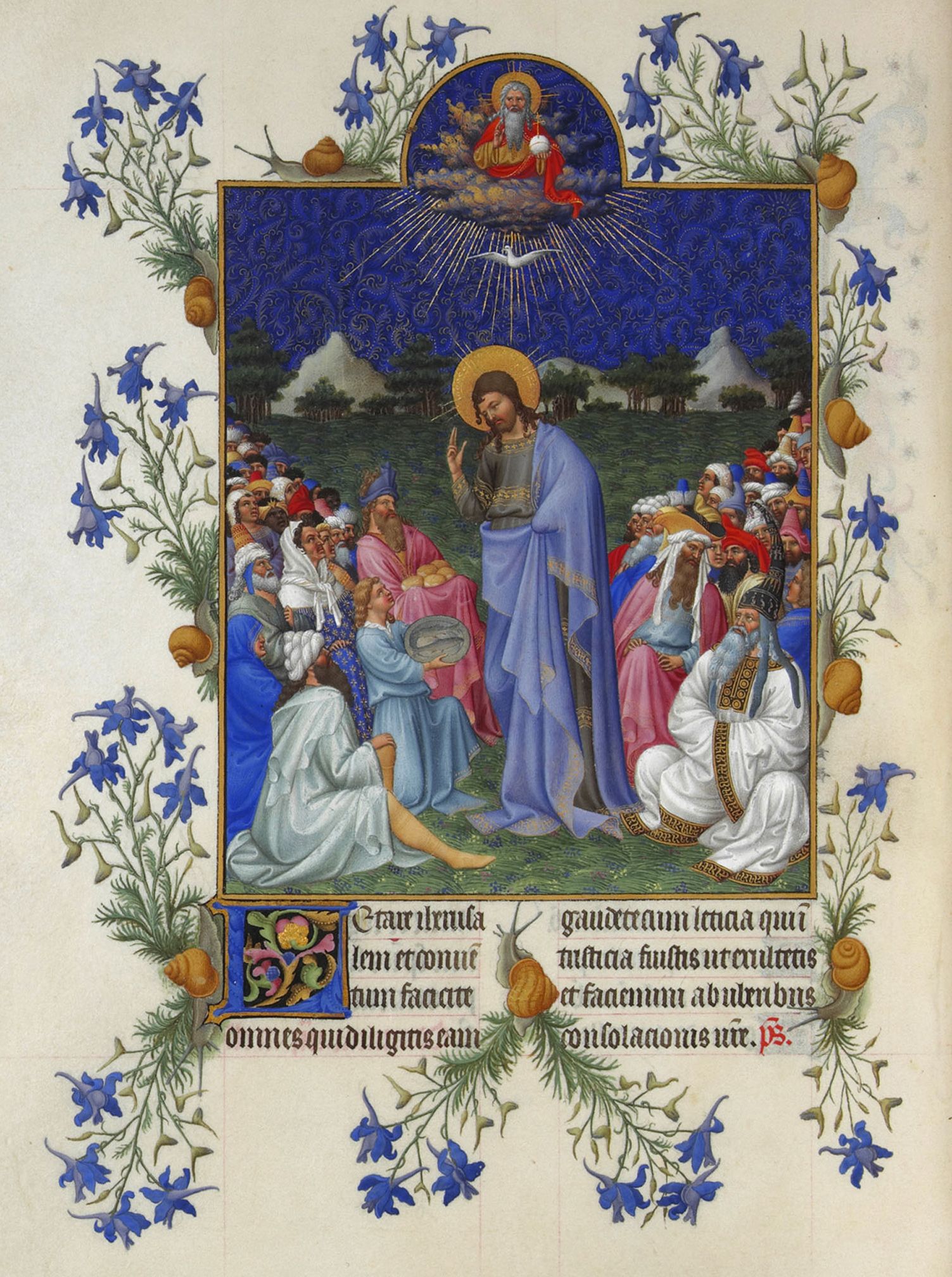
Consider the signs of Jesus mentioned in the Gospel passage.  Signs are mentioned twice:  once at the beginning of this passage, and the second time at the end.  At the beginning of the passage, Saint John the Evangelist explains to us that “a large crowd followed [Jesus] because they saw the signs he was performing on the sick.”  Then at the end of the passage, St. John explains how after “the people saw the sign He had done” just then—that is, multiplying the loaves and fish—“Jesus knew that they were going to come and carry him off to make him king, [and so] he withdrew again to the mountain alone.”

That’s a very sad statement:  Jesus “withdrew again to the mountain alone.”  Again.  Apparently this had happened before, and likely would also happen again later.  The problem, of course, was not Jesus, the one performing the signs.  The problem was in the crowds who saw His signs, but mistook their message.  Yet it’s not the crowds, but Jesus who chooses to withdraw, again and again, to the mountains alone.

Now, your average person, if he knew that a crowd were wanting to make him a king, would definitely not retreat into solitude.  We see this in the culture of the Internet, where on blogs or YouTube an individual can very quickly become a celebrity with thousands, or even millions, of followers, regardless of whether what he does is very noble or praiseworthy.  Sometimes, the baser the content, the more followers a content provider gains.

For His part, Jesus did not want to be a celebrity.  Jesus wanted crowds to follow Him, but only for the right reason.  At the end of today’s Gospel passage, after the Multiplication of the Loaves, the people proclaim Jesus to be “‘the Prophet, the one who is to come into the world.’”  “They were going to… carry Him off to make Him king.”  In these two sentences, we can see the problem with the way the people were looking at Jesus.  They were looking at Jesus for the sake of His signs, instead of looking at His signs for the sake of seeing Jesus.  Or in other words, Jesus to them is significant because of the way that He changes this world.  That’s why they call Him “the Prophet, the one who is to come into the world.”  That’s why they were going to carry Him off to make Him king:  because of the way that they thought that Jesus would change their world for the better.

They think Jesus is in this world to rid it of hunger by His miracles.  They don’t understand what the miracle of feeding 5000 is pointing to.  Like the sign of Jesus’ healing the sick, the miracle of feeding 5000 is meant to be a road sign, not the end of the road.  All of Jesus’ signs beg an important question.  What was the object of Jesus’ life on earth?  What were all of Jesus’ miracles advertising?

Every one of Jesus’ signs points to Jesus Himself.  Maybe that sounds too simple to be true, but it is.  Each of Jesus’ signs points to Himself.  He does this in order to reveal to others who He is, not simply so that people might be healed or miraculously fed, but instead so that they might follow Jesus, and abide with Jesus, and that Jesus might abide with them, and within them.

This is significant because this Sunday is the first of five Sundays during which most of the sixth chapter of St. John’s Gospel will be proclaimed.  This chapter of John 6, as you know, is where Jesus proclaims His teaching about the Most Blessed of the seven Sacraments:  that is, the Eucharist, where the Real Presence of Jesus Christ comes into our midst through the Holy Sacrifice of the Mass.  The Eucharist is not a mere sign, but a sacrament, which makes the end of the road present in our midst during our travels down the road of life. 

Practically speaking, I encourage you over the next several weeks to take your bible and read John 6.  Read the whole chapter at one sitting, so that you see what the Sunday Gospel passages are presenting to us in five separate passages.  See the signs that Jesus presents, and see what the signs are pointing to.  If you’re especially ambitious, also read John 13-17, because these chapters are set at the Last Supper.  In these chapters, Jesus speaks to the Apostles, to whom He is giving at the Last Supper the power to celebrate this Sacrament, and to ordain other men that they might do the same, so that Jesus Christ—really, truly, and sacramentally—will abide within the members of His Mystical Body, the Church.
The Sixteenth Sunday in Ordinary Time [B]

The Sixteenth Sunday in Ordinary Time [B]
Jeremiah 23:1-6  +  Ephesians 2:13-18  +  Mark 6:30-34

A few weeks ago, on June 25, I drove from my former parish to Eureka in order to drop off boxes of my belongings.  At the Copper Kettle in Eureka, three of us had lunch together:  the then-current, the newly appointed, and a previous pastor of Greenwood County:  namely, Father Nic, myself, and Father Mike Klag.  Some of the folks in the Copper Kettle might have called us the Three Amigos.  Some might have called us the Three Stooges.  But in fact, we were and are three brothers, like the brothers in today’s Gospel passage.

If you open your Bible to Mark Chapter 6, you’ll find this Sunday’s Gospel passage right after last Sunday’s.  They’re two parts of the same narrative.  They describe the Twelve Apostles:  first, being sent by Jesus to do His work; and later, returning to the Lord Jesus after completing their work, in order to rest.  However, Chapter 6 is fairly early on in St. Mark’s account of the Gospel, long before the events of Holy Week.  Jesus here is not sending the apostles out to preach the Good News of His Death and Resurrection, because His Death and Resurrection have not yet happened.  So for what purpose is Jesus sending the apostles out in today’s Gospel passage?

In any given part of the world, the Church is led there by the local bishop.  Each bishop is a successor of the Apostles.  Each bishop is sent to a given part of the world by the Pope, who is the successor of St. Peter.  Just as Jesus appointed Peter to act in His Name after Jesus ascended to Heaven, so also the Pope at any given time acts of behalf of Jesus.  One job of the Pope, then, is to send out bishops, just as Jesus sent the Twelve Apostles.

However, the world is a large place.  So the Sacrament of Holy Orders, which Jesus instituted at the Last Supper, includes not just the role of bishop, but also the role of priest.  Priests, as the Catechism describes them, are the bishop’s “co-workers” [CCC 1595].

When a young man enters the seminary in order to find out if God is calling him to be a priest, that young man has to be sponsored by a bishop, and the bishop sends him to a seminary of the bishop’s choosing.  If the young man perseveres in the seminary, he’s ordained by that bishop for that bishop’s diocese, and can be assigned by that bishop to serve anywhere in his diocese.

Yet as important as a priest’s relationship with his bishop is, his relationships with his brother priests is just as important.  In seminary they had a saying:  “The priest who rides like the Lone Ranger doesn’t make it far down the trail.”  In other words, a priest needs the support of his brothers.

Religious order priests, such as Benedictines and Franciscans, have built-in fraternity since they usually reside in community, pray together several times a day, take their meals together in the refectory, and carry out their labor alongside each other.  By contrast, secular priests—sometimes called diocesan priests—have to work harder at fostering priestly fraternity, and often have to travel long distances to do so.

That’s part of what Father Nic, Father Mike Klag, and I were up to on June 25.  I got to know Father Klag when he followed me as the pastor of St. Martin of Tours Parish in Caldwell.  After he moved there, he would call me at least once a month to visit about his new parish, and if he made a trip to Wichita we would have lunch, and visit not only about his new parish, but also about his carpentry and his gardening.  When he learned that I’d been appointed pastor in Greenwood County, he generously offered the use of his trailer to move my belongings, and said that he’d like to see the renovated rectory.

On June 25, during the lunch that the three of us had at the Copper Kettle, Father Klag did most of the talking, the majority of our conversation being about the parishes and parishioners of Greenwood County.  Father Nic would often chime in to confirm an observation that Father Mike made.  For my part, I mostly kept quiet, listening to my brothers and learning from them.

So why did Jesus send out the Twelve Apostles as we heard in last Sunday’s and today’s Gospel Readings?  The most obvious answer is to preach repentance, drive out demons, and anoint and cure the sick.  However, at the same time, we can see another purpose.

At the start of last Sunday’s Gospel Reading from Mark 6, the evangelist noted that Jesus sent them out two by two.  Jesus sent the Apostles two by two to learn to rely not only on God’s grace, but also on a brother’s shoulder.

+     +     +

Practically speaking, where does this connect to your life?  It might be interesting to hear about the life of a priest, or for that matter, about the Twelve Apostles.  But does any of that relate practically to the daily life of a lay person?

It does, because no Christian—whether layperson, consecrated religious, or priest—is meant to be a Lone Ranger.  Even the Lone Ranger had Tonto to help him out of a jam.  By God’s express design, the Christian disciple is meant to depend on his or her fellow Christians. This is part of what in the Apostles’ Creed we call the “Communion of Saints”.

The Romans, when they crucified Jesus, could not have known that the instrument of torture and death that they utilized to shame and eliminate their enemies would become the Sign by which God would offer salvation to man.  The Sign of the Cross is part and parcel of our Catholic Faith for many reasons.

One reason is that the two arms of the Cross—the vertical arm and the horizontal arm—symbolize what Jesus taught us about God’s commands to His disciples.  All the commands of God’s Law are summed up in two commands:  love your God, and love your neighbor.  Loving our God is symbolized by the vertical arm of the Cross, which is grounded in the earth, but rises up to Heaven.  Loving our neighbor is symbolized by the horizontal arm of the Cross, which stretches from left to right, bad to good, unlovable to lovable, reminding us to love our neighbor not because they are or are not like us, but because they were created in God’s Image and likeness.

Today’s Gospel passage, though, reminds us about another point that’s symbolized by the Sign of the Cross.  That’s the point that Jesus wanted His Twelve Apostles to learn when He sent them out two-by-two in order to carry out God’s work.  The vertical arm of the Cross reminds us that it’s by God’s grace that we—like the Apostles—accomplish any good works that we carry out for the sake of our families, our parish, or our community.

The horizontal arm of the Cross reminds us that, by God’s design and desire, each of us carries out his or her work alongside, and relying upon, our neighbors.  To give a specific example:  in marriage, husband and wife have to work together, and to teach their children how to be part of the team that is the family, also called the domestic church.  Likewise, God designs a parish family, and a local community, with different individuals with individual gifts who learn to work together for the good of others and the glory of God.

Having said that about our needs to rely on others, a heads-up about our Gospel passages for the next five Sundays.  This Sunday Jesus wants us to understand our need to depend on those around us.  Over the next five Sundays, the Gospel passage at Sunday Mass will come from John 6, helping us to appreciate better the gift of the Most Blessed Sacrament of the Eucharist.  The Body and Blood of Jesus Christ—who is true God and true man, who is the God and the neighbor whom we are to love—gives us His very self to depend upon:  Jesus, our Good Shepherd, who makes us to rest in green pasture, and to be nourished at His sacred banquet.

The Fifteenth Sunday in Ordinary Time [Year B]

The Fifteenth Sunday in Ordinary Time [B]
Amos 7:12-15  +  Ephesians 1:3-14  +  Mark 6:7-13

“So they went off and preached repentance.”

Sometimes it’s better to step back and consider Scripture in general, and sometimes it’s better to focus on one of the day’s Scripture passages.  Sometimes, it’s best to do both.  One of the saints of our Church can help us do so.

Saint Thomas More, who lived in England in the 1500s, was a husband and father, lawyer and statesman.  St. Thomas was also devoted to learning more about his Catholic Faith.  He was chosen by the King of England for the position of Lord Chancellor, the second-most powerful position in the kingdom, second only to the king.

However, St. Thomas, unlike many who wield worldly power, was clear-sighted.  One day he said to his son-in-law, “If my head could win the king a castle in France, it would not fail to go.”  Those were prophetic words.  St. Thomas More was martyred by the King of England because St. Thomas refused to call the king the head of the Church within England.  The feast day of St. Thomas More is June 22nd.

St. Thomas emphasized the need to read Sacred Scripture in the light of faith, with the early Fathers of the Church as guides.  About Sacred Scripture, St. Thomas wrote:  “Holy Scripture is the highest and best learning that any man can have, if one takes the right way in the learning.  It is [like a river] so marvellously well tempered that a mouse can wade therein and an elephant be drowned therein.”

This point about the elephant and the mouse is important to stop and consider.  Sometimes Christians think that they have to be an elephant when it comes to approaching Scripture.  That is to say, they think that if they’re going to approach Sacred Scripture, they have to tackle the entire Bible, and become a master of every book, chapter, and verse.  Frankly, that makes about as much sense as wanting to begin a walking regimen, and starting by walking to the top of Mount Everest.  Instead, it’s better to be a mouse.

When someone asks for counsel about reading, or studying, or reflecting upon Scripture more deeply, there are two points I make in reply.  The first is to start with one of the four Gospel accounts:  not “in the beginning” with the Book of Genesis, and not with the letters of St. Paul, as rich as they are, but instead with one of the four Gospel accounts.

The second point leads into today’s Scripture passages.  The second point to keep in mind when starting to read, study, or reflect upon Scripture more deeply is to be that mouse that St. Thomas More wrote about.  Specifically, when you turn to any chapter or paragraph of the Bible, ask the Holy Spirit to direct your mind and heart to one particular verse, or sentence, or even just a phrase.  That’s all you need.  That small creek of Scripture is enough to immerse yourself in the Word of God.  You don’t need to swim in the Mississippi.  You only need one verse, sentence, or phrase.

But then, once the Holy Spirit has helped you to select a specific verse, sentence, or phrase, ask Jesus, who is the Word of God made Flesh, to give you insight into the meaning of that verse, sentence, or phrase.

This past week, in preparing for this Sunday’s homily, the sentence that came to the forefront is the next-to-last sentence of today’s Gospel Reading.  “So they went off and preached repentance.”  What does Jesus, the Word of God made flesh, wants us to understand through these words?  We cannot exhaust their meaning, but we can ask the Lord Jesus to apply these words to our lives in the here and now.

Each one of us, by virtue of his or her baptism, is called by God to holiness.  There is no holiness for the sinner except by means of repentance.  Repentance, accepted through the virtue of humility, is the first step.

In turn, those who are called to shepherd others, have the responsibility to preach repentance to those entrusted to their care.  They may not do so from a pulpit, but they do so in the ordinary course of life.  Parents, for example, have to preach the need for repentance when their teenager, who has a curfew of midnight, comes home at 2:00 am.  In our civil society, citizens have to preach the need for repentance when laws fail to protect the lives of unborn children.

However, no Christian can preach to others unless he first examines his own conscience and seeks out what forgiveness he needs to accept from God or others.  Every night, during his prayers before falling asleep, the Christian disciple needs to make an examination of conscience, and pray the Confiteor or Act of Contrition.  Every month, the Christian disciple who wants to grow in holiness will accept Jesus’ gift of Divine Mercy through the Sacrament of Confession.

Growth in the Christian life begins with the virtue of humility, and repentance for one’s sins.  In other words, Christian growth is founded upon two basic truths of our Catholic Faith:  (1) that there is sin, and (2) that I am a sinner.

By contrast, we live in a world that professes two claims that contradict our Faith:  (1) that there is no objective truth, and therefore no such thing as sin, and (2) that instead, those who believe contrary to each other can only at best tolerate each other, or perhaps simply ignore each other, or at worst fight against each other.  However, if there is truth – and Jesus proclaims “I am the Way, and the Truth, and the Life” – then we are able to reason with others, even when we disagree with them, and even when there’s a need for repentance, whether on our part or on theirs.

Nonetheless, repentance is only the first step.  Because where there is human sin, there also is Christ willing to carry that sin on His shoulders to Calvary.  And where there is sin, there is Christ Jesus offering His grace.

Homily for the Thirteenth Sunday in Ordinary Time [B]

The Thirteenth Sunday in Ordinary Time [B]
Wisdom 1:13-15;2:23-24  +  2 Corinthians 8:7,9,13-15  +  Mark 5:21-43 [or Mark 5:21-24, 35-43]

There are certain seasons of the Church Year, and certain times of that year, when we expect that certain beliefs of our Faith will come to the forefront.  For example, during Lent, and even more so the closer we draw to Good Friday, we expect to hear about—and to be challenged to reflect upon—the sacred Death of Our Lord Jesus Christ.  Likewise, in the last Sundays of the Church Year, during the month of November, the Scriptures at Mass draw our attention to what Holy Mother Church calls the “Four Last Things”.  One of those four Last Things is death, and of course November—as nature all around us becomes colder and more barren, with fields and lawns turning yellow—is a fitting time to reflect upon death.

But this Sunday?  We’re in the heart of summer.  The days are filled with light and heat.  Fields and lawns are lush and green.  Why do our Scriptures today focus upon the harsh reality of human death?

Maybe it’s to remind us that death is often not predictable.  Reflecting upon death during Lent and November is fitting and timely.  But death often strikes unexpectedly, at a time that seems altogether unfitting.  Maybe that’s why on this Summer morning Holy Mother Church wants us to reflect upon death through the light of the Gospel.

+     +     +

In today’s First Reading, from the Old Testament Book of Wisdom, the author states:  “God did not make death, nor does He rejoice in the destruction of the living.”

But if God did not make death, then who did?  The answer is:  man made death; or at least, man made death into what we know it as.

“In the beginning”, when God created man—male and female He created them—He did not design man to experience death as we know it.  Certainly, God never intended man to live forever upon the earth.  But God did not design man to end his earthly days by means of what we know as death.

“In the beginning”, God created man so that an individual human person, upon reaching his or her final day on earth, would rise to Heaven both in body and soul, as the Blessed Virgin Mary did at the end of her days on earth.  As God originally designed man, the end of earthly life would not have resulted in the division of a man’s body from his soul.  The human body and soul were meant always to be united to each other:  both on earth and in Heaven.

But when Adam and Eve brought sin into human life, death as we know it resulted.  Human sin is the reason that the body and soul are separated from each other at the moment of death.  They remain separated, of course, until the end of time.  St. Paul, in his First Letter to the Corinthians, writes that at the end of time “the trumpet shall sound, and the dead shall be raised incorruptible” [1 Corinthians 15:52].  Those in Heaven will finally have their bodies joined again to their souls.

+     +     +

Death divides.  Life unites.

There are many ways in which death divides.  One way is that death divides the soul from the body.  But an even deeper division is the death caused by sin during life on earth.  Everyone experiences division within oneself, and on many different levels, some more important than others.  To give a less important, though difficult, example:  regarding something as simple as a diet, human persons are torn in two.  We “know” that we need to eat a more healthful diet, but we “want” to eat what’s satisfying.  That’s why the diet industry earns billions of dollars every year:  because human beings are divided inside, and their diets don’t address that fault line within the human person.

The same is true when we face decisions about spending time:  for example, whether to sleep in on a Saturday morning, or to tackle a needed chore.  Inside us, a tug-of-war goes on, and more often then not, the lower side—the baser side—wins.

St. Paul in his New Testament letters often writes about division within his own life.  But he doesn’t write about diets or chores.  He speaks about division in the very heart of man’s soul, and about sin as the cause of this division.  In his Letter to the Romans, St. Paul tackles this conflict head on.  He writes:

“I do not understand my own actions.  For I do not do what I want, but I do the very thing I hate.  ….  So then it is no longer I that do it, but sin which dwells within me.  …. I can will what is right, but I cannot do it.  For I do not do the good I want, but the evil I do not want is what I do.  ….   Wretched man that I am!  Who will deliver me from this body of death?  Thanks be to God through Jesus Christ our Lord!”  [Romans 7:15,17, 18-19, 24-25].

There is only one way strong enough to overcome division.  That way is Jesus Christ.  This truth was proclaimed in the Alleluia Verse before today’s Gospel Reading:  “Our Savior Jesus Christ destroyed death / and brought life to light through the Gospel” [see 2 Timothy 1:10].

Jesus has brought “life to light”.  What is this life?  This is the life of grace.

The life of grace—which is life in Christ—strengthens us not to give in to division in any form.  Finally, the life of grace strengthens us against the deepest temptation to division:  that is, the temptation to divide death from life.

This is really two opposite temptations.  You can divide death from life in two different ways.  Both ways lead away from Christ, or rather, away from the Way of Christ.

First, you can focus on death to the exclusion of life.  When you do this, you become not just weak and pessimistic, but self-centered, because your self-pity prevents you from seeing outside your misery.  You will neither allow others to give you a hand, or God to give you His grace.

Second, you can focus on life to the exclusion of death.  When you do this, you become what’s called a “Pollyanna”, believing in a false form of life, a phony optimism.  This false hope ignores the power and presence of sin and death, and so eventually has no need for either repentance or grace.

In Rome I wrote my thesis on the greatest work of the convert and apologist G. K. Chesterton, titled The Everlasting Man.  In the last chapter of that work, Chesterton wrote:  “Christendom has had a series of revolutions and in each one of them Christianity has died. Christianity has died many times and risen again; for it had a God who knew the way out of the grave.”  What Chesterton states about Christianity is true of each authentic disciple of Jesus Christ.  Each Christian falls because of his own sins and because of the sins of those around him.  But each Christian can rise through the grace offered by Christ’s sacraments.  The Christian life takes seriously both sin and grace, death and life, yet never doubts that in that stupendous battle between death and life, life in Christ will always be victorious.

references to the Catechism of the Catholic Church cited for this Sunday by the Vatican’s Homiletic Directory:

CCC 548-549646994: Jesus raises the dead
CCC 1009-1014: death transformed by Christ
CCC 1042-1050: hope for a new heaven and a new earth

Christ Raising Jairus’s Daughter by William Blake (1757–1827)