Homily for the feast of St. John, Apostle & Evangelist
December 27, 2023
Holy Mother Church privileges St. John’s Gospel account. At the Sacred Liturgy, she reserves the proclamation of John for the more important times of the Church year. While the Gospel accounts of Matthew, Mark, and Luke share many passages in common, much of St. John’s Gospel account is found only in John. In case you’re considering a New Year’s resolution of reading more Sacred Scripture in the new year, and in case you’re trying to decide which book of the Bible to start with, let me give you three reasons for giving your attention and reflection to the Gospel according to John.
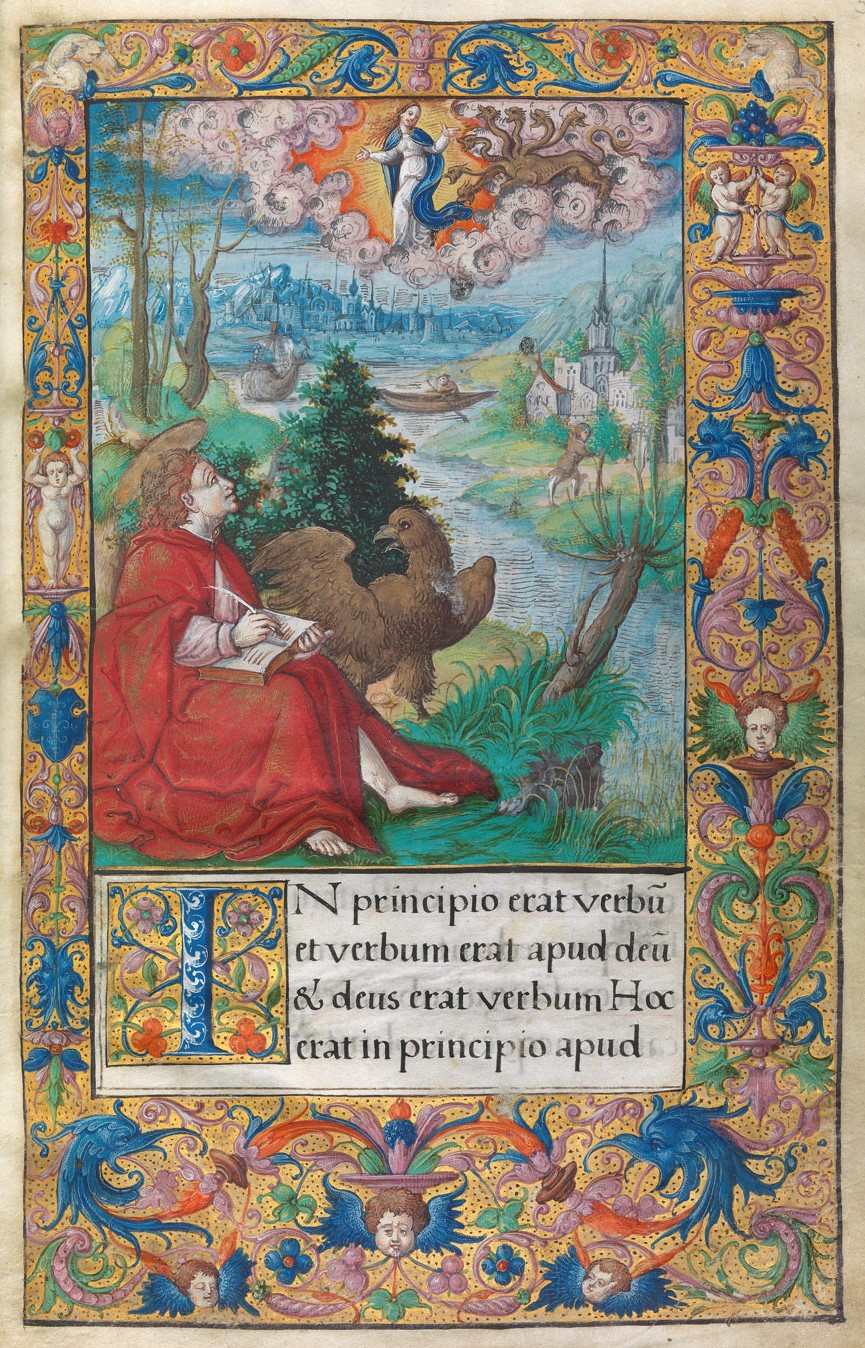
The first is the start of St. John’s Gospel account, sometimes called the “prologue” of John. It’s the first eighteen verses of John 1. If you’re old enough to remember the Latin Mass celebrated before Vatican II, you might recall that this prologue of St. John’s Gospel account was read at the end of every celebration of Holy Mass. The high point of the prologue is verse 14, which is both profoundly incarnational and Eucharistic: “And the Word became flesh and dwelt among us, full of grace and truth; we have beheld his glory, glory as of the only Son from the Father.” You can read this brief prologue of just eighteen verses in a few minutes, yet you can meditate upon the meaning of these verses for many, many hours.
A second unique feature of St. John’s Gospel account is the sixth chapter of John. The entire chapter is 71 verses long, but the heart of the chapter is what’s usually called “The Bread of Life Sermon”. In this sermon, not found in Matthew, Mark, or Luke, Jesus gives us His most profound teaching about His Real Presence in the Eucharist. Reading through this chapter in private devotion is usually best done with a commentary from a solid Catholic scholar (such as the Ignatius Study Bible). Nonetheless, every hour spent meditating upon John 6 allows one to grow deeper in devotion to the Most Blessed Sacrament.
A third unique feature of St. John’s Gospel account is John’s account of the Last Supper. St. Matthew records his account of the Last Supper in eleven verses; St. Mark, in ten verses; St. Luke, in 25 verses. But St. John’s account of the Last Supper is found in five entire chapters, consisting of 155 verses. Put another way: St. John’s Gospel account consists of 21 chapters, and five of these 21 chapters are devoted to John’s account of the Last Supper.
All three of these features of St. John’s Gospel account show how deeply Eucharistic the fourth Gospel is. If you want to grow in your understanding of and devotion to Jesus in the Most Holy Sacrament of the Eucharist, then the Gospel according to St. John is the place to start.
With prayers today on his feast day for the repose of the soul of my father, John Riley Hoisington.
 Reflections on the Sacred Liturgy