May is the month when the Church pays the greatest devotion to Our Blessed Mother Mary. After all, that’s why Western culture celebrates Mother’s Day during May: because the celebration is an offshoot of the Church’s devotion to Mary during the month of May.
After the month of May, though, the month of October is second in terms of devotion to Our Blessed Mother. The most important feast of Our Lady during October will be celebrated next Saturday on October 7th, the date of the feast of Our Lady of the Rosary. It’s because of this feast that the Church dedicates the entire month of October to the Holy Rosary.
There are two ways to honor Our Blessed Mother during October. The first is simply to pray the Rosary. Nothing complicated about that: pray the Rosary during October. If you don’t already pray the Rosary every day, start today. We pray the Rosary to honor Our Blessed Mother, which she of course deserves. Yet while we pray the Rosary to give honor to Mary, like so much in our Christian life, when we give, we receive. When we give honor to Mary by praying the Rosary, she draws us closer to her Son.
It’s very simple: if you want your family to grow spiritually stronger, then pray the Rosary together; if you want your parish to be strong, then pray the Rosary; if you want our world to be filled with God’s grace, then pray the Rosary, so that you and the members of your families and parish will take God’s grace into the world. So that’s the first way to honor Mary during October: by praying the Rosary.
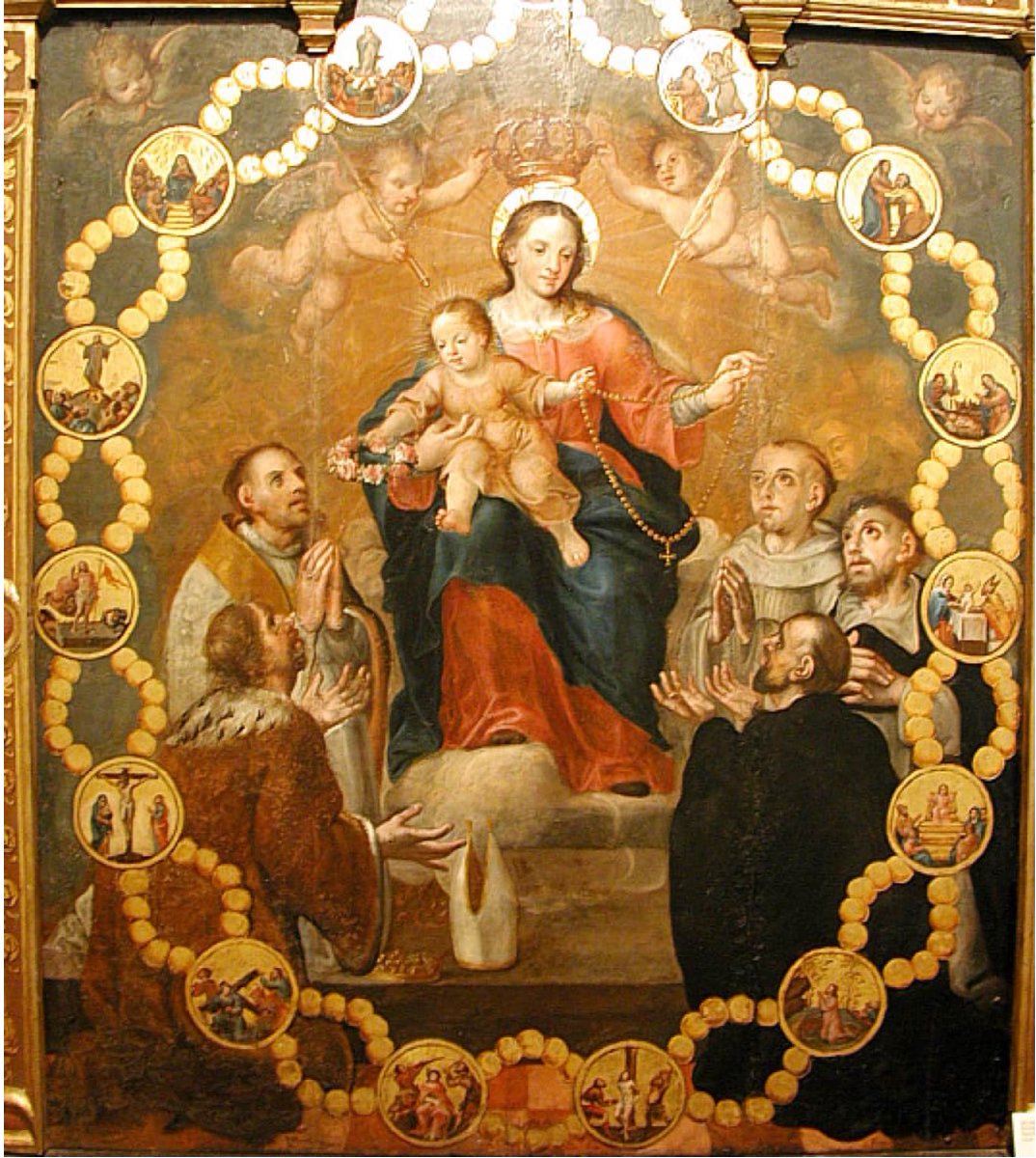
The second way to honor Our Blessed Mother during October is to stop and reflect upon what exactly the prayer of the Rosary is all about. The Rosary is such a simple prayer that there’s a risk of praying it without giving our full attention to the Rosary’s meaning. In other words, there’s a risk of praying it mindlessly, and if we pray the Rosary mindlessly, then we pray it fruitlessly. But if we stop every now and again—say, during October—and step back and consider the depth of the Rosary, then when we pray it, our prayers will be more fruitful.
One feature of the Rosary that deserves our reflection is the sets of mysteries that we meditate upon while praying the Rosary. Consider the three traditional sets of mysteries: the Joyful, Sorrowful, and Glorious Mysteries. The fourth set of mysteries—the Mysteries of Light that St. John Paul II proposed in the year 2002—deserve separate attention because that set of mysteries is so unique. In the 2002 document that St. John Paul wrote about the Rosary, you can read his reflections upon the Mysteries of Light.
However, the three traditional sets of mysteries—the Joyful, Sorrowful, and Glorious Mysteries—have several traits in common. One is that each set of mysteries is liturgical in nature. That is to say, the Joyful Mysteries are the Advent and Christmas Mysteries. The Sorrowful Mysteries are the Lenten mysteries. Then it follows that the Glorious Mysteries are the Easter mysteries, with an “epilogue”, if you will, given to Our Blessed Mother in the last two Glorious Mysteries.
So the Rosary is liturgical in nature. That is to say, the Rosary tracks the major seasons of the Church year. But to say that the Rosary tracks the Church’s seasons is simply to say that the Rosary is dramatic in nature: the drama in question being the unfolding of salvation history.
In other words, on a given day—let’s say Monday—when we pray the Rosary, the five mysteries that we pray that day—in the case of Monday, the Joyful Mysteries—are not five random snapshots from the lives of Mary and Jesus. The five Joyful Mysteries are inter-connected. We could say that they make a five-act play, with the events of each act leading to the events of the next, and the entirety of the Joyful Mysteries telling a single story about how God brought joy into the world through Mary and Jesus. Likewise, the Sorrowful Mysteries tell the story about how God chose to suffer for our sins, while the Glorious Mysteries tell the story of God’s victory over death: a victory He offers to all mankind, beginning with the Blessed Virgin Mary.
The Blessed Virgin Mary is the first and best disciple of Jesus Christ. In response to Mary’s fidelity to all God asked of her, when her earthly days were completed, God rewarded Mary by means of her Assumption and Coronation. Nonetheless, we need to remember that while Mary is the first disciple of Jesus, she’s not meant to be the last. She’s not the “last word” on how to follow her Son. She’s our mother, and we, as her children, learn from our Mother how to follow Jesus.
Let me finish with one of St. John Paul’s recommendations in his 2002 document about the Rosary. His recommendation concerns the start of each decade of the Rosary. He writes: “In order to supply a Biblical foundation and greater depth to our meditation, it is helpful to follow the announcement of the mystery with the proclamation of a related Biblical passage, long or short, depending on the circumstances. No other words can ever match the efficacy of the inspired word. As we listen, we are certain that this is the word of God, spoken for today and spoken ‘for me’.”
So if necessary, because, for example, there’s a Mass to follow the Rosary, the Scripture passage for each decade can be as short as one verse long. But when the Rosary is prayed at home, a little longer Scripture passage can be used, and a moment of silence can follow the Scripture passage. This makes it easier to meditate upon the mystery as the decade proceeds.
We pray the Rosary to honor Our Blessed Mother, as she deserves. Yet while we pray the Rosary to give honor to Mary, when we honor Mary by praying the Rosary, she draws us closer to her Son. Meditating upon her life shows us how to make His life the path of our own life.
For the link to St. John Paul II’s 2002 apostolic letter about the Rosary, click HERE.
 Reflections on the Sacred Liturgy