Friday of the Thirty-first Week in Ordinary Time [Years I & II]

Please note:  two reflections are given below, each based on the First Reading and/or Responsorial Psalm of the day.  The Year I readings apply to years ending in an odd number (for example, 2023), while the Year II readings apply to years ending in an even number, such as 2024.  The Gospel Reading is the same in both years.

+     +     +

Friday of the Thirty-first Week in Ordinary Time [I]
Romans 15:14-21  +  Luke 16:1-8

… because of the grace … in performing the priestly service of the Gospel of God ….

There are differences among Christians, and then there are disagreements.  Differences can be of various types, including those willed by God Himself for the sake of the Church.  For example, there are different religious orders, such as the Franciscans, Dominicans, and Carmelites.  These difference are willed by God, and make the Church richer.

So there are differences within the Church, but then there are disagreements.  Differences can come about through human sin, contrary to the will of God.  Some disagreements are rooted in beliefs that are contrary to the mind of God.

As an example, there are disagreements among Christians about Christians serving within the Church as priests.  A priest, of course, is a mediator:  in more common parlance, a “middle man”.  He stands between God and another human person in order to serve that person:  in order to bridge the gap between God and the other.  Is there such a thing as an authentic Christian priesthood?  Many Christians insist that the answer is “No”, and that any pretense of mere human beings acting as priests is an offense against God.

However, in today’s First Reading, speaking to the Romans about himself, St. Paul the Apostle speaks of his “priestly service of the Gospel… so that the offering up of the Gentiles may be acceptable”.

Among Christians who speak regularly against Catholic teaching and practice about the priesthood, you will often hear that there is only one mediator, Jesus Christ.  Therefore, there ought to be no human mediators between “me and Jesus”.  But St. Paul’s words today—inspired as they are by the Holy Spirit—clearly show such an idea to be contrary to the mind of God.  This is only the first point by which to understand God’s gift of Christian priesthood, but it’s good for us to reflect on it when we re-read today’s First Reading.

+     +     +

Friday of the Thirty-first Week in Ordinary Time [Year II]
Philippians 3:17—4:1  +  Luke 16:1-8

“And the master commended that dishonest steward for acting prudently.”

“Our citizenship is in Heaven”.  What would our lives look like if we believed these words sincerely?  Saint Paul is exhorting the Philippians neither to place their faith in this world, nor to use the things of this world for their own sake.

If our citizenship is in Heaven, then we are sojourners in this world.  To place our faith in this world is to sink our roots in this world, which can only tie us down when God chooses us to raise us to Himself:  either briefly in prayer, or into Heaven after our death.  How many persons spend a great deal of their time in Purgatory casting off their ties to the world?

If our citizenship is in Heaven, then the things of this world are means, rather than ends.  What do we seek in this life?  What we seek are our ends.  Do we seek things that are of this world?  Or is what we’re seeking of God?  God gives us good things in this world to use as stepping stones, to draw others, and to be drawn up into our true citizenship in Heaven.
OT 31-5

Thursday of the Thirty-first Week in Ordinary Time

Thursday of the Thirty-first Week in Ordinary Time
Luke 15:1-10

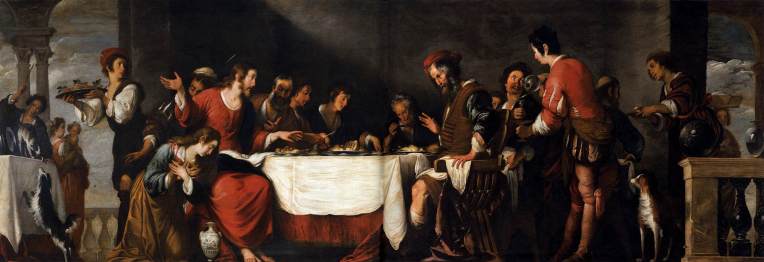
“This man welcomes sinners and eats with them.”

Jesus’ first parable in today’s Gospel is heartfelt, offering us hope of God’s compassion for the wayward.  Jesus offers a “moral” to the parable in explaining that “there will be more joy in Heaven over one sinner who repents than over ninety-nine righteous people who have no need of repentance.”

Although Jesus’ “moral” seems straightforward enough, there is something about it that seems paradoxical.  Wouldn’t it make sense for the “righteous” to rank higher in Heaven than the repentant?  Why isn’t there such rejoicing in Heaven over the righteous?  There are at least two responses that might be offered.

First, the “righteous” of whom Jesus is here speaking are defined by the righteous themselves.  Yet such self-righteousness is a false righteousness.  Only God can make a human person righteous.

Second, those who are righteous in the true sense of the word are so only through their repentance.  A saint is a sinner who knows he’s a sinner.  In this sense, all human beings in Heaven (excepting, of course, Our Lord and Our Blessed Mother) are righteous through their self-repentance.  You and I as sinners rejoice that the Lord has not left us in our sins, but has offered us His grace, which is the means to righteousness in God’s sight.

All Souls’ Day

All Souls’ Day
Wisdom 3:1-9  +  Romans 5:5-11  +  John 6:37-40
N.B.  There are many options for Scripture readings for today.

The souls of the just are in the hand of God.

The belief the Church celebrates today is part of the “communion of saints”.  That’s a familiar phrase—we recite it in the Apostles’ Creed—but the “communion of saints” isn’t just those who are canonized saints in Heaven, but also the members of the Church who are in Purgatory, as well as those on earth.  Today we who are members of that third group pray for those in the second, so that joined through prayer, we all may become members of the first.

Sometimes we feel torn like Saint Paul.  While it’s better to be in heaven, God wants us here on earth for His purposes.  Those purposes call each of us to help others in many ways.  One of the most important of these is prayer for others, which is formally called “intercession”.

Even in heaven, saints are given missions by God.  Saints are not simply fixed on God, without regard for others.  Saints in heaven pray for the rest of the “communion of saints”.

We on earth are like the saints in Heaven in this regard.  While we might want to fix our attention on God alone, God wants us to offer our lives for others, because this is often where we find God revealed in our lives.  So it is through our prayers of intercession, both for fellow pilgrims on earth, and for those in Purgatory.

Does this take away from God?  No.  God wants us to turn to each other.  Intercessory prayer is a form of Jesus’ command to “love your neighbor as yourself”.  If it’s valid in God’s eyes to pray for oneself, why wouldn’t it be to pray for others?  When a family suffers a tragedy, they draw closer together.  Part of this occurs through prayer, and they all are stronger afterwards, and more closely knit together.

Our prayer for others draws us closer to those we pray for.  Those in Heaven, in Purgatory, and on earth are drawn closer together through intercession.  When we intercede for another—or ask someone’s intercession—we don’t believe that that person is God.  We ask another to take our prayers to God.  When we call our mother and ask her to pray for us, we’re doing the same as when we kneel and pray a rosary:  we are asking our mother to pray to God for us.

Through all prayers of devout intercession, the Body of Christ grows stronger.  In the person of Christ, God and man are united.  Within Christ, we live as members of his Body.  Within Christ, we build others up, and so find God’s love for us.