Wednesday of the Twenty-seventh Week in Ordinary Time

Wednesday of the Twenty-seventh Week in Ordinary Time
Luke 11:1-4

“Father, hallowed be your Name, your Kingdom come.”

Every Christian knows by heart the ‘Our Father’:  the only recited prayer that Jesus taught to His followers.  But the ‘Our Father’ that we know in our hearts—which we pray at every Mass before receiving Holy Communion, and which we pray several times throughout the course of a rosary—is not exactly the ‘Our Father’ that we have just heard Jesus teach in today’s Gospel passage.

The version of the ‘Our Father’ that Luke records for us is shorter than the version that we know by heart. Maybe this shorter version is the first version that Jesus taught to his followers, much the same way that a teacher introduces just the key points first, and then later fleshes it out some more.

In this shorter version of the ‘Our Father’, there are three petitions that Jesus teaches us to pray.  In the silence following Holy Communion, of after Mass, or in your home, read and pray this shorter version, and see what the three petitions are.  What are the three things that Jesus teaches us to ask of our Heavenly Father?

The 28th Sunday in Ordinary Time [C]

The 28th Sunday in Ordinary Time [C]
II Kings 5:14-17  +  2 Timothy 2:8-13  +  Luke 17:11-19
Catechism Link: CCC 1272
October 9, 2022

… if we persevere we shall also reign with him.

“This saying is trustworthy:  If we have died with Him we shall also live with Him….”  Saint Paul, in saying this, is not subscribing to the belief that some Christians hold:  namely, that Jesus suffered and died so that you don’t have to.  In fact, Jesus suffered and died so that your suffering and death would not be meaningless:  so that your suffering and death would not be a brick wall, but a doorway.

Living with Jesus is our goal.  Dying with Jesus is our means.  Dying with Jesus is the way by which we enter into Jesus’ life.  But the choice is ours.

The first way that we can die with Jesus is baptism.  Now, you might say to yourself, “I was baptized as an infant, so I don’t remember anything about my baptism, and besides, that was a long time ago.  A lot of sins have passed under the bridge since then.”  Nonetheless, it’s important to look back at what happened at your baptism.

In his letter to the Romans, St. Paul asks:  “Do you not know that all of us who have been baptized into Christ Jesus were baptized into His death?  We were buried therefore with Him by baptism into death, so that as Christ was raised from the dead by the glory of the Father, we too might walk in newness of life” [Romans 6:3-4].

One of the important truths that St. Paul is setting down is that the effects of Baptism don’t completely vanish once you commit your first mortal sin.  On the contrary, dying and being buried with Jesus in baptism changes a person’s life forever.  The Sacrament of Baptism marks one’s soul with an indelible mark or seal that cannot erased later in life even by the worst of sins.

But what exactly is this mark or seal that Baptism imprints upon your soul?  You’ve probably seen individuals who have towels in their bathrooms with their initials on them.  It’s something like that with your soul, except it’s not your name, but God’s divine Name that’s imprinted on your soul.  This mark or seal is God’s way of saying, “This person belongs to me.  This person is my child and is destined for Heaven.”

Clearly we need never to presume upon this great gift, but there is a flip side to this coin.  The other side reminds us that with every gift comes a responsibility.

The first responsibility that comes with every gift is gratitude.  The great English journalist G. K. Chesterton once wrote:  “I would maintain that thanks are the highest form of thought; and that gratitude is happiness doubled by wonder” [A Short History of England].  The responsibility of gratitude is illustrated by Our Lord in today’s Gospel Reading.

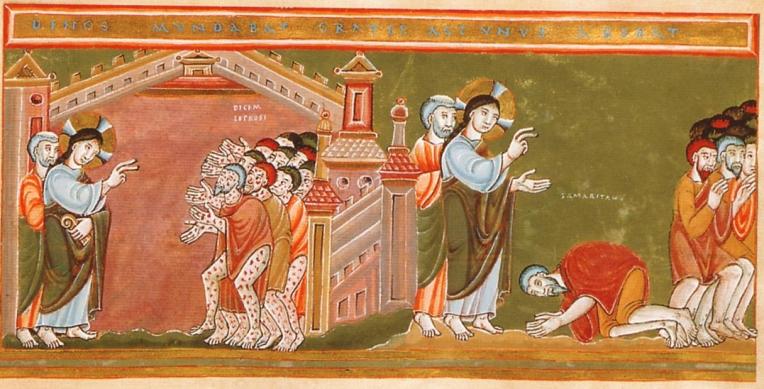
“Where are the other nine?”, Jesus asks.  “Has none but this foreigner returned to give thanks to God?”  This “foreigner” was a Samaritan, a group of Jewish people not only looked down upon by most other Jews.  The Samaritans, in fact, were people who refused to worship as God had asked in the Old Testament.  Nevertheless, in spite of this fact, Jesus praises this Samaritan because he knows the first responsibility of being given a gift:  that is, to give thanks in return.

The second way to die with Jesus is through our moral life.  When we decide whom to vote for in November, and when we decide whether or not to participate in gossip that someone else in the room initiated, and when we decide whether to spend money for luxuries, or for necessities, or for others, we are making moral choices.

Some moral choices are easy to make, but others demand a difficult dying-to-oneself.  It’s not difficult for a mother to love her infant and take care of him, although it might be more difficult at 2:00 a.m.  Nonetheless, the bond of love between mother and infant moves her to care for the child even when that requires self-sacrifice.

But other forms of dying-to-oneself are far more difficult, such as choosing to love someone who is not lovable, as an infant so naturally is.  This is akin to Christ’s love for you on the Cross.  His crucified love, in turn, has the power to lead you into the heavenly love who is the Most Holy Trinity, and even to let you dwell within this love during your earthly days.
Tuesday of the Twenty-seventh Week in Ordinary Time

Tuesday of the Twenty-seventh Week in Ordinary Time
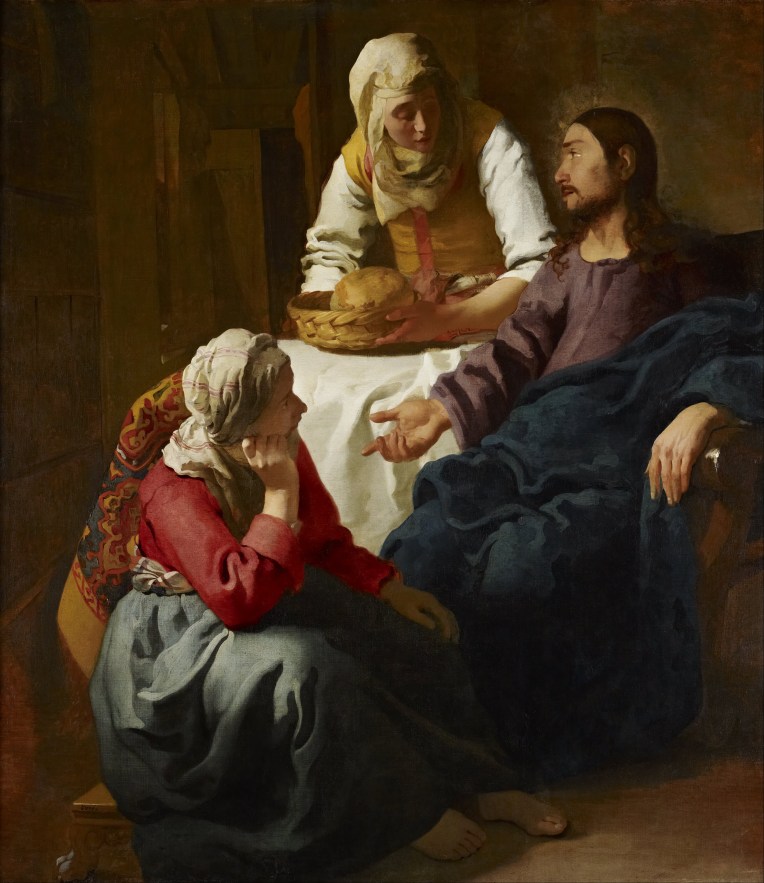
Luke 10:38-42

“Mary has chosen the better part and it will not be taken from her.”

In discussing, or learning about, the Catholic Faith, there’s often talk about how the Faith’s saving mysteries have a “both/and” dynamic at work.  The Church does not believe in reaching Heaven by “faith alone”; nor does she believe that one can earn Heaven by means of good works.  The Church’s perennial approach to the dynamic between faith and good works is “both/and”.  Likewise, Jesus is not a God who appears to be human, nor a human being that appears divine.  Jesus Christ is “both/and”:  fully divine and fully human.

Today’s Gospel passage raises another central duality among the Church’s saving mysteries.  The Church preaches that in the life of each Christian, both prayer and good works are vital to the Christian life.  Yet the point that Jesus makes in this passage is one of primacy.

Prayerful abiding at the feet of Jesus is primary in the Christian life.  Good works—even those done for Christ Himself—are secondary.  In turn, taking Jesus’ lesson here to heart helps us see that within every duality among the saving mysteries, one of the two is always prime.  Faith is primary to good works.  Jesus’ essential divinity is primary to His assumed humanity.  The Old Testament prepares for and is fulfilled by the New Testament.  The Liturgy of the Word prepares for and is consummated by the Liturgy of the Word made Flesh.

Our Christian faith challenges us to give ourselves over fully to all of the Church’s saving mysteries, yet to root our self-sacrifice in what is primary.  Striving to serve and striving to good works demands that we live like the sister of Martha:  beginning all we do with giving all we are in listening to Jesus.

Monday of the Twenty-seventh Week in Ordinary Time

Monday of the Twenty-seventh Week in Ordinary Time
Luke 10:25-37

“Teacher, what must I do to inherit eternal life?”

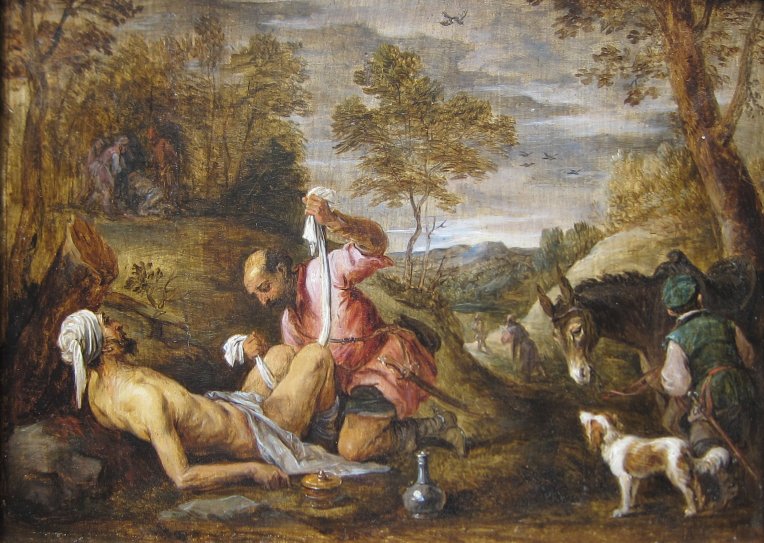
Today we hear one of the more famous parables of Jesus.  The Parable of the Good Samaritan ought profoundly to shape our spiritual and moral lives.  That order of things is important, however:  spiritual and then moral.

Although in a deeper sense there ought not be a distinction between our spiritual and moral lives, on the practical level, differences do mark the two.  We might say that the two are most sharply distinguished by sin.  The “scholar of the law” who “wished to justify himself” wants to be moral, but not spiritual.  Jesus demands that he be both, and that he be moral by being spiritual.

Mercy is the means by which the moral life is wedded to the spiritual life.  Or rather, mercy is the means by which the spiritual life begets authentic moral choices.  Were we not all children of Adam and Eve, fallen creatures, our moral choices would not demand mercy.  But in this world of sin and corruption, mercy is divine charity’s common currency.

In our spiritual lives, we look on each of our fellow human creatures through the eyes of God the Father.  We love each sinner, beaten and wounded by the sins of himself and others, with the mercy through which the Father sent His innocent Son to be slain for us.  Through this love, we can choose to serve the broken, bind the wounded, and know that in this service we serve God as well.