Tuesday of the Fourteenth Week in Ordinary Time

Tuesday of the Fourteenth Week in Ordinary Time
Matthew 9:32-38

“The harvest is abundant but the laborers are few ….”

The cry that we hear Jesus utter in today’s Gospel passage—“the harvest is abundant, but the laborers are few”—is one that we usually associate with the need for vocations in the Church.  But Jesus also speaks through these words about the harvest of one’s heart and the fruits of one’s soul.  In each person is a soul created by God, and each soul is capable of being completely filled, as much as it is able:  that is, to be “perfected” by God’s grace.

Unfortunately, this “harvest of the soul” is neglected by so many of us by our actions and our inaction.  We are not willing to believe what the Church teaches about God calling every human person to be a saint.  The Church at the Second Vatican Council spoke strongly about the “universal call to holiness”.

God gives each one of us many gifts, but only when we talk with God and are strengthened by Him do we learn how to use those gifts correctly, in accord with His plan.  Through our prayer, and God’s grace, our minds and wills can be formed, so that we can be more perfectly the saints God wants us to be.
Monday of the Fourteenth Week in Ordinary Time

Monday of the Fourteenth Week in Ordinary Time
Matthew 9:18-26

“Courage, daughter!  Your faith has saved you.”

In today’s Gospel passage are two people who see how God wants to be in their lives in time of need.  In our day and age, most prayers that are offered to God are prayers of petition.  Perhaps that’s always been the case.  In fact, our knowledge of that fact doesn’t mean that we ourselves don’t have lengthy lists of petitions that we’d like to offer to God.

It’s true that petitionary prayer—in which we ask for something from God—is not as selfless a form of prayer as adoration, or even as selfless as thanksgiving or contrition.  But God does desire that we present our petitions to Him.

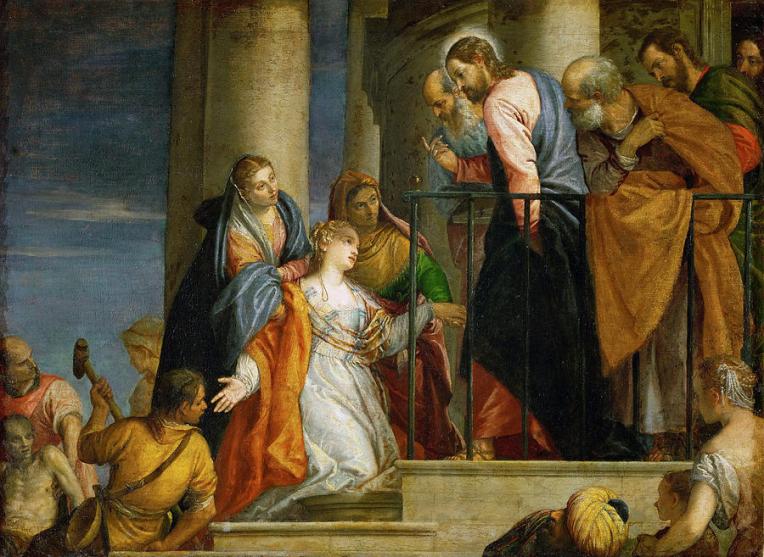
Consider the woman in today’s Gospel passage.  She had suffered for many years.  She interrupts Christ right in the middle of His trying to help someone else.  We should make that woman’s faith our own:  not simply her faith in Christ’s power, but also her faith in His patience and compassion.  There is no true need in our lives that we should not offer to God.

Of course, not every petition is answered as we wish, as are the petitions of this woman and the official.  Sadly, some Christians stop offering their petitions to God—or even stop believing in God—when He doesn’t provide the responses they want.  But growth in prayer requires the acceptance of God’s “No”’s, and learning through them to trust more deeply His providential Will.

Saturday of the Thirteenth Week in Ordinary Time

Saturday of the Thirteenth Week in Ordinary Time
Matthew 9:14-17

“Can the wedding guests mourn as long as the bridegroom is with them?”

It’s the disciples of St. John the Baptist—and not the saint himself—who appear and speak in today’s Gospel passage.  Nonetheless, today’s passage offers us similarities and contrasts between these two cousins:  one of them the voice of the Word, and the other the Word made Flesh.

One of the more obvious contrasts concerns fasting, and the fact that John’s disciples fast while Jesus’ do not.  But John’s disciples misunderstand the reason for this difference.  They misunderstand the relationship between John and Jesus.  Perhaps they thought of them as two equally inspiring religious figures.  Perhaps they thought of them as two equally valid paths leading to God’s righteousness.

In fact, John leads to Jesus.  John himself preached this clearly, but his disciples did not hear John clearly.

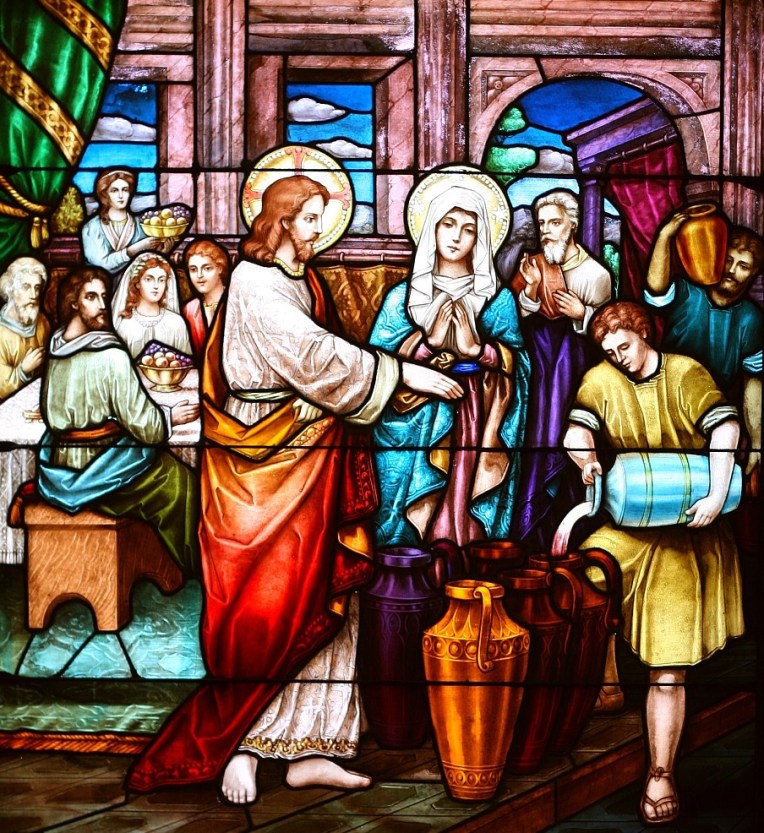
The last four sentences of today’s Gospel passage offer two mini-parables as a way to see these differences between John and Jesus.  Jesus is the new wine that must be poured into new wineskins.  This parable echoes His first public miracle at Cana [John 2:1-12].  To follow Jesus, a new approach to God must be accepted.  To be a disciple means to follow John in the constant need for penance and repentance.

OT 13-6 Wedding at Cana Mary