The Fourth Sunday of Easter [C]

The Fourth Sunday of Easter [C]
Acts 13:14,43-52  +  Revelation 7:9,14-17  +  John 10:27-30

“My sheep hear my voice; I know them, and they follow me.”

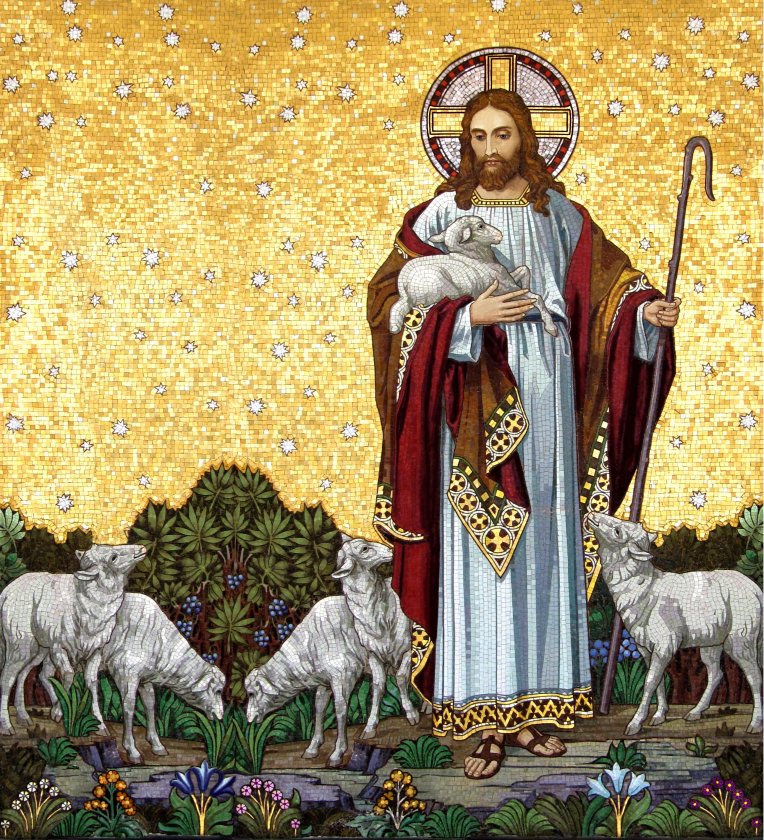
Jesus is our Good Shepherd.  He left the paradise of Heaven to seek out and save us who are lost sheep, who have mired ourselves in our sins.  The entire Season of Easter is about celebrating Christ’s victory over sin and death.  But on this Fourth Sunday of Easter, we reflect on the meaning of this truth for daily life.

The Fourth Sunday of Easter is traditionally called “Good Shepherd Sunday”.  This name stems from today’s Gospel passage, taken from the tenth chapter of John.  We Christians, although justified through the Sacrament of Baptism, continue throughout our lives to stray from God.  We need the Good Shepherd each day.

For the sake of our need, the Good Shepherd reveals Himself not only through the Gospel Reading.  He also proclaims who He is in the Responsorial:  “Know that the Lord is God; / He made us, His we are; / His people, the flock He tends.”

Ponder the words of this psalm.  After all, we don’t usually think of a shepherd as having “made” “the flock He tends.”  A shepherd might be involved in bringing together the ram and ewe that actually “make” sheep, but how could  you say that a shepherd “makes” his flock?  But that’s what the Bible says in today’s Responsorial Psalm.

The unusual fact that this Shepherd “made us” reveals our destiny, which is a loftier destiny than most sheep.  For your average sheep, its destiny is to provide wool, mutton, and milk.  The sheep is a means towards protection from the elements and nourishment.

But it’s foolish to think of us as sheep along these lines, because God needs neither protection nor nourishment.  So that begs the question:  why are the images of the Shepherd and His flock fitting to describe God and us?  What are we for?  For what end did this Shepherd make us?  In the venerable King James translation of Psalm 23, we hear:

“He maketh me to lie down in green pastures: he leadeth me beside the still waters.   He restoreth my soul:  he leadeth me in the paths of righteousness for his name’s sake.”

Here is why this Good Shepherd made us.  “For His Name’s sake” He made us:  for His sake, not for our own sake.  He made us for His life in Heaven, not for earth.  Unfortunately, too often, you and I not only live in this world.  We live for this world, and for ourselves as well.  The imagery of the 23rd Psalm evokes the reality of God’s life in Heaven:  “green pastures”, “still waters”, a table prepared by the Lord, and a cup that “runneth over”.

There’s a stark contrast here.  On the one hand are the natural differences between God and us fallen sinners.  On the other hand are the tender intimacy that the Shepherd has for, and wants for, His flock.  This is a closeness that we don’t deserve, but which the Shepherd desires for us.  The Good Shepherd will go to great extremes for His flock.  He will give up His life for His sheep.  In the same chapter that today’s Gospel passage comes from, Jesus says, “I am the good shepherd… just as the Father knows me and I know the Father; and I will lay down my life for the sheep” [John 10:14-15].  But Jesus will do even more.

In today’s Second Reading from the Book of Revelation, we hear St. John the Evangelist describe a vision that he had.  He points out that “‘the Lamb who is in the center of the throne will shepherd them and lead them to springs of life-giving water’”.  In fact, three times in today’s Second Reading—and forty times in the entire Book of Revelation—the word “lamb” is used by St. John.  But in this sentence from today’s Second Reading, he uses this word in an unusual way.  This “lamb” is also a “shepherd”“‘the Lamb who is in the center of the throne will shepherd them and lead them to springs of life-giving water’”. 

This “lamb”, of course, is the Risen Jesus.  This lamb is our Good Shepherd, the God who chose not only to become man, but also to offer His Body and Blood along with His soul and divinity on the Cross for you.  This crucified and risen God-man is a sheep like you, but also your divine shepherd.
Thursday of the Third Week of Easter

Thursday of the Third Week of Easter
Acts 8:26-40  +  John 6:44-51

“… the bread that I will give is my flesh for the life of the world.”

Jesus first declares, “I am the Bread of Life.”  Then He describes Himself as “the bread that comes down from Heaven so that one may eat it and not die.”  Third, Jesus calls Himself “the living bread”.  In all three of these statements, Jesus explains that He is not just nourishment.  Jesus is a bread that offers a life stronger than death.

“Life” is what Jesus is as God, in His divine nature.  “Bread” is what Jesus is for us, in His human nature.  So it’s through Jesus’ human nature that He reveals His love for us, and allows us to share in His love.

This Bread, in other words, is for you, but not about you.  Through the Bread of Life you grow in the likeness of the divine person of Jesus Christ.  Through the Bread of Life you participate in divine life.

Then Jesus reveals this awesome Mystery even further.  In the very last phrase of today’s Gospel passage, Jesus stakes the claim that makes or breaks His disciples:  not just that He is bread, and not just that as bread He gives life that’s stronger than death.

Jesus declares:  “the bread that I will give is my Flesh for the life of the world.”  Jesus is not just “bread”.  He is not just “food for the hungry”.  Jesus is not just bread that offers life.  He is not just bread that strengthens you to survive death.  Jesus is the divine Word made Flesh, and His Flesh is the bread that He “will give for the life of the world.

Easter 3-4

Wednesday of the Third Week of Easter

Wednesday of the Third Week of Easter
Acts 8:1-8  +  John 6:35-40

“… whoever comes to Me will never hunger, and whoever believes in Me will never thirst.”

One benefit of attending weekday Mass is how the experience of Sunday Mass is more enriching.  During Easter this is even more true.  The Scripture readings of weekday Masses especially tend to dovetail with those of Sunday Masses.

Starting last Friday and continuing through this Saturday, the Gospel passage at weekday Mass is from John Chapter Six.  This chapter culminates in Jesus’ teaching about His Real Presence in the Eucharist.  In this coming Sunday’s Gospel passage, Jesus describes Himself as the Good Shepherd.  Through these Scripture passages, we can deepen our faith in Christ by understanding more deeply who He is for us.

In today’s Gospel passage, Jesus first states, “I am the bread of life”, emphasizing His Eucharistic doctrine.  But about two-thirds of the way through the passage, He focuses upon the sort of action a shepherd carries out.  He states:  “this is the will of the one who sent me, that I should not lose anything of what he gave me”.

As we read, and re-read John Chapter Six, we become aware of how Our Lord is weaving together several different truths about Himself.  He does this in order to deepen our love for Him, and faith in Him.  In these two truths—Jesus as the Bread of Life, and Jesus as the Shepherd who sacrifices Himself for us—we see why Holy Mother Church calls us to see Jesus as “our All”.  The Church, in one of the prefaces at Mass for Easter, likewise chants the following to God the Father:  “By the oblation of His Body, / [Jesus] brought the sacrifices of old to fulfillment / in the reality of the Cross / and, by commending Himself to You for our salvation, / showed Himself the Priest, the Altar, and the Lamb of sacrifice.”

Easter 3-3

Sts. Philip & James, Apostles

Sts. Philip & James, Apostles
1 Corinthians 15:1-8  +  John 14:6-14

“Whoever has seen Me has seen the Father.”

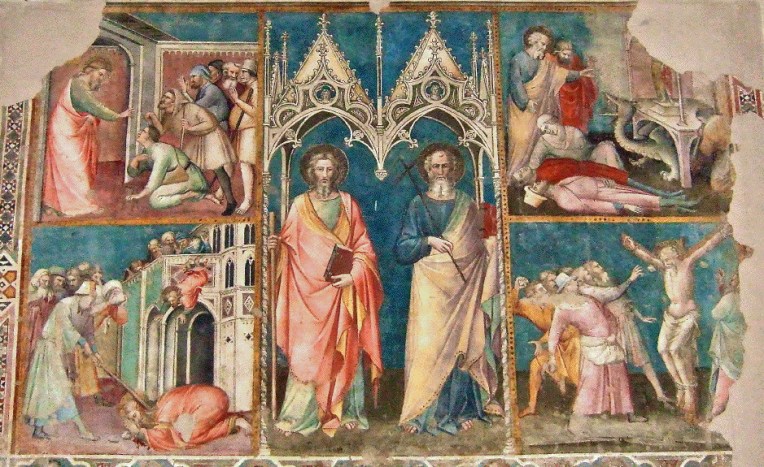
Throughout the Easter Season, the Scriptures at Holy Mass focus our attention upon several recurring themes.  Examples of this are the Good Shepherd, the Bread of Life, and the unity of the Church.  As is fitting for the feast of two apostles, the Scriptures for today’s feast of St. Philip and St. James highlight how the Church’s foundation is apostolic.  Of course, the role of the apostles goes beyond the Church’s beginning.

Those ordained to the office of bishop continue to carry out the work first entrusted to the apostles.  Each and every member of the Church has a vocation that is missionary in nature:  in fact, “apostolic” in nature, inasmuch as the word “apostle” literally means “one who is sent”.  Every Christian is called to “go outside himself” and share with others the natural and supernatural gifts he has received.  Most Christians do this chiefly through family life, and in the secular workplace and community.  We might say that the laity are apostles “ad extra”, outside the walls of the Church.

However, within the Church, those called to the office of bishop have a unique role.  While laypeople proclaim the Gospel within the domestic church and in the workplace and community, bishops proclaim the Gospel to all of the Church’s members, and this chiefly through the Sacred Liturgy.  The Gospel is meant—among other goals—to bring order to chaos:  that is, to foster unity.  Everyone who is a member of a family, a neighborhood, a parish, etc. knows how difficult it can be to cultivate unity.

Unity is the first of the Church’s four marks for a reason.  Apostolicity serves her unity.  For this reason, then, pray for your local bishop and for our universal bishop, His Holiness the Pope, called to preside in charity over the Church throughout the entire earth.

Monday of the Third Week of Easter

Monday of the Third Week of Easter
Acts 6:8-15  +  John 6:22-29

“… believe in the one He sent.”

In today’s Gospel passage from John 6, we hear the crowd ask Jesus two questions.  First they ask, “Rabbi [meaning, “Teacher”], when did you get here?”  Jesus doesn’t answer their question, but He confronts them with the fact that they are only concerning themselves about their physical hunger.  It was for this reason that they had wanted to make Him their king.  But Jesus wants them to want something greater.

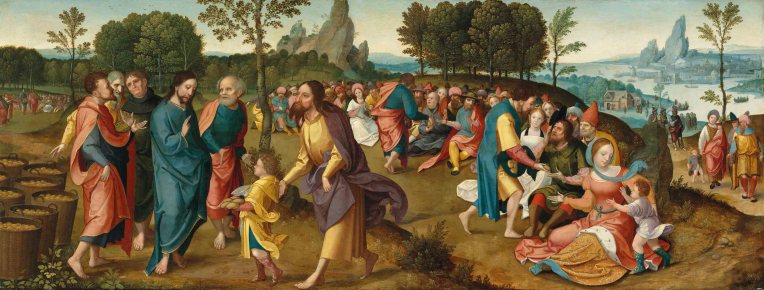
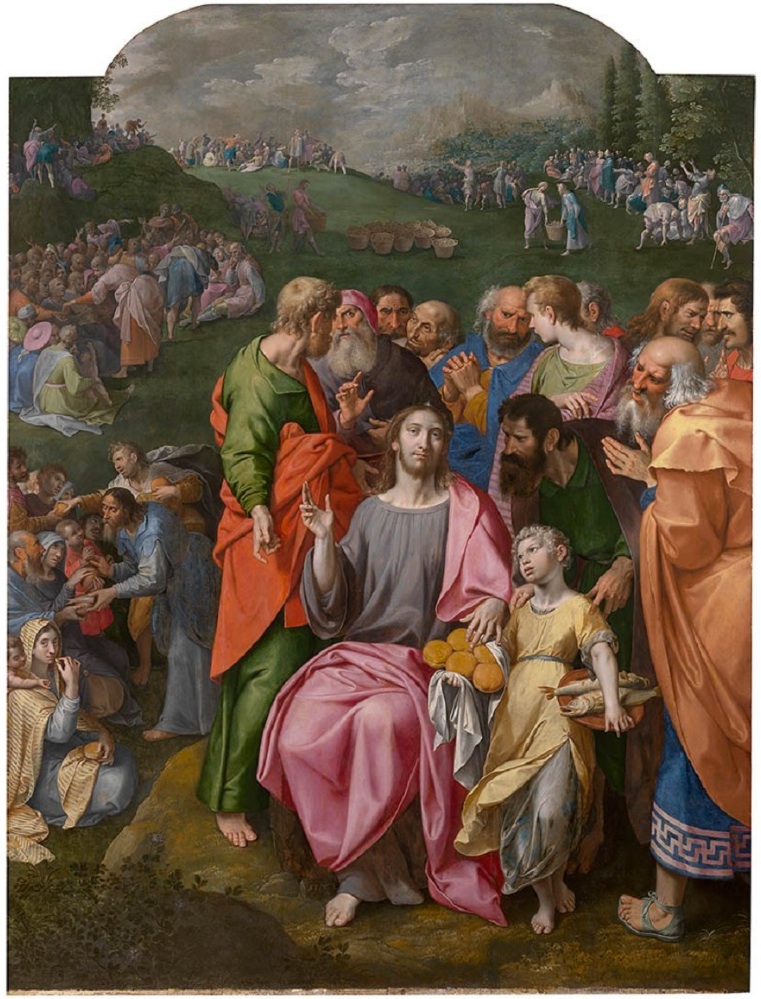
Towards this end, He shifts their attention from the physical hunger that He satisfied shortly before through the multiplication of loaves, to the spiritual hunger that He will satisfy later through the Institution of the Holy Sacrifice of the Mass.  To the extent that they understand how Jesus is trying to shift the direction of their conversation, the crowd wants in.

So they ask Jesus their second question:  “What can we do to accomplish the works of God?”  Jesus’ response is brief.  The work of God is to have faith in the One He sent.  In other words, they do not themselves have the means to satisfy this hunger:  there is no spiritual refrigerator, supermarket, or field for them to go to.  Their spiritual hunger is not only for something to fill the emptiness inside their souls.  That hunger is also for something to fill the emptiness around them.  For there is nothing around them in the world that is capable of sustaining them eternally, but only dependence upon God through the divine virtue of faith.

Easter 3-1