Wednesday of the Third Week of Advent

Wednesday of the Third Week of Advent
Isaiah 45:6-8,18,21-25  +  Luke 7:18-23
December 15, 2021

“In the Lord shall be the vindication and the glory of all the descendants of Israel.”

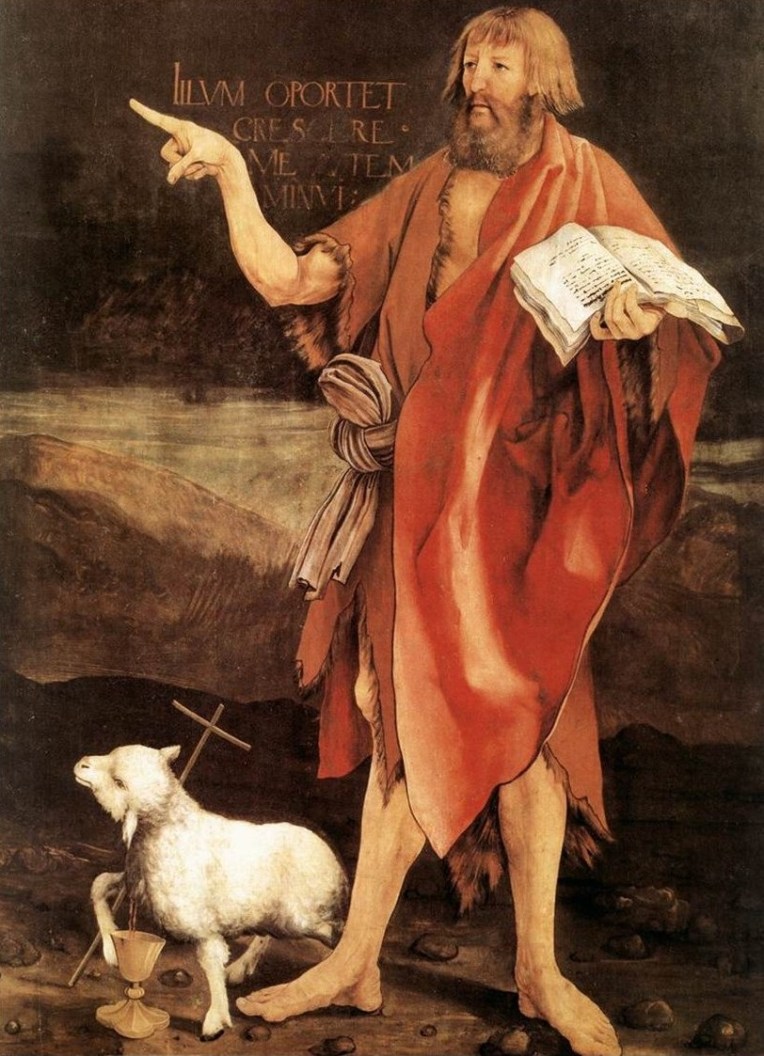
Confusion sometimes arises from the question that John the Baptist in today’s Gospel Reading instructs his disciples to ask Jesus.  People wonder:  “Doesn’t this question—‘Are you the one who is to come, or should we look for another?’—suggest that John the Baptist wasn’t really familiar with his cousin Jesus, and was even uncertain about the role of Jesus in the Lord God’s plan for Israel?”  The answer, of course, is “No.”  But why then does John instruct his disciples to ask this question?

By way of answering, we might point out that John isn’t sending his disciples for his own sake, but for theirs.  John wants each of them to encounter Jesus and hear Jesus’ answer to the question as a sort of initiation into a relationship with Jesus.

However, one might in response ask a further question.  “Why, then, did Jesus answer the disciples’ question by saying, ‘Go and tell John what you have seen and heard ….’?”  The fact is that these disciples need for the time being to remain under the instruction of John the Baptist.

Jesus does not say to these disciples what He said to Peter and Andrew:  “Come, follow me.”  These disciples, like us during Advent, need to sit at the feet of John the Baptist and allow his message to sink more deeply into our hearts before we can be true disciples of the Lord Jesus.

St. John of the Cross, Priest & Doctor of the Church

St. John of the Cross, Priest & Doctor of the Church
Zephaniah 3:1-2,9-13  +  Matthew 21:28-32
December 14, 2021

“Which of the two did his father’s will?”

Like the one proclaimed on Thursday of the First Week of Advent [Mt 7:21,24-27], today’s Gospel Reading from the twenty-first chapter of Matthew focuses upon good works.  Both of these passages contrast mere words with resolute works.  Yet there’s a further similarity that’s even more important.

In the passage from Matthew 7, Jesus insists that for one to enter Heaven, one must do the will of God the Father.  In today’s Gospel Reading, Jesus proclaims a parable at whose center is a father with two sons.  The human father in this parable is a symbol of God the Father.

This focus of God the Father can help you see that it’s not your own human will that’s key in your life.  The key is the will of God the Father.  This is the same Father who within salvation history loved His erring children—those resembling the first son in today’s parable—enough to send His only divine Son to die for them.  The Father “willed” that His Only-Begotten, the one who in all things does His Father’s will—even on Calvary—sacrificed His life for the sinful son, who is you and me.

Monday of the Third Week of Advent

Monday of the Third Week of Advent
Numbers 24:2-7,15-17  +  Matthew 21:23-27

He guides the humble to justice, / he teaches the humble his way.

Humility is not a virtue with much currency in the modern world.  The modern world would be more likely to consider humility a vice or stumbling block to virtue.  The modern world’s key principle is what Nietzsche called the “will to power”.

Yet the Gospel from beginning to end is a way marked by humility.  We might say that humility is in fact each step along this way.  This is why St. Thérèse called the living of the Gospel the “Little Way”.

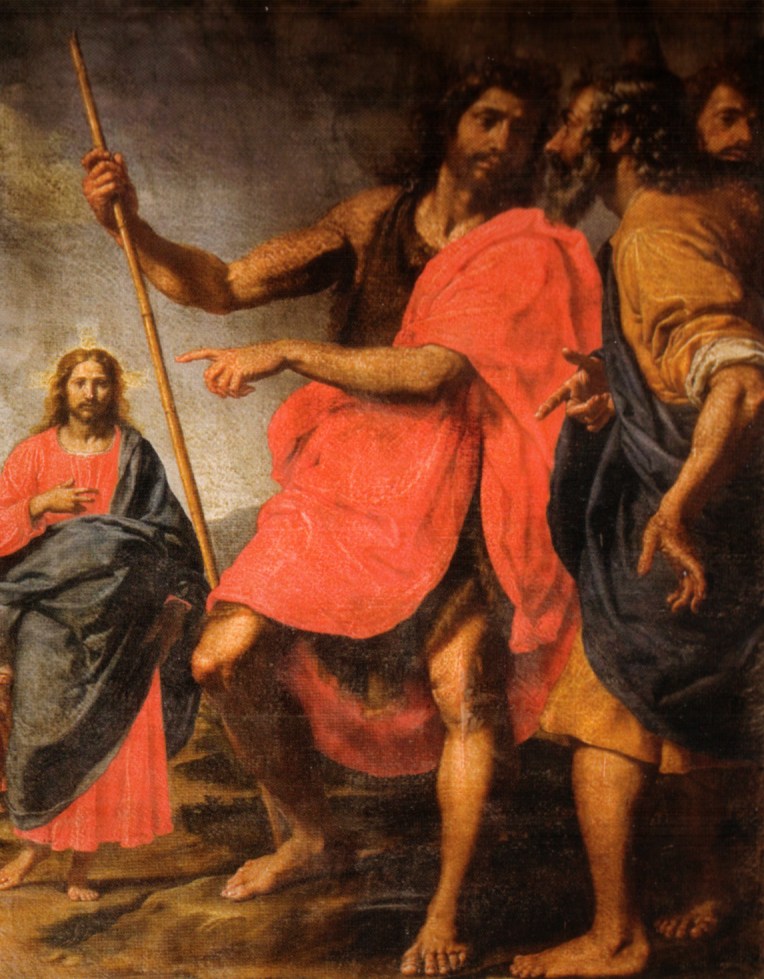
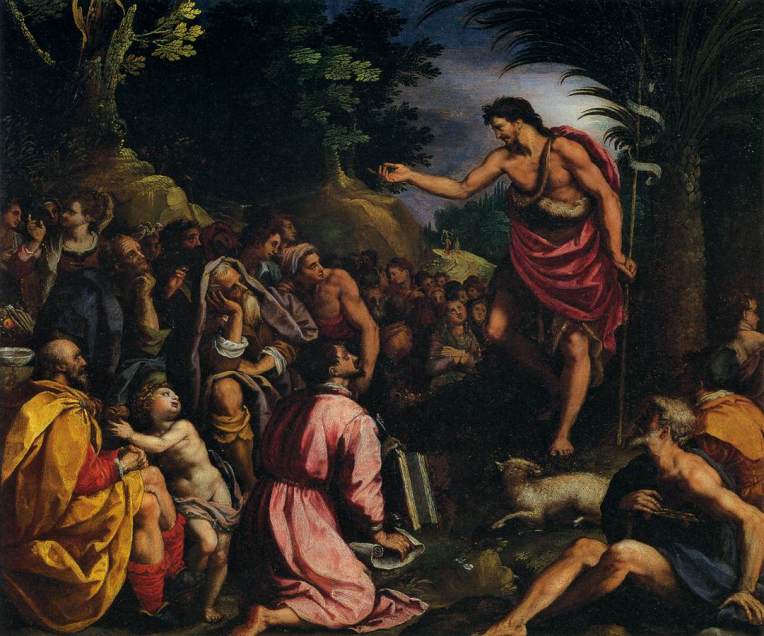
This little way begins with St. John the Baptist, who in different ways appears at the start of each of the four Gospel accounts.  This way leads to Mount Calvary and the Via Dolorosa.  There we learn that the Cross is the Lord’s will to power.  Let’s listen to St. John the Baptist’s message since he teaches us the first steps along His way.

4x5 original

Saturday of the Second Week of Advent

Saturday of the Second Week of Advent
Sirach 48:1-4,9-11  +  Matthew 17:9,10-13
December 11, 2021

Then the disciples understood that He was speaking to them of John the Baptist.

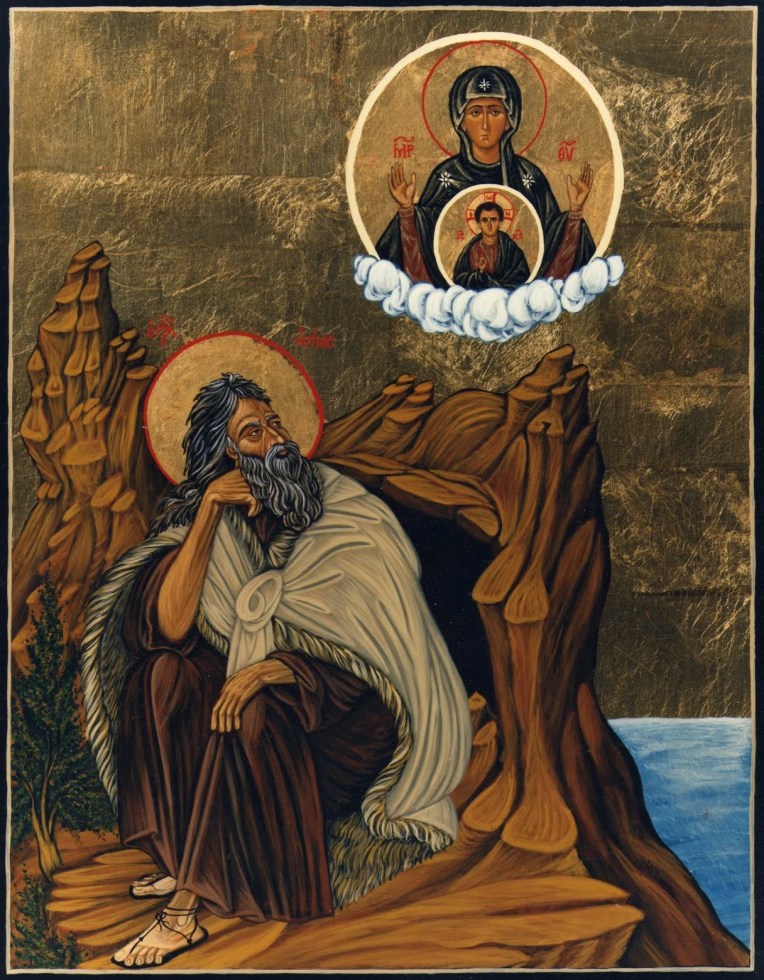
Both the First Reading and the Gospel Reading of this morning’s Mass speak of the Old Testament prophet Elijah.  His importance in the Old Testament is highlighted by the fact that he (along with Moses) appears with Jesus at the Transfiguration.

There are eighteen prophetic books in the Old Testament.  Yet Elijah’s importance is highlighted by the fact that he’s also mentioned within the Wisdom literature of the Old Testament:  in the case of this morning’s First Reading, in the Book of Sirach.  In this passage, Elijah is brought to our attention not only because he has a prophecy for us to attend to, and not only because at the end of his earthly life he ascended to Heaven in a flaming chariot.  Such is the holiness of Elijah that the person is “blessed” who “shall have seen [him] and who falls asleep in [his] friendship.”

In the Gospel Reading, however, Jesus mysteriously identifies St. John the Baptist with Elijah.  While Jesus does not elaborate upon this identification, we know that Elijah and St. John the Baptist are both ultimately important for the same reason:  because they foreshadow the advent of the Messiah.  As we reflect upon the prophetic ministry of Elijah, we ask the Lord to allow Elijah’s words and deeds to motivate us to accept Christ when He comes.

Friday of the Second Week of Advent

Friday of the Second Week of Advent
Isaiah 48:17-19  +  Matthew 11:16-19
December 10, 2021

“But wisdom is vindicated by her works.”

There are many points that one might conclude from Jesus’ enigmatic statement that “wisdom is vindicated by her works.”  Consider one point about wisdom, and another about wisdom’s works.

Wisdom can be considered from the perspective of God’s own nature, or in terms of what God freely chooses to do in salvation history.  In the Catholic tradition, this consideration would be referred to in terms of the “immanent Trinity” and the “economic Trinity”.

What Jesus declares in today’s Gospel Reading ought to be considered in terms of God’s work of salvation history:  creation, redemption, and sanctification.  This is especially so in terms of wisdom being “vindicated”.  The masterpiece of Saint Augustine of Hippo, The City of God, explores the vagaries of salvation history, which often seems to hold more troughs than peaks; more sin than grace; and more sinners than saints.

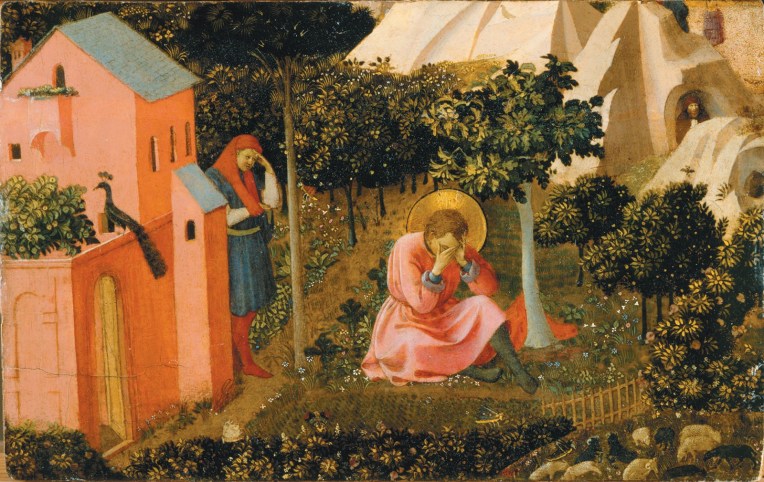
When it comes to salvation history, God certainly plays a “long game”.  This ought to comfort those of us who waste so many years of our lives following our own interests rather than God’s.  Saint Augustine explored this sad dynamic in his own life in another of his masterpieces, The Confessions.  Fortunately for each of us, God loves us more than we love ourselves, and in Jesus is willing to make our sins His own so that His wisdom might prevail over our folly.

The Conversion of St. Augustine of Hippo by Fra Angelico

The Third Sunday of Advent [C]

The Third Sunday of Advent [C]
Zephaniah 3:14-18  +  Philippians 4:4-7  +  Luke 3:10-18

“Now the people were filled with expectation, and all were asking in their hearts whether John might be the Christ.”

If there’s one word that sums up the Lord’s coming—both 2000 years ago as He came to Mary, and this year as He wishes to come to you—that one word would likely be “expectation”.  The word “expectation” connotes both waiting and hopefulness.  As an example, think of children during December who write out their wish lists with the expectation of a visit from Saint Nicholas.  However, in English the word “expecting” is also related to the experience of pregnancy, which of course in the person of Mary lies at the heart of Advent.

Yet in today’s Gospel passage, there’s a heightened sense of expectation.  Think of children at the beginning of December expecting St. Nicholas’ visit, and then think of those same children on Christmas Eve, with their expectation brimming over.  The latter is the sense of expectation that the evangelist evokes in today’s Gospel passage, telling us that “the people” were not just in expectation of “the Christ”, but in fact “were filled with expectation”.

Then, however, the other shoe drops.  The evangelist explains that the people “were asking in their hearts whether John [the Baptist] might be the Christ.”  This is bittersweet, since we know that the expectation of the people is misplaced.

Here, though, is a spiritual lesson for us.  The evangelist wants us to profit from the mistake of those who mistook John for the Christ.  Even though you and I know that John the Baptist was not the Christ that the people in today’s Gospel passage were hoping for, we’re not off the hook.

More often than we like to admit, we act like the people in today’s Gospel passage.  We look for Christ in all the wrong places.  Furthermore, without an authentic encounter with Christ, we end up looking for happiness in all the wrong places.

Consider some of the wrong-headed ways that fallen human beings look for happiness in life.  St. Thomas Aquinas, in his summary of theology, explores the more common ways that man falsely seeks lasting happiness in this world.  He names eight, the first four of which are specific goods:  wealth, honor, fame, and power.  While each of these certainly can be good, and can be stepping stones to true happiness, it’s vain to search for lasting happiness in things such as wealth, honor, fame, and power.

Here’s another way to contrast the difference between authentic and false sources of happiness.  All you have to do is reflect on your pet dog Fido.  Fido has some base understanding of the value of food and drink and shelter.  Fido might also appreciate a vehicle:  not only because it saves him from getting tired, but also because he loves to stick his head out the window into the breeze.  It’s true that Fido might have a harder time understanding the value of clothing, although if you took him with you on vacation to Alaska in January, he probably would appreciate that doggie sweater that you got him for Christmas.

But Fido cannot understand coins or bills or stock certificates having any value.  He would only understand that there’s value in the food or whatever else you purchase with money.  Fido is more sane than fallen man.  Maybe that’s why the dog is man’s best friend:  because he keeps us grounded in what is real.

Fido can keep us from looking up at what we should look down upon.  Unfortunately, Fido cannot help us look up to what we ought to look up at.  Fido can help us from having false gods, but he cannot help us find the true God.

In the end, just like Johnny Lee, fallen man spends a lot of time looking for love in all the wrong places, and in too many faces.  There’s only one Face in which fallen man can find abiding happiness, and that’s in the Divine Face of Jesus.

Picture Mary after she gives birth to Jesus.  She looks at the Face of her newborn Son.  As she looks at Him, Mary knows what is truly important in life.  She encounters Jesus as she gazes at Him, and commits herself to Him.  That’s the sort of focus and priority that each of us can strengthen inside our hearts, minds, and souls by celebrating the rest of Advent and Christmastide with joy and faith.
Thursday of the Second Week of Advent

Thursday of the Second Week of Advent
Isaiah 41:13-20  +  Matthew 11:11-15

“And if you are willing to accept it, he is Elijah, the one who is to come.”

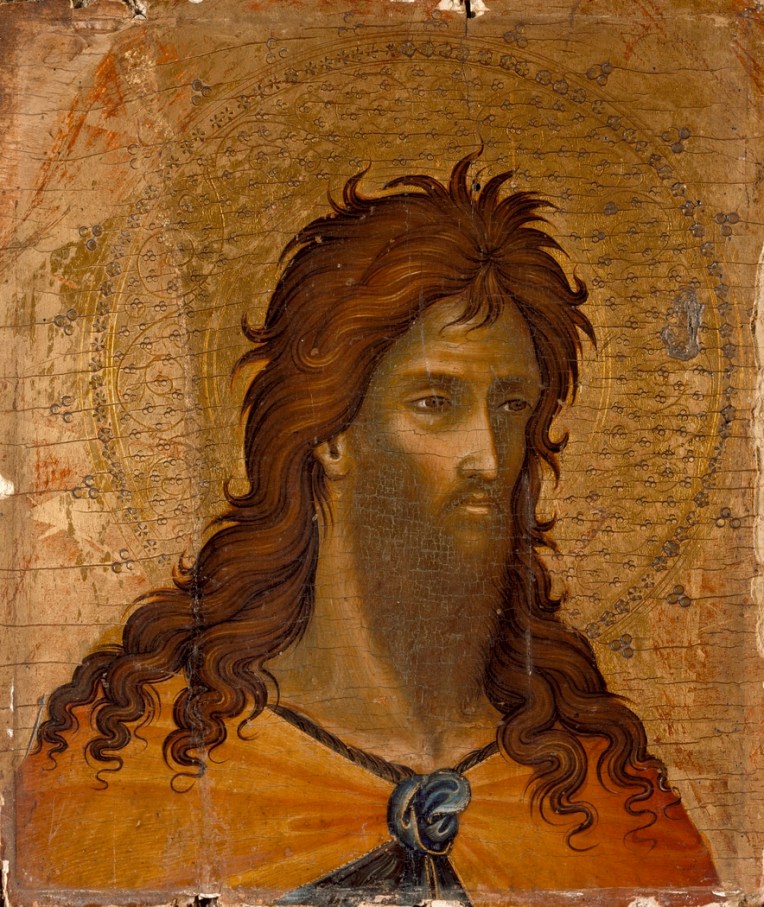
St. John the Baptist is a major figure of the early weeks of Advent.  On several of the weekdays in the week leading up to Christmas Day, the Church proclaims passages in which we hear of the Nativity of St. John the Baptist.  The Church, through these passages from St. Luke’s Gospel account, wants us to compare the nativities of John and Jesus in order to understand the connection between the two.

Today’s Gospel Reading is set during the public ministry of Jesus, who declares that John the Baptist “is Elijah, the one who is to come”.  How are we to understand this declaration?  The last book of the Old Testament can help us.  In Malachi 3:23 the Lord of Hosts proclaims:  “Now I am sending to you / Elijah the prophet, / Before the day of the Lord comes, / the great and terrible day”.

During Advent we might well identify “the day of the Lord” with the Nativity of Jesus.  But we ought to remember that Jesus was born at Bethlehem in order to die at Calvary.  The day of Jesus’ death on Calvary is more properly “the day of the Lord”, for on that Good Friday the Lord Jesus took upon His shoulders the sins of all mankind.  That day of Good Friday is “the great and terrible day” of which the Lord speaks in Malachi, and for which St. John the Baptist means to prepare us.

St. Ambrose, Bishop & Doctor of the Church

St. Ambrose, Bishop and Doctor of the Church
Isaiah 40:1-11  +  Matthew 18:12-14
December 7, 2021

“… it is not the will of your heavenly Father that one of these little ones be lost.”

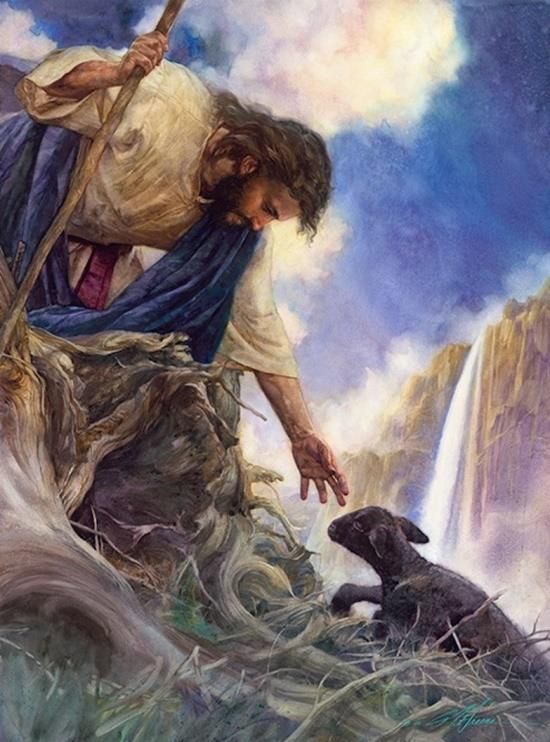
It’s always comforting to think of the Good Shepherd.  But why does the Church evoke this image today on a weekday of Advent?

In today’s brief Gospel Reading, Jesus speaks to the motive of His Incarnation.  While there have been theologians who have speculated that the Son of God would have become human even had mankind never sinned, in the actual course of salvation history, man did sin.  In response to man’s sin, God could have freely chosen to abandon His fallen creature.

Instead, God chose from Heaven to act like a Good Shepherd.  He descended from the perfection of Heaven in order to enter a world of sin and darkness.  The sacrifice of His whole self—Body and Blood, soul and divinity—within that world reflects the love of God’s divine nature, which through the Incarnation you and I have the chance to enter into for eternity.

Monday of the Second Week of Advent

Monday of the Second Week of Advent
Isaiah 35:1-10  +  Luke 5:17-26
December 6, 2021

The desert and the parched land will exult; the steppe will rejoice and bloom.

In today’s First Reading from the thirty-fifth chapter of Isaiah, “the desert” is a focus.  This focus is apt for the first two weeks of Advent, when St. John the Baptist is so often at the forefront of the scripture passages we hear.  The desert, after all, is where John the Baptist dwells.  In the desert he carries out his ministry of preaching and baptizing, both of these for the sake of repentance.

Yet in spite of the desert’s connection with solitude and penance, and as fruitful as points can be for our Advent meditation, today’s First Reading describes the desert for a different purpose.  Isaiah describes the desert for the sake of illustrating, in a phrase, the “reversal of fortune” that the Lord’s merciful love will effect when He comes.

The desert is a place where little to nothing grows.  Yet when the Lord come, “the parched land will exult”, “will bloom with abundant flowers, and rejoice with joyful song.”  This is not the only reversal of fortune that Isaiah foretells in this passage.  Through the Lord’s power “the eyes of the blind be opened, the ears of the deaf be cleared”, and “the lame leap like a stag”.  The Lord brings life to what seems dead, as the birth of Jesus offers hope for new life to fallen man.

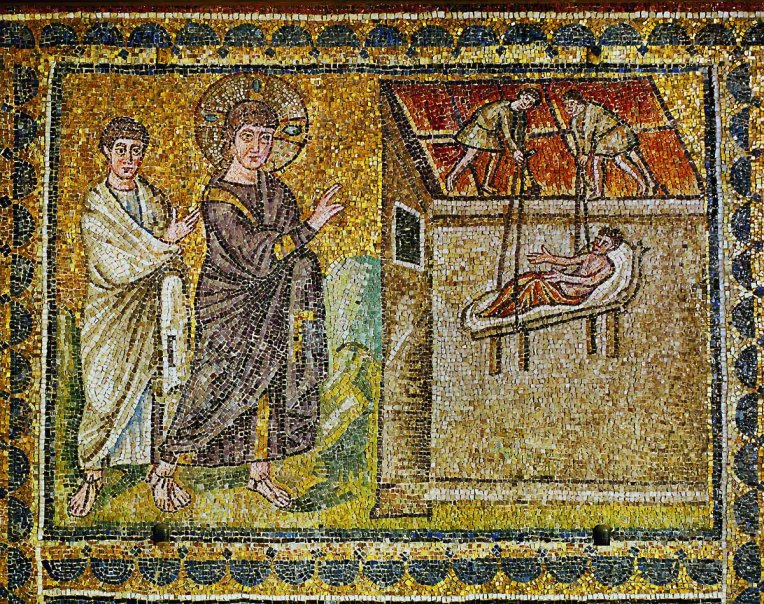
The paralytic lowered from the roof, Jesus and an apostle. Mosaic (6th)