The Thirty-second Sunday in Ordinary Time [B]

The Thirty-second Sunday in Ordinary Time [B]
I Kings 17:10-16  +  Hebrews 9:24-28  +  Mark 12:38-44

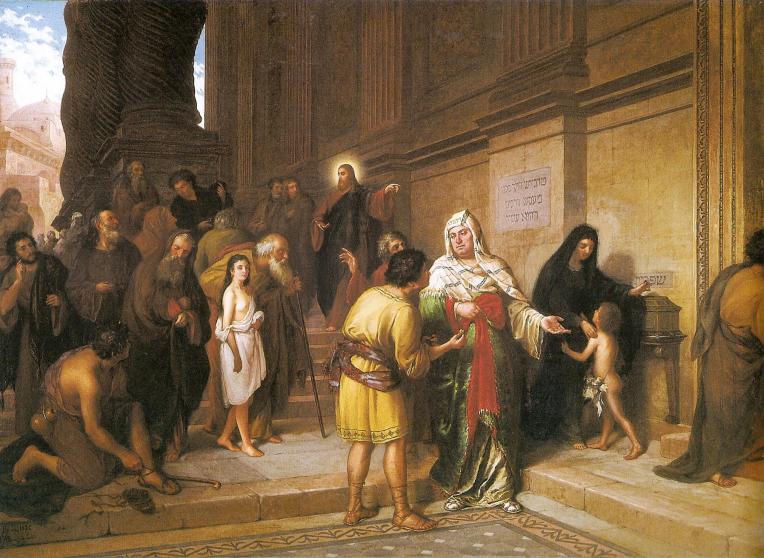
“… she, from her poverty, has contributed all she had, her whole livelihood.”

Tithing is a biblical tradition by which one can carry out the Precept to support the Church materially (CCC 2043).  Yet tithing demands more from some than others.  To illustrate, say that the currency that the characters in today’s Gospel passage put into the treasury was dollars.  And let’s say that one of those “rich people” earned $100,000 a year, and that in today’s Gospel passage, this rich person put $10,000 into the treasury:  in other words, 10% of his annual income.  Certainly that’s a large sum.

So then imagine that the “poor widow” had an annual income of 20 small coins.  The “two small coins” that she put into the treasury was ten percent of her annual income.  But at the time of today’s Gospel passage, those “two small coins” were all she had in her possession.  She had no savings or checking account, no mutual funds or IRA, no annuity, stocks, or bonds.  She had no husband, no children or extended family, no Social Security or Lord’s Diner.  This widow, “from her poverty, … contributed all she had, her whole livelihood.”

By contrast, the rich person who put ten thousand dollars into the treasury had more where that came from.  As Jesus said, the rich person “contributed from [his] surplus wealth”.  So while the rich person and the poor widow both may have given equal percentages of their income, the rich person still gave from his surplus, while the poor widow gave “from her poverty”.

Jesus points our attention towards—and wants us to imitate—this “poor widow” giving “from her poverty”.  That’s easier said than done.  But there are at least two ways to make this easier.  The first is a virtue to be cultivated, and the second is a practice to be followed.

First is the virtue of trust:  specifically, putting one’s trust in God.  The virtue of putting trust in God first means acknowledging that God is your providential Father.  God has made you for Himself, and you can only reach Him in Heaven by surrendering each day to the One who is your providential Father.

What practice, then, might help us concretely to give like the “poor widow”?  It’s the practice of giving “first fruits”.

Giving God one’s first fruits is rooted in Sacred Scripture.  Of course, the examples in the Bible of giving from one’s first fruits are literal, based on harvesting different grains grown by many of God’s People.

Consider a farmer with 1000 acres.  In ancient times, having only primitive tools meant that it would take him a long time to harvest 1000 acres.  At any point during that stretch of harvest time, bad weather could destroy the remaining crops.  So for a farmer to give the fruits of the first hundred of his acres to be harvested—not knowing how much of the remaining 90% would ever be harvested—was a concrete act of trust on the part of that farmer.

So how would a modern person relate such a biblical example to giving one’s treasure to God?  How could one today imitate the “poor widow” in giving one’s “first fruits”?

Maybe the simplest way would be—to use a modern expression—by giving to God off the top.  If you haven’t gone green when it comes to paying bills, and if you don’t pay all your bills by means of automatic withdrawal, then each month you have a stack of paper bills to pay.  Many Christians are tempted to give God from their “leftover treasure”:  if, that is, there is any treasure left over after the bills are paid.  Instead, you can metaphorically offer God the first fruits of your monthly treasure by giving to God a sacrificial amount before even touching the first bill that needs to be paid.

There are many other practical ways to include one’s personal finances within the sphere of one’s spiritual life, rather than falsely thinking that the two have nothing to do with each other.  This inclusion—your finances within your spiritual life—demands the virtue of trust.  The foundation of this trust is the wisdom that the “poor widow” demonstrated:  knowing oneself to be nothing without God.  Knowing oneself to be nothing without God is the foundation that allows us to give from our poverty, and allows God to bear abundant fruit through our lives.
St. Charles Borromeo, Bishop

St. Charles Borromeo, Bishop
Romans 14:7-12  +  Luke 15:1-10
November 4, 2021

“This man welcomes sinners and eats with them.”

Jesus’ first parable in today’s Gospel is heartfelt, offering us hope of God’s compassion for the wayward.  Jesus offers a “moral” to the parable in explaining that “there will be more joy in Heaven over one sinner who repents than over ninety-nine righteous people who have no need of repentance.”

Although Jesus’ “moral” seems straightforward enough, there is something about it that seems paradoxical.  Wouldn’t it make sense for the “righteous” to rank higher in Heaven than the repentant?  Why isn’t there such rejoicing in Heaven over the righteous?  There are at least two responses that might be offered.

First, the “righteous” of whom Jesus is here speaking are defined by the righteous themselves.  Yet such self-righteousness is a false righteousness.  Only God can make a human person righteous.

Second, those who are righteous in the true sense of the word are so only through their repentance.  A saint is a sinner who knows he’s a sinner.  In this sense, all human beings in Heaven (excepting, of course, Our Lord and Our Blessed Mother) are righteous through their self-repentance.  You and I as sinners rejoice that the Lord has not left us in our sins, but has offered us His grace, which is the means to righteousness in God’s sight.

OT 31-4

Wednesday of the Thirty-first Week in Ordinary Time

Wednesday of the Thirty-first Week in Ordinary Time
Luke 14:25-33

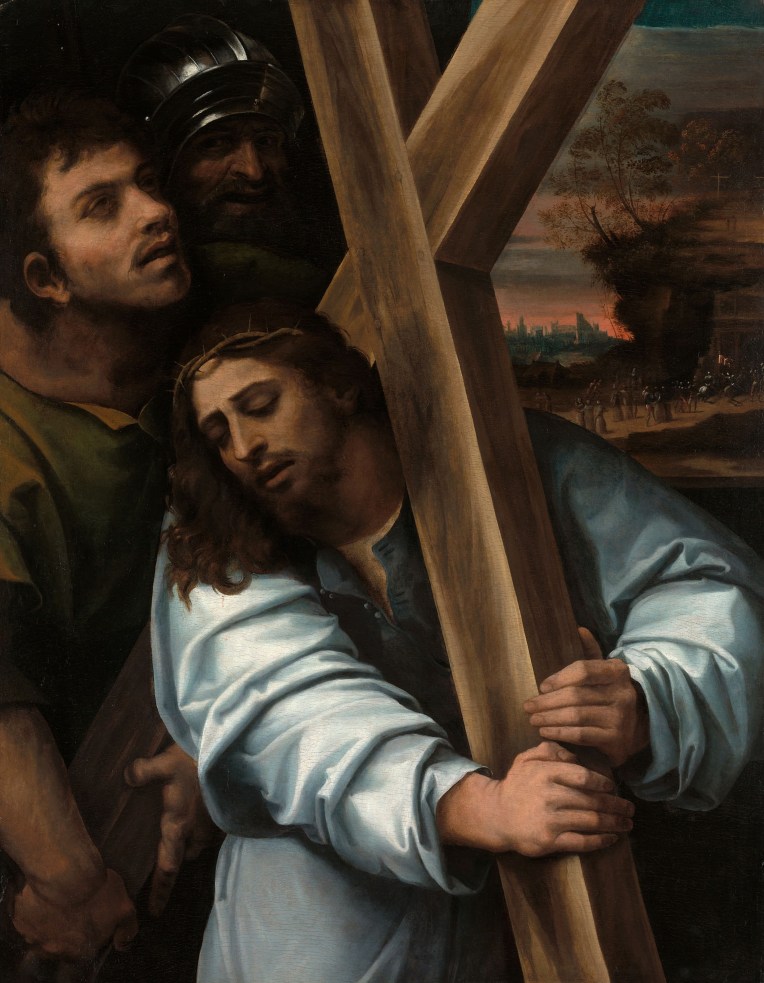
“Whoever does not carry his own cross and come after Me cannot be My disciple.”

The Catholic approach to following Jesus is not “either/or”, but “both/and”.  Throughout the course of the Church’s two thousand year history, various heretical groups have tried to split apart aspects of the Catholic Faith that God means to be wedded to each other.  For example, regarding the person of Jesus Christ, some heretics have falsely taught that Jesus is only a human being, and not divine.  In turn, other heretics have falsely taught that Jesus is only divine, and not human.  There are serious consequences to believing in either of these falsehoods.  By contrast, salvation is only possible if Jesus Christ is both fully divine and fully human.

In today’s Gospel passage, Jesus speaks to an area of the Christian life that calls for another “both/and”:  faith and good works.  There are some who claim that faith in what Jesus accomplished two thousand years ago on Calvary is enough to reach Heaven.  Jesus insists, however, that both faith and good works are needed.  Not only must a Christian have faith in Christ’s saving work on Calvary.  One must also conform the whole of one’s life – heart, mind, soul, and strength – to what Christ accomplished on Good Friday.  This is what He refers to when He insists:  “Whoever does not carry his own cross and come after Me cannot be My disciple.”

The phrase “his own cross” distinguishes that the disciple is an individual with free will:  he may choose to carry his own cross, or not to carry his own cross.  Nonetheless, when the disciple – with faith in the power of Jesus’ saving death and resurrection – carries “his own cross”, he is not merely following Jesus at a distance.  Carrying one’s own cross is not only a moral act.  For the Christian, carrying one’s own cross after Jesus is one of the chief means of entering into Jesus’ saving sacrifice on Calvary.

OT 31-3

All Souls

All Souls
Wisdom 3:1-9  +  Romans 5:5-11  +  John 6:37-40
N.B.  There is a wide selection of Scripture readings for today.
November 2, 2021

The souls of the just are in the hand of God.

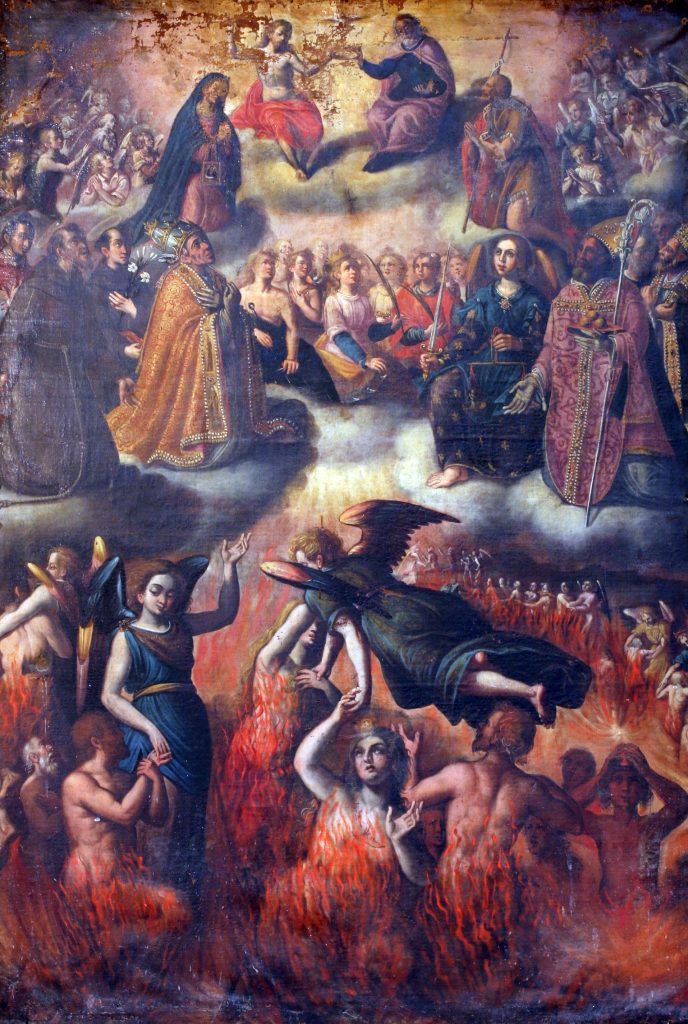
The belief the Church celebrates today is part of the “communion of saints”.  That’s a familiar phrase—we recite it in the Apostles’ Creed—but the “communion of saints” isn’t just those who are canonized saints in Heaven, but also the members of the Church who are in Purgatory, as well as those on earth.  Today we who are members of that third group pray for those in the second, so that joined through prayer, we all may become members of the first.

Sometimes we feel torn like Saint Paul.  While it’s better to be in heaven, God wants us here on earth for His purposes.  Those purposes call each of us to help others in many ways.  One of the most important of these is prayer for others, which is formally called “intercession”.

Even in heaven, saints are given missions by God.  Saints are not simply fixed on God, without regard for others.  Saints in heaven pray for the rest of the “communion of saints”.

We on earth are like the saints in Heaven in this regard.  While we might want to fix our attention on God alone, God wants us to offer our lives for others, because this is often where we find God revealed in our lives.  So it is through our prayers of intercession, both for fellow pilgrims on earth, and for those in Purgatory.

Does this take away from God?  No.  God wants us to turn to each other.  Intercessory prayer is a form of Jesus’ command to “love your neighbor as yourself”.  If it’s valid in God’s eyes to pray for oneself, why wouldn’t it be to pray for others?  When a family suffers a tragedy, they draw closer together.  Part of this occurs through prayer, and they all are stronger afterwards, and more closely knit together.

Our prayer for others draws us closer to those we pray for.  Those in Heaven, in Purgatory, and on earth are drawn closer together through intercession.  When we intercede for another—or ask someone’s intercession—we don’t believe that that person is God.  We ask another to take our prayers to God.  When we call our mother and ask her to pray for us, we’re doing the same as when we kneel and pray a rosary:  we are asking our mother to pray to God for us.

Through all prayers of devout intercession, the Body of Christ grows stronger.  In the person of Christ, God and man are united.  Within Christ, we live as members of his Body.  Within Christ, we build others up, and so find God’s love for us.