Wednesday of the Fifth Week of Easter

Wednesday of the Fifth Week of Easter
Acts 15:1-6  +  John 15:1-8
May 5, 2021

“I am the true vine, and my Father is the vine grower.”

Jesus today proclaims a powerful metaphor.  He captures the relationships among the Vinegrower, the Vine, and the branches with their fruit.  This metaphor expresses powerfully the relationship between God the Father and God the Son.  Within this relationship we see our place as members of the Mystical Body of Christ.

John’s account of the Gospel is the most mystical and sublime of the four Gospel accounts.  Therefore it’s also the most difficult to reach into and meditate upon.  Today’s metaphor opens a window into the sacred Teaching of the Beloved Disciple.

Begin with a simple question:  What is God the Father like as a Vinegrower?  This is a very simple, earthly and earthy image.  If you know anyone who is a gardener (or even more specifically, a vintner), you can picture some of the qualities that this image evokes.  The tenderness, patience, perseverance, and dedication that flow from this image teach us about the Love of the Father for His Son, and for us who are members of His Son’s Body.
Easter 5-3

Tuesday of the Fifth Week of Easter

Tuesday of the Fifth Week of Easter
Acts 14:19-28  +  John 14:27-31
May 4, 2021

“Peace I leave with you; my peace I give to you.”

One of the blessings of the priesthood is ministering to someone laying on his deathbed.  Its certainly true that there’s often grief—sometimes dramatic grief—on the faces of loved ones surrounding the dearly departing.  Yet it’s rare to see someone who is dying cry.

Why would this be?  It’s not likely that the dying person loves those surrounding him less than they love him.  But his focus is different than the focus of those around him.  Their focus in upon him:  or, more specifically, losing him.  His focus, on the other hand, is the mystery of death, and the many questions posed by that mystery:  “Where am I going?”  “What and whom will I see there?”  “What has my life up to now amounted to?”

In the face of all those questions that fill the mind and heart of a dying person, that person usually experiences one of two things:  either anguish, or peace.  No doubt, you can find many different people to give you many different definitions of peace.  But the peace of the Christian who is dying in Christ is one of Our Lord’s greatest gifts.  Of course, we don’t have to wait until our deathbed to experience this peace.

Jesus speaks about this peace today.  Helpfully, Jesus clarifies what this peace is not:  “not as the world gives do I give it to you.”  The peace that the world seeks is fleeting and based on compromise.  The peace of Jesus, on the contrary, does not need to engage in compromise because it consists in what is truly best for each and all.  As such, it is abiding, as we are called to abide in Christ, and as He wishes to abide within each of us.

Do we believe that this sort of peace is truly possible in this world?  Through the power of the Holy Spirit, it is possible to fix our lives on this gift, and to abide in it throughout our lives.  However, to do so takes a lot of cultivation of our souls through works of sacrifice and the virtues.  The goal of all this is formation in the natural and supernatural virtues, that within each of us, God’s grace can take root and flower abundantly.

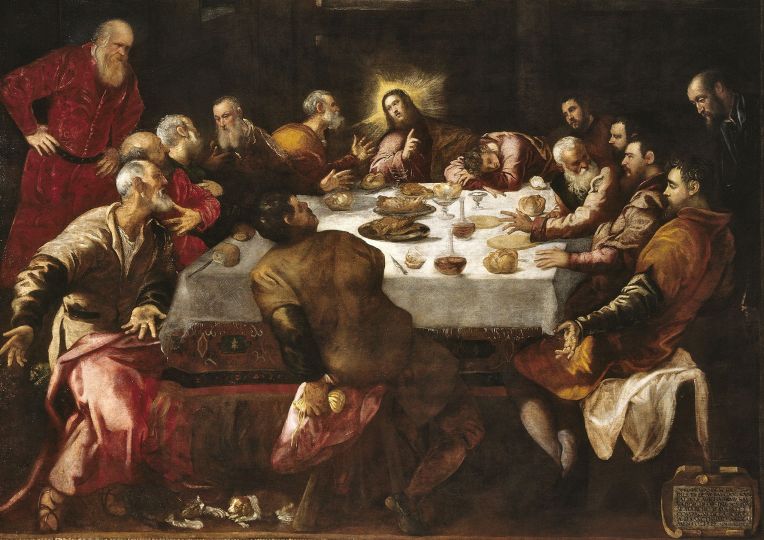
Easter 5-2 Last Supper

Sts. Philip & James, Apostles

Sts. Philip & James, Apostles
1 Corinthians 15:1-8  +  John 14:6-14
May 3, 2021

“Whoever has seen Me has seen the Father.”

Throughout the Easter Season, the Scriptures at Holy Mass focus our attention upon several recurring themes.  Examples of this are the Good Shepherd, the Bread of Life, and the unity of the Church.  As is fitting for the feast of two apostles, the Scriptures for today’s feast of St. Philip and St. James highlight how the Church’s foundation is apostolic.  Of course, the role of the apostles goes beyond the Church’s beginning.

Those ordained to the office of bishop continue to carry out the work first entrusted to the apostles.  Each and every member of the Church has a vocation that is missionary in nature:  in fact, “apostolic” in nature, inasmuch as the word “apostle” literally means “one who is sent”.  Every Christian is called to “go outside himself” and share with others the natural and supernatural gifts he has received.  Most Christians do this chiefly through family life, and in the secular workplace and community.  We might say that the laity are apostles “ad extra”, outside the walls of the Church.

However, within the Church, those called to the office of bishop have a unique role.  While laypeople proclaim the Gospel within the domestic church and in the workplace and community, bishops proclaim the Gospel to all of the Church’s members, and this chiefly through the Sacred Liturgy.  The Gospel is meant—among other goals—to bring order to chaos:  that is, to foster unity.  Everyone who is a member of a family, a neighborhood, a parish, etc. knows how difficult it can be to cultivate unity.

Unity is the first of the Church’s four marks for a reason.  Apostolicity serves her unity.  For this reason, then, pray for your local bishop and for our universal bishop, His Holiness the Pope, called to preside in charity over the Church throughout the entire earth.