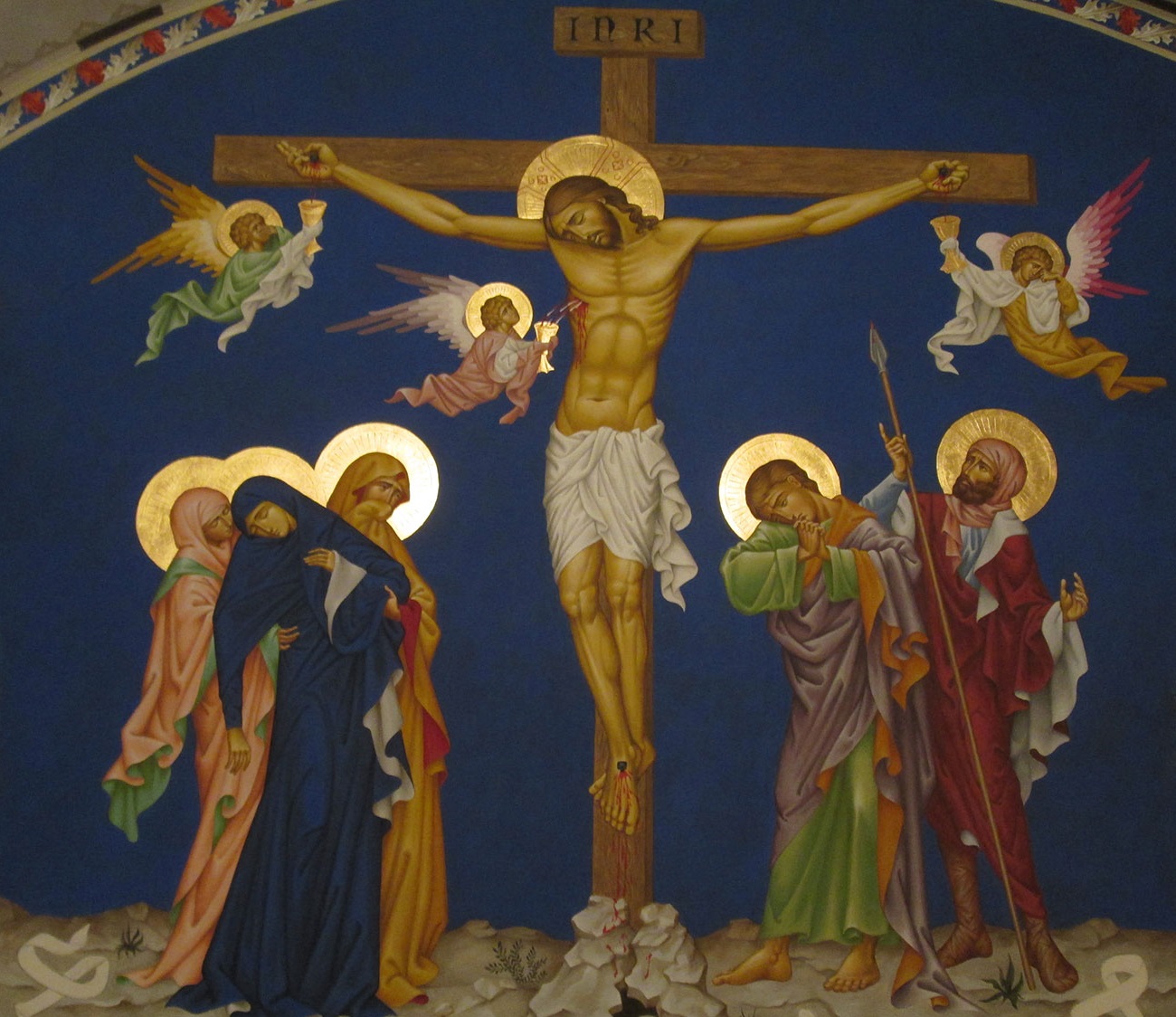
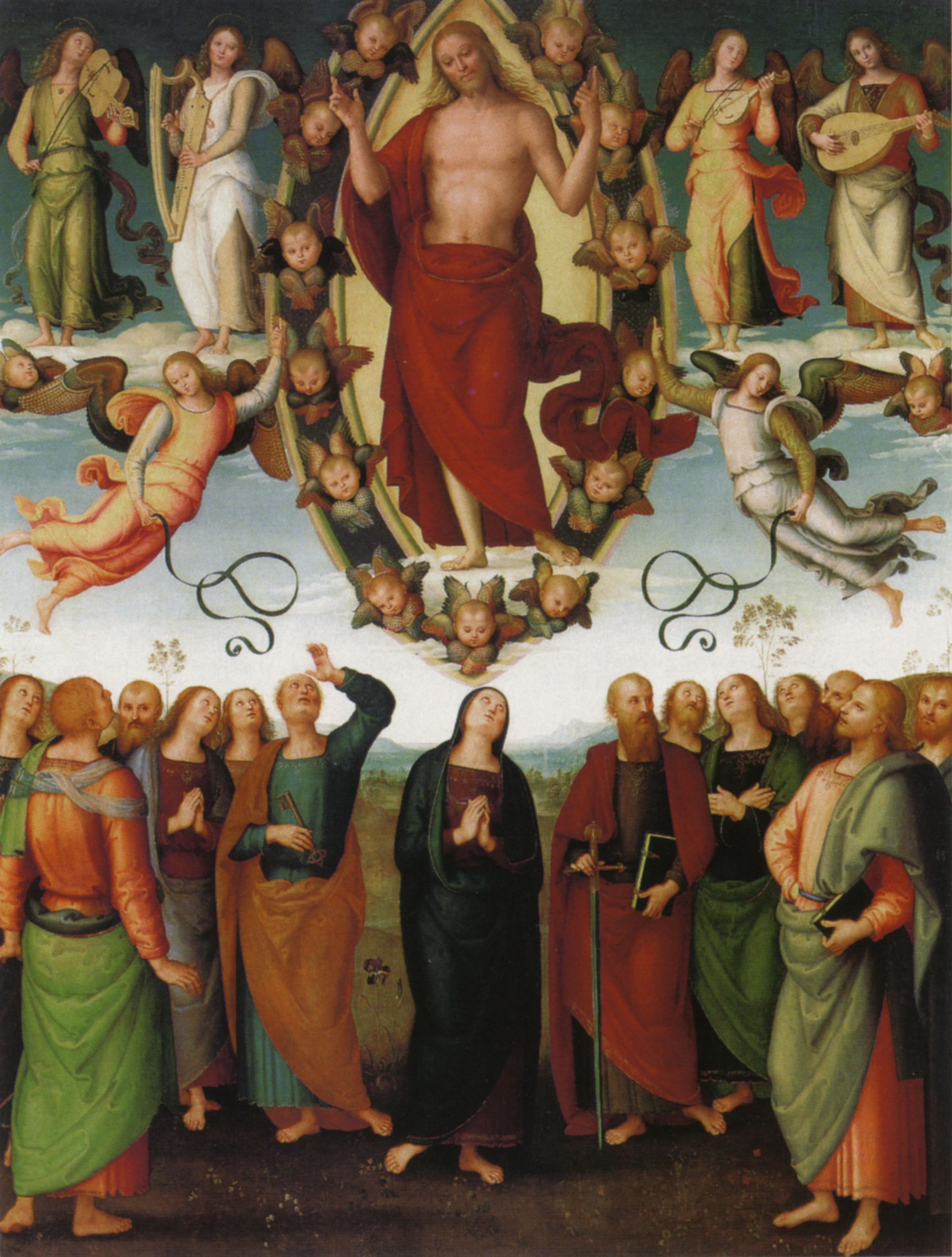
The Ascension of the Lord [B]

PLEASE NOTE:  In some dioceses, the Ascension is celebrated on the Thursday that is the fortieth day of Eastertide instead of being celebrated on the Seventh Sunday of Easter.  This year’s reflection for the Seventh Sunday of Easter is found HERE.

The Ascension of the Lord [B]
Acts 1:1-11  +  Ephesians 1:17-23  +  Mark 16:15-20

“Whoever believes and is baptized will be saved ….”

Each of us has to go through the experience of leave-taking.  Sometimes other people leave our lives.  At other times, it’s we who have to leave others.  The leave may be forced, or it may be freely chosen.  When seniors graduate from one school to another, or when young people graduate from studies to a job, a familiar setting has to be left behind so that one can grow through new experiences.

As difficult as all this may be, the most radical form of “leave taking” in life—the most dramatic separation between people—is when someone leaves this earth.  That’s one part of what the Church is celebrating on the feast of the Ascension.

The readings today proclaim Jesus Christ taking leave of His followers by leaving this earth:  ascending to Paradise, and—in effect—leaving them behind in the dust.  We hear on this feast the end of the Gospel according to Saint Mark, and the beginning of the Acts of the Apostles.

For the followers of Jesus, the day of Jesus’ Ascension was filled with a great deal of fear and anxiety.  In a way, the day of Jesus’ Ascension is like Good Friday.  We might ask:  why should we celebrate the end of a good thing?  Why do we call the day of Jesus’ death “Good” Friday?  Both the death of Jesus and His Ascension to Heaven point us to one of the central mysteries of our spiritual life:  that those who are bound together by love do not have to grow weaker when they are separated from each other.

In the life of Christ and His Bride, the Church, these two events—Jesus’ Death and His Ascension—were necessary parts of God’s plan of salvation.  In fact, God is never truly gone from our midst:  not on Good Friday, and not today as He rises out of the midst of His followers.

Though Jesus departs, He wants now to appear in new ways.  The Ascension of Jesus—His leaving this earth in bodily form—allowed his followers to assume their calling to be the Mystical Body of Christ:  the Church.  Without Jesus leaving this earth, there would be no reason for the Church to be the Body of Christ on earth.

In our own spiritual lives, we have to be willing to look for God’s presence as He wills to make Himself present.  Back in Jesus’ day, the people of Israel had been demoralized by the Roman Empire.  The nation of Israel had always prided itself on its military power, and then their nation was taken over by the Romans.  “Where was God?” they asked.  When Jesus walked this earth, He claimed to answer their question, and for His answer He was put to death through the acclamation of His own people.  Then, the same question was asked to Jesus’ followers:  “Where is your God?”  On the third day Jesus answered that question by His Resurrection.  But:  He revealed this answer only to His followers.  This is significant.

Why did He make His presence known only to His followers?  Because it would be their job—as the Church—to answer this question to those outside the Church.  It would be their job to speak in His Name as one Body.  But for some days after the Ascension, the apostles and disciples weren’t sure about this great commission Jesus had given them.  They were afraid, and they locked themselves into an upper room to spend the days in prayer.  It wasn’t a coincidence that it was the same upper room where He had given them the gift of His Body and Blood in the Eucharist.

Ten days after the Ascension—that is, 53 days after Jesus had given His Body and Blood through the Institution of the Eucharist—Jesus revealed His very Self in a new way.  Through the Power of the Holy Spirit, God bound together the followers of Jesus into the Mystical Body of Christ, which is the Church.  By the Power of the Holy Spirit, God began on that day to speak through the followers of Jesus.

That day is the culmination of the Easter Season.  That day is Pentecost Sunday, which the Church will celebrate with great joy a week from this Sunday.
Thursday of the Sixth Week of Easter

PLEASE NOTE:  Some dioceses will celebrate today the Ascension of the Lord.  For the reflection upon the Solemnity of the Ascension, click HERE.

Thursday of the Sixth Week of Easter
Acts 18:1-8  +  John 16:16-20
May 13, 2021

“… you will grieve, but your grief will become joy.”

Just as the earth has two poles, so the Season of Easter has two poles:  the Resurrection and Pentecost.  Both are solemnities of great joy for Christians.  Yet each is preceded by an event of loss, of “grieving” even.  The Resurrection is preceded by the Death of the Lord, and Pentecost is preceded by the Ascension of the same Lord.  But to use the word “preceded” here is a bit lacking.  The Death and Ascension of the Lord are the “events”—the sacred “mysteries”—that make the Resurrection and Pentecost possible.

Jesus refers to both sets of mysteries—the Death and Resurrection, and the Ascension and Pentecost—by His words in today’s Gospel passage:  “you will grieve, but your grief will become joy.”  Today’s Gospel passage is from the sixteenth chapter of John:  part of Jesus’ Last Supper discourse.  In the short-term, then, He is speaking about His Death and Resurrection.  Yet in His divinity, Jesus also knew of His impending Ascension as well as the Descent of the Holy Spirit, so He is also speaking here about His Ascension and Pentecost.

Much of the world today celebrates the Ascension of the Lord.  Some dioceses will transfer the Ascension to this coming Sunday, and celebrate today as a weekday of Easter.  In either case, begin a novena today:  nine days of prayer, longing for the Holy Spirit to come into your life more powerfully, and to help you live more fully your vocation within the Mystical Body of Christ.

SONY DSC

Wednesday of the Sixth Week of Easter

Wednesday of the Sixth Week of Easter
Acts 17:15,22—18:1  +  John 16:12-15
May 12, 2021

“… when He comes, the Spirit of truth, He will guide you to all truth.”

St. John Henry Newman, the nineteenth century convert to the Church from Anglicanism, is renowned for many theological works.  One of the more famous is about the process of the “development of doctrine”.  Newman had from boyhood been a keen student of history, and later in life he said that “to be deep in history is to cease to be Protestant”.

To make an analogy:  as fundamentalist Christians say that God created the universe, Earth, and mankind immediately (that is, within six days), so the same fundamentalists often say that God created the doctrines of the Church immediately.  If a phrase is not found in the Bible—they insist—it cannot be admitted into mind of a Christian.  Therefore, dogmas such as the “Immaculate Conception” and “papal infallibility” are clearly not Christian—they insist—because the apostles who composed the Bible never used these phrases, or spoke about these topics.

However, if beliefs cannot be accepted by Christians if they are not mentioned in the Bible, then these same people cannot profess a belief in the “Trinity”, since this word never appears in the Bible.  “But,” these fundamentalists might argue, “the belief in the Trinity is in the Bible.  It’s the word “Trinity” that came later, in order to dispel false interpretations of the Bible….”  Yet such a defense supports Cardinal Newman’s teaching, which itself is simply an unpacking of Jesus’ words today:  “when He comes, the Spirit of truth, He will guide you to all truth.”

Easter 6-3 Holy Spirit

Tuesday of the Sixth Week of Easter

Tuesday of the Sixth Week of Easter
Acts 16:22-34  +  John 16:5-11
May 11, 2021

“But if I go, I will send Him to you.”

In addition to their divinity, the divine Persons of God the Son and God the Holy Spirit were both sent by God the Father into this world, filled as it is by sin and death.  Their missions differ, yet their missions converge as God’s Providential Will unfolds within salvation history.

Of course, before considering the Son’s and the Holy Spirit’s missions within salvation history, we ought to reflect on their work “in the beginning”.   God the Father created everything in the universe, visible and invisible, through His divine Word, and through the Power of the Holy Spirit.  The creation narratives in Genesis are more suggestive than telling.  Nonetheless, they point us towards contrasts that we ought to reflect upon as we approach Pentecost:  contrasts, that is, between God’s work of creation “in the beginning”, and God’s work of redemption in the fullness of time.

Perhaps the most significant contrast between the missions of the Son and Spirit in creation, and then again their missions in the work of redemption, is that in the latter they manifest themselves incarnately.  Their missions converge within the Mystical Body of Christ.  “In the beginning”, the Word remained the Word.  But in the fullness of time, “the Word became Flesh and dwelt among us”.  “In the beginning”, the Spirit hovered silently over the face of the deep.  But in the fullness of time, He is the soul of the Mystical Body of Christ, animating that Body’s members, so that the Christ’s saving work is carried out “unto the end of the age.”

Easter 6-2

Monday of the Sixth Week of Easter

Monday of the Sixth Week of Easter
Acts 16:11-15  +  John 15:26—16:4
May 10, 2021

“When the Advocate comes whom I will send you from the Father, the Spirit of truth who proceeds from the Father, He will testify to me.”

Today Jesus—still addressing us from the Cenacle, at the Last Supper—proclaims the coming of the Holy Spirit. We note from Jesus’ words that—as we profess in the Church’s Creed—the Holy Spirit proceeds from both the God the Father and God the Son.  Jesus Himself describes God the Holy Spirit as the One “whom I will send you from the Father, the Spirit of truth who proceeds from the Father”.

In the Creed of the First Council of Constantinople (in A.D. 431), the first ecumenical council to describe at any length the nature of God the Holy Spirit, the council Fathers stated that the Holy Spirit is “the Lord, the Giver of Life [and] proceeds from the Father….”  This council did not state that the Holy Spirit proceeds from the Father and the Son.  The phrase “and the Son” (in Latin, filioque) was added by the Church to the Creed later.  Controversy continues to this day as to the propriety of this addition.

Christians of the West accept the dogma of the Holy Spirit’s procession from both the Father and the Son.  We see in the doctrine an expression of the closeness of the Father and the Son, while maintaining their distinction as divine Persons.  God the Holy Spirit proceeds from both the Father and the Son because the Holy Spirit is the Love of the Father and the Son both for each other (not merely the love of one for the other).  Saint Augustine explores the meaning of this great teaching in his very long, profound, and difficult work “On the Trinity” (De Trinitate).  Pray for the Holy Spirit to enter your life more fully, and towards this end, plan to begin a novena to God the Holy Spirit this Thursday.

Easter 6-1 Holy Spirit

Saturday of the Fifth Week of Easter

Saturday of the Fifth Week of Easter
Acts 16:1-10  +  John 15:18-21
May 8, 2021

“I have chosen you out of the world ….”

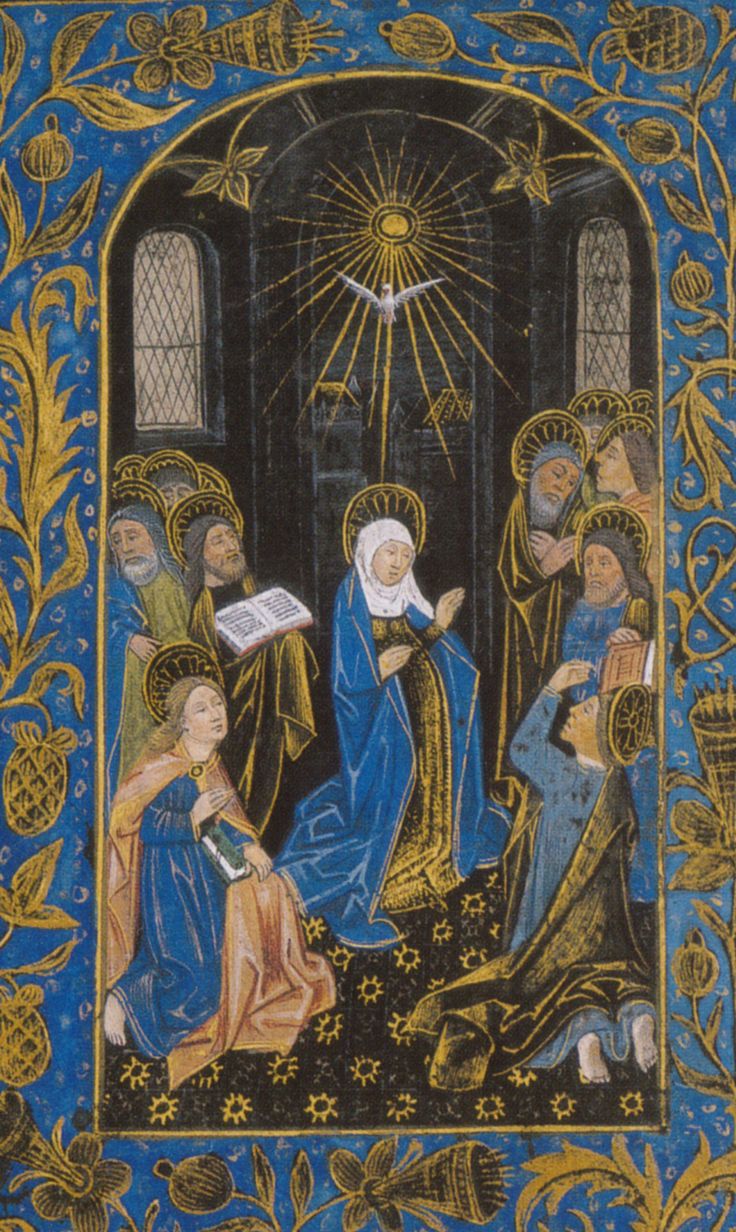
In this Easter season, we continue to hear in the First Reading about the flurry of apostolic activity that spread through the world following the first Christian Pentecost.  But what of Mary, the lowly Virgin, mother of the child who grew in this world in order to offer His life in sacrifice for our sins?  What about the mother of Him who is the Good News that the apostles spread throughout the world?  Where is Mary at Pentecost?

We might forget that she is the Mother of God, the Mother of Him through whom all things were made.  We might forget that she, too, was present in that upper room.  Why is she there?  She surely had no need to receive that fullness of the Holy Spirit who descended at Pentecost.  Her Pentecost—her Confirmation, so to speak—took place at the Annunciation.  At that moment, the power of the Holy Spirit overshadowed her who had been sinless from the moment of her conception in the womb of Saint Anne.

At the Annunciation of the Good News, God became man:  Christ’s Body began forming within Mary’s womb.  Here in the upper room at Pentecost, that same Holy Spirit descends again, to overshadow the apostles.  Here in the upper room, Christ had offered the first celebration of the Sacrifice of the Eucharist.  There the Church—the Body of Christ—was born, that the apostles might go forth into the world to preach the Gospel and offer their lives in sacrifice for Christ.

Easter 5-6 Mary Trinity

Friday of the Fifth Week of Easter

Friday of the Fifth Week of Easter
Acts 15:22-31  +  John 15:12-17
May 7, 2021

“This is my commandment:  love one another as I love you.”

Today’s Gospel passage is often proclaimed at Nuptial Masses.  It speaks to the reality of love.  It gives some concrete form to love.  This concreteness is necessary when one lives—as you and I do—in a culture which equates love with warm, fuzzy feelings.

Today’s Gospel passage was written by St. John the Evangelist, who in one of his epistles tells us that “God is love” [1 John 4:8].  Today John quotes Jesus so as to give shape to the definition of God as love.  In terms of the divine Person of Jesus, John quotes Christ Himself.  The evangelist explains that “no one has greater love than… to lay down one’s life for one’s friends.”  The setting of today’s Gospel passage is the Last Supper.  As He spoke these words, Jesus knew that He would give the ultimate example of such love the next day.

But the Church proclaims today’s Gospel passage during the midst of Easter.  The reason for this is that Christ doesn’t want His disciples simply to admire His sacrifice, but to enter into it.  To do what our Savior commands, we need the power of the Holy Spirit, whom the Father and Son will send at Pentecost.  In the Spirit of the Father and the Son, you can find the strength to love your neighbor as Jesus has loved you.

Easter 5-5 Trinity Botticelli

The Sixth Sunday of Easter [B]

The Sixth Sunday of Easter [B]
Acts 10:25-26,34-35,44-48  +  1 John 4:7-10  +  John 15:9-17

In this is love:  not that we have loved God, but that He loved us, and sent His Son as expiation for our sins.

Saint John, the Beloved Disciple, in his letters and Gospel account, fleshes out his description of God as “love”.  In the last sentence of today’s Second Reading, St. John does this very poignantly, telling us that “In this is love:  not that we have loved God, but that He loved us, and sent His Son as expiation for our sins.”

The first part of St. John’s description here insists on the primacy of God’s love.

When St. John says that love consists in the truth that God loved us, and not that we first loved God, he’s pointing out that God doesn’t wait to love you until He determines whether you will love Him back.  God doesn’t stop loving you if you stop loving Him.  In every sense of the word, God’s Love is primary.  Our love for Him can only be a response, and cannot diminish His love for us if our love is in some way lacking.

But we all know from experience that confusion arises here.  Human beings feel at times that God does not love them.  One reason for this is that love—at least, divine love—is itself not a feeling.  When people expect God to make them feel good, they can easily become confused about the real meaning of God’s love.  This doesn’t mean that our feelings are illusory, or that God cannot manifest Himself through emotions.  It’s to say, rather, that divine Love is not identical with positive emotions.  God’s love transcends feelings, and can be present amidst the worst of feelings.

The second reason that someone might believe that God no longer loves him is the fact that it’s not unusual for God to be absent from the human soul.  Yet God being absent from someone’s soul does not mean that God does not love that person.  In fact, there can be very different reasons for this absence, one negative and one positive.

On the one hand, the absence of God from a human soul can be the result of mortal sin.  A mortal sin that’s freely and knowingly chosen destroys all the grace dwelling in that soul.  What’s more, the presence of a mortal sin prevents the reception of further graces.  Ironic though it may seem, it’s a sign of God’s love that He endows the human person with a free will strong enough to keep His love at bay.

On the other hand, the absence of God from someone’s soul can be a sign of growth.  This might seem counter-intuitive.  Many saints, in writing about the three basic stages of the spiritual life, note that God often spurs the human person towards growth by temporarily removing Himself from the person’s soul.

It’s not that this person is no longer in a state of grace, but rather that the Christian has no sense or perception of God in her soul.  Only darkness appears.  But God wants His disciples to transcend appearances.  He does this in order to increase the human person’s longing for Him:  that is, in order to teach the human person to live for God alone.

One of the saints who wrote profoundly about the spiritual life was Saint Bernard of Clairvaux.  In addition to serving as one of the first abbots of the Cistercian religious order, he also wrote many commentaries on Scripture.  He often wrote about divine love, and also often wrote about the connection between knowledge and divine love.  In one place St. Bernard writes:

“… there are some who want knowledge for the sole purpose of knowing, and this is … curiosity.  And there are some who seek knowledge in order to be known themselves; and this is … vanity …  and there are … those who seek knowledge in order to sell their knowledge … for money or for honors; and this is [greed].  But there are also those who seek knowledge in order to edify [others], and this is charity.”

Charity—the love of Christ—urges us forward throughout the course of earthly life, and even to death and Heaven’s gates.  It’s to convince us of this simple truth that we hear Jesus today:  “I command you:  love one another.”  He commands us to love not as we wish to love, but as He loves:  sacrificially.

Thursday of the Fifth Week of Easter

Thursday of the Fifth Week of Easter
Acts 15:7-21  +  John 15:9-11
May 6, 2021

“If you keep my commandments, you will remain in my love ….”

The long discourse of Jesus at the Last Supper, recorded in chapters 13-17 of John, has several themes which Jesus touches upon over and over again.  Jesus weaves these themes together, as if his words on this solemn night formed a tapestry of the Good News.

Jesus’ words—“If you keep my commandments, you will remain in my love”focus our attention on two of these themes:  “my commandments” and “my love”. Sometimes in a culture that encourages us to base our actions on our feelings, and which defines love as nothing more than a feeling, “commandments” and “love” seem directly opposed.  Some say, in fact, that the person who truly loves does not need commandments:  in this case, we could understand Jesus saying, “If you remain in my love, you will keep my commandments.”  But Jesus here says the opposite.

Jesus claims in this verse that if you keep His commandments, you will remain in His love.  His commandments are a means to the end of His love.  This is not to say that the opposite is not also true.  But Jesus’ words today remind us of the importance of His commandments, and that all of His commandments are in fact nothing more than commands to love God fully, and to love one’s neighbor as oneself.