Easter Sunday of the Resurrection of the Lord
Acts 10:34,37-43 + Colossians 3:1-4 + John 20:1-9
April 4, 2021
So Peter and the other disciple went out and came to the tomb.
+ + +
click HERE to read Monsignor Charles Pope’s Easter homily
click HERE to watch Bishop Michael Burbidge’s homily for Easter (6:47)
click HERE to watch Archbishop Alexander Sample’s homily for Easter (12:36)
click HERE to watch Archbishop Charles Chaput’s homily for Easter (17:05)
+ + +
click HERE to read the 2019 homily of Pope Francis for Easter
click HERE to read the 2012 homily of Pope Benedict XVI for Easter
click HERE to read the 2000 homily of Pope St. John Paul II for Easter
+ + +
references to the Catechism of the Catholic Church cited for this Sunday by the Vatican’s Homiletic Directory:
CCC 638-655, 989, 1001-1002: the Resurrection of Christ and our resurrection
CCC 647, 1167-1170, 1243, 1287: Easter, the Lord’s Day
CCC 1212: the Sacraments of Initiation
CCC 1214-1222, 1226-1228, 1234-1245, 1254: Baptism
CCC 1286-1289: Confirmation
CCC 1322-1323: Eucharist
+ + +
Easter is not just the single day of Easter Sunday, but a season of seven weeks plus one more day. The Church celebrates Easter for fifty days so as to be able to ponder thoroughly the mysteries of this holiest season of the Church’s year. There are three mysteries of our Faith that the Church celebrates throughout the Easter Season. They are the first three Glorious Mysteries of the Rosary. We need to see how all three of these are part of a single plan.
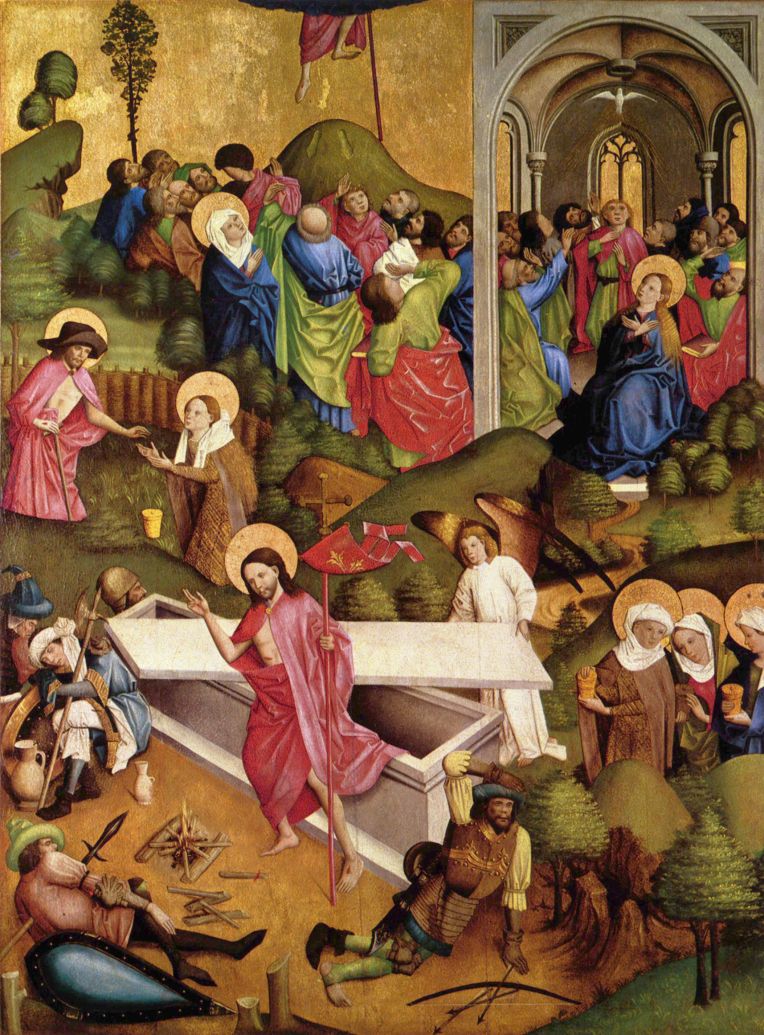
The First Glorious Mystery is the proper focus of today: the Resurrection of Jesus Christ from the dead. This mystery is presented by today’s Gospel Reading, where the young apostle John serves as a model of how to ponder.
St. John, who served God as both apostle and evangelist, accomplished all he did because he was the Beloved Disciple. As an apostle and an evangelist, he was like a zealous Martha. But before he acted zealously, he was a faithful Mary. The Beloved Disciple at the Last Supper took the stance that Mary did at the meal in her home, sitting and listening at the feet of the Word made Flesh.
In many churches, we see above the high altar the youngest of the apostles—St. John—at one side of the Cross, and our Blessed Mother on the other. This is the scene of the Crucifixion that the Church celebrated just days ago.
But on the third day, John ran with Peter to the tomb. Along with Saint Peter and the beloved disciple, Saint John, we also see the wrappings lying on the ground. John saw and believed. With no sign of Jesus and without a word from Jesus, John saw and believed simply because the tomb was empty. It is ironic that on the greatest feast of the Christian year, Christ doesn’t even appear in the Gospel passage, nor speak a word. We see only His empty tomb, and hear only silence.
Following His Resurrection on Easter Sunday, Jesus appears several times in His glorified body. Yet He remained on this earth only for forty days proclaiming the Resurrection in this glorified body. He remained only forty days because He had in store a different means of proclaiming the Resurrection, by means of a different body: the Mystical Body of Christ. What Jesus did in a glorified body for forty days, He would do until the end of time in His Mystical Body.
The Second Glorious Mystery is the Ascension. The Ascension is the bittersweet transition between two means of Jesus revealing His love for fallen man. The first means was the physical body that He received from the Blessed Virgin Mary—through the power of the Holy Spirit—at the Annunciation. The second means was, is, and will be “unto the end of the age” the Church as the Mystical Body of Christ. All of the Joyful, Luminous, and Sorrowful Mysteries of the Rosary, as well as the first two Glorious Mysteries, make possible the event of Pentecost: the “birth” of the Church as the Mystical Body of Christ. All of those earlier mysteries are preludes or prologues to the event of Pentecost. Even the Resurrection that took place on Easter Sunday morning.
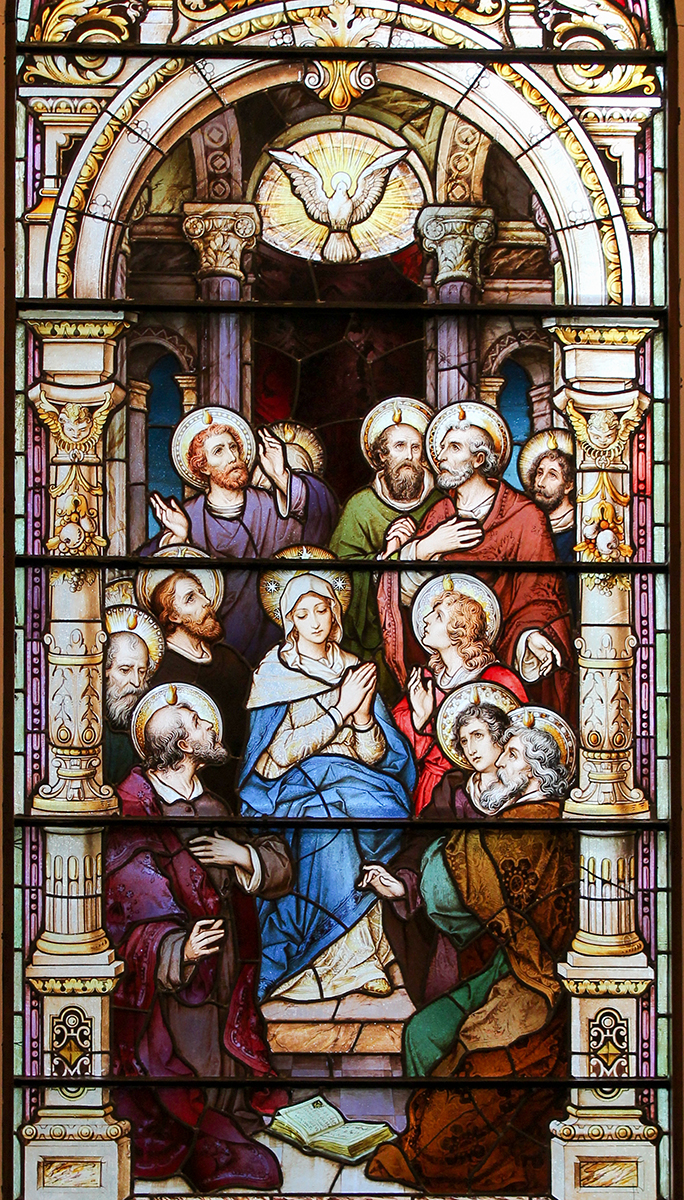
The Third Glorious Mystery is the “birth” of the Church at Pentecost. This is what Jesus died for. This is what Jesus rose for. Jesus’ resurrection in a glorified body foreshadows what the Church becomes on the day of Pentecost.
Jesus bears new life when He rises from the dead. Yet He wants His new life to ours. The Church—the Mystical Body of Christ—is the means by which we share in the life of the Risen Jesus. The Church makes it possible for Easter to be not a mere historical event, but an ever-present reality: in fact, the source of strength and grace each day that we live on this earth.
St. John teaches us to pray during these fifty days of Easter for a great gift. God has a gift ready for us, the Gift of the Holy Spirit. That is why we hear every day of Easter from the Acts of the Apostles: the book that describes the Church at work through the Power of the Holy Spirit. The descent of the Holy Spirit at Pentecost is the culminating mystery of Easter. We don’t simply celebrate it on the last day of Easter as an afterthought: it is the mystery that Jesus leads us towards through His Resurrection.
 Reflections on the Sacred Liturgy